India Domestic Heating Appliances Market Growth Rate Analysis (2021-2031)
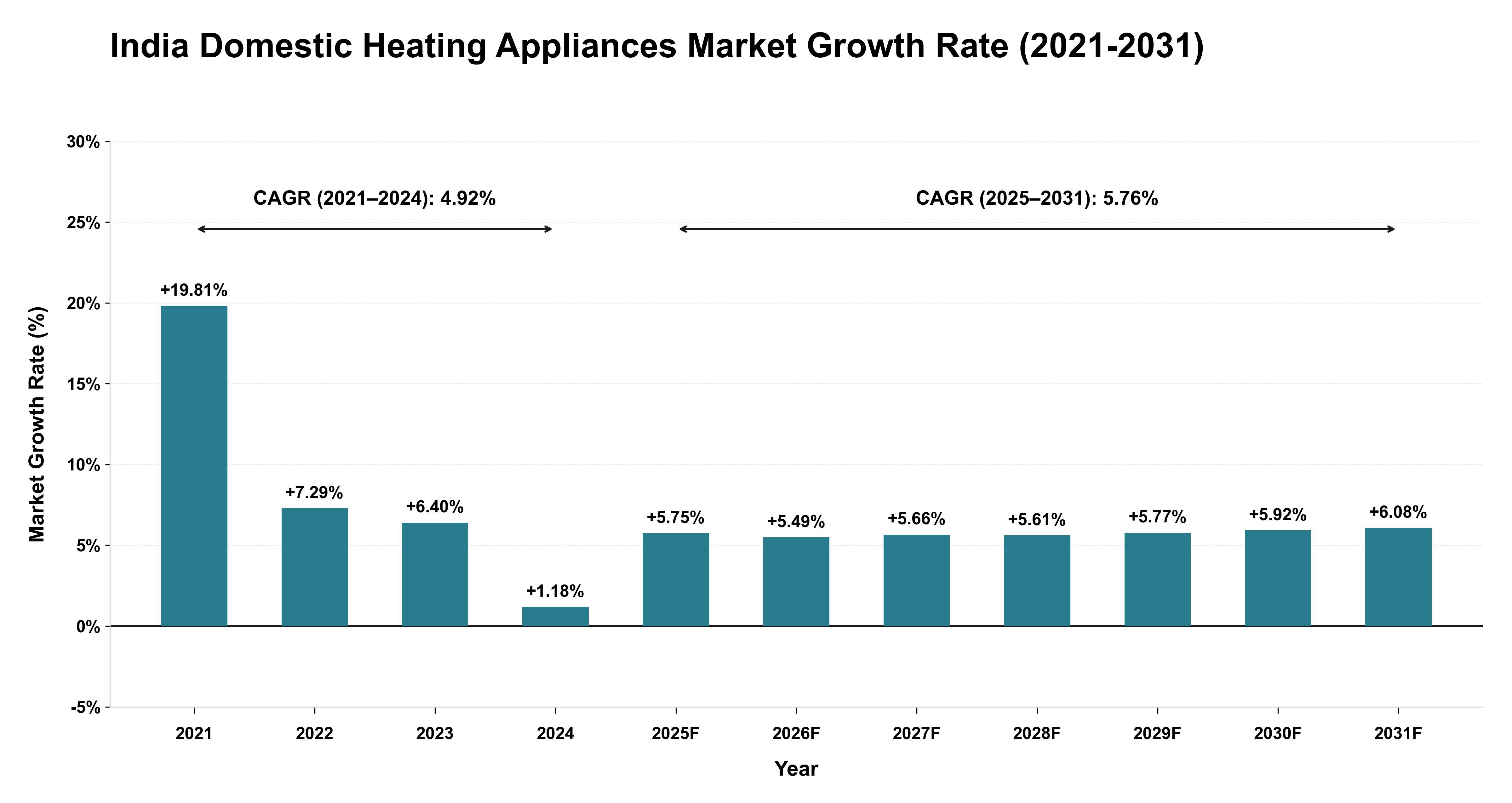
The India Domestic Heating Appliances Market witnessed robust growth from 2021 to 2024, with a CAGR of 4.92%, driven by a significant surge in 2021 at 19.81%, followed by steady but slowing growth in subsequent years. The market experienced a structural consolidation in 2024, with growth dipping to 1.18%. Looking ahead to the forecast period from 2025 to 2031, the market is expected to exhibit stabilizing expansion, with a forecasted CAGR of 5.76%. This growth trajectory indicates a gradual stabilization following the volatile historical base effect post-2021 spikes, with annual growth rates ranging between 5.49% to 6.08%. The market is poised for continued growth supported by factors such as increasing disposable income, urbanization, and changing consumer preferences towards energy-efficient appliances.
India Domestic Heating Appliances Market Synopsis
The India domestic heating appliances market size was estimated at USD 3 billion and is anticipated to grow at a CAGR greater than 11% owing primarily rising disposable incomes coupled with rapid urbanization resulting into increased preference for reliable sources or energy efficient solutions such as gas heaters or electric room heaters among residential consumers across country thereby positively impacting overall business landscape. Additionally there has been an increase usage cooking stoves within households due their convenience factor further complementing product demand. Furthermore expansion strategies adopted by numerous international players has provided fillip terms availability product variety along competitive prices further stimulating sector growth.
Market Drivers of the market
India domestic heating appliances market has been driven by factors such as changing consumer lifestyles, increasing disposable income, and urbanization. As people seek more comfort and convenience in their homes, the adoption of domestic heating appliances like room heaters and electric blankets has increased significantly, especially during the colder months.
Challenges of the Market
The domestic heating appliances market in India faces challenges due to changing consumer preferences and energy concerns. Consumers increasingly seek energy-efficient and environmentally friendly heating solutions, pushing manufacturers to innovate. Moreover, affordability and distribution networks play a vital role in reaching a broader consumer base.
Covid-19 Impact on the Market
The COVID-19 pandemic had varying effects on the domestic heating appliances market in India. While there was an initial surge in demand for heating appliances due to increased stay-at-home activities, the subsequent economic slowdown affected consumers` purchasing power, leading to reduced sales. Supply chain disruptions and import/export challenges further impacted the market.
Key Players of the Market
The India domestic heating appliances market is led by companies like Bajaj Electricals Ltd, Havells India Ltd, Usha International Ltd, and V-Guard Industries Ltd. These companies offer a diverse range of domestic heating appliances such as room heaters, water heaters, and heat convectors.
Key Highlights of the Report:
- India Domestic Heating Appliances Market Outlook
- Market Size of India Domestic Heating Appliances Market, 2024
- Forecast of India Domestic Heating Appliances Market, 2031
- Historical Data and Forecast of India Domestic Heating Appliances Revenues & Volume for the Period 2021-2031
- India Domestic Heating Appliances Market Trend Evolution
- India Domestic Heating Appliances Market Drivers and Challenges
- India Domestic Heating Appliances Price Trends
- India Domestic Heating Appliances Porter's Five Forces
- India Domestic Heating Appliances Industry Life Cycle
- Historical Data and Forecast of India Domestic Heating Appliances Market Revenues & Volume By Types for the Period 2021-2031
- Historical Data and Forecast of India Domestic Heating Appliances Market Revenues & Volume By Electric Storage Heating Radiators for the Period 2021-2031
- Historical Data and Forecast of India Domestic Heating Appliances Market Revenues & Volume By Soil Heating for the Period 2021-2031
- Historical Data and Forecast of India Domestic Heating Appliances Market Revenues & Volume By Non-electric Heaters for the Period 2021-2031
- Historical Data and Forecast of India Domestic Heating Appliances Market Revenues & Volume By Electric Heating Resistors for the Period 2021-2031
- Historical Data and Forecast of India Domestic Heating Appliances Market Revenues & Volume By Application for the Period 2021-2031
- Historical Data and Forecast of India Domestic Heating Appliances Market Revenues & Volume By Private for the Period 2021-2031
- Historical Data and Forecast of India Domestic Heating Appliances Market Revenues & Volume By Commercial for the Period 2021-2031
- India Domestic Heating Appliances Import Export Trade Statistics
- Market Opportunity Assessment By Types
- Market Opportunity Assessment By Application
- India Domestic Heating Appliances Top Companies Market Share
- India Domestic Heating Appliances Competitive Benchmarking By Technical and Operational Parameters
- India Domestic Heating Appliances Company Profiles
- India Domestic Heating Appliances Key Strategic Recommendations






































