India E-waste Management Market Size, Share & Growth Rate
The India E-waste Management Market was estimated at USD 1411 Million in 2025 and is projected to reach USD 2012 Million by 2032, growing at a CAGR of 5.2% from 2026 to 2032. This growth trajectory can be attributed to several compelling factors, including a substantial rise in e-waste generation driven by rapid technological advancements and increasing consumer electronics usage. Moreover, the implementation of stringent regulations aimed at e-waste management and the escalating awareness regarding environmental sustainability are pivotal in reshaping the market landscape.
India E-waste Management Market Year-wise Growth Rate and Key Drivers
This graph highlights how the India E-waste Management Market has steadily grown over the years, supported by major growth factors.
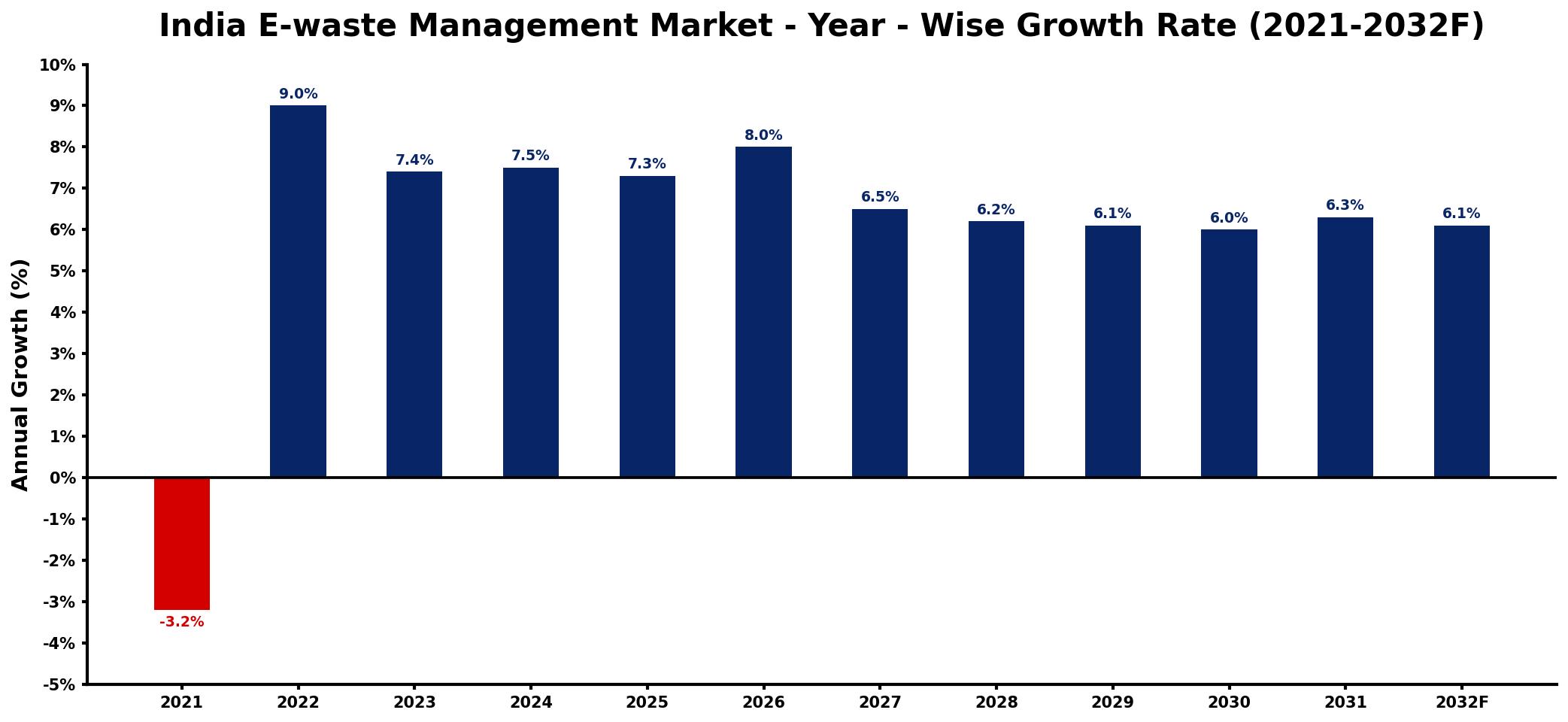
The table below presents the year‑wise growth rates along with the key drivers influencing the market
| Year | Growth Rate | Major Drivers |
| 2021 | -3.2% | Regulatory compliance enforcement increase |
| 2022 | 9.0% | Rising consumer electronics adoption |
| 2023 | 7.4% | Innovative recycling technologies introduction |
| 2024 | 7.5% | Corporate sustainability initiatives expansion |
| 2025 | 7.3% | Government incentives for recycling |
| 2026 | 8.0% | Growing public awareness campaigns |
| 2027 | 6.5% | Investment in circular economy models |
| 2028 | 6.2% | Collaboration between industries enhancement |
| 2029 | 6.1% | Emerging markets demand growth |
| 2030 | 6.0% | Technological advancements in processing |
| 2031 | 6.3% | Increased focus on resource recovery |
| 2032 | 6.1% | Expansion of collection infrastructure |
Note: Market size estimations and growth projections presented in this report are based on 6Wresearch's proprietary forecasting methodology, utilizing the latest available industry data, government publications, and primary research inputs.
India E-waste Management Market Synopsis
India is currently grappling with a significant increase in electronic waste, with the expanding electronics and IT sectors contributing to this pressing issue. As the nation seeks to improve its e-waste management capabilities, innovative recycling practices and regulatory measures are becoming increasingly critical.
The rising consumer awareness of the hazards associated with improper e-waste disposal has catalyzed the adoption of more sustainable practices. As a result, many companies are now prioritizing responsible e-waste management solutions that align with both regulatory compliance and their sustainability commitments.
India E-waste Management Market Key Takeaways
- The market is fueled by growing electronic waste generated from consumer devices and IT equipment.
- Government regulations are becoming increasingly stringent, driving compliance in e-waste management.
- There is a rising demand for advanced recycling technologies focused on sustainability.
- Public awareness of e-waste hazards is accelerating the shift towards responsible disposal practices.
- The emphasis on circular economy principles is shaping market dynamics and investment opportunities.
Evaluation of Restraints in India E-waste Management Market
Despite the promising growth in the India E-waste Management Market, significant challenges remain. A critical barrier is the inadequate infrastructure for the efficient collection and recycling of e-waste, which hampers effective management. Moreover, there exists a pervasive lack of awareness among consumers and businesses regarding the consequences of improper disposal practices. This gap in understanding slows the transition to responsible e-waste management, ultimately affecting market potential.
India E-waste Management Market Trends
Several trends are currently shaping the India E-waste Management Market. The first is the increasing emphasis on circular economy practices, promoting resource recovery and reuse. Additionally, the adoption of advanced recycling technologies is becoming more prevalent, providing a sustainable solution to manage growing e-waste volumes. Another notable trend is the collaboration between private and public sectors to enhance recycling initiatives and awareness campaigns.
India E-waste Management Market Opportunities
The landscape is ripe with opportunities for growth in the India E-waste Management Market. Investment in infrastructure for e-waste collection and recycling represents a key area for development. Furthermore, the burgeoning demand for innovative recycling solutions tailored for specific electronic devices creates avenues for specialized service providers. As regulatory frameworks evolve, companies can enhance their market positions by aligning their operations with these standards.
Government Initiatives in the India E-waste Management Market
The Indian government has introduced several initiatives aimed at tackling the e-waste challenge effectively. This includes implementing stringent regulations for e-waste disposal and promoting sustainable recycling practices. Public spending is increasingly directed towards building necessary infrastructure and public awareness campaigns to educate consumers about e-waste hazards and disposal methods. Such initiatives are crucial for fostering a culture of responsible e-waste management in the country.
Future Insights of the India E-waste Management Market
Looking ahead to 2026-2032, the India E-waste Management Market is poised for substantial growth as technological innovations and regulatory frameworks continue to evolve. The shift towards a circular economy will likely accelerate, with more companies committing to sustainable practices and responsible disposal solutions. As consumers become increasingly aware of the environmental impact of e-waste, the demand for efficient recycling options will rise, propelling the market towards new heights.
India E-waste Management Market Latest Developments (2025 - 2026)
Recent developments in the India E-waste Management Market indicate a growing collaboration between industry stakeholders and government bodies. Initiatives focused on enhancing collection and recycling systems are gaining momentum, alongside campaigns aimed at raising public awareness about e-waste hazards. Emerging technologies are being integrated into recycling processes, which are expected to improve efficiency and sustainability in the coming years.
India E-waste Management Market - Key Attractiveness of the Report
- 10 Years of Market Numbers
- Historical Data Starting from 2022 to 2025
- Base Year: 2025
- Forecast Data until 2032
- Key Performance Indicators Impacting the Market
- Major Upcoming Developments and Projects
Key Highlights of the Report:
- India E-waste Management Market Outlook
- Market Size of India E-waste Management Market, 2025
- Forecast of India E-waste Management Market, 2032
- Historical Data and Forecast of India E-waste Management Revenues & Volume for the Period 2022-2032F
- India E-waste Management Market Trend Evolution
- India E-waste Management Market Drivers and Challenges
- India E-waste Management Price Trends
- India E-waste Management Porter's Five Forces
- India E-waste Management Industry Life Cycle
- Historical Data and Forecast of India E-waste Management Market Revenues & Volume By Material Type for the Period 2022-2032F
- Historical Data and Forecast of India E-waste Management Market Revenues & Volume By Metal for the Period 2022-2032F
- Historical Data and Forecast of India E-waste Management Market Revenues & Volume By Plastic for the Period 2022-2032F
- Historical Data and Forecast of India E-waste Management Market Revenues & Volume By Glass for the Period 2022-2032F
- Historical Data and Forecast of India E-waste Management Market Revenues & Volume By Others for the Period 2022-2032F
- Historical Data and Forecast of India E-waste Management Market Revenues & Volume By Source Type for the Period 2022-2032F
- Historical Data and Forecast of India E-waste Management Market Revenues & Volume By Household Appliances for the Period 2022-2032F
- Historical Data and Forecast of India E-waste Management Market Revenues & Volume By Industrial Electronics for the Period 2022-2032F
- Historical Data and Forecast of India E-waste Management Market Revenues & Volume By Consumer Electronics for the Period 2022-2032F
- Historical Data and Forecast of India E-waste Management Market Revenues & Volume By Application for the Period 2022-2032F
- Historical Data and Forecast of India E-waste Management Market Revenues & Volume By Trashed for the Period 2022-2032F
- Historical Data and Forecast of India E-waste Management Market Revenues & Volume By Recycled for the Period 2022-2032F
- India E-waste Management Import Export Trade Statistics
- Market Opportunity Assessment By Material Type
- Market Opportunity Assessment By Source Type
- Market Opportunity Assessment By Application
- India E-waste Management Top Companies Market Share
- India E-waste Management Competitive Benchmarking By Technical and Operational Parameters
- India E-waste Management Company Profiles
- India E-waste Management Key Strategic Recommendations






































