India Edible Beans Market Top 5 Importing Countries and Market Competition (HHI) Analysis
India`s edible beans import market continued to witness steady growth in 2024, with top exporting countries being Ethiopia, Myanmar, China, Brazil, and Uganda. The market concentration, as measured by the Herfindahl-Hirschman Index (HHI), remained at a moderate level. The compound annual growth rate (CAGR) from 2020 to 2024 stood at an impressive 10.6%, indicating sustained demand for edible beans. Moreover, the growth rate from 2023 to 2024 was recorded at 9.28%, reflecting a positive trend in import shipments. These figures suggest a promising outlook for the edible beans market in India.
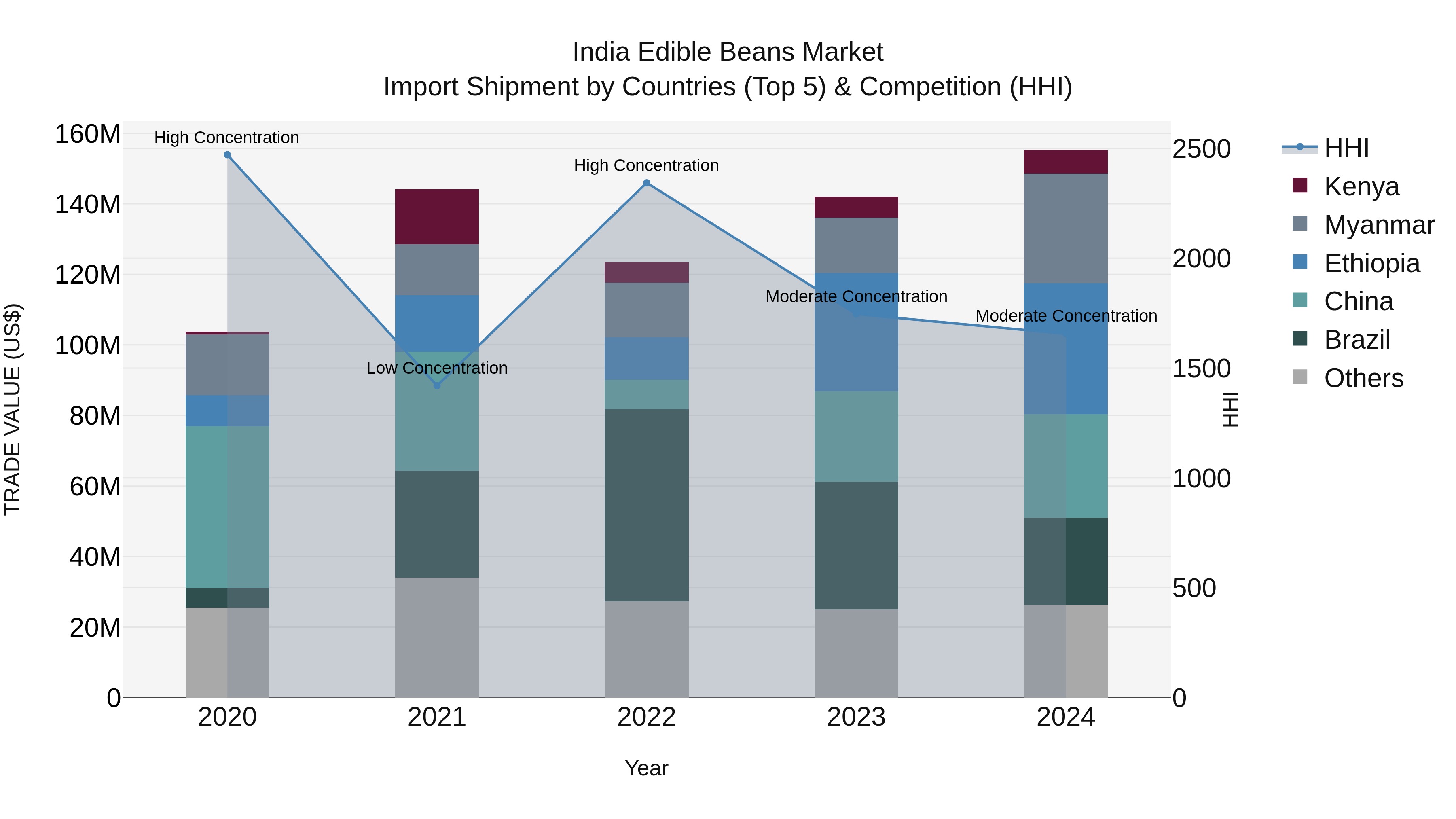
India Edible Beans Market Synopsis
The edible beans market in India is witnessing an upward trend due to the growing popularity of plant-based protein sources and health-conscious consumer behavior. Beans are an essential dietary component in India, and the market is benefitting from the rising preference for nutritious and sustainable food choices.
Drivers of the market
The market for edible beans in India is witnessing robust growth, primarily due to several drivers that have contributed to its expansion. Firstly, there is a significant shift in consumer preferences towards healthy and plant-based diets, which has increased the demand for protein-rich alternatives to meat products. Edible beans, being a valuable source of protein, fiber, and essential nutrients, have gained popularity among health-conscious consumers. Secondly, government efforts to promote the cultivation of pulses and legumes, including edible beans, through supportive policies and subsidies for farmers, have led to increased production and supply in the market. Moreover, the rise in disposable income and changing lifestyles have boosted the demand for convenience foods, where edible beans find applications in ready-to-eat meals and snacks. Additionally, the export potential of India edible beans has attracted the attention of international markets, further driving the growth of the sector. Overall, the positive consumer perception, government support, and the versatility of edible beans have contributed to the favorable outlook for the market in India.
Challenges of the Market
The India edible beans market faces challenges related to quality control and standardization. The lack of uniform quality standards can lead to discrepancies in the grading and pricing of edible beans, impacting the overall market stability. Additionally, the sector is vulnerable to weather fluctuations and climate change, which can affect crop yields and supply. As consumer awareness of food safety and traceability increases, there is a growing demand for certified organic and non-GMO edible beans, posing challenges for conventional bean producers.
Covid-19 Impact on the Market
The COVID-19 pandemic had a mixed impact on the edible beans market in India. While there was an initial surge in demand as people stocked up on essential food items during lockdowns, disruptions in the supply chain and transportation affected distribution and availability. However, as the situation stabilized, the market regained its momentum.
Key Players of the Market
The India edible beans market is experiencing growth due to the increasing popularity of plant-based protein sources and health-conscious consumption patterns. Key players in this market include Tata Consumer Products Ltd., ITC Limited, Adani Wilmar Limited, and Cargill India Pvt. Ltd.
Key Highlights of the Report:
- India Edible Beans Market Outlook
- Market Size of India Edible Beans Market, 2024
- Forecast of India Edible Beans Market, 2031
- Historical Data and Forecast of India Edible Beans Revenues & Volume for the Period 2021-2031
- India Edible Beans Market Trend Evolution
- India Edible Beans Market Drivers and Challenges
- India Edible Beans Price Trends
- India Edible Beans Porter's Five Forces
- India Edible Beans Industry Life Cycle
- Historical Data and Forecast of India Edible Beans Market Revenues & Volume By Product Type for the Period 2021-2031
- Historical Data and Forecast of India Edible Beans Market Revenues & Volume By Pinto Beans for the Period 2021-2031
- Historical Data and Forecast of India Edible Beans Market Revenues & Volume By Navy Beans for the Period 2021-2031
- Historical Data and Forecast of India Edible Beans Market Revenues & Volume By Great Northern Beans for the Period 2021-2031
- Historical Data and Forecast of India Edible Beans Market Revenues & Volume By Red Kidney Beans for the Period 2021-2031
- Historical Data and Forecast of India Edible Beans Market Revenues & Volume By Black Beans for the Period 2021-2031
- Historical Data and Forecast of India Edible Beans Market Revenues & Volume By Yellow Beans for the Period 2021-2031
- Historical Data and Forecast of India Edible Beans Market Revenues & Volume By Others for the Period 2021-2031
- Historical Data and Forecast of India Edible Beans Market Revenues & Volume By Distribution Channel for the Period 2021-2031
- Historical Data and Forecast of India Edible Beans Market Revenues & Volume By Supermarket/Hypermarket for the Period 2021-2031
- Historical Data and Forecast of India Edible Beans Market Revenues & Volume By Online Stores for the Period 2021-2031
- Historical Data and Forecast of India Edible Beans Market Revenues & Volume By Specialty Stores for the Period 2021-2031
- Historical Data and Forecast of India Edible Beans Market Revenues & Volume By Other for the Period 2021-2031
- Historical Data and Forecast of India Edible Beans Market Revenues & Volume By Application for the Period 2021-2031
- Historical Data and Forecast of India Edible Beans Market Revenues & Volume By Household for the Period 2021-2031
- Historical Data and Forecast of India Edible Beans Market Revenues & Volume By Restaurants for the Period 2021-2031
- Historical Data and Forecast of India Edible Beans Market Revenues & Volume By Others for the Period 2021-2031
- India Edible Beans Import Export Trade Statistics
- Market Opportunity Assessment By Product Type
- Market Opportunity Assessment By Distribution Channel
- Market Opportunity Assessment By Application
- India Edible Beans Top Companies Market Share
- India Edible Beans Competitive Benchmarking By Technical and Operational Parameters
- India Edible Beans Company Profiles
- India Edible Beans Key Strategic Recommendations






































