India Educational Toys Market Growth Rate
According to 6Wresearch internal database and industry insights, the India Educational Toys Market is projected to expand at a CAGR of approximately 3.2% during 2026–2032.
India Educational Toys Market Year-wise Growth Rate and Key Drivers (2022–2032)
This graph illustrates the annual growth rates of the India Educational Toys Market from 2022 to 2032, highlighting gradual market development and stronger expansion during the forecast period.
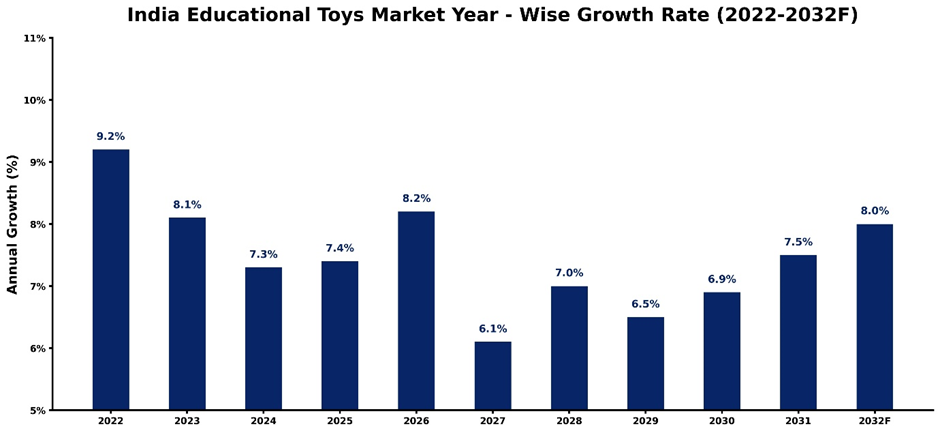
The following table presents the estimated annual growth rates of the market for each year, along with the key factors influencing market performance during the respective period. The values are intended to highlight year-wise drivers rather than provide a direct comparison between individual years.
| Year | Estimated Annual Growth (%) | Market Rationale |
| 2022 | 9.2% | Rising parental focus on early learning and skill development |
| 2023 | 8.1% | Growing adoption of interactive and activity-based learning toys |
| 2024 | 7.3% | Increasing awareness of cognitive and developmental benefits |
| 2025 | 7.4% | Expansion of online retail and wider product availability |
| 2026 | 8.2% | Rising demand for STEM and technology-enabled educational toys |
| 2027 | 6.1% | Growing adoption of eco-friendly and sustainable toy products |
| 2028 | 7% | Increasing integration of digital content with physical toys |
| 2029 | 6.5% | Rising demand for culturally relevant and personalized learning products |
| 2030 | 6.9% | Greater emphasis on holistic child development |
| 2031 | 7.5% | Increasing collaboration between toy manufacturers and educational institutions |
| 2032 | 8% | Stronger quality standards and continued innovation in educational toys |
Topics Covered in the India Educational Toys Market Report
The India Educational Toys Market report provides detailed analysis across Product Type, Age Group, and End-Users. The report provides detailed analysis of ongoing market trends, opportunities/high-growth areas, and market drivers that will help stakeholders align strategies based on current and future market dynamics.
India Educational Toys Market Highlights
| Report Name | India Educational Toys Market |
| Forecast period | 2026-2032 |
| CAGR | 3.2% |
| Growing Sector | Consumer Goods and Education |
India Educational Toys Market Overview
The India Educational Toys Market is expected to witness significant growth in the next few years as parents are increasingly focusing on learning-based play, early childhood development, and skill-building activities. The rising demand is supported by the rising awareness of STEM education, cognitive development, problem-solving, creativity, and motor skills. Availability of educational toys is being driven by a large child population, growing middle income households, organized retail, and rapid growth in e-commerce penetration in the country. Manufacturers are also introducing interactive, technology-enabled and age-specific products. Schools and learning centers are increasingly incorporating educational toys into activity-based learning programs.
Evaluation of Drivers in India Educational Toys Market (2026–2032)
Below mentioned are some major drivers and their influence on market dynamics:
| Market Driver | Primary Segment Affected | Why It Matters (Evidence) |
| Increasing focus on early childhood development | Academic Toys, Cognitive Toys | Growing parental emphasis on early learning encourages spending on toys that develop language, numeracy, memory, and problem-solving abilities. |
| Surge of STEM education | Cognitive Toys, Academic Toys | There is a rising demand for educational kits and experiment-based toys due to increasing interest in science, technology, engineering, and mathematics. |
| Rising penetration of e-commerce | All Product Types | Online platforms provide access to a wider range of educational toys across metropolitan and smaller cities. |
| Large child population | All Product Types | India has more than 250 million children aged 5–14 which creates a substantial consumer base for learning and recreational products. |
| Rising disposable income and premiumization | Cognitive Toys, Motor Skills Toys | Higher household spending capacity encourages purchases of branded, innovative, and technology-enabled educational products. |
India Educational Toys Market is projected to grow at a CAGR of over 3.2% during 2026-2032. India has a large youth population which is a strong foundation for consumption of educational toys. The country has more than 250 million children in the 5–14 age bracket, while digital commerce continues to improve product accessibility across urban and emerging markets. There are some other factors encouraging parents and institutions to purchase educational toys that combine entertainment with measurable learning outcomes include increasing incorporation of activity-based learning in schools and the growing popularity of STEM education.
Evaluation of Restraints in India Educational Toys Market
Below mentioned are some major restraints and their influence on market dynamics:
| Market Restraint | Primary Segment Affected | Why It Matters (Evidence) |
| High prices of premium educational toys | Cognitive Toys, Academic Toys | Advanced STEM kits, robotics products, and technology-enabled toys can be expensive for price-sensitive households. |
| Availability of low-cost conventional toys | All Product Types | Lower-priced traditional toys can limit adoption of specialized educational products. |
| Limited awareness in smaller markets | Academic Toys, Motor Skills Toys | Awareness of age-specific developmental benefits remains comparatively lower in some non-metro markets. |
| Product quality and safety concerns | All Product Types | Parents increasingly expect toys to meet safety, durability, and material-quality requirements. |
| Competition from digital entertainment | Cognitive Toys, Academic Toys | Smartphones, tablets, and online gaming compete for children's leisure and learning time. |
Challenges in India Educational Toys Industry
The India educational toys market is facing various challenges such as low awareness among parents about the long-term learning benefits of educational toys, price sensitivity among consumers, and stiff competition from low-cost and unorganized toy manufacturers. Lack of availability of quality educational toys in small cities and rural areas, inconsistent product quality, and concerns regarding child safety and compliance to quality standards also restrict the growth of the market. Besides this, changing consumer preferences, limited availability of innovative and age-appropriate products, dependence on imported components, and difficulties in reaching customers through effective distribution and retail networks can restrict market expansion.
Trends in India Educational Toys Market
Below mentioned are some of the numerous trends that impact the market:
- Growing Focus on STEM Learning: Parents and schools are increasingly spending toys that introduce children to science, technology, engineering, and mathematics concepts through hands-on activities, puzzles, experiments, and construction sets.
- Rise of EdTech-Integrated Toys: To create more engaging and personalized learning experiences, educational toys are being combined majorly with digital applications, augmented reality and connected devices.
- Increasing Demand for Skill-Based Toys: There is a rising interest in toys which develop problem-solving, creativity, fine motor skills, and cognitive abilities instead of providing entertainment alone.
Investment Opportunities in the India Educational Toys Market
Below mentioned are some of the areas where investments can be made in the market:
- Affordable Educational Toys: Companies can target price-sensitive households and penetrate tier-two, tier-three and rural markets by creating affordable products that do not compromise on safety or educational value.
- Personalized Educational Kits: Offering subscription-based, personalized activity kits based on children’s ages, and developmental stages can generate recurring income streams and promote ongoing engagement with educational products.
- Distribution and Retail Networks: Making investment in regional distributors, specialty toy stores, and omnichannel retail networks can improve product availability and allow brands to access underserved markets.
Leading Players in India Educational Toys Market
Stated below are some of the leading companies contributing significantly to the India Educational Toys Market share:
1. Funskool India Limited
| Company Name | Funskool India Limited |
|---|---|
| Established Year | 1988 |
| Headquarters | Chennai, India |
| Official Website | Click Here |
Funskool India is a major toy manufacturer offering educational and developmental products across multiple age groups. Its portfolio includes learning, construction, preschool, and skill-development toys distributed through organized retail and online channels.
2. Smartivity Labs
| Company Name | Smartivity Labs |
|---|---|
| Established Year | 2015 |
| Headquarters | New Delhi, India |
| Official Website | Click Here |
Smartivity develops STEM-focused educational toys and activity kits designed to combine hands-on construction with science, engineering, creativity, and problem-solving. Its products target children seeking experiential and activity-based learning.
3. Skillmatics
| Company Name | Skillmatics |
|---|---|
| Established Year | 2016 |
| Headquarters | Mumbai, India |
| Official Website | Click Here |
Skillmatics focuses on educational games and learning products designed to develop cognitive, communication, and problem-solving skills. The company's portfolio includes activity-based products for children across multiple age categories.
Government Initiatives in India Educational Toys Market
According to Indian government data, there are some programs like early childhood education, experiential learning, domestic toy manufacturing, and National Education Policy, which are contributing to building the educational toy ecosystem of India. The National Education Policy 2020 highlights experiential, play-based and activity-based learning in foundational education. Under the Make in India program and initiatives for promoting local production, quality standards, and reducing dependence on imports, the government has also promoted local toy manufacturing. These measures are supporting the development of locally manufactured educational, STEM, and skill-development toy products.
Future Outlook of India Educational Toys Market
The future of the India Educational Toys Market seems optimistic as parents increasingly connect play with academic development and life skills. Other factors that will drive the market growth include STEM education, early childhood learning, e-commerce penetration, rising household spending, premium educational products, and technology-enabled toys. The expansion of organized retail and online distribution into smaller cities will further broaden the customer base. Domestic manufacturing, sustainable product development, and collaborations between toy companies and educational institutions are also expected to create new opportunities through 2032.
Market Segmentation Analysis
The report offers a comprehensive study of the following market segments and their leading categories in the market:
By Product Type – Academic Toys Dominated the Market, Cognitive Toys Expected to Witness Strong Growth
According to Sumit Sagar, Senior Research Analyst, 6Wresearch, The Academic Toys segment accounted for the largest share of approximately 34.6% of the India Educational Toys Market in 2025, supported by demand for products linked to mathematics, language, science, and foundational learning. Meanwhile, the Cognitive Toys segment is expected to witness stronger growth during 2026–2032, with an estimated CAGR of 12.4%, driven by increasing parental focus on problem-solving, memory, logical reasoning, and creativity.
By Age Group – 4–8 Years Dominated the Market, above 8 Years Expected to Witness Strong Growth
The 4–8 Years segment accounted for the largest share of approximately 41.2% of the India Educational Toys Market in 2025, supported by strong demand for foundational academic and skill-development products. The Above 8 Years segment is expected to register stronger growth during 2026–2032, with an estimated CAGR of 12.7%, driven by increasing demand for STEM kits and advanced problem-solving toys.
By End-Users – Residential Dominated the Market, Commercial Expected to Witness Strong Growth
The Residential segment accounted for approximately 72.8% of the India Educational Toys Market in 2025, supported by parental spending on home-based learning and recreational activities. The Commercial segment is expected to witness stronger growth during 2026–2032, with an estimated CAGR of 13.1%, supported by increasing adoption of educational toys in schools, preschools, activity centres, libraries, and learning institutions.
Note: Market size estimations and growth projections presented in this report are based on 6Wresearch's proprietary forecasting methodology, utilizing the latest available industry data, government publications, and primary research inputs.
Key Attractiveness of the Report
- 10 Years of Market Numbers
- Historical Data Starting from 2022 to 2025
- Base Year: 2025
- Forecast Data until 2032
- Key Performance Indicators Impacting the Market
- Major Upcoming Developments and Projects
Key Highlights of the Report:
- India Educational Toys Market Outlook
- Market Size of India Educational Toys Market, 2025
- Forecast of India Educational Toys Market, 2032
- Historical Data and Forecast of India Educational Toys Market Revenues & Volume for the Period 2022–2032
- India Educational Toys Market Trend Evolution
- India Educational Toys Market Drivers and Challenges
- India Educational Toys Market Price Trends
- India Educational Toys Market Porter's Five Forces
- India Educational Toys Industry Life Cycle
- Historical Data and Forecast of India Educational Toys Market Revenues & Volume By Product Type for the Period 2022–2032
- Historical Data and Forecast of India Educational Toys Market Revenues & Volume By Academic Toys for the Period 2022–2032
- Historical Data and Forecast of India Educational Toys Market Revenues & Volume By Cognitive Toys for the Period 2022–2032
- Historical Data and Forecast of India Educational Toys Market Revenues & Volume By Motor Skills Toys for the Period 2022–2032
- Historical Data and Forecast of India Educational Toys Market Revenues & Volume By Others for the Period 2022–2032
- Historical Data and Forecast of India Educational Toys Market Revenues & Volume By Age Group for the Period 2022–2032
- Historical Data and Forecast of India Educational Toys Market Revenues & Volume By 1–4 Years for the Period 2022–2032
- Historical Data and Forecast of India Educational Toys Market Revenues & Volume By 4–8 Years for the Period 2022–2032
- Historical Data and Forecast of India Educational Toys Market Revenues & Volume By Above 8 Years for the Period 2022–2032
- Historical Data and Forecast of India Educational Toys Market Revenues & Volume By Others for the Period 2022–2032
- Historical Data and Forecast of India Educational Toys Market Revenues & Volume By End-Users for the Period 2022–2032
- Historical Data and Forecast of India Educational Toys Market Revenues & Volume By Residential for the Period 2022–2032
- Historical Data and Forecast of India Educational Toys Market Revenues & Volume By Commercial for the Period 2022–2032
- India Educational Toys Import Export Trade Statistics
- Market Opportunity Assessment By Product Type
- Market Opportunity Assessment By Age Group
- Market Opportunity Assessment By End-Users
- India Educational Toys Top Companies Market Share
- India Educational Toys Competitive Benchmarking By Technical and Operational Parameters
- India Educational Toys Company Profiles
- India Educational Toys Key Strategic Recommendations
Market Covered
The report offers a comprehensive study of the subsequent market segments:
By Product Type
- Academic Toys
- Cognitive Toys
- Motor Skills Toys
- Others
By Age Group
- 1–4 Years
- 4–8 Years
- Above 8 Years
- Others
By End-Users
- Residential
- Commercial






































