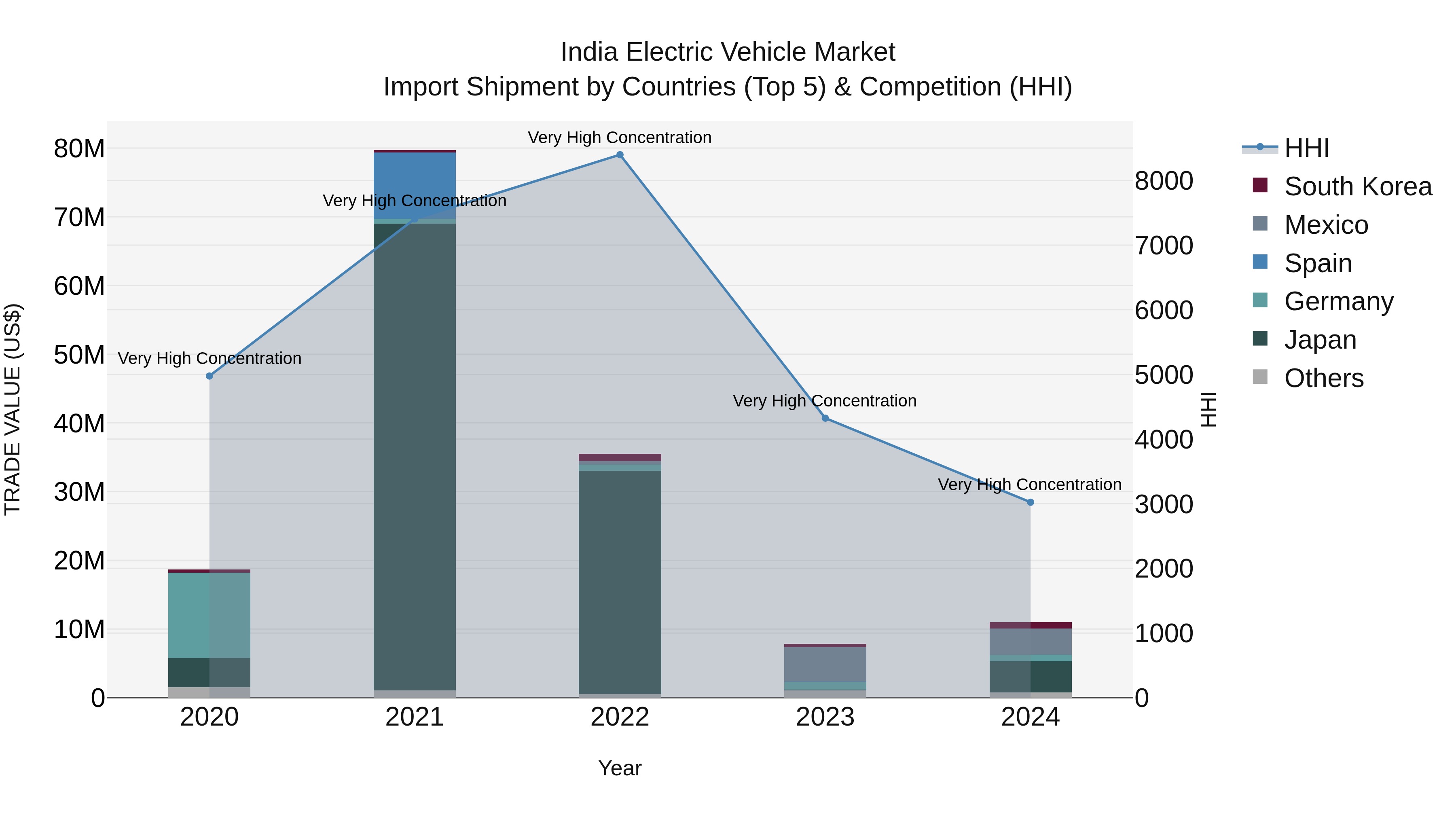
India Electric Vehicle Market Top 5 Importing Countries and Market Competition (HHI) Analysis
India`s electric vehicle import market in 2024 saw key contributions from top exporting countries such as Japan, Mexico, South Korea, and Germany. The high Herfindahl-Hirschman Index (HHI) indicates a concentrated market, while the negative Compound Annual Growth Rate (CAGR) from 2020-24 suggests a decline in overall imports. However, the impressive growth rate of 41.1% from 2023-24 hints at a potential rebound and increased demand for electric vehicles in the Indian market. This dynamic landscape presents both challenges and opportunities for stakeholders in the electric vehicle industry.
India Electric Vehicle Market Growth Rate
According to 6Wresearch internal database and industry insights, The India Electric Vehicle Market is projected to grow at a compound annual growth rate (CAGR) of 23.3% during the forecast period (2025–2031).
India Electric Vehicle Market Highlights
| Report Name | India Electric Vehicle Marke |
| Forecast Period | 2025-2031 |
| CAGR | 23.3% |
| Growing Sector | Electric 2-Wheelers & Public Transport Fleets |
Topics Covered in the India Electric Vehicle Market Report
The India Electric Vehicle Market report thoroughly covers the market by vehicle types, charger types, DC charger connector types, DC charger power ratings, and charger end consumers. The market report provides an unbiased and detailed analysis of ongoing market trends, opportunities/high growth areas, and market drivers, which would help stakeholders to devise and align their market strategies according to the current and future market dynamics.
India Electric Vehicle Market Synopsis
India Electric Vehicle Market is anticipated to get major growth due to the government’s concentration on electrification, increasing fuel costs, and the need to cut vehicular emissions in highly inhabited urban areas. EVs across two-wheelers, three-wheelers, passenger cars, buses, and trucks are increasingly acquired in both private and commercial transport.
Additionally, electric two-wheelers are the largest category deployed in India, they are propelled by their budget-friendliness and major use for commuting and last mile deliveries.
Evaluation of Growth Drivers in the India Electric Vehicle Market
Below mentioned are some transformative drivers and their influence on the market dynamics:
| Drivers | Primary Segments Affected | Why it matters (evidence) |
| Government Incentives & Policies | All Vehicle Types | There is encouragement for EV sales through subsidies, tax rebates, and incentives for local manufacturing. |
| High Fuel Prices | 2-Wheelers, 3-Wheelers, Passenger Vehicles | Rising petrol and diesel prices make EVs more cost-effective for daily commuting and commercial usage by the National and state EV policies under FAME-II and PLI. |
| Urban Air Pollution | Passenger Cars, Buses | Zero-emission vehicles demand in metro cities is accelerated by Strict emission norms and worsening city air quality. |
| Public Transport Electrification | Bus, 3-Wheeler | Adoption in public and shared mobility is spurred by Large-scale government acquisition of e-buses and subsidies for e-rickshaws. |
| Private Sector Investment | Chargers, 4-Wheelers | Domestic and global players are progressively allocating money in battery plants, charging networks, and local EV assembly units. |
The India Electric Vehicle Market size is projected to grow at the CAGR of 23.3% during the forecast period of 2025–2031. The EV industry in India is increasingly encouraged by local requirements for budget-friendly mobility, government-backed policies, and potent renewable energy integration. Daily commuting and last-mile connectivity also gets dominated by the EV industry which is encouraged by the local requirements for budget-friendly transport solutions, especially among two-wheeler and three-wheeler segments.
Evaluation of Restraints in the India Electric Vehicle Market
Below mentioned are some major restraints and their influence on the market dynamics:
| Restraints | Primary Segments Affected | What this means (evidence) |
| High Upfront Costs | Passenger Vehicle, Bus | Despite subsidies, EVs continues to stay expensive than conventional vehicles, which limits affordability for middle-income buyers. |
| Charging Infrastructure Gaps | Trucks, Passenger Vehicles | Insufficient fast-charging coverage along highways reduces acquirement of EVs for long-distance travel and logistics. |
| Battery Import Dependence | All Vehicle Types | Heavy dependence on imported lithium-ion cells increases acquirement prices and exposes the sector to global price volatility. |
| Limited Consumer Awareness | 2-Wheeler, Passenger Vehicle | Lack of education about EV benefits and misconceptions around battery life discourage adoption in rural and semi-urban markets. |
| Grid Load Concerns | Chargers, Buses | Increasing EV acquirement could strain local distribution grids, necessitating smart charging and infrastructure upgrades. |
India Electric Vehicle Market Challenges
Despite growing momentum, the India Electric Vehicle Industry faces challenges consisting of reduced attainability for a majority of consumers due to increasing upfront vehicle costs and insufficient financing options. India’s large consumer base represents middle- and low-income households, wherein cost-effectiveness persists to stay as the single biggest hurdle.
This issue is also worsened due to lack of broad financing methods such as leasing, subscription-based models, and innovative pay-as-you-go plans, which restricts EV uptake to higher-income groups and fleet operators. Using an EV or owning it becomes more complex due to the absence of a strong aftersales service chains and proficient workforce for EV maintenance.
India Electric Vehicle Market Trends
Several prominent trends reshaping the market growth include:
- Battery Swapping Models: E-rickshaws and two-wheelers are decreasing downtime and lowering upfront vehicle prices, and it is evolving as a major trend.
- Smart Charging Infrastructure: Advancement in IoT-enabled chargers and energy management systems to balance grid loads and enables efficient charging.
- Public EV Transit: Urban mobility is transforming due to rising government deployment of electric buses for metro and state transport corporations.
- Local EV Manufacturing & PLI Push: There is growth in domestic manufacturing of EVs and advanced batteries which is also decreasing dependency on imports due to the incentives under the Production Linked Incentive scheme.
Investment Opportunities in the India Electric Vehicle Industry
Some prominent investment opportunities in the market include:
- Battery Manufacturing Plants – To secure local battery supply, establishing large-scale gigafactories under the PLI scheme.
- High-Capacity Charging Corridors – To support long-haul logistics and intercity travel, deployment of DC fast chargers across highways.
- EV Financing Models – To augment cost-effectiveness, introducing of leasing, pay-per-use, and subscription-based EV ownership plans.
- Public Transport Electrification Projects – Providing electric buses and charging depots for metro cities and Smart City projects.
Top 5 Leading Players in the India Electric Vehicle Market
Some leading players operating in the India Electric Vehicle Market consist of:
1. Tata Motors Limited
| Company Name | Tata Motors Limited |
| Established Year | 1945 |
| Headquarters | Mumbai, India |
| Official Website | Click Here |
Tata Motors offers passenger cars, electric buses, and light commercial EVs under its Nexon EV and Tigor EV brands and is a leading EV manufacturer in India.
2. Mahindra Electric Mobility Limited
| Company Name | Mahindra Electric Mobility Limited |
| Established Year | 2010 |
| Headquarters | Bengaluru, India |
| Official Website | Click Here |
Mahindra Electric manufactures electric 3-wheelers, passenger cars, and commercial vehicles part of Mahindra Group, and is a pioneer in India’s EV industry.
3. Ola Electric
| Company Name | Ola Electric |
| Established Year | 2017 |
| Headquarters | Bengaluru, India |
| Official Website | Click Here |
Ola Electric specializes in cost-effective electric 2-wheelers and battery-swapping infrastructure, spurring large-scale adoption in the urban mobility segment.
4. Hero Electric
| Company Name | Hero Electric |
| Established Year | 2007 |
| Headquarters | Gurugram, India |
| Official Website | Click Here |
Hero Electric concentrates on economical scooters and commuter EVs for mass deployment and is one of India’s largest electric 2-wheeler manufacturers.
5. BYD India Private Limited
| Company Name | BYD India Private Limited |
| Established Year | 2007 |
| Headquarters | Chennai, India |
| Official Website | Click Here |
BYD functions in India with electric buses and premium passenger cars, utilising its global leadership in battery and EV technologies.
Government Regulations Introduced in the India Electric Vehicle Market
According to Indian government data, multiple initiatives to boost EV adoption are introduced by the government of India. The National Electric Mobility Mission Plan (NEMMP) sets targets for mass deployment. Subsidies for EV buyers and charging infrastructure is given by the FAME-II scheme. This policy is decreasing upfront prices and extend consumer access to budget-friendly electric mobility. Additionally, incorporation of EVs in procurement programs to accomplish net-zero emission goals is being done by the Indian Railways and public transport agencies.
Future Insights of the India Electric Vehicle Market
The India Electric Vehicle Market Growth is predicted to extend majorly in the upcoming years, propelled by strong government support, dropping battery costs, and consumer requirement for cost-efficient mobility. Deployment across vehicle categories will be influenced by increased electrification of public and shared transport, along with increasing investments in charging infrastructure. India is poised to become one of the world’s largest EV markets by 2031, with solid domestic production abilities and export capabilities.
Market Segmentation Analysis
The report offers a comprehensive study of the subsequent market segments and their leading categories.
Electric 2-Wheelers to Dominate the Market – By Vehicle Types
According to Shubhamdeep, Senior Research Analyst at 6Wresearch, the Electric 2-Wheeler category holds the largest India Electric Vehicle Market Share. This dominance is due to their cost-effectiveness, broad usage in daily commuting, and deployment by delivery and ride-hailing platforms.
DC Charger to Dominate the Market – By Charger Types
DC chargers dominate the India Electric Vehicle Market as they encourage fast charging for buses, trucks, and passenger vehicles, decreasing downtime and enabling effective fleet operations. Their installation across highways and metro corridors makes them more better for large-scale adoption.
CCS Connectors to Dominate the Market – By DC Charger Connector Types
CCS connectors dominate the market as they are widely adopted by global OEMs and gives compatibility and reliability for fast-charging infrastructure by being supported in most new EV models launched in India.
80-120 kW Power Rating to Dominate the Market – By DC Charger Power Ratings
The 80–120 kW power rating segment dominates as it balances affordability with efficient charging times, making it suitable for urban fleets and intercity passenger vehicles.
Public End Consumers to Dominate the Market – By Charger End Consumers
Public charging infrastructure dominates the market since government agencies, private operators, and startups are allocating money largely in setting up stations across metro cities and highways to encourage large-scale EV adoption.
Key Attractiveness of the Report
- 10 Years of Market Numbers.
- Historical Data Starting from 2021 to 2024.
- Base Year: 2024.
- Forecast Data until 2031.
- Key Performance Indicators Impacting the Market.
- Major Upcoming Developments and Projects.
Key Highlights of the Report:
- India Electric Vehicle Market Overview
- India Electric Vehicle Market Outlook
- India Electric Vehicle Market Forecast
- Historical Data and Forecast India Electric Vehicle Market Revenues and Volume for the Period 2021 - 2031F
- Historical Data and Forecast of India Electric Vehicle Market Revenues and Volume, By Vehicle Types, for the Period 2021 - 2031F
- Historical Data and Forecast of India Electric Vehicle Market Revenues and Volume, By Charger Types, for the Period 2021 - 2031F
- Historical Data and Forecast of India Electric Vehicle Market Revenues and Volume, By DC Charger Power Ratings, for the Period 2021 - 2031F
- Historical Data and Forecast of India Electric Vehicle Market Revenues and Volume, By Charger End Consumers, for the Period 2021 - 2031F
- Market Drivers and Restraints
- Industry Life Cycle
- Porter’s Five Force Analysis
- Impact Analysis of COVID-19
- Market Trends
- India Vehicle Market Revenue Ranking, By Companies
- Competitive Benchmarking
- Company Profiles
- Key Strategic Recommendations
Market Covered
The report offers a comprehensive study of the subsequent market segments:
By Vehicle Types
- Electric 2-Wheeler
- Electric 3-Wheeler
- Electric 4-Wheeler (Passenger Car and Light Commercial Vehicle (Goods Carrier))
- Electric Bus
- Electric Truck
By Charger Types
- AC
- DC
By DC Charger Connector Types
- CHAdeMO
- CCS
- Others (including Tesla superchargers and GB/T)
By DC Charger Power Ratings
- 40-80 kW
- 80-120 kW
- 120-200 kW
By Charger End Consumers
- Public
- Private






































