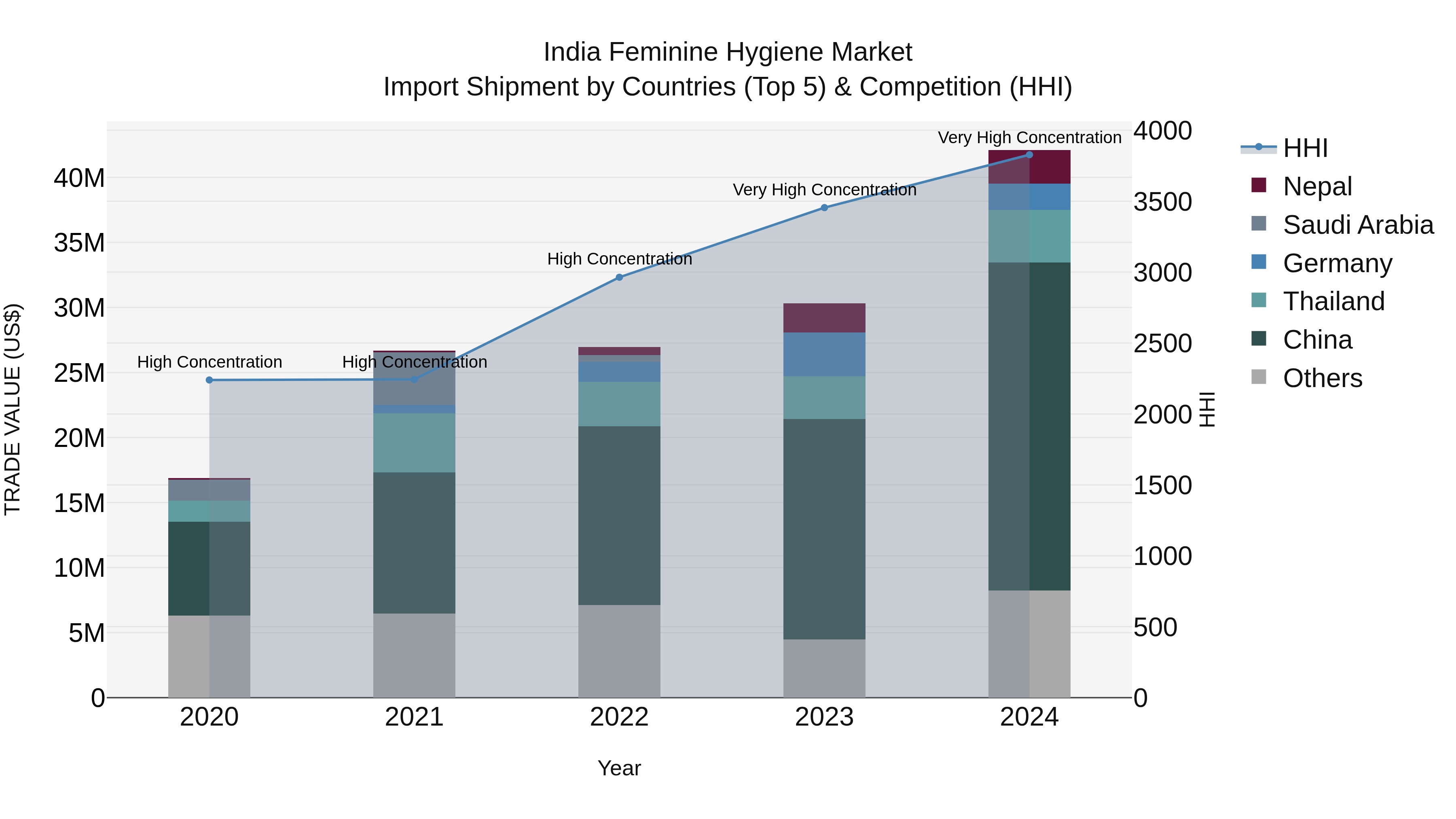
India Feminine Hygiene Market Top 5 Importing Countries and Market Competition (HHI) Analysis
India`s feminine hygiene import market continued to thrive in 2024, with top exporting countries including China, Thailand, Hungary, Nepal, and Germany. The high Herfindahl-Hirschman Index (HHI) indicates a concentrated market. The robust compound annual growth rate (CAGR) of 25.67% from 2020 to 2024 highlights the increasing demand for feminine hygiene products in India. Furthermore, the impressive growth rate of 38.91% from 2023 to 2024 suggests a rapid expansion of the market, presenting opportunities for both domestic and international players in the industry.
India Feminine Hygiene Market Growth Rate
According to 6Wresearch internal database and industry insights,
India Feminine Hygiene Market Highlights
| Report Name | India Feminine Hygiene Market |
| Forecast period | 2025-2031 |
| CAGR | 8.1% |
| Growing Sector | Personal Care and Hygiene |
Topics Covered in the India Feminine Hygiene Market Report
The India Feminine Hygiene Market report thoroughly covers the market by product types and distribution channels. The market report provides an unbiased and detailed analysis of ongoing market trends, opportunities/high growth areas, and market drivers, which would help stakeholders to devise and align their market strategies according to the current and future market dynamics.
India Feminine Hygiene Market Synopsis
The India Feminine Hygiene Market is anticipated to witness healthy growth, driven by an increase in awareness about menstrual health, retail access, and availability of affordable products. Consumers are increasingly seeking ultra-thin, biodegradable, and dermatologically tested products that demonstrate comfort and safety. Additionally, government-backed initiatives that include school-level awareness campaigns, exemptions of Goods and Services Tax (GST) on sanitary napkins, and the proliferation of e-Commerce platforms have enhanced affordability and accessibility for consumers, particularly in semi-urban and rural areas of the country.
Evaluation of Growth Drivers in the India Feminine Hygiene Market
Below mentioned are some prominent drivers and their influence to the market dynamics:
| Drivers | Primary Segments Affected | Why it matters (evidence) |
| Awareness Campaigns & School Programs | Sanitary Napkins; Menstrual Cups | Government/NGO initiatives expand first-time adoption and regular usage among adolescents, lifting penetration. |
| Affordability & GST Exemption | Pads; Value Packs | GST exemption and low-cost SKUs improve affordability for low-income consumers, widening addressable market. |
| E-commerce & D2C Expansion | All Products; Online | Subscriptions, discreet delivery, and pan-India reach accelerate trials and repeat purchases beyond metros. |
| Product Innovation & Biodegradables | Pads; Menstrual Cups | Ultra-thin cores, rash-free topsheets, and eco-friendly materials enhance comfort and sustainability appeal. |
| Urbanization & Working Women Share | Pads; Tampons | Increasing female workforce participation boosts demand for convenient, high-performance products and multi-pack formats. |
India Feminine Hygiene Market is anticipated to witness significant expansion, registering a CAGR of 8.1% during the forecast period of 2025-2031. The India Feminine Hygiene Market Growth is attributed due to ongoing investments in brand education, last-mile rural distribution, and portfolio premiumization. The development of femtech platforms, telehealth consultations, and period-tracking apps has also elevated consumer engagement and loyalty in the market. These digital developments provide personalized insights into menstrual health and help drive awareness, especially among younger consumers. Collectively, these trends are enhancing long-term growth, improving access, and increasing traction for safe, comfortable, and feature-led feminine hygiene products among different consumer segments in India.
Evaluation of Restraints in the India Feminine Hygiene Market
Below mentioned are some major restraints and their influence to the market dynamics:
| Restraints | Primary Segments Affected | What this means (evidence) |
| Cultural Stigma & Myths | Rural Users; New Adopters | Social taboos suppress trial and continued usage, limiting penetration in specific regions. |
| Affordability Gaps | Entry-Level Buyers | Rural and low-income groups are affected by price sensitivity, which limits their ability to shop regularly on a monthly basis. |
| Rural Supply Chain Gaps | All Products | Intermittent stock, limited cold/dry storage, and distribution gaps hinder consistent availability. |
| Waste Management & Disposal | Pads; Tampons | Municipalities and institutions have concerns about limitations of disposal infrastructure in relation to compliance, environmental, and/or safety issues. |
| Quality & Counterfeit Risks | Value Channels | Unregulated products |
India Feminine Hygiene Market Challenges
The India feminine Hygiene Industry faces several challenges that hinder its overall development. Fragmented rural retail and extended distribution chains increase operational costs and reduce product availability in remote areas. Furthermore, inadequate sanitation facilities in schools and workplaces restrict comfort and product adoption. Rising environmental concerns and evolving material regulations also pressure brands to innovate sustainable and biodegradable alternatives. Furthermore, these factors influence pricing structures, packaging innovation, consumer education strategies, and investment decisions among national and regional manufacturers.
India Feminine Hygiene Market Trends
The India Feminine Hygiene Market is being shaped by a few emerging trends, including:
- Sustainable & Biodegradable Products: There has been a growing preference for eco-friendly pads, organic cotton types, and natural fiber topsheets. This trend is helping to reduce waste generation and appeal to environmentally conscious buyers.
- Femtech & Digital Education: Period-tracking applications, telehealth education, and influencer education are reducing stigma and improving product literacy about menstruation.
- Subscriptions & Personalization: Direct-to-consumer brands are creating curated boxes, quizzes for sizing and fit, and subscription replenishment- improving adherence and convenience.
- Format Diversification: The consumption of menstrual cups and premium tampons is expanding for urban consumers with an emphasis on comfort, mobility, and lower lifetime cost of use.
Investment Opportunities in the India Feminine Hygiene Industry
There are several potential investment opportunities in the industry that continue to open new avenues:
- Purchasing Biodegradable Materials and Local Manufacturing – Make investments in supplies that can be both green and locally produced by expanding options for pulp, bioplastics, and compostable films in order to provide more independence from imports and more sustainability.
- Rural Last Mile and Micro-Entrepreneurs – Create hub and spoke models with women entrepreneurs both for greater access and education in low service areas.
- Purchasing Vending and Disposal Infrastructure – Equip schools, factories, and public transit sites with vending and incinerators to improve safe access and disposal for biodegradable options.
Top 5 Leading Players in the India Feminine Hygiene Market
Some leading players operating in the India Feminine Hygiene Market Share include:
1. Procter & Gamble Hygiene and Health Care Ltd. (Whisper)
| CompanyName | Procter & Gamble Hygiene and Health Care Ltd. (Whisper) |
|---|---|
| Established Year | 1964 (India entity) |
| Headquarters | Mumbai, India |
| Official Website | Click Here |
P&G markets Whisper sanitary pads with a strong focus on comfort technologies, dermatological testing, and education campaigns; its portfolio spans value to premium ranges and leverages extensive retail reach and e-commerce.
2. Johnson & Johnson Pvt. Ltd. (Stayfree, o.b., Carefree)
| CompanyName | Johnson & Johnson Pvt. Ltd. (Stayfree, o.b., Carefree) |
|---|---|
| Established Year | 1957 (India) |
| Headquarters | Mumbai, India |
| Official Website | Click Here |
J&J offers pads and liners emphasizing skin friendliness and reliable protection; the company invests in school programs and awareness drives to expand safe menstrual practices.
3. Unicharm India Pvt. Ltd. (Sofy)
| CompanyName | Unicharm India Pvt. Ltd. (Sofy) |
|---|---|
| Established Year | 2007 (India) |
| Headquarters | Gurugram, India |
| Official Website | Click Here |
Unicharm’s Sofy brand provides ultra-thin and overnight pads; the company focuses on localized manufacturing, innovation in absorbent cores, and strong modern trade presence.
4. Soothe Healthcare Pvt. Ltd. (Paree)
| CompanyName | Soothe Healthcare Pvt. Ltd. (Paree) |
|---|---|
| Established Year | 2012 |
| Headquarters | Noida, India |
| Official Website | Click Here |
Soothe Healthcare manufactures Paree pads targeting heavy-flow comfort and affordability; the company expands through general trade, chemists, and D2C channels with regional marketing.
5. Sirona Hygiene Pvt. Ltd. (Sirona)
| CompanyName | Sirona Hygiene Pvt. Ltd. (Sirona) |
|---|---|
| Established Year | 2014 |
| Headquarters | New Delhi, India |
| Official Website | Click Here |
Sirona offers menstrual cups, tampons, pads, and hygiene accessories; the brand is positioned around innovation, sustainability, and community education via digital platforms.
Government Regulations & Initiatives Introduced in the India Feminine Hygiene Market
According to Indian Government data, The Government of India and state programmes and efforts affect a range of feminine hygiene items. The Menstrual Hygiene Scheme (MHS), part of the National Health Mission, creates awareness and supplies schoolgirls who experience menstruation with cheap pads to ensure menstrual hygiene. The Suvidha program, implemented under the Pradhan Mantri Bhartiya Janaushadhi Pariyojana (PMBJP), makes low-cost sanitary napkins available through Janaushadhi stores. However,several states have distributed free or subsidized pads, such as the Udaan program in Rajasthan, Khushi program in Odisha, and school distribution in Tamil Nadu.
Future Insights of the India Feminine Hygiene Market
The India Feminine Hygiene Market is forecasted to grow steadily, with an emphasis on skin-friendly materials, sustainable products, and less obvious distribution methods. Brands will continue to make big bets with biodegradable substrates, inclusive sizing/fit, and differentiated education to reach new users, alongside reducing churn. Furthermore, there will be heightened expansion of vending and disposal services in public institutions and factory settings. Digital platforms will also facilitate product discovery, adherence reminders, and tele-counseling, which in turn will help support long-term penetration across urban and rural markets.
Market Segmentation Analysis
The report offers a comprehensive study of the subsequent market segments and their leading categories.
Sanitary Napkins/Pads to Dominate the Market- By Product Types
According to Ritika Kalra, Senior Research Analyst, 6Wresearch, Sanitary Napkins/Pads dominate the India Feminine Hygiene Market Share owing to their wide availability, ease of use, and strong brand-led education. Frequent promotions, value multipacks, and broad retail reach across chemists and kirana stores reinforce repeat purchase cycles.
Drug Stores/Pharmacies to Dominate the Market- By Distribution Channel
Drug Stores/Pharmacies dominate the India Feminine Hygiene Market as they offer assured availability, privacy, and trusted advice, especially for first-time or young buyers. Pharmacist-led guidance, proximity to residential areas, and consistent stocking of multiple SKUs support higher conversion and basket size.
Key attractiveness of the report
- 10 Years of Market Numbers.
- Historical Data Starting from 2021 to 2024.
- Base Year: 2024
- Forecast Data until 2031.
- Key Performance Indicators Impacting the market.
- Major Upcoming Developments and Projects.
Key Highlights of the Report:
- India Feminine Hygiene Market Outlook
- Market Size of India Feminine Hygiene Market, 2024
- Forecast of India Feminine Hygiene Market, 2031
- Historical Data and Forecast of India Feminine Hygiene Revenues & Volume for the Period 2021-2031
- India Feminine Hygiene Market Trend Evolution
- India Feminine Hygiene Market Drivers and Challenges
- India Feminine Hygiene Price Trends
- India Feminine Hygiene Porter's Five Forces
- India Feminine Hygiene Industry Life Cycle
- Historical Data and Forecast of India Feminine Hygiene Market Revenues & Volume By Product Types for the Period 2021-2031
- Historical Data and Forecast of India Feminine Hygiene Market Revenues & Volume By Sanitary Napkins/Pads for the Period 2021-2031
- Historical Data and Forecast of India Feminine Hygiene Market Revenues & Volume By Tampons for the Period 2021-2031
- Historical Data and Forecast of India Feminine Hygiene Market Revenues & Volume By Menstrual Cups for the Period 2021-2031
- Historical Data and Forecast of India Feminine Hygiene Market Revenues & Volume By Others for the Period 2021-2031
- Historical Data and Forecast of India Feminine Hygiene Market Revenues & Volume By Distribution Channel for the Period 2021-2031
- Historical Data and Forecast of India Feminine Hygiene Market Revenues & Volume By Hypermarkets/Supermarket for the Period 2021-2031
- Historical Data and Forecast of India Feminine Hygiene Market Revenues & Volume By Convenience Stores for the Period 2021-2031
- Historical Data and Forecast of India Feminine Hygiene Market Revenues & Volume By Drug Stores/Pharmacies for the Period 2021-2031
- Historical Data and Forecast of India Feminine Hygiene Market Revenues & Volume By Others for the Period 2021-2031
- India Feminine Hygiene Import Export Trade Statistics
- Market Opportunity Assessment By Product Types
- Market Opportunity Assessment By Distribution Channel
- India Feminine Hygiene Top Companies Market Share
- India Feminine Hygiene Competitive Benchmarking By Technical and Operational Parameters
- India Feminine Hygiene Company Profiles
- India Feminine Hygiene Key Strategic Recommendations
Market Covered
The report offers a comprehensive study of the subsequent market segments:
By Product Types
- Sanitary Napkins/Pads
- Tampons
- Menstrual Cups
- Others
By Distribution Channel
- Hypermarkets/Supermarket
- Convenience Stores
- Drug Stores/Pharmacies
- Others






































