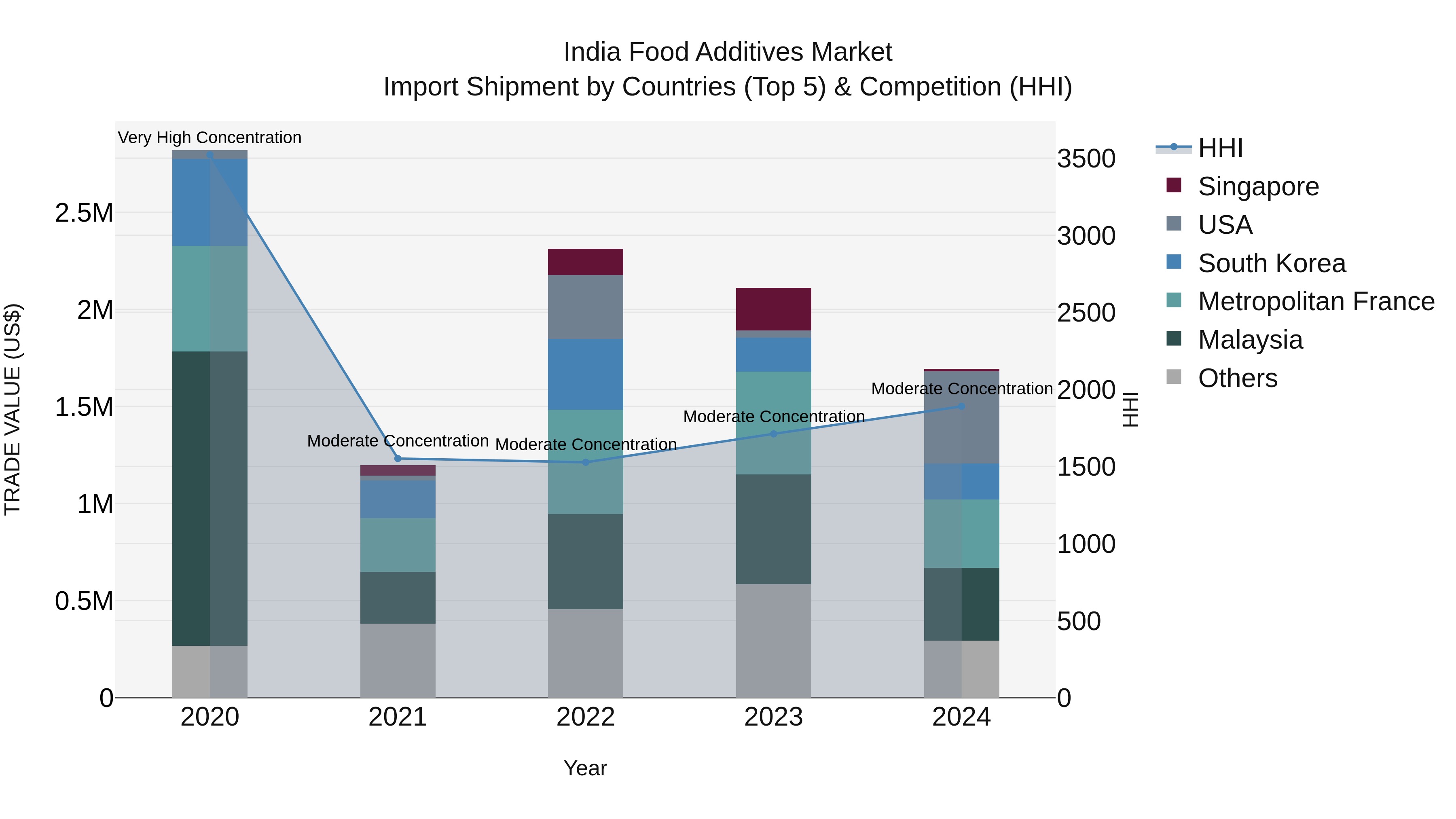
India Food Additives Market Top 5 Importing Countries and Market Competition (HHI) Analysis
In 2024, India`s food additives import market saw significant contributions from top exporting countries including the USA, Malaysia, Metropolitan France, South Korea, and UAE. Despite a moderate concentration level indicated by the HHI, the market experienced a negative CAGR of -11.96% from 2020 to 2024. Furthermore, the growth rate for 2023-24 stood at -19.73%, signaling a challenging period for the industry. It will be crucial for market players to closely monitor these trends and adapt their strategies to navigate the evolving landscape of the food additives market in India.
India Food Additives Market Growth Rate
According to 6Wresearch internal database and industry insights, the India Food Additives Market is projected to grow at a compound annual growth rate (CAGR) of 7.8% during the forecast period (2026-2032).
Topics Covered in the India Food Additives Market Report
The India Food Additives Market report thoroughly covers the market by type, source, and applications. The market report provides an unbiased and detailed analysis of ongoing market trends, opportunities/high growth areas, and market drivers, which help stakeholders devise and align their market strategies according to the current and future market dynamics.
India Food Additives Market Highlights
| Report Name |
India Food Additives Market |
| Forecast period | 2026-2032 |
| CAGR | 7.8% |
| Growing Sector |
Beverages |
India Food Additives Market Synopsis
The India Food Additives Market is expected to witness significant growth due to various reasons, including the growing consumption of processed foods, urbanization, and changing diet patterns. The food processing industry has grown, which has led to a rise in the need for additives like preservatives, flavoring agents, and emulsifiers. Also, more people are using natural ingredients since they are more aware of their health. Government initiatives and investments in the food technology industry have also been driving market growth, ensuring that there is quality and safety in all types of food products.
Evaluation of Growth Drivers in the India Food Additives Market
Below mentioned are some prominent drivers and their influence on the market dynamics:
| Drivers | Primary Segments Affected | Why it Matters (Evidence) |
| Rising Demand for Processed Foods | All Types; Bakery & Beverages | Urban lifestyles increase reliance on packaged food products, boosting additive usage. |
| Food Processing Industry Growth | Emulsifiers; Dairy and Bakery | Increase in production units boosts the need for additives and stabilizers. |
| Growing Trend towards Use of Natural Additives | Natural Origin; All Uses | Trend moves consumers to healthier foods, thereby enhancing natural additive consumption. |
| Retail and Online Sales Expansion | All Additive Types; Drinks and Snacks | Diverse marketing methods make processed foods more accessible. |
| Government Policies Favoring the Food Sector | All Sectors; All Additives | Government policies ensure food safety and innovation, which enhances additive consumption. |
India Food Additives Market is expected to grow at the CAGR of 7.8% during the forecast period of 2026-2032. The growth of this market will be fueled by increased consumption of processed food products, changes in consumer preferences, and improvements in food processing infrastructure. The growing consciousness regarding food safety and extension of shelf life have been adding to the demands for food additives. Moreover, the trend toward using natural and organic substances in food products is prompting innovation in the industry. Government policies and investments in food technology are also aiding the growth of this market.
Evaluation of Restraints in the India Food Additives Market
Below mentioned are some major restraints and their influence on the market dynamics:
| Restraints | Primary Segments Affected | What This Means (Evidence) |
| Stringent Food Safety Regulations | All Types; All Applications | Compliance requirements increase production costs and approval timelines. |
| Cost of Using Natural Additives | Natural Additives; High-Quality Products | The high cost restricts usage among manufacturers that rely on budget-friendly operations. |
| Possible Concerns About Health Issues With Artificial Additives | Artificial Additives; Drinks and Foods | Due to health concerns, consumers tend to avoid artificial additives. |
| Raw Material Constraints & Application Variability | Various Additives; Multiple Applications | Different additives are required for different uses, and a lack of raw materials can slow down production. |
| Low Awareness in Rural Areas | Various Additives; Other Products | Reduced exposure to processed foods lowers the use of additives. |
India Food Additives Industry Challenges
Irrespective of strong growth prospects, the India Food Additives Industry faces several challenges that impact its expansion. The major challenge facing fast food restaurants is trying to find a way to cut costs while providing healthy options to consumers. In addition, compliance can be challenging due to the nature of the complex regulatory environment and ever-changing food safety requirements. Issues relating to improper refrigeration and supply chain management make it difficult to ensure that the quality of the products remains intact. Increasing consumer mistrust in artificial components requires constant innovations from the part of the manufacturers.
India Food Additives Market Trends
Key trends shaping the India Food Additives Market Growth include:
- Growing Preference for Clean Labels: Consumers have become aware of the need for clean labels and have started selecting items that include natural ingredients. It has compelled food companies to come up with product formulations using fewer artificial ingredients.
- Rise of Health Benefits-Based Additives: Additives that provide consumers with health benefits besides providing the basic functions are increasing in demand. There has been a rise in innovations in nutrition-based food and drink products.
- Technological Innovations in Food Processing: Innovative techniques are being used in food processing technology, which helps additives provide enhanced functionality.
Investment Opportunities in the India Food Additives Market
Key areas offering strong investment potential in the India Food Additives Market include:
- Natural Additives Manufacturing Plants – Investments in natural and organic additive manufacturing can satisfy the increasing demand for clean label products. The natural additives manufacturing sector provides growth potential in the long term due to the increase in consumer awareness.
- Research & Development in Health Additives – Creation of novel additives having nutritional properties can help in gaining access to high-value markets. Companies can concentrate on manufacturing fortified and nutraceutical-based products.
- New Food Processing Plants – Setting up new food processing facilities can boost demand for additives.
Top 5 Leading Players in the India Food Additives Market
Some leading players operating in the India Food Additives Market include:
1. Dabur India Limited
| Company Name | Dabur India Limited |
|---|---|
| Established Year | 1884 |
| Headquarters | Ghaziabad, India |
| Official Website | Click Here |
Dabur India Limited is a major player in health-oriented food ingredients and natural additives. The company leverages its strong heritage in Ayurveda to offer herbal and plant-based solutions, catering to the rising demand for natural and functional food products in India.
2. Himalaya Wellness Company
| Company Name | Himalaya Wellness Company |
|---|---|
| Established Year | 1930 |
| Headquarters | Bengaluru, India |
| Official Website | Click Here |
Himalaya Wellness Company is a significant player in functional and natural ingredients, specializing in herbal-based additives. Its product portfolio is aligned with clean-label and wellness trends, supporting both nutraceutical and food applications.
3. Patanjali Ayurved Limited
| Company Name | Patanjali Ayurved Limited |
|---|---|
| Established Year | 2006 |
| Headquarters | Haridwar, India |
| Official Website | Click Here |
Patanjali Ayurved Limited is a high-volume supplier of food ingredients and additives within the consumer goods sector. The company emphasizes natural, Ayurvedic formulations and has rapidly scaled its production to cater to mass-market demand across India.
4. Adani Wilmar Limited
| Company Name | Adani Wilmar Limited |
|---|---|
| Established Year | 1999 |
| Headquarters | Ahmedabad, India |
| Official Website | - |
Adani Wilmar Limited is a leading player in food processing, particularly in additives used in edible oil refining. The company supports large-scale food manufacturing with a strong presence in oils, fats, and value-added food ingredients.
5. Zydus Lifesciences
| Company Name | Zydus Lifesciences |
|---|---|
| Established Year | 1952 |
| Headquarters | Ahmedabad, India |
| Official Website | Click Here |
Zydus Lifesciences is a key supplier of specialized food additives, nutrients, and pharma-derived ingredients. The company leverages its pharmaceutical expertise to deliver high-quality nutraceutical and functional ingredient solutions for the food and healthcare industries.
Government Regulations Introduced in the India Food Additives Market
According to India’s Government Data, some measures have been taken by the India government to regulate and develop the market for food additives. FSSAI (Food Safety and Standards Authority of India) has set up stringent measures to make sure that the additives being added to food items are safe and of good quality. Moreover, the “Make in India” campaign, along with the PLI (Production Linked Incentive), also helps develop the food processing industry. The government also encourages the consumption of clean-label products using natural additives.
Future Insights of the India Food Additives Market
The India Food Additives Market Share is expected to witness significant growth in the coming years, driven by increasing urbanization, evolving consumer preferences, and technological advancements in food processing. The market is also expected to be driven by increased consumer demands for ingredients that have functionality and clean labeling and expanded usage in beverages and convenience foods. Further, continuous investments made in research and development and governmental assistance in food production can aid in boosting market expansion. In addition, increased exports and partnerships across the globe can help India become a major market in the global food additives industry.
Market Segmentation Analysis
The report offers a comprehensive study of the subsequent market segments and their leading categories.
Emulsifiers to Dominate the Market – By Type
According to Mohit, Senior Research Analyst, 6Wresearch, the Emulsifiers category leads the India Food Additives Market. This leadership is due to the extensive usage of these products in baked goods, dairy products, and processed food items. India Food Additives Market Growth will be facilitated due to rising demand for convenience foods and consistency in product quality.
Natural Source to Dominate the Market – By Source
Natural segment leads India Food Additives Market. Rising inclination towards organic food is boosting the demand for natural additives derived from plants. Market growth in India Food Additives Market can also be attributed to increasing health concerns among consumers.
Beverages to Dominate the Market – By Application
The segment of Beverages accounts for the largest market share in the India Food Additives Market. The growing popularity of ready-to-drink beverages and flavoured beverages is fuelling the demand for additives such as sweeteners and colours.
Key Attractiveness of the Report
- 10 Years of Market Numbers.
- Historical Data Starting from 2022 to 2025.
- Base Year: 2025.
- Forecast Data until 2032.
- Key Performance Indicators Impacting the Market.
- Major Upcoming Developments and Projects.
Key Highlights of the Report:
- India Food Additives Market Outlook
- Market Size of India Food Additives Market, 2025
- Forecast of India Food Additives Market, 2032
- Historical Data and Forecast of India Food Additives Revenues & Volume for the Period 2022-2032
- India Food Additives Market Trend Evolution
- India Food Additives Market Drivers and Challenges
- India Food Additives Price Trends
- India Food Additives Porter's Five Forces
- India Food Additives Industry Life Cycle
- Historical Data and Forecast of India Food Additives Market Revenues & Volume By Type for the Period 2022-2032
- Historical Data and Forecast of India Food Additives Market Revenues & Volume By Acidulants for the Period 2022-2032
- Historical Data and Forecast of India Food Additives Market Revenues & Volume By Colors for the Period 2022-2032
- Historical Data and Forecast of India Food Additives Market Revenues & Volume By Emulsifiers for the Period 2022-2032
- Historical Data and Forecast of India Food Additives Market Revenues & Volume By Flavors for the Period 2022-2032
- Historical Data and Forecast of India Food Additives Market Revenues & Volume By Hydrocolloids for the Period 2022-2032
- Historical Data and Forecast of India Food Additives Market Revenues & Volume By Preservatives for the Period 2022-2032
- Historical Data and Forecast of India Food Additives Market Revenues & Volume By Sweeteners for the Period 2022-2032
- Historical Data and Forecast of India Food Additives Market Revenues & Volume By Source for the Period 2022-2032
- Historical Data and Forecast of India Food Additives Market Revenues & Volume By Natural for the Period 2022-2032
- Historical Data and Forecast of India Food Additives Market Revenues & Volume By Synthetic for the Period 2022-2032
- Historical Data and Forecast of India Food Additives Market Revenues & Volume By Application for the Period 2022-2032
- Historical Data and Forecast of India Food Additives Market Revenues & Volume By Bakery & Confectionery for the Period 2022-2032
- Historical Data and Forecast of India Food Additives Market Revenues & Volume By Beverages for the Period 2022-2032
- Historical Data and Forecast of India Food Additives Market Revenues & Volume By Dairy & Frozen Desserts for the Period 2022-2032
- India Food Additives Import Export Trade Statistics
- Market Opportunity Assessment By Type
- Market Opportunity Assessment By Source
- Market Opportunity Assessment By Application
- India Food Additives Top Companies Market Share
- India Food Additives Competitive Benchmarking By Technical and Operational Parameters
- India Food Additives Company Profiles
- India Food Additives Key Strategic Recommendations
Market Covered
The report offers a comprehensive study of the subsequent market segments:
By Type
- Acidulants
- Colors
- Emulsifiers
- Flavors
- Hydrocolloids
- Preservatives
- Sweeteners
By Source
- Natural
- Synthetic
By Application
- Bakery & Confectionery
- Beverages
- Dairy & Frozen Desserts






































