India Food Retail Market Summary
The india food retail market was estimated at USD 387 Million in 2025 and is projected to reach USD 643 Million by 2032, growing at a CAGR of 10.3% from 2026 to 2032.
India Food Retail Market Year-wise Growth Rate and Key Drivers
This graph highlights how the India Food Retail Market has steadily grown over the past five years, supported by major growth factors.
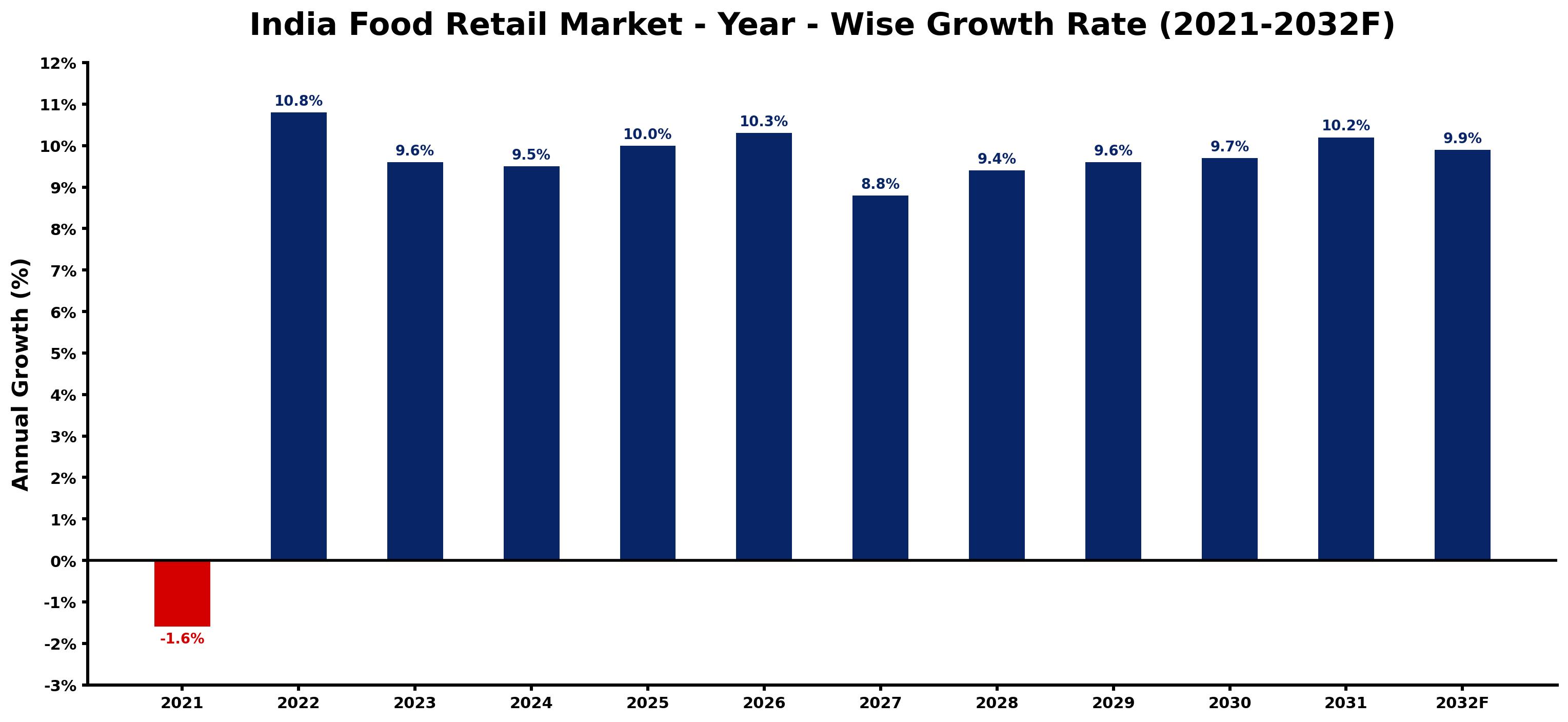
The table below presents the year wise growth rates along with the key drivers influencing the market
| Year | Growth Rate | Major Drivers |
| 2021 | -1.6% | Unfavorable supply chain disruptions led to stock shortages, dampening consumer access and sales in food retail. |
| 2022 | 10.8% | Digital transformation initiatives enhance e-commerce capabilities in traditional food retail sectors. |
| 2023 | 9.6% | Urbanization trends lead to increased demand for convenient, ready-to-eat meal options. |
| 2024 | 9.5% | Investment in cold chain infrastructure supports fresh food availability across diverse regions. |
| 2025 | 10.0% | Health consciousness among consumers drives organic and nutritious food product offerings. |
| 2026 | 10.3% | Emergence of local brands challenges established players, enhancing market competition significantly. |
| 2027 | 8.8% | Technological integration, like AI analytics, optimizes inventory management and customer insights. |
| 2028 | 9.4% | Emerging payment solutions, including UPI, streamline transactions, attracting younger demographics. |
| 2029 | 9.6% | Sustainability initiatives prompt retailers to explore eco-friendly packaging and sourcing. |
| 2030 | 9.7% | Increased penetration of smart devices elevates online grocery shopping experiences dramatically. |
| 2031 | 10.2% | Partnerships with food delivery services create synergistic opportunities for traditional retailers. |
| 2032 | 9.9% | Consumer preferences shift towards personalized shopping experiences, necessitating advanced data analytics. |
Note - Market size estimations and growth projections presented in this report are based on 6Wresearch's advanced forecasting approach, validated with industry datasets as of June 2026.
India Food Retail Market Synopsis
The India Food Retail Market is projected to reach 10.3% and witness significant growth during the forecast period (2026-2032). This growth is underpinned by robust demographic trends, including a growing population and increasing disposable incomes. Changes in consumer lifestyles and preferences towards modern shopping formats are also pivotal in shaping the market landscape. The Indian food retail industry encompasses a variety of channels, including supermarkets, hypermarkets, e-commerce platforms, and convenience stores, with a noticeable shift towards organized retail and digital shopping experiences.
India Food Retail Market Growth Drivers
Several key factors are driving the expansion of the India Food Retail Market. First and foremost, the rising disposable incomes among the urban population are creating a more affluent consumer base that is willing to spend on quality food products. Secondly, rapid urbanization is resulting in lifestyle changes that favor convenience and accessibility, leading to a greater demand for processed and ready-to-eat food items. Additionally, consumer trends are increasingly shifting towards organic and health-focused food options, further stimulating market growth. The proliferation of online grocery platforms, which provide not only convenience but also competitive pricing, is another significant driver. Finally, relaxed foreign direct investment policies by the government are encouraging investments from international players, thus enhancing market dynamics.
India Food Retail Market Trends and Opportunities
The India Food Retail Market is characterized by notable trends that present various opportunities for stakeholders. There is a marked trend towards fragmentation as diverse business models emerge, particularly in the online retail space and dark kitchens. This fragmentation is complemented by strategic consolidation among companies aiming to capture synergies across supply chains and distribution networks. Furthermore, the growth of private labels is becoming a prominent strategy for retailers seeking to attract price-sensitive consumers while offering quality alternatives to established brands. Technology adoption is also a critical trend, with retailers increasingly embracing innovations aimed at operational efficiency and enhanced customer experiences.
India Food Retail Market Challenges and Restraints
Despite the positive growth outlook, the India Food Retail Market faces several challenges that hinder its full potential. One of the primary obstacles is the high entry barriers for smaller retailers, which struggle to compete with the established large chains dominating the market. Additionally, inadequate infrastructure remains a significant concern, creating logistical challenges that affect supply chain efficiency. Limited access to capital for smaller players compounds this issue, often leading to pressure on profit margins and operational viability. Furthermore, the sector experiences a shortage of skilled labor, posing challenges in maintaining quality service and operational standards.
India Food Retail Market Government Investment and Initiatives
The Indian government has undertaken several initiatives aimed at promoting the growth of the food retail sector. Policy frameworks encouraging foreign investments have been established, aiming to enhance market competitiveness and expand infrastructure. There are also various public spending programs focused on improving logistical networks and supply chain efficiency. Additionally, the government is actively promoting the digitization of retail operations, supporting the rise of e-commerce platforms within the food retail space. This strategic focus on modernization and digital integration is positioned to further facilitate growth and innovation within the sector.
India Food Retail Market Latest Developments (May 2025 - June 2026)
In recent months, the India Food Retail Market has witnessed several key developments that are shaping its trajectory. There has been a marked increase in investments towards developing technological solutions for inventory management and supply chain optimization, responding to the evolving consumer expectations for faster and more reliable services. Retailers are diversifying their offerings by incorporating more local and organic products, catering to the increasing consumer demand for health-focused options. Moreover, partnerships between traditional retailers and online platforms have proliferated, enhancing the industry's ability to reach a broader customer base. Additionally, promotional campaigns targeting urban areas have become more prevalent, reflecting the industry's focus on engaging with tech-savvy consumers.
India Food Retail Market - Key Attractiveness of the Report
- 10 Years of Market Numbers
- Historical Data Starting from 2022 to 2025
- Base Year: 2025
- Forecast Data until 2032
- Key Performance Indicators Impacting the Market
- Major Upcoming Developments and Projects
Key Highlights of the Report:
- India Food Retail Market Outlook
- Market Size of India Food Retail Market, 2025
- Forecast of India Food Retail Market, 2032
- Historical Data and Forecast of India Food Retail Revenues & Volume for the Period 2022-2032F
- India Food Retail Market Trend Evolution
- India Food Retail Market Drivers and Challenges
- India Food Retail Price Trends
- India Food Retail Porter's Five Forces
- India Food Retail Industry Life Cycle
- Historical Data and Forecast of India Food Retail Market Revenues & Volume By Product Types for the Period 2022-2032F
- Historical Data and Forecast of India Food Retail Market Revenues & Volume By Unpackaged Food for the Period 2022-2032F
- Historical Data and Forecast of India Food Retail Market Revenues & Volume By Packaged Food for the Period 2022-2032F
- Historical Data and Forecast of India Food Retail Market Revenues & Volume By Drinks for the Period 2022-2032F
- Historical Data and Forecast of India Food Retail Market Revenues & Volume By Household Products for the Period 2022-2032F
- Historical Data and Forecast of India Food Retail Market Revenues & Volume By Packaging Types for the Period 2022-2032F
- Historical Data and Forecast of India Food Retail Market Revenues & Volume By Boxes for the Period 2022-2032F
- Historical Data and Forecast of India Food Retail Market Revenues & Volume By Cans for the Period 2022-2032F
- Historical Data and Forecast of India Food Retail Market Revenues & Volume By Cellophane Wrapping for the Period 2022-2032F
- Historical Data and Forecast of India Food Retail Market Revenues & Volume By Cylindrical Cardboard for the Period 2022-2032F
- India Food Retail Import Export Trade Statistics
- Market Opportunity Assessment By Product Types
- Market Opportunity Assessment By Packaging Types
- India Food Retail Top Companies Market Share
- India Food Retail Competitive Benchmarking By Technical and Operational Parameters
- India Food Retail Company Profiles
- India Food Retail Key Strategic Recommendations






































