India Forklifts Market Growth Rate
According to 6Wresearch internal database and industry insights, the India Forklifts Market is growing at a compound annual growth rate (CAGR) of 7.85% during the forecast period (2026-2032).
India Forklifts Market Year-wise Growth Rate and Key Drivers
This graph highlights how the India Forklifts Market has steadily grown over the past five years, supported by major growth factors.
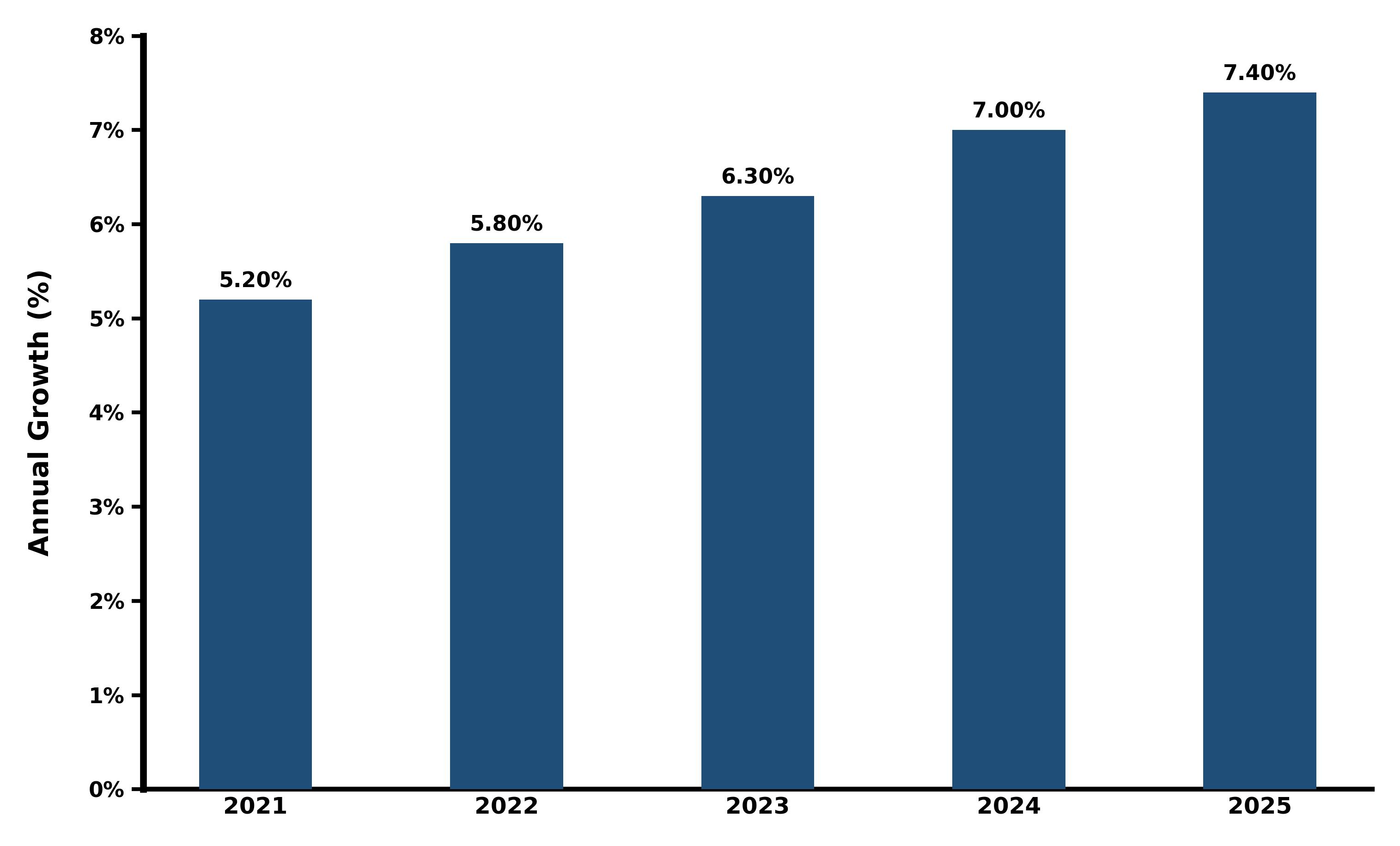
The table below presents the year‑wise growth rates along with the key drivers influencing the market
| Years | Est. Annual Growth in % | Growth Drivers |
| 2021 | 5.2% | Rising demand from organized warehousing and logistics sector. |
| 2022 | 5.8% | Growth of e-commerce driving material handling equipment demand. |
| 2023 | 6.3% | Expansion of manufacturing sector under industrial policies. |
| 2024 | 7% | Increasing adoption of electric forklifts for efficiency and sustainability. |
| 2025 | 7.4% | Growth in infrastructure and cold storage facilities. |
Topics Covered in the India Forklifts Market Report
India Forklifts Market report thoroughly covers the market by fuel type, class type, and applications. The market report provides an unbiased and detailed analysis of ongoing market trends, opportunities/high growth areas, and market drivers, which would help stakeholders devise and align their market strategies according to the current and future market dynamics.
India Forklifts Market Highlights
| Report Name |
India Forklifts Market |
| Forecast period | 2026-2032 |
| CAGR | 7.85% |
| Market Size | Warehousing & Logistics |
India Forklifts Market Synopsis
The India Forklifts Market is predicted to experience a quick growth due to the rise in demand from logistics, manufacturing, and warehousing sectors. Also, the rapid expansion of e-commerce and organized retail is fueling the need for efficient material handling solutions. Besides, these government initiatives are promoting the industrialization and infrastructure development are also contributing significantly to market’s growth. Furthermore, the transition toward electric forklifts and automation in warehouses is accelerating adoption across industries.
Evaluation of Growth Drivers in the India Forklifts Market
Below mentioned some growth drivers and their impact on market dynamics:
| Drivers | Primary Segments Affected | Why It Matters |
| Growth in E-commerce & Warehousing | Applications (Warehousing, Logistics) | Increases equipment demand as rising online orders require efficient material handling, faster inventory movement, and optimized warehouse operations. |
| Industrial Expansion Initiatives | Class Type, Applications | Boosts manufacturing usage by increasing production capacity, requiring forklifts for handling raw materials and finished goods efficiently. |
| Shift Toward Electric Equipment | Fuel Type (Battery-Electric) | This reduces operating costs and lowers emissions, supports sustainability goals and makes electric forklifts worthy for indoor operations. |
| Infrastructure Development | All Segments | Enhances deployment scope by boosting logistics networks, industrial zones and warehousing facilities that increases forklift usage across the regions. |
| Automation & Smart Warehousing | Class Type, Applications | Improves efficiency through real-time tracking, reduced manual intervention, enhanced safety, and optimized workflow management in modern warehouses. |
The India Forklifts Market is projected to grow significantly, with a CAGR of 7.85% during the forecast period of 2026-2032. The growth of logistics networks and increasing investments in warehousing framework are main contributors to this growth. Also, the government-led programs such as “Make in India” and the Production Linked Incentive (PLI) campaigns are refining the manufacturing output, which in turn increases the demand for forklifts. Moreover, the rise in adoption of battery-electric forklifts due to environmental concerns and operational cost efficiency is shaping the market dynamics.
Evaluation of Restraints in the India Forklifts Market
Below mentioned are some major restraints and their influence on market dynamics:
| Restraints | Primary Segments Affected | What This Means |
| High Initial Investment | Fuel Type, Class Type | Restricts adoption as companies hesitate due to high upfront costs and longer return on investment periods. |
| Limited Skilled Workforce | All Segments | Lowers efficiency due to improper handling, reduce productivity, and raise risk of operational errors and accidents. |
| Maintenance Costs | All Segments | This increases operational load with frequent servicing needs and higher repair expenses which affects business continuity. |
| Dependence on Imports | Components, Equipment | Creates supply chain risks owing to import slowdowns, currency shifts, and reliance on foreign suppliers for significant parts. |
| Infrastructure Gaps | Applications | Controls penetration in semi-urban and rural areas owing to insufficient logistics facilities and limited warehouse development. |
India Forklifts Market Challenges
The India Forklifts Market faces challenges such as high upfront costs associated with innovative forklifts, particularly electric variants. In addition, the limited skilled operators impacts operational efficiency and safety. Besides, reliance on imported components can delay supply chains and increase costs. Furthermore, the uneven infrastructure development in semi-urban areas limits market perception, while maintaining requirements that adds to the overall operational burden for end-users. Besides, the rising energy costs and limited access to charging infrastructure further restrict the global adoption of electric forklift solutions across industries.
India Forklifts Market Trends
Some major trends contributing to the India Forklifts Market Growth are:
- Rise of Electric Forklifts: The increase in adoption of battery-electric forklifts owing to reduce emissions, lowers noise, low maintenance costs, and suitability for indoor warehouse operations.
- Integration of IoT & Automation: There are some smart forklifts equipped with sensors and telematics that improves real-time tracking, predictive maintenance, safety monitoring, and overall warehouse productivity.
- Growth of Organized Warehousing: This expansion of modern warehouses and logistics parks is refining demand for innovative forklifts, while enabling efficient inventory management and faster order fulfillment.
Investment Opportunities in the India Forklifts Market
Here are some investment opportunities in the India Forklifts Industry:
- Electric Forklift Manufacturing: The investment in local production of battery-electric forklifts can lowers reliance on imports, reduce costs, and meet rise of demand efficiently.
- Warehouse Automation Solutions: By developing the integrated automation systems which includes forklifts and robotics offers a high growth potential by enhancing productivity, lowering labor costs, and improving operational efficiency.
- Aftermarket Services: Recurring revenue opportunities from efficient maintenance, spare parts, and service networks ensures equipment uptime, which extends lifecycle, and building long-term customer relationships.
Top 5 Leading Players in the India Forklifts Market
Here are some top companies contributing to India Forklifts Market Share:
1. Godrej Material Handling
| Company Name | Godrej Material Handling |
|---|---|
| Established Year | 1961 |
| Headquarters | Mumbai, India |
| Official Website | - |
Godrej Material Handling is a leading domestic manufacturer of forklifts offering a wide range of diesel and electric models. The company focuses on innovation, sustainability, and strong service networks, making it a dominant player in India’s material handling equipment market.
2. Toyota Material Handling India
| Company Name | Toyota Material Handling India |
|---|---|
| Established Year | 2010 |
| Headquarters | Bengaluru, India |
| Official Website | Click Here |
Toyota Material Handling India provides advanced forklift solutions known for durability and efficiency. The company emphasizes automation and electric forklifts, catering to industries such as logistics, manufacturing, and warehousing.
3. KION India
| Company Name | KION India (Linde Material Handling) |
|---|---|
| Established Year | 2006 |
| Headquarters | Pune, India |
| Official Website | - |
KION India offers premium forklifts under the Linde brand, focusing on high-performance equipment and advanced technology solutions. The company serves sectors requiring precision and heavy-duty operations.
4. Voltas Material Handling
| Company Name | Voltas Material Handling (Voltas Limited) |
|---|---|
| Established Year | 1954 |
| Headquarters | Mumbai, India |
| Official Website | Click Here |
Voltas Material Handling provides a wide range of forklifts and warehouse equipment. It is known for its strong distribution network and cost-effective solutions tailored for Indian industries.
5. Hyundai Construction Equipment India
| Company Name | Hyundai Construction Equipment India |
|---|---|
| Established Year | 2007 |
| Headquarters | Pune, India |
| Official Website | Click Here |
Hyundai Construction Equipment India offers robust forklift solutions designed for heavy-duty industrial applications. The company focuses on durability and advanced engineering to meet diverse operational needs.
Government Regulations Introduced in the India Forklifts Market
According to Indian government data, the development of the India Forklifts Market is influenced by several regulatory programs. The “Make in India” program supports domestic manufacturing of industrial equipment, which also includes forklifts, while reducing dependence on imports. The Production Linked Incentive (PLI) scheme refines manufacturing and technological innovation. In addition, the safety regulations under the Factories Act mandate a proper handling equipment and operator training to ensure workplace safety. The National Logistics Policy aims to enhance logistics efficiency, indirectly boosting forklift demand by improving warehouse framework and connectivity.
Future Insights of the India Forklifts Market
The upcoming years for the India Forklifts Market remains to be highly positive, supported by quick industrialization and expansion of logistics. The increasing investments in smart warehouses and automation technologies are predicted to fuel demand for advanced forklifts. Moreover, the transition towards sustainable and energy-efficient equipment will further accelerate the adoption of electric forklifts. Furthermore, the government programs supporting framework development and manufacturing growth will continue to create some favorable conditions for market’s expansion.
Market Segmentation Analysis
The report offers a comprehensive study of the subsequent market segments and their leading categories.
Diesel to Dominate the Market - By Fuel Type
According to Kanak Phartiyal, Senior Research Analyst, 6Wresearch, diesel forklifts dominate the market due to their high power, longevity, and ability to handle heavy loads in outdoor and industrial environments. These forklifts are mostly used in construction sites, ports, and large-scale manufacturing units where performance and load capacity are critical, making them a preferred choice despite the gradual shift toward electric alternatives.
Class 3 forklifts to Dominate the Market – By Class Type
Class 3 forklifts, which includes electric pallet trucks and stackers, leads the market due to their extensive use in warehouses and retail distribution centers. Their compact design, ease of operation, and suitability for indoor material handling make them highly preferred in the growing organized warehousing sector, especially driven by e-commerce expansion.
Warehousing to Dominate the Market – By Applications
Warehousing dominates the application segment as the rise of e-commerce and third-party logistics providers raises demand for efficient storage and material handling solutions. Also, the modern warehouses require forklifts for inventory management, in order fulfillment, and space optimization, making this segment the largest contributor to overall market’s demand.
Key attractiveness of the report
- 10 Years Market Numbers.
- Historical Data Starting from 2022 to 2025.
- Base Year: 2025
- Forecast Data until 2032.
- Key Performance Indicators Impacting the Market.
- Major Upcoming Developments and Projects.
Key Highlights of the Report:
- India Forklifts Market Overview
- India Forklifts Market Outlook
- India Forklifts Market Forecast
- Historical Data of India Forklifts Market Revenues for the Period 2022-2032
- India Forklifts Market Size and India Forklifts Market Forecast of Revenues, Until 2032
- Historical Data of India Forklifts Market Revenues, By Product Type, for the Period 2022-2032
- Market Size & Forecast of India Forklifts Market Revenues, By Product Type, Until 2032
- Historical Data of India Forklifts Market Revenues, By Movement Mechanism, for the Period 2022-2032
- Market Size & Forecast of India Forklifts Market Revenues, By Movement Mechanism, Until 2032
- Historical Data of India Forklifts Market Revenues, By Applications, for the Period 2022-2032
- Market Size & Forecast of India Forklifts Market Revenues, By Applications, Until 2032
- Historical Data of India Forklifts Market Revenues, By Regions, for the Period 2022-2032
- Market Size & Forecast of India Forklifts Market Revenues, By Regions, Until 2032
- Market Drivers and Restraints
- India Forklifts Market Trends
- India Forklifts Market Trends and Industry Life Cycle
- Porter’s Five Force Analysis
- Market Opportunity Assessment
- India Forklifts Market Share, By Players
- India Forklifts Market Share, By Regions
- India Forklifts Market Overview on Competitive Benchmarking
- Company Profiles
- Key Strategic Recommendations
Market covered
The report subsequently covers the market by following segments and subsegments.
By Fuel Type
- Diesel
- Battery- Electric
- Gasoline & LPG/CNG
By Class Type
- Class 1
- Class 2
- Class 3
- Class 4&5
By Applications
- Freight & Logistics
- Manufacturing
- Warehousing
- Others






































