India Gift Retailing Market Summary
The india gift retailing market was estimated at USD 1315 Million in 2025 and is projected to reach USD 2168 Million by 2032, growing at a CAGR of 10.3% from 2026 to 2032.
India Gift Retailing Market Year-wise Growth Rate and Key Drivers
This graph highlights how the India Gift Retailing Market has steadily grown over the past five years, supported by major growth factors.
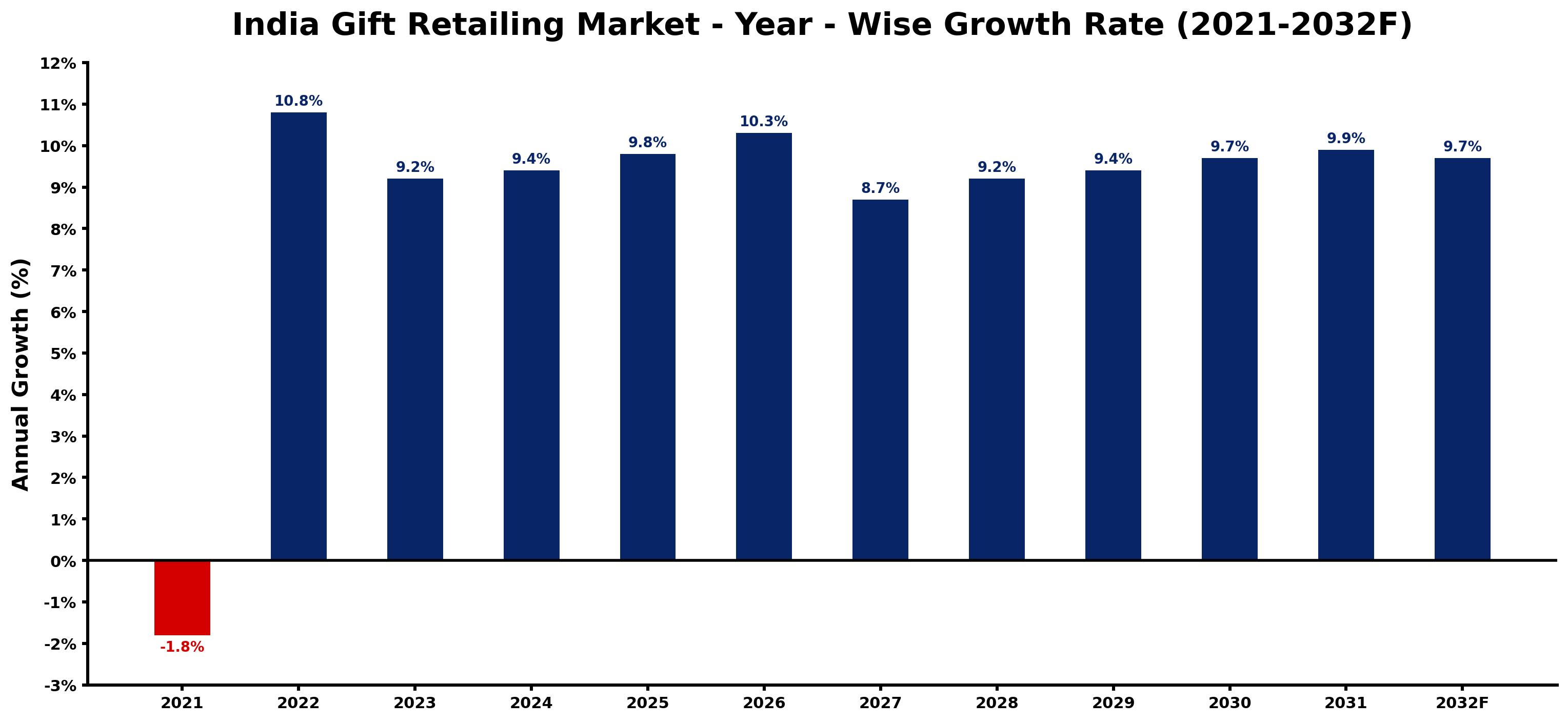
The table below presents the year wise growth rates along with the key drivers influencing the market
| Year | Growth Rate | Major Drivers |
| 2021 | -1.8% | Increased emphasis on online shopping led to significant store closures, diminishing foot traffic and sales in retail gift shops. |
| 2022 | 10.8% | A cultural revival emphasized personalized gifts, enhancing emotional connections among consumers. |
| 2023 | 9.2% | Digital payment solutions streamlined transactions, boosting convenience for online gift purchases. |
| 2024 | 9.4% | Corporate gifting trends emerged, fostering strong client relationships and brand loyalty. |
| 2025 | 9.8% | Sustainable and eco-friendly gifting options gained popularity, aligning with consumer values. |
| 2026 | 10.3% | Social media campaigns effectively showcased unique gifting ideas, attracting diverse customer segments. |
| 2027 | 8.7% | Expansion of tier 2 and tier 3 cities presented new opportunities for retail outlets. |
| 2028 | 9.2% | Integration of augmented reality in shopping experiences transformed how consumers engage with gifts. |
| 2029 | 9.4% | Collaborations with local artisans emphasized craftsmanship, appealing to the conscious consumer market. |
| 2030 | 9.7% | Customized gifting experiences began influencing consumer preferences, driving repeat purchases. |
| 2031 | 9.9% | Advances in supply chain logistics reduced delivery times, enhancing customer satisfaction significantly. |
| 2032 | 9.7% | Emergence of gifting subscription services created consistent revenue streams for retailers. |
Note - Market size estimations and growth projections presented in this report are based on 6Wresearch's advanced forecasting approach, validated with industry datasets as of June 2026.
India Gift Retailing Market Synopsis
The India Gift Retailing Market is projected to reach 10.3% and witness significant growth during the forecast period (2026-2032). This market is anticipated to grow at a compound annual growth rate (CAGR) of 8.3%, propelled by an increasing gifting culture and rising disposable incomes among the Indian populace. Moreover, the demand for personalized gifts and premium items is further enhancing market dynamics.
India Gift Retailing Market Growth Drivers
Several factors are driving the expansion of the India Gift Retailing Market at an accelerated pace:
- The integration of gifting into various aspects of Indian life, such as weddings, festivals, and birthdays, has positioned gifting as a vital cultural practice. This trend generates substantial opportunities for retailers, establishing a robust customer base.
- As the Indian middle class expands, disposable incomes rise concurrently, enabling consumers to allocate increased spending on discretionary items, including gifts. This uptick in available income particularly influences spending behaviors during festive seasons.
- Personalization is becoming increasingly important in gift selection, with consumers seeking unique, customized items. This trend encourages businesses to innovate and offer bespoke gift options, effectively catering to evolving consumer preferences.
- The rising popularity of ecommerce platforms facilitates a seamless shopping experience, allowing consumers to explore a vast array of gifting options from the comfort of their homes. This convenience is particularly notable among younger demographics who are inclined towards online shopping.
- Marketing strategies that emphasize emotional connections in gifting are gaining traction, helping retailers establish brand loyalty and encouraging repeat purchases. This relatability strengthens customer relationships within the market.
India Gift Retailing Market Challenges and Restraints
Despite its growth potential, the India Gift Retailing Market faces several challenges that could impede its progress:
- The fragmentation of the market presents a significant challenge, as numerous players operate in diverse channels. This competition, especially from unorganized sectors offering lower-cost options, complicates the decision-making process for consumers.
- The lack of brand awareness among consumers is notable, primarily due to limited marketing efforts by players in this space. Additionally, insufficient consumer education initiatives can lead to a lack of understanding of product offerings.
- Supply chain disruptions, particularly highlighted during the COVID-19 pandemic, still linger, affecting inventory management and distribution. Retailers must navigate these complexities to maintain market stability.
- Economic fluctuations and regional disparities in income levels may lead to inconsistent consumer spending patterns, affecting overall market growth.
- Shifting consumer preferences toward eco-friendly and sustainable products pose a challenge for traditional gift retailers, pushing them to adapt or risk losing market relevance.
India Gift Retailing Market Government Investment and Initiatives
The government of India has recognized the potential of the gift retailing sector and is implementing various initiatives to foster its growth:
- Policy frameworks aimed at promoting entrepreneurship in the retail space are being developed, enabling new entrants to innovate and compete effectively within the market.
- Investment in infrastructure, such as logistics and transportation networks, is crucial for enhancing supply chain efficiency, reducing costs, and improving overall market operations.
- Support for handicraft and artisanal products through government programs encourages the promotion of locally made gifting items, stimulating both traditional and modern gifting practices.
- Public spending on social events and festivals supports the retail sector by boosting consumer spending during peak gifting seasons.
- Incentives for digital transformation aid small retailers in establishing an online presence, helping them reach a broader audience and adapt to changing consumer shopping habits.
India Gift Retailing Market Latest Developments (May 2025 - June 2026)
Recent developments within the India Gift Retailing Market highlight a shift towards digitalization and personalized offerings:
- Companies are increasingly leveraging technology to enhance consumer engagement through personalized marketing and AI-driven recommendations for gift selection.
- Collaborations between retail brands and e-commerce platforms have expanded product visibility, making a wider range of gifts available to consumers across regions.
- Retailers are focusing on sustainability by incorporating eco-friendly materials into their products, aligning with evolving consumer expectations for environmental responsibility.
- Promotions and partnerships with influencers have gained traction, providing brands with fresh avenues to reach potential customers and cultivate brand loyalty.
- The introduction of subscription-based gifting services is emerging as an innovative model, allowing consumers to gift curated items on a recurring basis, thereby enhancing customer retention.
India Gift Retailing Market - Key Attractiveness of the Report
- 10 Years of Market Numbers
- Historical Data Starting from 2022 to 2025
- Base Year: 2025
- Forecast Data until 2032
- Key Performance Indicators Impacting the Market
- Major Upcoming Developments and Projects
Key Highlights of the Report:
- India Gift Retailing Market Outlook
- Market Size of India Gift Retailing Market, 2025
- Forecast of India Gift Retailing Market, 2032
- Historical Data and Forecast of India Gift Retailing Revenues & Volume for the Period 2022-2032F
- India Gift Retailing Market Trend Evolution
- India Gift Retailing Market Drivers and Challenges
- India Gift Retailing Price Trends
- India Gift Retailing Porter's Five Forces
- India Gift Retailing Industry Life Cycle
- Historical Data and Forecast of India Gift Retailing Market Revenues & Volume By Product Type for the Period 2022-2032F
- Historical Data and Forecast of India Gift Retailing Market Revenues & Volume By Souvenirs and Novelty Items for the Period 2022-2032F
- Historical Data and Forecast of India Gift Retailing Market Revenues & Volume By Seasonal Decorations for the Period 2022-2032F
- Historical Data and Forecast of India Gift Retailing Market Revenues & Volume By Greeting Cards for the Period 2022-2032F
- Historical Data and Forecast of India Gift Retailing Market Revenues & Volume By Giftware? for the Period 2022-2032F
- Historical Data and Forecast of India Gift Retailing Market Revenues & Volume By Other? for the Period 2022-2032F
- Historical Data and Forecast of India Gift Retailing Market Revenues & Volume By Distribution Channel for the Period 2022-2032F
- Historical Data and Forecast of India Gift Retailing Market Revenues & Volume By Online for the Period 2022-2032F
- Historical Data and Forecast of India Gift Retailing Market Revenues & Volume By Offline for the Period 2022-2032F
- India Gift Retailing Import Export Trade Statistics
- Market Opportunity Assessment By Product Type
- Market Opportunity Assessment By Distribution Channel
- India Gift Retailing Top Companies Market Share
- India Gift Retailing Competitive Benchmarking By Technical and Operational Parameters
- India Gift Retailing Company Profiles
- India Gift Retailing Key Strategic Recommendations






































