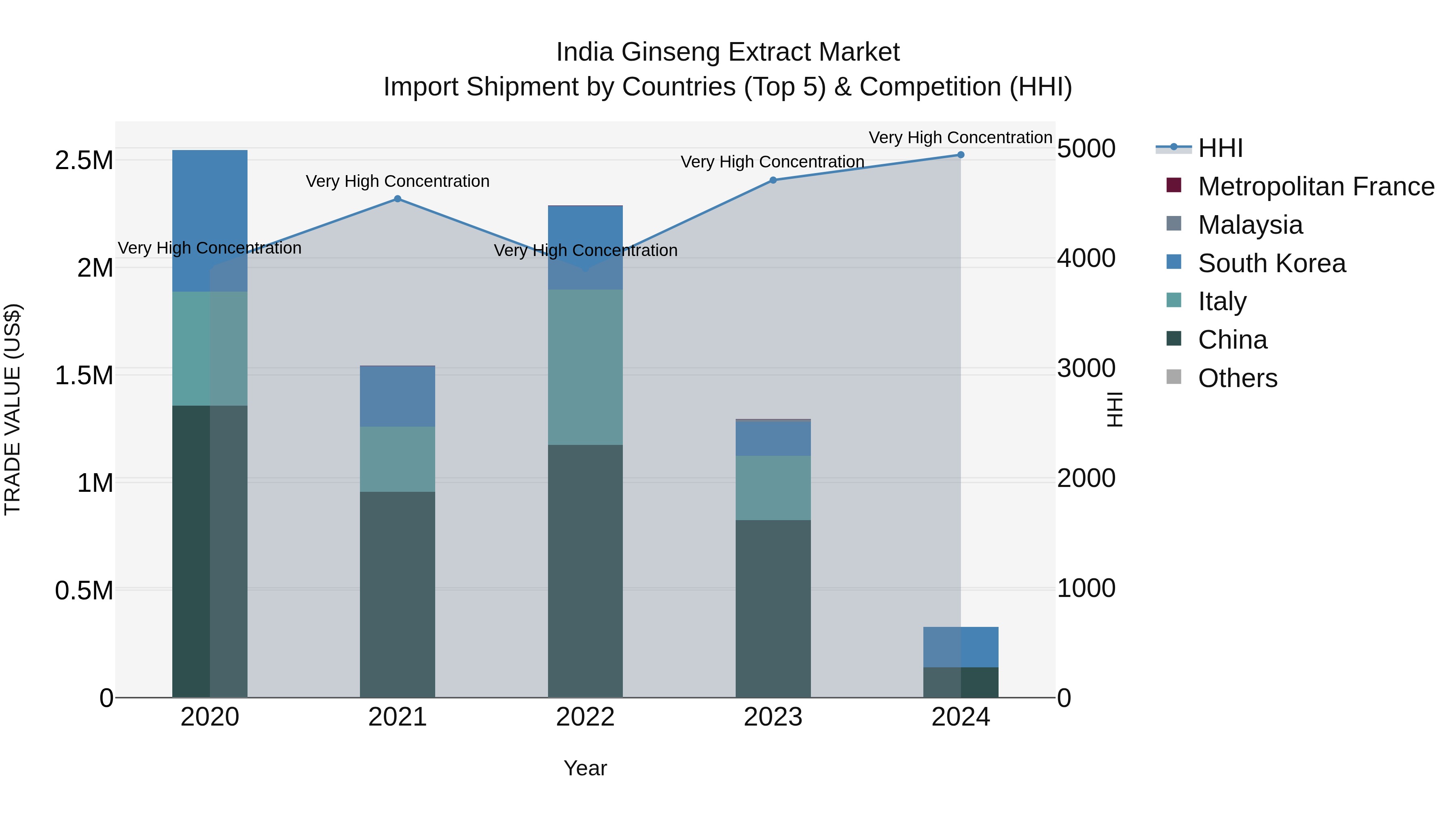
India Ginseng Extract Market Top 5 Importing Countries and Market Competition (HHI) Analysis
India continues to heavily rely on imports of ginseng extract, with key suppliers in 2024 being South Korea, China, Spain, Germany, and Italy. The market shows high concentration with a high Herfindahl-Hirschman Index (HHI) in 2024. However, the industry experienced a significant decline with a Compound Annual Growth Rate (CAGR) of -40.04% from 2020 to 2024. The negative growth trend continued in 2024 with a sharp decline of -74.6%, indicating challenges in the market that may impact future import shipments of ginseng extract to India.
India Ginseng Extract Market Overview
The India ginseng extract market is witnessing steady growth due to increasing consumer awareness about the health benefits associated with ginseng consumption. Ginseng is known for its adaptogenic properties, which help in reducing stress, boosting immunity, and improving cognitive function. The market is driven by the rising demand for natural and herbal supplements among the health-conscious population in India. Additionally, the increasing prevalence of lifestyle-related diseases and the growing popularity of traditional medicine practices are further fueling the market growth. Key players in the India ginseng extract market are focusing on product innovation, strategic partnerships, and marketing initiatives to expand their market presence. Overall, the market is expected to continue its growth trajectory in the coming years as more consumers prioritize health and wellness products.
India Ginseng Extract Market Trends
In the India ginseng extract market, there is a growing demand for natural and herbal products, leading to an increasing popularity of ginseng extract due to its perceived health benefits. Consumers are becoming more health-conscious and are seeking products that can boost immunity, improve cognitive function, and enhance overall well-being. Additionally, there is a rising interest in traditional medicines and Ayurveda, where ginseng is often used as a key ingredient. The market is witnessing a trend towards innovative product formulations, such as ginseng-infused beverages, supplements, and skincare products. With the increasing awareness about the potential health benefits of ginseng extract, the market is expected to continue growing as consumers look for natural remedies and wellness products.
India Ginseng Extract Market Challenges
In the India ginseng extract market, several challenges are faced, including limited awareness and understanding of the benefits of ginseng among consumers, leading to lower demand compared to other herbal supplements. Additionally, the lack of standardized regulations for ginseng products in India poses a challenge in terms of quality control and consistency across different brands. Competition from other herbal supplements and traditional Ayurvedic medicines further complicates market penetration for ginseng extract products. Pricing concerns also play a role, as ginseng extract is often perceived as a premium product, potentially limiting its accessibility to a broader consumer base. Overall, overcoming these challenges would require targeted marketing efforts, education campaigns, quality assurance measures, and strategic pricing strategies to enhance the market prospects for ginseng extract in India.
India Ginseng Extract Market Investment Opportunities
The India ginseng extract market presents attractive investment opportunities due to the growing consumer awareness about the health benefits of ginseng, such as improved immunity, energy levels, and cognitive function. With the increasing demand for natural and plant-based supplements, the market for ginseng extract products is expected to expand further. Investing in this market can be lucrative for companies involved in the production, distribution, and marketing of ginseng extract products, as well as for retailers looking to cater to the rising demand for health and wellness products in India. Additionally, the potential for innovation and product development in the ginseng extract market offers opportunities for investors to capitalize on emerging trends and preferences among health-conscious consumers.
India Ginseng Extract Market Government Policy
In India, the government does not have specific policies or regulations focused solely on ginseng extract. However, the market for ginseng extract may be influenced by broader regulations governing herbal and traditional medicines, food supplements, and trade policies. The Food Safety and Standards Authority of India (FSSAI) regulates the safety and quality of food products, including herbal supplements like ginseng extract. Import and export of ginseng extract may be subject to trade regulations set by the Directorate General of Foreign Trade (DGFT). Additionally, the Ministry of AYUSH (Ayurveda, Yoga & Naturopathy, Unani, Siddha, and Homoeopathy) promotes traditional Indian medicine systems, which may indirectly impact the ginseng extract market. Overall, businesses operating in the ginseng extract market in India should comply with relevant regulations to ensure product quality and safety.
India Ginseng Extract Market Future Outlook
The India ginseng extract market is poised for steady growth in the coming years, driven by increasing awareness about the health benefits of ginseng and rising demand for natural supplements. Factors such as the growing focus on holistic health and wellness, coupled with the expanding consumer base seeking alternative remedies for various health issues, are expected to fuel the market`s expansion. Additionally, the rising disposable income levels and changing lifestyles in India are likely to contribute to the market`s growth as consumers become more inclined towards preventive healthcare practices. With a growing number of companies entering the market and introducing innovative ginseng-based products, the India ginseng extract market is anticipated to witness significant development and offer lucrative opportunities for both new entrants and established players.
Key Highlights of the Report:
- India Ginseng Extract Market Outlook
- Market Size of India Ginseng Extract Market,2024
- Forecast of India Ginseng Extract Market, 2031
- Historical Data and Forecast of India Ginseng Extract Revenues & Volume for the Period 2021-2031
- India Ginseng Extract Market Trend Evolution
- India Ginseng Extract Market Drivers and Challenges
- India Ginseng Extract Price Trends
- India Ginseng Extract Porter's Five Forces
- India Ginseng Extract Industry Life Cycle
- Historical Data and Forecast of India Ginseng Extract Market Revenues & Volume By Form for the Period 2021-2031
- Historical Data and Forecast of India Ginseng Extract Market Revenues & Volume By Powder for the Period 2021-2031
- Historical Data and Forecast of India Ginseng Extract Market Revenues & Volume By Liquid for the Period 2021-2031
- Historical Data and Forecast of India Ginseng Extract Market Revenues & Volume By Capsules for the Period 2021-2031
- Historical Data and Forecast of India Ginseng Extract Market Revenues & Volume By Application for the Period 2021-2031
- Historical Data and Forecast of India Ginseng Extract Market Revenues & Volume By Cosmetics & Personal Care for the Period 2021-2031
- Historical Data and Forecast of India Ginseng Extract Market Revenues & Volume By Pharmaceuticals for the Period 2021-2031
- Historical Data and Forecast of India Ginseng Extract Market Revenues & Volume By Dietary Supplements for the Period 2021-2031
- Historical Data and Forecast of India Ginseng Extract Market Revenues & Volume By Food& Beverages for the Period 2021-2031
- Historical Data and Forecast of India Ginseng Extract Market Revenues & Volume By Distribution Channel for the Period 2021-2031
- Historical Data and Forecast of India Ginseng Extract Market Revenues & Volume By Pharmacies/Drug Stores for the Period 2021-2031
- Historical Data and Forecast of India Ginseng Extract Market Revenues & Volume By Hypermarket/Supermarket for the Period 2021-2031
- Historical Data and Forecast of India Ginseng Extract Market Revenues & Volume By Online Retailing for the Period 2021-2031
- Historical Data and Forecast of India Ginseng Extract Market Revenues & Volume By Health/Beauty Stores for the Period 2021-2031
- Historical Data and Forecast of India Ginseng Extract Market Revenues & Volume By Direct Selling for the Period 2021 - 2029
- India Ginseng Extract Import Export Trade Statistics
- Market Opportunity Assessment By Form
- Market Opportunity Assessment By Application
- Market Opportunity Assessment By Distribution Channel
- India Ginseng Extract Top Companies Market Share
- India Ginseng Extract Competitive Benchmarking By Technical and Operational Parameters
- India Ginseng Extract Company Profiles
- India Ginseng Extract Key Strategic Recommendations






































