India Grape Wine Lees Market Top 5 Importing Countries and Market Competition (HHI) Analysis
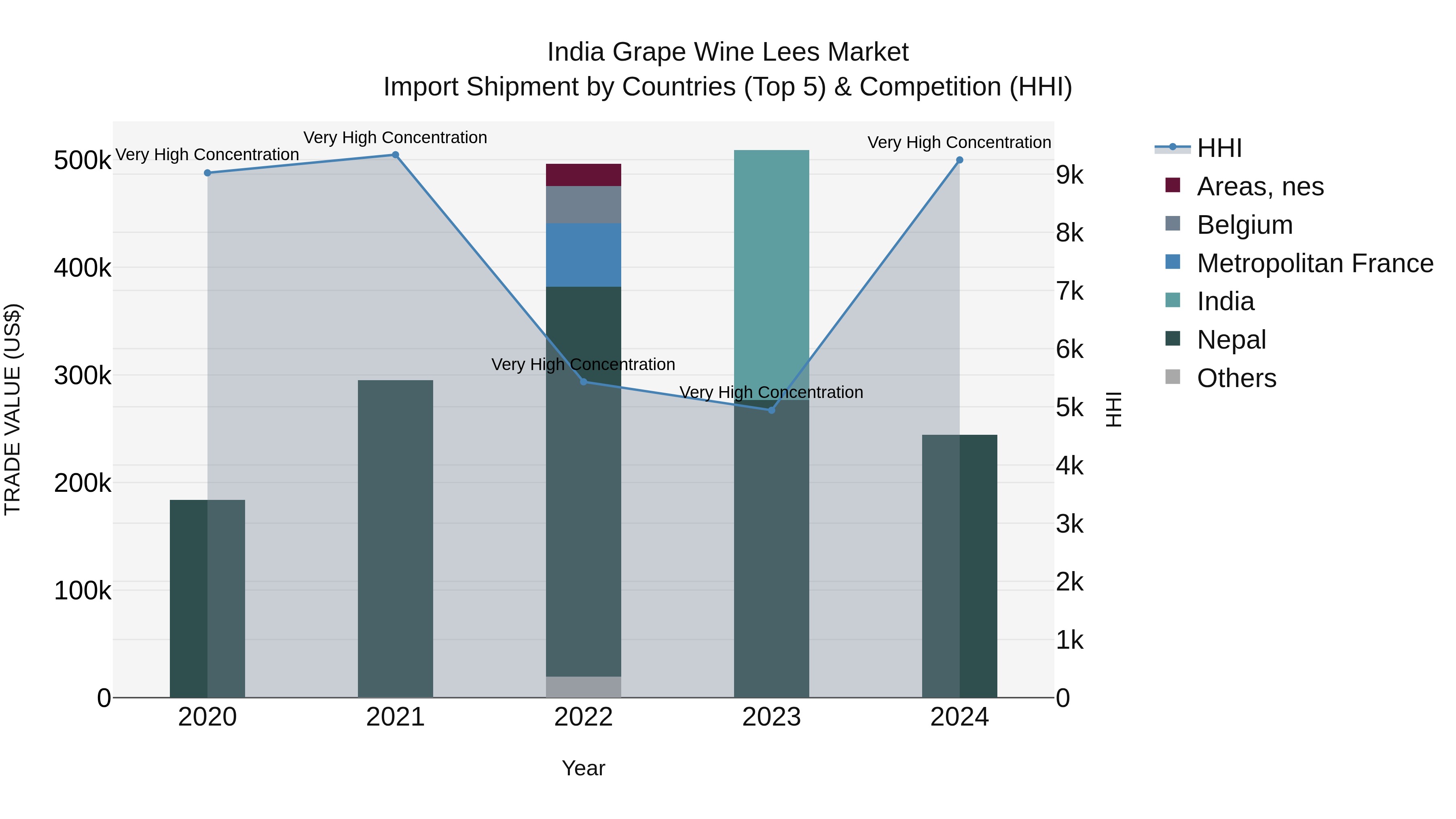
India`s grape wine lees import market saw a significant concentration in 2024, with top exporting countries being Nepal, USA, Areas nes, Belgium, and Finland. Despite a slight decline in growth rate from 2023 to 2024, the compound annual growth rate from 2020 to 2024 stood strong at 7.37%. This data indicates a stable demand for grape wine lees imports in India, with key countries continuing to play a crucial role in supplying the market.
India Grape Wine Lees Market Synopsis
The India grape wine lees market size was valued at USD 44 million in 2025 witnessing growth at CAGR 4.9 % driven by increased focus on fortifying existing wines? flavor profile combined with escalating adoption among winemakers looking for alternatives that offer superior taste characteristics without using any artificial additives or preservatives. Besides usage being limited only within winery industry , emerging trend amongst food manufacturers seeking natural flavoring agents further propelling product penetration across wider range applications.
Market Drivers of the market
The grape wine lees market in India is witnessing growth, driven by several factors. The rising popularity of wine consumption, especially among the urban population, has increased the generation of grape wine lees as a byproduct. As a result, wineries are exploring opportunities to utilize grape wine lees for various purposes, such as in the production of cosmetics, dietary supplements, and animal feed, driving market expansion. Additionally, the increasing awareness of sustainability and circular economy principles has encouraged wineries to find innovative ways to manage and utilize their byproducts, further fueling the market`s growth.
Challenges of the Market
In the goat meat market, challenges include ensuring the welfare of animals and maintaining proper hygiene during the slaughtering and processing processes. Consumers are increasingly conscious of ethical and sustainable practices, making it essential for the industry to adopt responsible methods.
Covid-19 Impact on the Market
The grape wine lees market in India faced significant challenges during the pandemic. With the hospitality industry coming to a standstill, wine consumption at hotels, restaurants, and bars declined drastically. Wineries encountered difficulties in managing their by-products like grape wine lees due to reduced production and storage constraints. However, some wineries pivoted to direct-to-consumer sales and explored alternative uses for grape wine lees to mitigate the impact of the pandemic.
Key Players of the Market
The grape wine lees market in India is relatively niche, but some notable players like Sula Vineyards, Grover Zampa Vineyards, Sankalp Winery Private Limited, and York Winery have been engaged in the production and utilization of grape wine lees for various applications.
Key Highlights of the Report:
- India Grape Wine Lees Market Outlook
- Market Size of India Grape Wine Lees Market, 2024
- Forecast of India Grape Wine Lees Market, 2031
- Historical Data and Forecast of India Grape Wine Lees Revenues & Volume for the Period 2021-2031
- India Grape Wine Lees Market Trend Evolution
- India Grape Wine Lees Market Drivers and Challenges
- India Grape Wine Lees Price Trends
- India Grape Wine Lees Porter's Five Forces
- India Grape Wine Lees Industry Life Cycle
- Historical Data and Forecast of India Grape Wine Lees Market Revenues & Volume By Vinification for the Period 2021-2031
- Historical Data and Forecast of India Grape Wine Lees Market Revenues & Volume By First Fermentation Lees for the Period 2021-2031
- Historical Data and Forecast of India Grape Wine Lees Market Revenues & Volume By Second Fermentation Lees for the Period 2021-2031
- Historical Data and Forecast of India Grape Wine Lees Market Revenues & Volume By Aging Wine Lees for the Period 2021-2031
- Historical Data and Forecast of India Grape Wine Lees Market Revenues & Volume By Particle Size for the Period 2021-2031
- Historical Data and Forecast of India Grape Wine Lees Market Revenues & Volume By Heavy Lees for the Period 2021-2031
- Historical Data and Forecast of India Grape Wine Lees Market Revenues & Volume By Light Lees for the Period 2021-2031
- India Grape Wine Lees Import Export Trade Statistics
- Market Opportunity Assessment By Vinification
- Market Opportunity Assessment By Particle Size
- India Grape Wine Lees Top Companies Market Share
- India Grape Wine Lees Competitive Benchmarking By Technical and Operational Parameters
- India Grape Wine Lees Company Profiles
- India Grape Wine Lees Key Strategic Recommendations






































