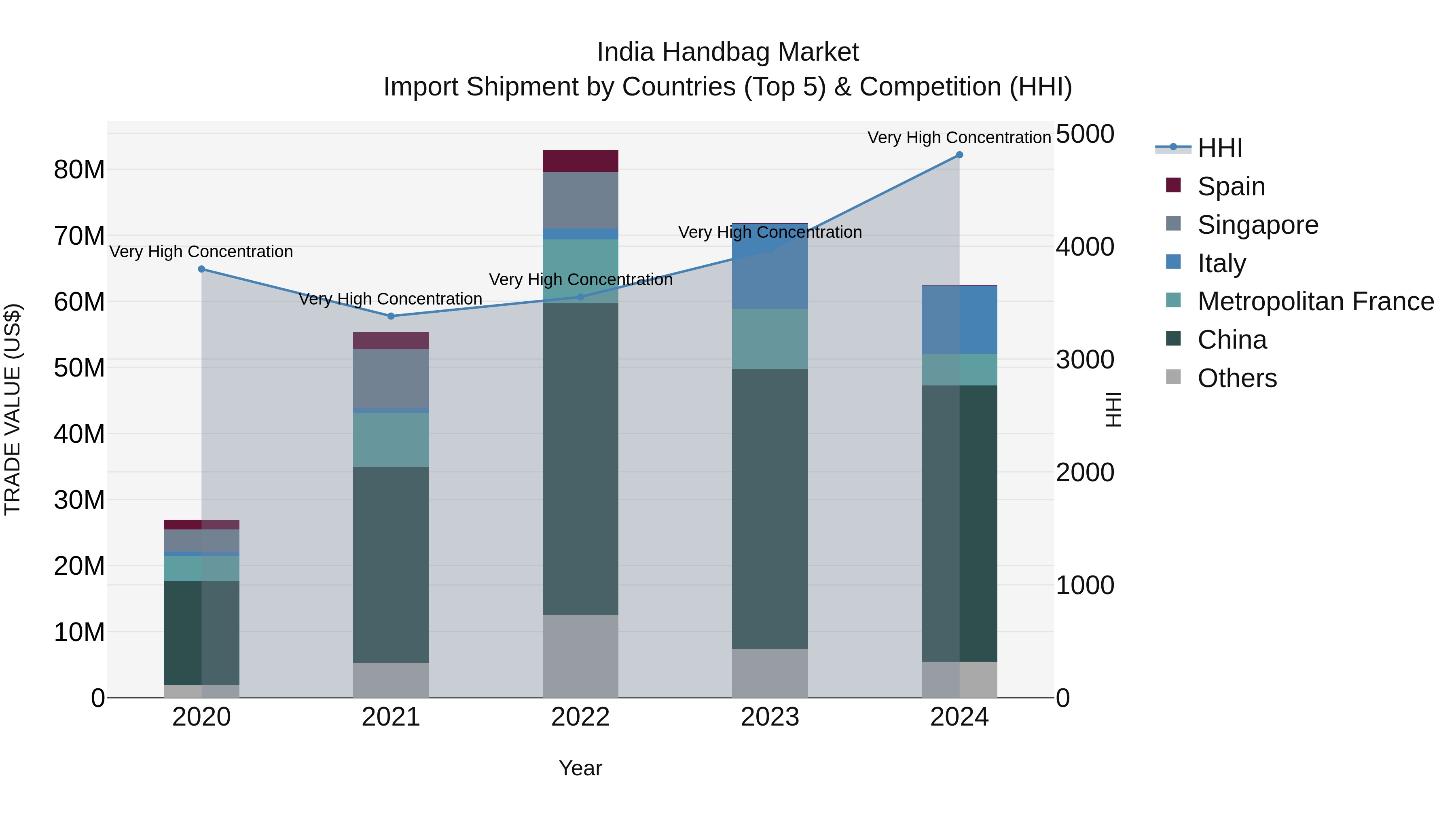
India Handbag Market Top 5 Importing Countries and Market Competition (HHI) Analysis
India`s handbag import market in 2024 saw China, Italy, Metropolitan France, Indonesia, and Vietnam as the top exporting countries. Despite a negative growth rate of -13.05% in 2024, the market maintained a high level of concentration with a Herfindahl-Hirschman Index (HHI) remaining very high. The compound annual growth rate (CAGR) from 2020 to 2024 stood at an impressive 23.45%, indicating strong overall growth in the Indian handbag import sector over the past few years. The dominance of key exporting countries and the significant growth rate highlight the dynamic nature of this market.
India Handbag Market Growth Rate
According to 6Wresearch internal database and industry insights,
Five-Year Growth Trajectory of the India Handbag Market with Core Drivers
Below mentioned is the evaluation of year-wise growth rate along with key growth drivers:
| Year | Est. Annual Growth (%) | Growth Drivers |
| 2021 | 5.1% | Rising disposable income and demand for premium brands |
| 2022 | 6% | Growing influence of social media and celebrity endorsements |
| 2023 | 7% | Increase in online retail channels and accessibility |
| 2024 | 7.8% | Expansion of domestic and international handbag brands in tier 2 and tier 3 cities |
| 2025 | 8% | Rising awareness about the need for sustainable, eco-friendly handbags |
Topics Covered in the India Handbag Market Report
The India Handbag Market report thoroughly covers the market by product type and distribution channel. The market report provides an unbiased and detailed analysis of ongoing market trends, opportunities/high growth areas, and market drivers, which help stakeholders devise and align their market strategies according to the current and future market dynamics.
India Grow Light Market Highlights
| Report Name | India Handbag Market |
| Forecast Period | 2026–2032 |
| CAGR | 8.5% |
| Growing Sector | Online Retail Stores |
India Handbag Market Synopsis
The growth in the India handbag market is marked especially on the grounds of the growing interest of consumers in luxury goods, rising discretionary income, and changing fashion preferences. Nearly all the southern states were disenfranchised due to their losses in the Civil War. It was estimated that over half the population of the southern states were illiterate, and Southern nationalism remained strong. Confederate sympathizers saw an inclining number of African The handbag industry of India is split into products such as Tote bags, Clutches, satchels, and bucket bags, which offer a wide range of options to entice consumers of all classes. Although majority of handbags continue to be sold via brick-and-mortar retailers, the emergence of e-commerce has accelerated proliferation online. However, the continued challenges in the market include rising raw material price and existence of counterfeit goods. In essence, the Indian handbag market is growing slowly due to increased consumer demand in the market and new trends.
Evaluation of Growth Drivers in the India Handbag Market
Below mentioned are some prominent drivers and their influence on the market dynamics:
| Drivers | Primary Segments Affected | Why it Matters (Evidence) |
| Rising Disposable Income | All Segments | Higher disposable income leads to an increased purchasing power for premium and luxury handbags. |
| Influence of Social Media | All Segments | Social media marketing and celebrity endorsements drive consumer interest and boost sales. |
| Growth of Online Retail | All Segments | The rapid adoption of online shopping platforms increases consumer accessibility to various brands. |
| Shift Toward Sustainability | By Product Type, All Segments | Growing consumer awareness about the environmental impact of fashion is shifting demand toward eco-friendly handbags. |
| Expansion of Domestic Brands | By Distribution Channel | Local handbag brands are expanding across India, meeting the diverse needs of consumers in smaller cities. |
The India Handbag Market is expected to grow at a CAGR of 8.5% during the forecast period of 2026-2032. The India Handbag Market is experiencing growth as improved Indian consumers’ incomes and expanded urban areas increase these developments. The surge in demand for premium and branded accessories has greatly increased demand for luxury handbags. Adoption of new methods from manufacturing combined with new designs help brands interact with their specific audience segments. Regular online selling as well as good discounts have really helped India Handbag Market to expand in volume. Awareness of sustainable practices lies at the bottom of the rising demand for eco-friendly and vegan handbags. Their combined push thrusts India handbag market growth.
Evaluation of Restraints in the India Handbag Market
Below mentioned are some major restraints and their influence on the market dynamics:
| Restraints | Primary Segments Affected | What This Means (Evidence) |
| High Cost of Luxury Handbags | By Product Type | Luxury handbags are expensive, limiting access for a large segment of the population. |
| Counterfeit Products | All Segments | The presence of counterfeit handbags affects brand reputation and consumer trust. |
| Lack of Skilled Labour | By Product Type | The limited availability of skilled artisans in India can hamper the production of high-quality handbags. |
| Fluctuating Raw Material Prices | By Product Type | Volatile prices of leather and other materials impact manufacturing costs, leading to price hikes. |
| Limited Availability in Rural Areas | By Distribution Channel | While urban areas see widespread availability, rural regions face challenges in accessing popular handbag brands. |
India Handbag Market Challenges
The India Handbag Market Share faces challenges such as the presence of counterfeit products, which impact brand value and customer perception. Additionally, price volatility in the cost of raw materials like leather can affect the price of final products in the market. Furthermore, the presence of unorganized players in rural and semi-urban areas creates significant challenges for organized players, hindering their ability to expand their market share and reach.
India Handbag Market Trends
The key trends that are shaping the evaluation of the India Handbag Market are:
- Focus on Sustainable Fashion: Consumers are looking for sustainable fashion in terms of eco-friendly and vegan handbags. Many handbag brands are using cruelty-free and biodegradable materials for their products.
- E-commerce Growth: Growing internet penetration in India is taking online shopping to a new level. Handbag sales alone have been increasing rapidly on the net. Online market places are flooded with range and varieties of handbags that cater to the ever, growing consumer demand.
- Celebrity Endorsed Handbags: Celebrity endorsements of handbags are the reason behind consumers being so attracted towards handbags. Many the handbag brands are giving going to the extent of teaming up with celebrities to get their products marketed.
- Smart and Functional Handbags: Handbags are now being designed in such a way that technology is incorporated in the form of USB ports and secret pockets to store gadgets and other electronic devices.
Investment Opportunities in the India Handbag Market
Some of the key investment opportunities in the India Handbag Market are as follows:
- Investment in the Production of Luxury Handbags: Investing in the production of luxury handbags, especially in luxury materials such as leather.
- Investment in the Expansion of Online Retail Platforms: Investing in the expansion of online retail platforms, providing a better user experience, especially in virtual try-ons.
- Brand Collaborations: Investing in brand collaborations with celebrities to produce exclusive ranges of handbags to meet the growing demand for exclusive products.
- Investment in Sustainable Handbag Manufacturing: Investing in the manufacturing of handbags in a sustainable manner, focusing on sustainability as well as the environment.
Top 5 Leading Players in the India Handbag Market
Some leading players operating in the India Handbag Market include:
1. Baggit India
| Company Name | Baggit India |
|---|---|
| Established Year | 1990 |
| Headquarters | Mumbai, India |
| Official Website | Click Here |
Baggit India manufactures stylish and affordable handbags for the Indian market, focusing on eco-friendly materials and sustainable production practices.
2. Hidesign
| Company Name | Hidesign |
|---|---|
| Established Year | 1990 |
| Headquarters | Puducherry, India |
| Official Website | Click Here |
Hidesign produces luxury leather handbags and accessories, known for their craftsmanship and contemporary designs tailored for the Indian market.
3. Caprese
| Company Name | Caprese |
|---|---|
| Established Year | 2012 |
| Headquarters | Mumbai, India |
| Official Website | Click Here |
Caprese offers a wide range of trendy handbags, known for their modern design and reasonable price point, catering to young, fashion-forward consumers.
4. Lino Perros
| Company Name | Lino Perros |
|---|---|
| Established Year | 1999 |
| Headquarters | New Delhi, India |
| Official Website | Click Here |
Lino Perros produces affordable yet stylish handbags, emphasizing fashion, comfort, and practicality for everyday use.
5. Fossil
| Company Name | Fossil |
|---|---|
| Established Year | 1984 |
| Headquarters | Richardson, Texas, USA |
| Official Website | Click Here |
Fossil produces high-quality leather handbags and accessories, with a strong presence in India, offering both luxury and casual designs for diverse consumers.
Government Regulations Introduced in the India Handbag Market
According to Indian Government Data, the government has put in place various measures that encourage sustainable practices, as well as the reduction of counterfeit goods within the market. Various policies, such as those of the 'Make in India' initiative, encourage local production, thereby promoting the growth of the handbag market. The BIS (Bureau of Indian Standards) has set product quality standards for consumers. Moreover, the Plastic Waste Management Rules support sustainable practices in product manufacturing. All these policies and reforms seek to build a fair and competitive environment for players in the market.
Future Insights of the India Handbag Market
The India Handbag Industry is expected to experience notable growth in the coming years due to rising consumer demand for trendy and sustainable products. Technological advancements in fields like 3D printing for custom design creation and consumer analytics using AI technology shall help businesses cater to consumer demands for personalization. Environmental issues and fluctuations in raw material costs shall continue to affect businesses.
Market Segmentation Analysis
The report offers a comprehensive study of the subsequent market segments and their leading categories:
Tote Bags to Dominate the Market – By Product Type
According to Ravi Bhandari, Research Analyst, 6wresearch, among the types of handbags in the India market, tote bags are experiencing significant growth. This can be explained by the fact that these bags have the advantage of serving both functional and fashionable needs. Tote bags, given their design, have gained popularity among working professionals or students who need to carry their personal items.
Online Retail Stores to Dominate the Market – By Distribution Channel
In the distribution channel segment, online retail stores are witnessing tremendous growth in the India handbag market. The penetration of online retail stores, led by the increasing use of smartphones and accessibility of the internet, has provided convenience for the purchase of handbags online.
Key Attractiveness of the Report
- 10 Years of Market Numbers.
- Historical Data Starting from 2022 to 2025.
- Base Year: 2025.
- Forecast Data until 2032.
- Key Performance Indicators Impacting the Market.
- Major Upcoming Developments and Projects.
Key Highlights of the Report:
- India Handbag Market Outlook
- Market Size of India Handbag Market, 2025
- Forecast of India Handbag Market, 2032
- Historical Data and Forecast of India Handbag Revenues & Volume for the Period 2022-2032
- India Handbag Market Trend Evolution
- India Handbag Market Drivers and Challenges
- India Handbag Price Trends
- India Handbag Porter's Five Forces
- India Handbag Industry Life Cycle
- Historical Data and Forecast of India Handbag Market Revenues & Volume By Product Type for the Period 2022-2032
- Historical Data and Forecast of India Handbag Market Revenues & Volume By Satchel for the Period 2022-2032
- Historical Data and Forecast of India Handbag Market Revenues & Volume By Bucket Bag for the Period 2022-2032
- Historical Data and Forecast of India Handbag Market Revenues & Volume By Clutch for the Period 2022-2032
- Historical Data and Forecast of India Handbag Market Revenues & Volume By Tote Bag for the Period 2022-2032
- Historical Data and Forecast of India Handbag Market Revenues & Volume By Other Product Types for the Period 2022-2032
- Historical Data and Forecast of India Handbag Market Revenues & Volume By Distribution Channel for the Period 2022-2032
- Historical Data and Forecast of India Handbag Market Revenues & Volume By Online Retail Stores for the Period 2022-2032
- Historical Data and Forecast of India Handbag Market Revenues & Volume By Offline Retail Stores for the Period 2022-2032
- India Handbag Import Export Trade Statistics
- Market Opportunity Assessment By Product Type
- Market Opportunity Assessment By Distribution Channel
- India Handbag Top Companies Market Share
- India Handbag Competitive Benchmarking By Technical and Operational Parameters
- India Handbag Company Profiles
- India Handbag Key Strategic Recommendations
Market Covered
The report offers a comprehensive study of the subsequent market segments:
By Product Type
- Satchel
- Bucket Bag
- Clutch
- Tote Bag
- Other Product Types
By Distribution Channel
- Online Retail Stores
- Offline Retail Stores






































