India Hemp Market Growth Rate
According to 6Wresearch internal database and industry insights, the India Hemp Market is expected to grow at a compound annual growth rate (CAGR) of 26.1% during the forecast period (2026-2032).
India Hemp Market Year-wise Growth Rate and Key Drivers
This graph highlights how the India Hemp Market has steadily grown over the past five years, supported by major growth factors.
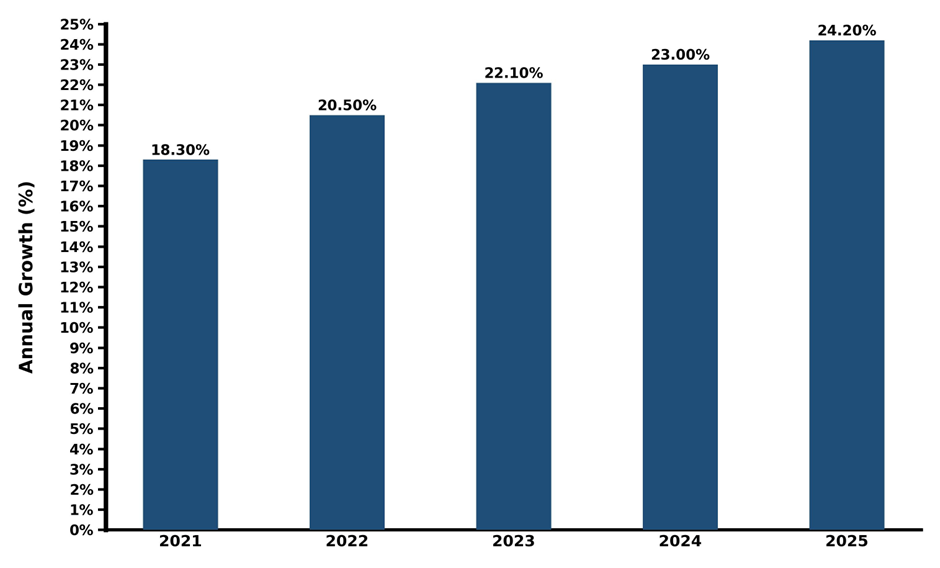
The table below presents the year‑wise growth rates along with the key drivers influencing the market
| Year | Est. Annual Growth (%) | Growth Drivers |
| 2021 | 18.3% | Growing demand of hemp-based products in the wellness sector, led to increase in the demand for sustainable and eco-friendly products. |
| 2022 | 20.5% | Increasing usage of hemp in food, and textile industries, along with rise in awareness about its health benefits. |
| 2023 | 22.1% | Implementation of strict regulations, and government policies on hemp cultivation, and its processing. |
| 2024 | 23% | Growing use of hemp in wellness sector, and personal care products is gaining traction among people. |
| 2025 | 24.2% | Increasing demand for hemp-based biofuels and the growing trend of eco-conscious consumerism. |
Topics Covered in the India Hemp Market Report
The India Hemp Market report comprehensively covers the market by type, source, consumer age group, and application. It includes a detailed analysis of current market trends, opportunities, challenges, and drivers that are vital for stakeholders to align their strategies based on present and future market trends.
India Hemp Market Highlights
| Report Name | India Hemp Market |
| Forecast period | 2026-2032 |
| CAGR | 26.1% |
| Growing Sector | Hemp-based Products |
India Hemp Market Synopsis
The Indian Hemp Market is set for significant growth during the forecast period, driven by the increasing demand for hemp-based products across diverse sectors. The rise in awareness among consumer about hemp’s health benefits, coupled with the growing interest in sustainable and eco-friendly alternatives, has contributed to the market growth. The growing eco-conscious behaviour, particularly in urban regions, has fuelled the demand for hemp-based products.
Evaluation of Growth Drivers in India Hemp Market (2026-2032)
The table below lists the major drivers contributing to the India Hemp Market Growth and their influence on market dynamics:
| Drivers | Primary Segment Affected | Why It Matters (Evidence) |
| Regulatory Support for Hemp Cultivation | Hemp Farming, Hemp Processing | Government's focus on encouraging hemp farming by implementing legal framework has paved the way for hemp sector growth. |
| Sustainable Consumerism Trends | Textile Industry, Packaging | Growing preference for eco-friendly products has led to increased use of hemp in textiles, and packaging industry. |
| Technological Advancements in Hemp Processing | Hemp Processing, Biofuels | Advanced methods used in hemp processing have enhanced the quality of hemp products, facilitating broader market applications. |
| Global Export Potential | Hemp Export Market | India’s increasing capacity to produce hemp-based products is opening doors for exports. |
| Awareness of Health Benefits | Wellness, Personal Care | Hemp’s nutritional properties, and the growing interest in its medical properties have positioned it as a strong wellness product. |
The India Hemp Market is poised for rapid growth during the forecast period, with an estimated CAGR of 26.1%. The driving forces behind this growth are increased demand for hemp-based products, growing emphasis on sustainable and eco-friendly alternatives, and supportive government policies. The agricultural sector's ability to produce hemp at large scale, and advancements in processing technologies, has further strengthened India’s position in the international hemp market.
Evaluation of Restraints in India Hemp Market
Below is the tabular representation of some major restraints and their influence on India Hemp Market dynamics:
| Restraints | Primary Segment Affected | What This Means (Evidence) |
| Limited Awareness of Hemp Benefits | Consumer Education, Market Penetration | The full potential of hemp products is still underexplored, despite growing awareness, limiting their market penetration. |
| Regulatory Challenges in Hemp Cultivation | Hemp Farming, Legal Compliance | The regulatory framework around hemp cultivation is still evolving, and discrepancies in state-level regulations could hinder its growth. |
| High Production Costs | Hemp Farming, Processing | Hemp’s production and processing costs are high, limiting its profitability for farmers. |
| Cultural Barriers and Misconceptions | Consumer Perception | Cultural stigma surrounding hemp products, may reduce consumer acceptance. |
| Inconsistent Supply Chain | Distribution, Retail | The lack of an efficient supply chain could impact the timely availability of hemp-based products when required. |
India Hemp Market Challenges
The India Hemp Market is facing several challenges that could hinder its growth. The primary challenge is the cultural stigma surrounding hemp, as people often ties its association with cannabis. There are some regulatory challenges too, which can complicate the cultivation, and sale of hemp products in the market. Furthermore, the high production cost, and limited awareness about the benefits of hemp products among people could hinder its broader adoption. Addressing these challenges through consumer education campaigns, enhancing supply chain efficiency, and simplifying regulatory frameworks would be essential for the hemp’s market growth.
India Hemp Market Trends
Listed below are some of the major trends responsible for India Hemp Market Growth:
- Growing Demand for Sustainable & Eco-Friendly Products: Hemp’s versatile applications in construction, packaging, and textile industries are driving strong demand as consumers and industries seek environmentally friendly alternatives to conventional materials.
- Expansion Across Diverse End-Use Segments: The hemp market is no longer limited to a few applications. It is rather expanding across textile, construction, food & beverages, and paper industries, which is fuelling demand at multiple levels of the supply chain.
- Innovation in Processing Technologies: Advancement and upgradation in processing technologies, such as improved extraction methods, and fibre decortication, are enhancing product's quality, allowing producers to develop high value hemp derivatives for market.
- Emerging Export Opportunities: With global industrial hemp demand rising, India has begun to explore export opportunities for hemp fibre, seeds, and processed derivatives positioning the Indian hemp industry to tap into global value chains.
Investment Opportunities in the India Hemp Market
Given below are the investment opportunities available in India Hemp Market:
- Hemp Cultivation & Agriculture: Commercial farming of industrial hemp presents attractive prospects for agri-tech investors and farmers due to high yield potential. Investment in farm training, seed production, and precision cultivation technology can help small farmers to maximize output and quality.
- Processing & Downstream Infrastructure: Hemp requires specialized processing facilities for various activities like protein production, and seed oil extraction. Therefore, investment in refining facilities, and cold pressed extraction units increases its value compared to selling raw biomass.
- Hemp Based Consumer Products: Investment opportunities in brand creation, distribution networks, product development, and ecommerce platforms can target premium, and sustainable product segments as India’s hemp market is diversifying into multiple consumer categories.
- International Branding & Export: The low production cost, and vast agricultural base of India makes it competitive in the international market. Developing “Made in India” hemp brands with strong traceability, and quality certifications could command premium pricing.
Top 5 Leading Players in India Hemp Market
Stated below are some of the leading companies holding majority of India Hemp Market Shares:
1. Bombay Hemp Company (BOHECO)
| Company Name | Bombay Hemp Company (BOHECO) |
|---|---|
| Established Year | 2013 |
| Headquarters | Mumbai, Maharashtra, India |
| Official Website | Click Here |
A pioneering startup focused on industrial hemp, collaborating with local farmers and promoting sustainable agricultural practices, BOHECO is widely recognized for building a comprehensive hemp ecosystem. BOHECO works across the entire value chain from educating farmers and supporting industrial hemp cultivation to producing finished goods.
2. India Hemp Organics (IHO)
| Company Name | India Hemp Organics (IHO) |
|---|---|
| Established Year | 2020 |
| Headquarters | Bengaluru, Karnataka, India |
| Official Website | Click Here |
India Hemp Organics specializes in high-quality, ethically sourced, and legally compliant medical cannabis and hemp products. It focuses on holistic wellness through hemp, combining Ayurvedic wisdom with modern science. The brand also emphasizes on strict lab testing, traceability, and sustainable sourcing from local Himalayan farmers.
3. Ananta Hemp Works
| Company Name | Ananta Hemp Works |
|---|---|
| Established Year | 2021 |
| Headquarters | New Delhi, India |
| Official Website | Click Here |
Ananta Hemp Works is a major player specializing in hemp nutrition, personal care, and medical products, offering a diverse portfolio of hemp products. The brand blends Ayurvedic principles with modern hemp applications, and produces ayurvedic hemp medicines under licensed frameworks alongside dietary and skincare solutions.
4. Hemp Horizons (operating under the Health Horizons Brand)
| Company Name | Hemp Horizons (operating under the Health Horizons Brand) |
|---|---|
| Established Year | 2017 |
| Headquarters | Noida, Uttar Pradesh, India |
| Official Website | Click Here |
Hemp Horizons is one of India’s earliest hemp companies, produces hemp hearts, cold-pressed seed oils, protein powders, and CBD-related topicals, with a zero-waste, carbon-negative manufacturing approach.
5. Satliva
| Company Name | Satliva |
|---|---|
| Established Year | 2016 |
| Headquarters | Bengaluru, Karnataka, India |
| Official Website | Click Here |
A brand focused on high-quality hemp-based skin and hair care products, utilizing hemp seed oil, Satliva is a hemp wellness and personal care brand focuses on cold-pressed, all-natural products emphasizing purity. Its “fresh-made” production model reinforces quality and sustainability in the Indian hemp cosmetics segment.
Government Initiatives being implemented in the India Hemp Market
According to Indian government data, several key initiatives have been taken to support the hemp industry and promote its growth as a regulated and sustainable sector. These initiatives include legalizing industrial hemp cultivation under strict regulation. The government is introducing policies to encourage research of hemp-based products, and offering tax incentives, and subsidies for the establishment of processing and manufacturing units for producing hemp-based products. Additionally, the government is also focusing on educating stakeholders, about the environmental impact, and economic benefits of hemp.
Future Insights of the India Hemp Market
The future of the India Hemp Market looks quite promising with significant growth driven by growing demand for sustainable, and eco-friendly products in the market. The use of hemp-based products in textiles, construction, and personal care will further diversify the market. Additionally, advancements in processing technologies and growing international demand for hemp products will drive exports, while increasing focus on sustainability and green finance will attract investors.
Market Segmentation Analysis
The report offers a comprehensive study of the following market segments and their leading categories in India Hemp Market:
By Type - Hemp Seed Dominates the Market
According to Sachin, Senior Research Analyst, 6Wresearch, Hemp seeds are one of the most widely used products due to their high nutritional value making them dominant in the food & beverage industry, where they are used in supplements, snacks, and protein powders.
By Source – Conventional Source to Lead the Market
The conventional sub-segment dominates due to lower production costs, wider availability, and easier scalability. The infrastructure and farming methods for conventional hemp are more established in India.
By Consumer Age Group - 25-34 Age Group Dominates the Market
The 25-34 age group is the most dominant consumer segment in the hemp market due to their high purchasing power, and inclination toward wellness trends. This age group is highly influenced by social media which advocate for hemp as a health and beauty product.
By Application – Personal Care Products to Lead the Market
Hemp is widely used in haircare and skincare products due to its anti-inflammatory properties. The personal care products segment is the dominant application for hemp due to the growing demand for natural, organic, and sustainable skincare solutions. These products also appeal to consumers who are willing to pay premium for sustainable, and environmentally friendly products.
Key Attractiveness of the Report:
- 10 Years of Market Numbers
- Historical Data Starting from 2022 to 2025
- Base Year: 2025
- Forecast Data until 2032
- Key Performance Indicators Impacting the Market
- Major Upcoming Developments and Projects
Key Highlights of the Report:
- India Hemp Market Outlook
- Market Size of India Hemp Market, 2025
- Forecast of India Hemp Market, 2032
- Historical Data and Forecast of India Hemp Revenues & Volume for the Period 2022- 2032
- India Hemp Market Trend Evolution
- India Hemp Market Drivers and Challenges
- India Hemp Price Trends
- India Hemp Porter's Five Forces
- India Hemp Industry Life Cycle
- Historical Data and Forecast of India Hemp Market Revenues & Volume By Type for the Period 2022- 2032
- Historical Data and Forecast of India Hemp Market Revenues & Volume By Hemp Seed for the Period 2022- 2032
- Historical Data and Forecast of India Hemp Market Revenues & Volume By Hemp Seed Oil for the Period 2022- 2032
- Historical Data and Forecast of India Hemp Market Revenues & Volume By CBD Hemp Oil for the Period 2022- 2032
- Historical Data and Forecast of India Hemp Market Revenues & Volume By Others for the Period 2022- 2032
- Historical Data and Forecast of India Hemp Market Revenues & Volume By Source for the Period 2022- 2032
- Historical Data and Forecast of India Hemp Market Revenues & Volume By Conventional for the Period 2022- 2032
- Historical Data and Forecast of India Hemp Market Revenues & Volume By Organic for the Period 2022- 2032
- Historical Data and Forecast of India Hemp Market Revenues & Volume By Consumer Age Group for the Period 2022- 2032
- Historical Data and Forecast of India Hemp Market Revenues & Volume By 18-24 for the Period 2022- 2032
- Historical Data and Forecast of India Hemp Market Revenues & Volume By 25-34 for the Period 2022- 2032
- Historical Data and Forecast of India Hemp Market Revenues & Volume By 35-44 for the Period 2022- 2032
- Historical Data and Forecast of India Hemp Market Revenues & Volume By 45-54 for the Period 2022- 2032
- Historical Data and Forecast of India Hemp Market Revenues & Volume By 55-64 for the Period 2022- 2032
- Historical Data and Forecast of India Hemp Market Revenues & Volume By Above 65 for the Period 2022- 2032
- Historical Data and Forecast of India Hemp Market Revenues & Volume By Application for the Period 2022- 2032
- Historical Data and Forecast of India Hemp Market Revenues & Volume By Personal Care Product for the Period 2022- 2032
- Historical Data and Forecast of India Hemp Market Revenues & Volume By Textiles for the Period 2022- 2032
- Historical Data and Forecast of India Hemp Market Revenues & Volume By Pharmaceuticals for the Period 2022- 2032
- Historical Data and Forecast of India Hemp Market Revenues & Volume By Construction & Materials for the Period 2022- 2032
- Historical Data and Forecast of India Hemp Market Revenues & Volume By Others for the Period 2022- 2032
- India Hemp Import Export Trade Statistics
- Market Opportunity Assessment By Type
- Market Opportunity Assessment By Source
- Market Opportunity Assessment By Consumer Age Group
- Market Opportunity Assessment By Application
- India Hemp Top Companies Market Share
- India Hemp Competitive Benchmarking By Technical and Operational Parameters
- India Hemp Company Profiles
- India Hemp Key Strategic Recommendations
Market Covered
The report offers an extensive study of the following market segments:
By Type
- Hemp Seed
- Hemp Seed Oil
- CBD Hemp Oil
- Others
By Source
- Conventional
- Organic
By Consumer Age Group
- 18-24
- 25-34
- 35-44
- 45-54
- 55-64
- Above 65
By Application
- Personal Care Product
- Textiles
- Pharmaceuticals
- Construction & Materials
- Others






































