India Hexane Market Top 5 Importing Countries and Market Competition (HHI) Analysis
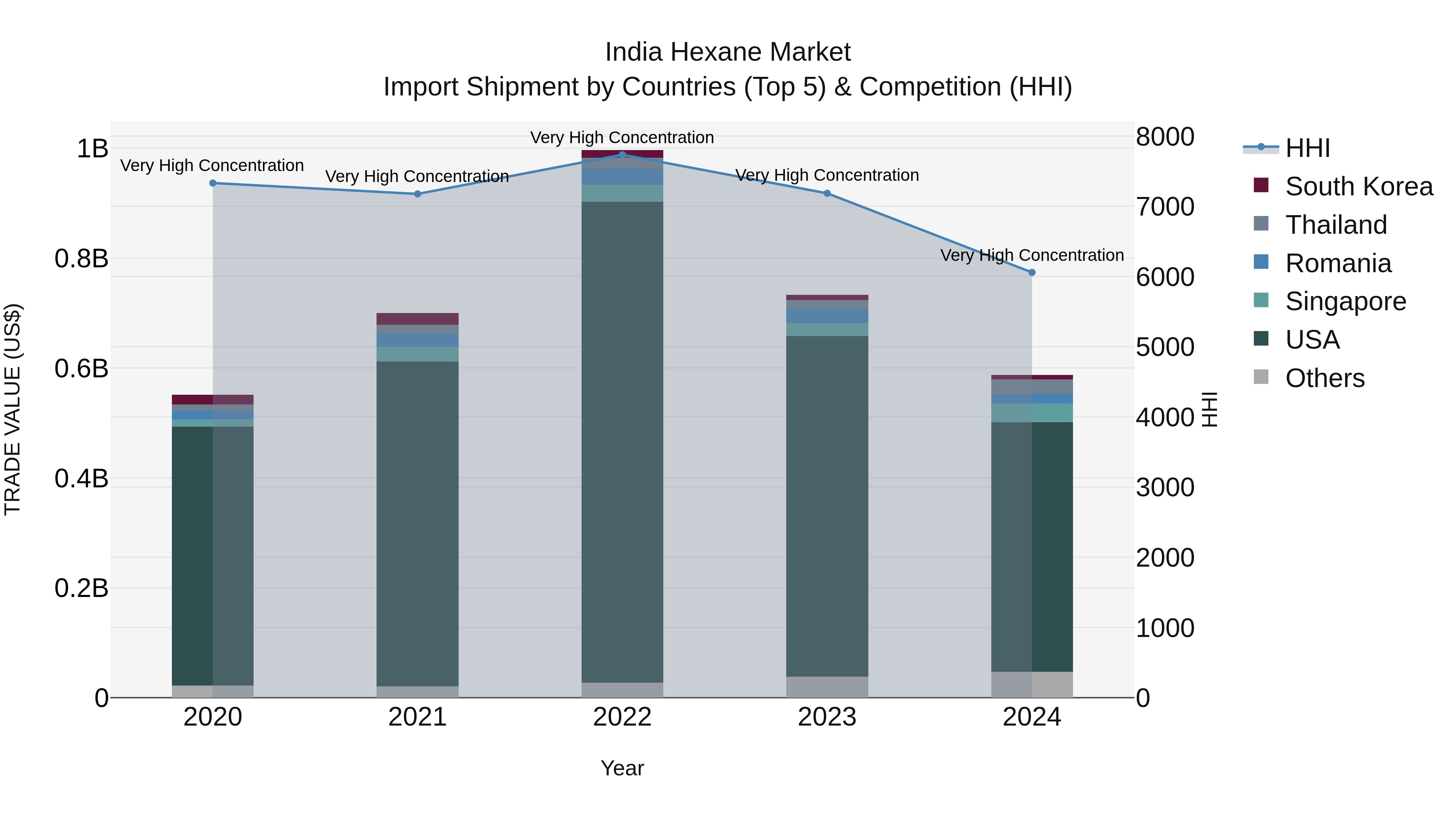
In 2024, India saw significant hexane import shipments from top exporters including the USA, Singapore, Thailand, Iran, and China. The market continues to be highly concentrated, with a very high Herfindahl-Hirschman Index (HHI) reflecting a dominant market structure. Despite a modest Compound Annual Growth Rate (CAGR) of 1.6% from 2020 to 2024, the recent growth rate of -19.86% in 2023-24 indicates a temporary decline in demand. Overall, the Indian hexane import market remains dynamic with key players driving trade patterns and influencing market trends.
India Hexane Market Overview
Hexane, a chemical solvent, is essential in various industrial processes. The India hexane market is driven by the demand in sectors like pharmaceuticals, food processing, and oil extraction. It plays a vital role in extraction processes, such as vegetable oil production and the pharmaceutical industry.
Drivers of the Market
The India hexane market is driven by its applications in various industries, including pharmaceuticals, food, and chemicals. Hexane is commonly used as a solvent and an extraction agent. The growth of these industries, coupled with an expanding population and increasing consumer demand, fuels the demand for hexane. Additionally, the agrochemical sector relies on hexane for the extraction of edible oils from seeds, which is integral to the food industry. As the food and pharmaceutical industries continue to expand, the hexane market in India is expected to grow accordingly.
Challenges of the Market
The India hexane market faces challenges related to environmental concerns and regulations. Hexane is a volatile organic compound that can contribute to air pollution and has adverse health effects. Stringent regulations on emissions and workplace safety require manufacturers to invest in expensive pollution control and safety measures. Moreover, the market is sensitive to fluctuations in crude oil prices since hexane is derived from petroleum, which can affect production costs and pricing stability.
COVID-19 Impact on the Market
The India hexane market, primarily used in the extraction of edible oils and as a solvent, felt the repercussions of the pandemic. With restrictions on movement and trade disruptions, the supply chain for hexane was affected, causing fluctuations in prices. Additionally, the food processing industry, a major consumer of hexane, experienced a decline in production and demand as a result of workforce limitations and changing consumer behavior. The market also witnessed shifts in demand as the pharmaceutical and cosmetics sectors faced varying challenges during the pandemic. As the situation stabilizes, the hexane market is expected to rebound, driven by the recovery of the food and agro-processing industries.
Key Players in the Market
In the hexane market, key players in India encompass companies such as ExxonMobil, Royal Dutch Shell, Bharat Petroleum, Hindustan Petroleum, and Reliance Industries. These companies are involved in the production and distribution of hexane, primarily used as a solvent in various industrial applications.
Key Highlights of the Report:
- India Hexane Market Outlook
- Market Size of India Hexane Market, 2024
- Forecast of India Hexane Market, 2031
- Historical Data and Forecast of India Hexane Revenues & Volume for the Period 2021-2031
- India Hexane Market Trend Evolution
- India Hexane Market Drivers and Challenges
- India Hexane Price Trends
- India Hexane Porter's Five Forces
- India Hexane Industry Life Cycle
- Historical Data and Forecast of India Hexane Market Revenues & Volume By Grade for the Period 2021-2031
- Historical Data and Forecast of India Hexane Market Revenues & Volume By Oil Extraction/Food for the Period 2021-2031
- Historical Data and Forecast of India Hexane Market Revenues & Volume By Pharmaceutical for the Period 2021-2031
- Historical Data and Forecast of India Hexane Market Revenues & Volume By Industrial for the Period 2021-2031
- Historical Data and Forecast of India Hexane Market Revenues & Volume By Application for the Period 2021-2031
- Historical Data and Forecast of India Hexane Market Revenues & Volume By Oil Extraction for the Period 2021-2031
- Historical Data and Forecast of India Hexane Market Revenues & Volume By Pharmaceutical for the Period 2021-2031
- Historical Data and Forecast of India Hexane Market Revenues & Volume By Industrial Cleaning for the Period 2021-2031
- Historical Data and Forecast of India Hexane Market Revenues & Volume By Degreasing for the Period 2021-2031
- Historical Data and Forecast of India Hexane Market Revenues & Volume By Polymerization for the Period 2021-2031
- India Hexane Import Export Trade Statistics
- Market Opportunity Assessment By Grade
- Market Opportunity Assessment By Application
- India Hexane Top Companies Market Share
- India Hexane Competitive Benchmarking By Technical and Operational Parameters
- India Hexane Company Profiles
- India Hexane Key Strategic Recommendations






































