India Human Capital Management Market Size & Growth Rate (2026-2032)
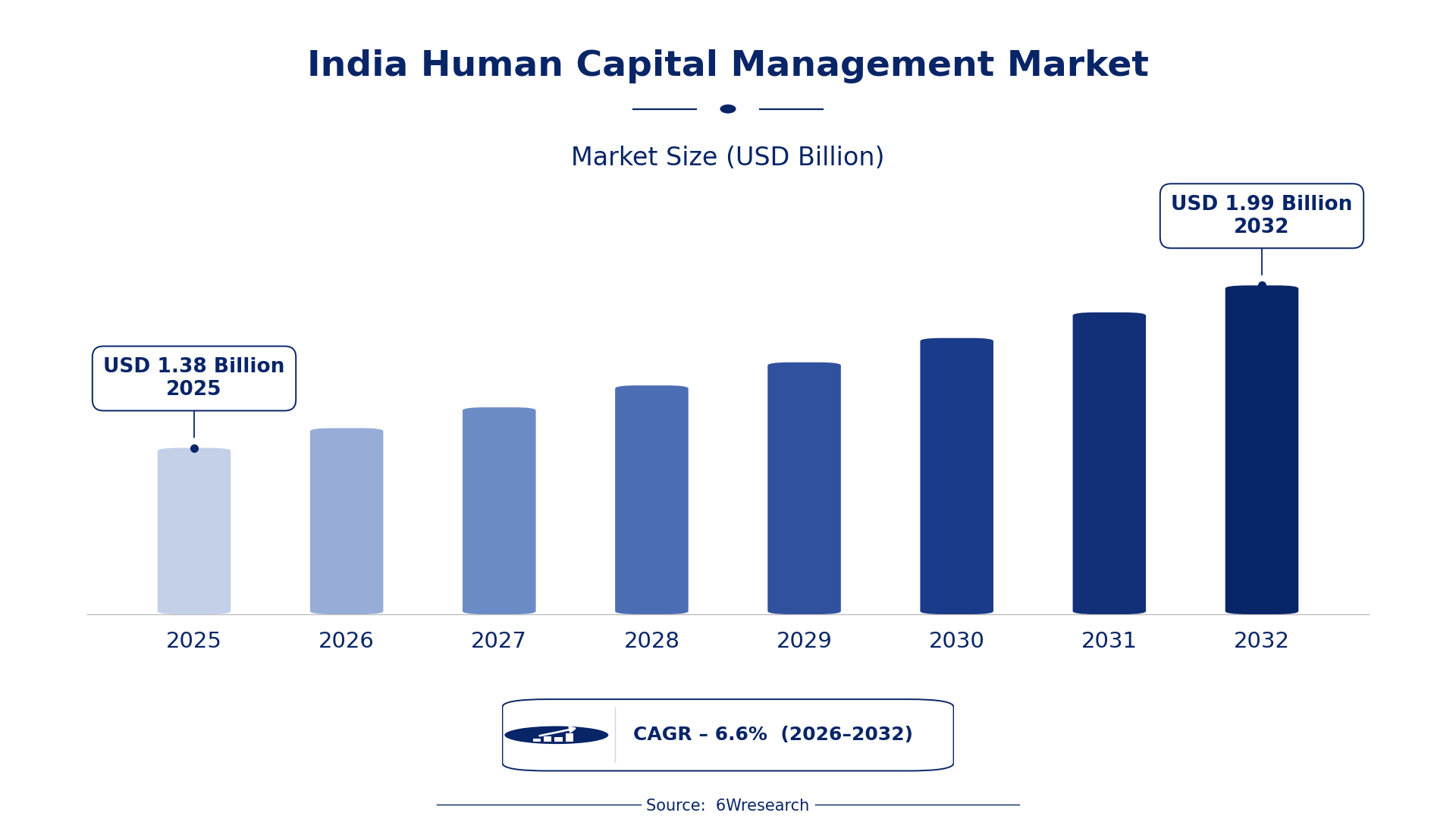
The India Human Capital Management Market was estimated at USD 1381 Million in 2025 and is projected to reach USD 1988 Million by 2032, growing at a CAGR of 6.6% from 2026 to 2032.
India Human Capital Management Market Synopsis
The India Human Capital Management (HCM) market is witnessing a pronounced shift as organizations increasingly focus on optimizing their workforce management strategies. As complexities in labor regulations mount, businesses are turning to comprehensive HCM software solutions to effectively manage employee data, payroll, and talent management.
This trend is further amplified by the growing recognition of the need for enhanced employee engagement and performance metrics. As companies adapt to new workplace dynamics, integrated HCM systems are becoming indispensable tools across various sectors in India.
India Human Capital Management Market Year-wise Growth Rate and Key Drivers
This graph illustrates the annual growth rates of the India Human Capital Management Market from 2021 to 2032, highlighting a steady upward trajectory and projected expansion over the forecast period.
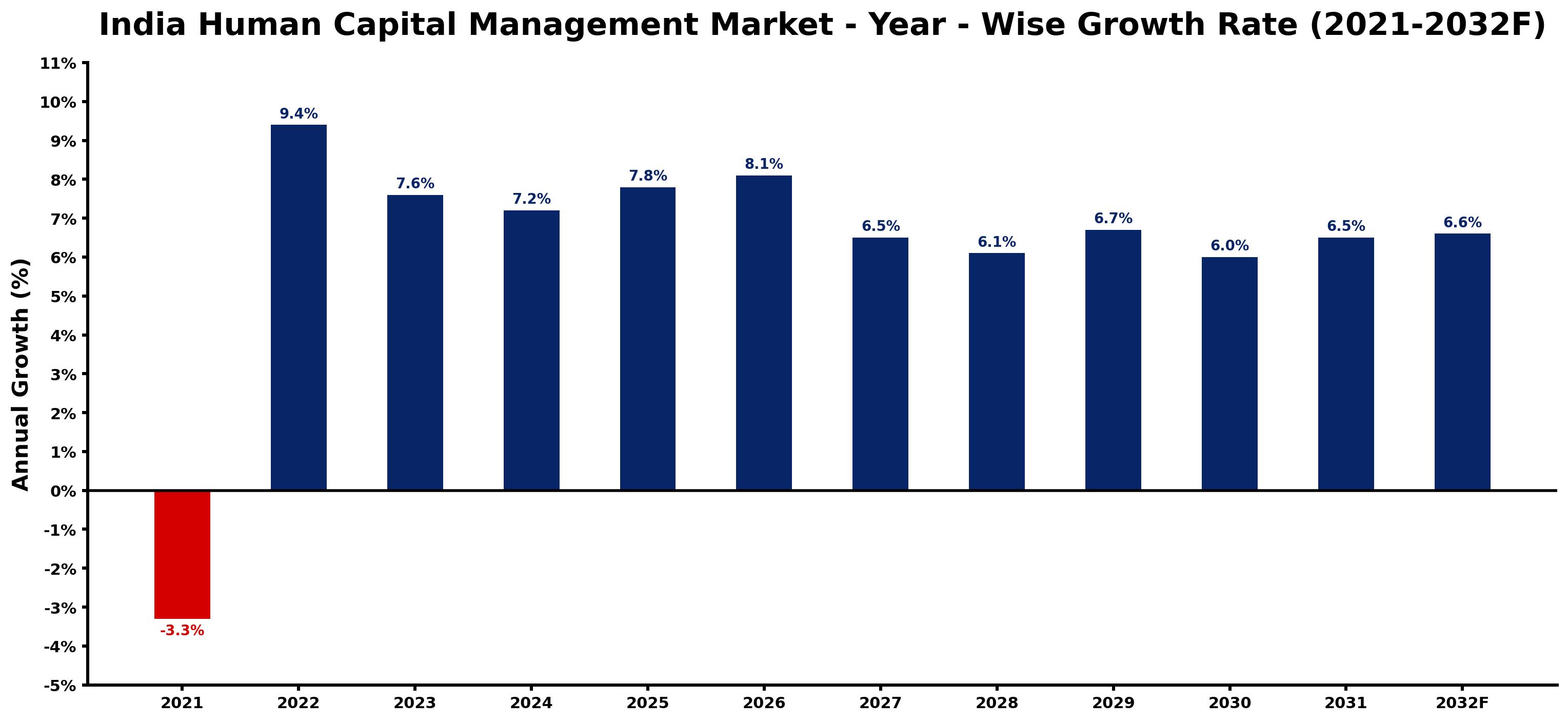
The table below presents the year‑wise growth rates along with the key drivers influencing the market
| Year | Growth Rate | Major Drivers |
| 2021 | -3.3% | Demand decline due to COVID-19 lockdown impact on hiring. |
| 2022 | 9.4% | Government's Skill India initiative enhancing workforce capabilities |
| 2023 | 7.6% | Rise in startup ecosystem driving HR tech adoption |
| 2024 | 7.2% | Increased focus on remote work policies by enterprises |
| 2025 | 7.8% | Demand for AI-driven recruitment tools surging amid digitization |
| 2026 | 8.1% | Local companies prioritizing employee well-being and retention strategies |
| 2027 | 6.5% | Shift towards performance-driven cultures in organizations emerging |
| 2028 | 6.1% | Youth demographic growth pushing talent acquisition innovations |
| 2029 | 6.7% | Digital transformation in HR processes gaining momentum |
| 2030 | 6.0% | Emerging gig economy creating new talent management needs |
| 2031 | 6.5% | Regulatory changes fostering flexible work arrangements enhancing appeal |
| 2032 | 6.6% | Corporate training programs evolving with advanced learning technologies |
Note: Market size estimations and growth projections presented in this report are based on 6Wresearch's proprietary forecasting methodology, utilizing the latest available industry data, government publications, and primary research inputs.
India Human Capital Management Market Key Takeaways
Below are some of the specific key takeaways from the market, including:
- Demand for automated HR processes is driving HCM system adoption across industries.
- Complex labor regulations necessitate compliance features in HCM solutions.
- Organizations are prioritizing employee engagement tools to enhance productivity.
- The market is witnessing a surge in demand for integrated talent management systems.
- COVID-19 has accelerated the transition to remote workforce management solutions.
Evaluation of Restraints in India Human Capital Management Market
Despite its growth, the India HCM market grapples with considerable restraints. One major hurdle is the challenge of managing a diverse workforce that includes multiple generations, each with distinct needs and expectations. This diversity complicates the implementation of standardized systems and requires tailored approaches to engagement and management. Additionally, businesses face the ongoing challenge of navigating varying state-level labor laws, which can impede compliance efforts and create operational inefficiencies. Integrating HCM solutions with existing payroll and attendance systems often proves to be a complex and resource-intensive task, further restricting the market’s potential.
India Human Capital Management Market Trends
The market is currently shaped by several key trends. The rise of remote work has led organizations to seek HCM solutions that facilitate virtual team management and employee engagement. Another notable trend is the increasing emphasis on data analytics within HCM systems, allowing businesses to make informed decisions about talent management and workforce planning. on top of that, there is a growing demand for user-friendly platforms that enhance employee experience, reflecting a broader shift towards personalization in HR functions. These trends indicate a future where HCM systems will be more integrated, data-driven, and employee-centric.
India Human Capital Management Market Opportunities
Opportunities abound in the India HCM market as organizations recognize the critical role of effective talent management in achieving their business objectives. The increasing need for compliance-focused solutions presents an avenue for growth, particularly for vendors who can provide adaptive systems that align with local regulations. Additionally, the shift towards digitalization opens doors for innovative HCM solutions that incorporate artificial intelligence and machine learning, enhancing workforce analytics and predictive capabilities. As companies strive for operational efficiency, investments in comprehensive HCM systems will continue to rise.
Government Initiatives in the India Human Capital Management Market
Government policy in India is increasingly recognizing the importance of effective human capital management. With a focus on enhancing workforce capabilities and compliance, various initiatives are being introduced to support businesses in their HCM strategies. As the regulatory framework evolves, understanding these initiatives is crucial for organizations aiming to remain compliant and competitive.
- A regulatory framework introduced in early 2025 mandating compliance with new labor laws aimed at improving employee rights.
- Currently underway is a national skill development program focusing on upskilling the workforce to meet industry demands.
- A planned public-private partnership initiative is expected to enhance digital infrastructure for HR management by 2028.
- A recently launched program to incentivize small businesses for adopting HCM technologies, promoting digital transformation.
- Ongoing efforts to streamline labor regulations across states to reduce the compliance burden on businesses.
Future Insights of the India Human Capital Management Market
Looking ahead to 2026-2032, the India HCM market is set to experience transformative growth. The ongoing digital revolution will drive demand for innovative solutions that not only address compliance but also enhance employee experience. As organizations increasingly invest in technology to foster a more engaged and productive workforce, the integration of advanced analytics and AI will redefine talent management strategies. Companies that embrace these changes will likely gain a competitive edge in attracting and retaining top talent.
India Human Capital Management Market Latest Developments
In the past 12-14 months, the India HCM market has seen a wave of activity as businesses adapt to evolving workforce dynamics. This period has been marked by increased investments in technology, driven by the need for efficient management of remote and hybrid teams. Providers are rolling out innovative solutions that cater specifically to the challenges posed by the current work environment.
- A major technology vendor launched a new HCM platform in Q1 2025, aimed at facilitating remote workforce management.
- An initiative that began in late 2024 is currently underway, focusing on integrating AI capabilities into existing HCM systems.
- A product enhancement was completed in early 2025, introducing advanced analytics features to support data-driven decision-making.
- A rollout expected to begin in mid-2026 will offer specialized training modules for HR professionals to adapt to new technologies.
- Partnerships between HCM solution providers and educational institutions are being established to promote workforce upskilling, with initiatives planned for 2026.
India Human Capital Management Market - Key Attractiveness of the Report
- 10 Years of Market Numbers
- Historical Data Starting from 2022 to 2025
- Base Year: 2025
- Forecast Data until 2032
- Key Performance Indicators Impacting the Market
- Major Upcoming Developments and Projects
Key Highlights of the Report:
- India Human Capital Management Market Outlook
- Market Size of India Human Capital Management Market, 2025
- Forecast of India Human Capital Management Market, 2032
- Historical Data and Forecast of India Human Capital Management Revenues & Volume for the Period 2022-2032F
- India Human Capital Management Market Trend Evolution
- India Human Capital Management Market Drivers and Challenges
- India Human Capital Management Price Trends
- India Human Capital Management Porter's Five Forces
- India Human Capital Management Industry Life Cycle
- Historical Data and Forecast of India Human Capital Management Market Revenues & Volume By Component for the Period 2022-2032F
- Historical Data and Forecast of India Human Capital Management Market Revenues & Volume By Software for the Period 2022-2032F
- Historical Data and Forecast of India Human Capital Management Market Revenues & Volume By Services for the Period 2022-2032F
- Historical Data and Forecast of India Human Capital Management Market Revenues & Volume By Organization Size for the Period 2022-2032F
- Historical Data and Forecast of India Human Capital Management Market Revenues & Volume By SMEs for the Period 2022-2032F
- Historical Data and Forecast of India Human Capital Management Market Revenues & Volume By Large Enterprises for the Period 2022-2032F
- Historical Data and Forecast of India Human Capital Management Market Revenues & Volume By Deployment Mode for the Period 2022-2032F
- Historical Data and Forecast of India Human Capital Management Market Revenues & Volume By On-Premises for the Period 2022-2032F
- Historical Data and Forecast of India Human Capital Management Market Revenues & Volume By Cloud for the Period 2022-2032F
- Historical Data and Forecast of India Human Capital Management Market Revenues & Volume By Vertical for the Period 2022-2032F
- Historical Data and Forecast of India Human Capital Management Market Revenues & Volume By Banking, Financial Services, and Insurance (BFSI) for the Period 2022-2032F
- Historical Data and Forecast of India Human Capital Management Market Revenues & Volume By Government for the Period 2022-2032F
- Historical Data and Forecast of India Human Capital Management Market Revenues & Volume By Manufacturing for the Period 2022-2032F
- Historical Data and Forecast of India Human Capital Management Market Revenues & Volume By Telecom and IT for the Period 2022-2032F
- Historical Data and Forecast of India Human Capital Management Market Revenues & Volume By Consumer Goods and Retail for the Period 2022-2032F
- Historical Data and Forecast of India Human Capital Management Market Revenues & Volume By Healthcare and Life Sciences for the Period 2022-2032F
- Historical Data and Forecast of India Human Capital Management Market Revenues & Volume By Energy and Utilities for the Period 2022-2032F
- Historical Data and Forecast of India Human Capital Management Market Revenues & Volume By Transportation and Logistics for the Period 2022-2032F
- India Human Capital Management Import Export Trade Statistics
- Market Opportunity Assessment By Component
- Market Opportunity Assessment By Organization Size
- Market Opportunity Assessment By Deployment Mode
- Market Opportunity Assessment By Vertical
- India Human Capital Management Top Companies Market Share
- India Human Capital Management Competitive Benchmarking By Technical and Operational Parameters
- India Human Capital Management Company Profiles
- India Human Capital Management Key Strategic Recommendations






































