India Hydrophobic and Superhydrophobic Materials Market Size, Share & Growth Rate
The India Hydrophobic and Superhydrophobic Materials Market was estimated at USD 1333 Million in 2025 and is projected to reach USD 1910 Million by 2032, growing at a CAGR of 5.3% from 2026 to 2032. This growth trajectory can be attributed to the surging demand across various sectors such as oil & gas, automotive, and consumer electronics. As innovations in hydrophobic and superhydrophobic technologies continue to proliferate, industries are increasingly recognizing their potential to enhance performance and efficiency.
India Hydrophobic and Superhydrophobic Materials Market Year-wise Growth Rate and Key Drivers
This graph highlights how the India Hydrophobic and Superhydrophobic Materials Market has steadily grown over the years, supported by major growth factors.
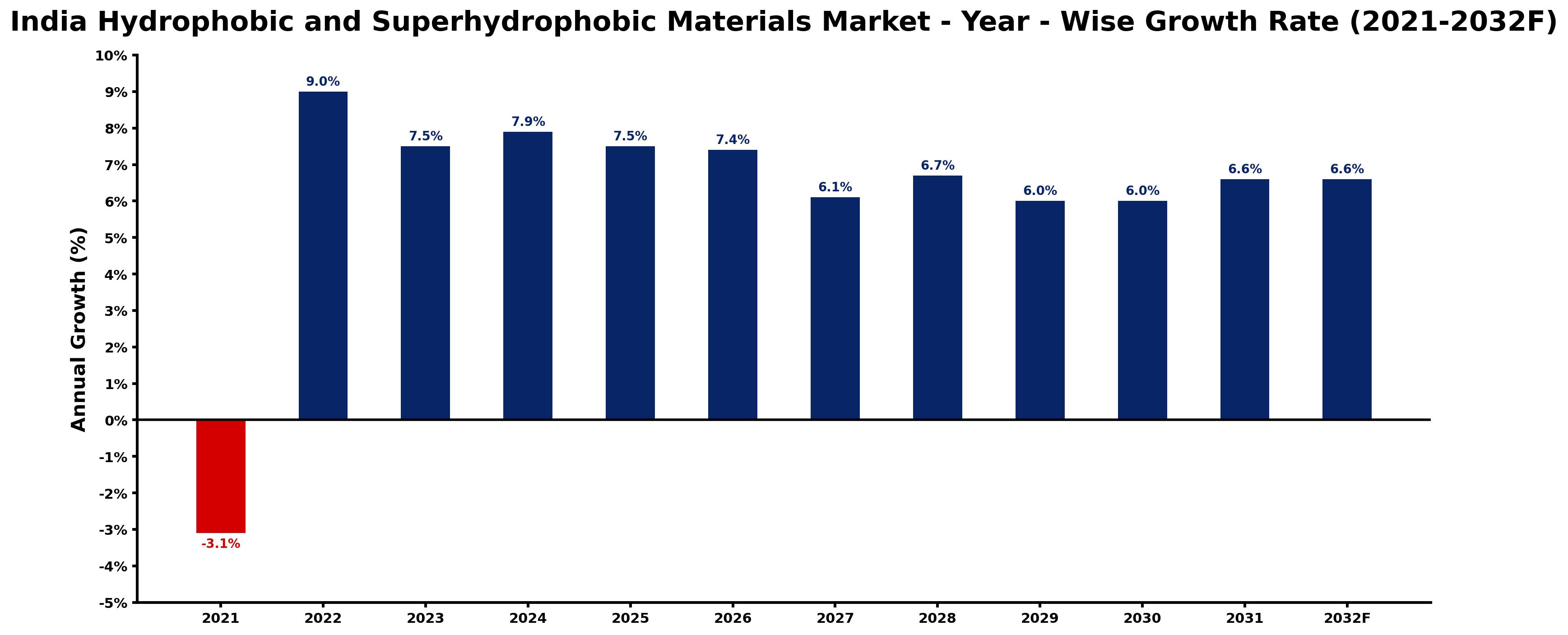
The table below presents the year‑wise growth rates along with the key drivers influencing the market
| Year | Growth Rate | Major Drivers |
| 2021 | -3.1% | Growing renewable energy integration projects |
| 2022 | 9.0% | Expansion of commercial construction activities |
| 2023 | 7.5% | Increasing adoption of advanced technologies |
| 2024 | 7.9% | Increasing smart city development projects |
| 2025 | 7.5% | Rapid growth in telecom and data center sectors |
| 2026 | 7.4% | Rapid growth in telecom and data center sectors |
| 2027 | 6.1% | Expansion of manufacturing activities |
| 2028 | 6.7% | Rising electricity demand across industries |
| 2029 | 6.0% | Growing renewable energy integration projects |
| 2030 | 6.0% | Rapid growth in telecom and data center sectors |
| 2031 | 6.6% | Growing urbanization and commercial development |
| 2032 | 6.6% | Growing urbanization and commercial development |
Note - Market size estimations and growth projections presented in this report are based on 6Wresearch’s advanced forecasting approach, validated with industry datasets as of June 2026.
India Hydrophobic and Superhydrophobic Materials Market Synopsis
The most influential force currently shaping the India Hydrophobic and Superhydrophobic Materials Market is the burgeoning automotive sector. As consumer disposable incomes rise and electric vehicles gain traction, the demand for lightweight, high-performance materials is expected to surge, offering lucrative opportunities for hydrophobic coatings.
Furthermore, the growing production of electronic devices and consumer goods plays a critical role in driving this market. Advances in digitalization and the rollout of 5G technology are fostering a manufacturing environment where hydrophobic materials can be instrumental, especially in enhancing product durability and performance.
India Hydrophobic and Superhydrophobic Materials Market Key Takeaways
- The market is poised for robust growth, driven by demand across multiple industries.
- Automotive advancements, especially in electric vehicles, are major growth accelerators.
- Increased production of consumer electronics is leading to higher demand for innovative materials.
- Hydrophobic coatings offer unique benefits such as self-cleaning and enhanced durability.
- Developers face challenges due to high costs and a lack of standardized regulations.
Evaluation of Restraints in India Hydrophobic and Superhydrophobic Materials Market
Despite the promising outlook, several restraints could impede growth in the India Hydrophobic and Superhydrophobic Materials Market. The high costs associated with developing advanced hydrophobic materials can deter small and mid-sized players from entering or expanding in this sector. Additionally, the lack of standardized regulations poses compatibility challenges that may lead to uncertainty among stakeholders, complicating industry dynamics.
India Hydrophobic and Superhydrophobic Materials Market Trends
Notable trends shaping the market include the rise of nanotechnology and its integration into hydrophobic materials, enhancing their functionality and performance. Additionally, an increasing focus on sustainability and eco-friendly solutions is driving interest in non-toxic hydrophobic coatings, reflecting a broader consumer preference for environmentally responsible products.
India Hydrophobic and Superhydrophobic Materials Market Opportunities
Genuine growth opportunities lie in the automotive and electronics sectors, where manufacturers are seeking innovative solutions to improve product life and functionality. Moreover, the expanding aerospace and healthcare industries also represent promising avenues, as the need for advanced materials capable of resisting contamination and enhancing performance becomes critical.
Government Initiatives in the India Hydrophobic and Superhydrophobic Materials Market
The Indian government has implemented several initiatives aimed at bolstering manufacturing capabilities, particularly in high-tech sectors like automotive and electronics. Programs promoting technology adoption and research and development in innovative materials are crucial for supporting the growth of hydrophobic solutions. Regulatory frameworks encouraging investment in sustainable technologies further enhance the attractiveness of this market.
Future Insights of the India Hydrophobic and Superhydrophobic Materials Market
Looking ahead to 2026-2032, the India Hydrophobic and Superhydrophobic Materials Market is set to thrive, propelled by the ongoing evolution in electric vehicles, consumer electronics, and a broader push for sustainable materials. As companies continue to innovate and the applications for hydrophobic materials expand, the market will likely experience a pronounced shift toward more advanced, efficient, and eco-friendly solutions.
India Hydrophobic and Superhydrophobic Materials Market Latest Developments (May 2025 - June 2026)
Recent developments in the India Hydrophobic and Superhydrophobic Materials Market indicate a growing interest in advanced coating technologies, particularly within the automotive and healthcare sectors. Innovations aimed at reducing production costs and improving material efficacy are becoming prominent, as is the increasing collaboration among industry stakeholders to address regulatory challenges and improve standardization efforts.
India Hydrophobic and Superhydrophobic Materials Market - Key Attractiveness of the Report
- 10 Years of Market Numbers
- Historical Data Starting from 2022 to 2025
- Base Year: 2025
- Forecast Data until 2032
- Key Performance Indicators Impacting the Market
- Major Upcoming Developments and Projects
Key Highlights of the Report:
- India Hydrophobic and Superhydrophobic Materials Market Outlook
- Market Size of India Hydrophobic and Superhydrophobic Materials Market, 2025
- Forecast of India Hydrophobic and Superhydrophobic Materials Market, 2032
- Historical Data and Forecast of India Hydrophobic and Superhydrophobic Materials Revenues & Volume for the Period 2022-2032F
- India Hydrophobic and Superhydrophobic Materials Market Trend Evolution
- India Hydrophobic and Superhydrophobic Materials Market Drivers and Challenges
- India Hydrophobic and Superhydrophobic Materials Price Trends
- India Hydrophobic and Superhydrophobic Materials Porter's Five Forces
- India Hydrophobic and Superhydrophobic Materials Industry Life Cycle
- Historical Data and Forecast of India Hydrophobic and Superhydrophobic Materials Market Revenues & Volume By Product for the Period 2022-2032F
- Historical Data and Forecast of India Hydrophobic and Superhydrophobic Materials Market Revenues & Volume By Anti-corrosion for the Period 2022-2032F
- Historical Data and Forecast of India Hydrophobic and Superhydrophobic Materials Market Revenues & Volume By Anti-wetting for the Period 2022-2032F
- Historical Data and Forecast of India Hydrophobic and Superhydrophobic Materials Market Revenues & Volume By Anti-icing for the Period 2022-2032F
- Historical Data and Forecast of India Hydrophobic and Superhydrophobic Materials Market Revenues & Volume By Self-cleaning for the Period 2022-2032F
- Historical Data and Forecast of India Hydrophobic and Superhydrophobic Materials Market Revenues & Volume By End user for the Period 2022-2032F
- Historical Data and Forecast of India Hydrophobic and Superhydrophobic Materials Market Revenues & Volume By Steel & Metal for the Period 2022-2032F
- Historical Data and Forecast of India Hydrophobic and Superhydrophobic Materials Market Revenues & Volume By Building & Construction for the Period 2022-2032F
- Historical Data and Forecast of India Hydrophobic and Superhydrophobic Materials Market Revenues & Volume By Automotive for the Period 2022-2032F
- Historical Data and Forecast of India Hydrophobic and Superhydrophobic Materials Market Revenues & Volume By Textile & Fabric for the Period 2022-2032F
- Historical Data and Forecast of India Hydrophobic and Superhydrophobic Materials Market Revenues & Volume By Others for the Period 2022-2032F
- India Hydrophobic and Superhydrophobic Materials Import Export Trade Statistics
- Market Opportunity Assessment By Product
- Market Opportunity Assessment By End user
- India Hydrophobic and Superhydrophobic Materials Top Companies Market Share
- India Hydrophobic and Superhydrophobic Materials Competitive Benchmarking By Technical and Operational Parameters
- India Hydrophobic and Superhydrophobic Materials Company Profiles
- India Hydrophobic and Superhydrophobic Materials Key Strategic Recommendations






































