India Identity Verification Market Size & Growth Rate (2026-2032)
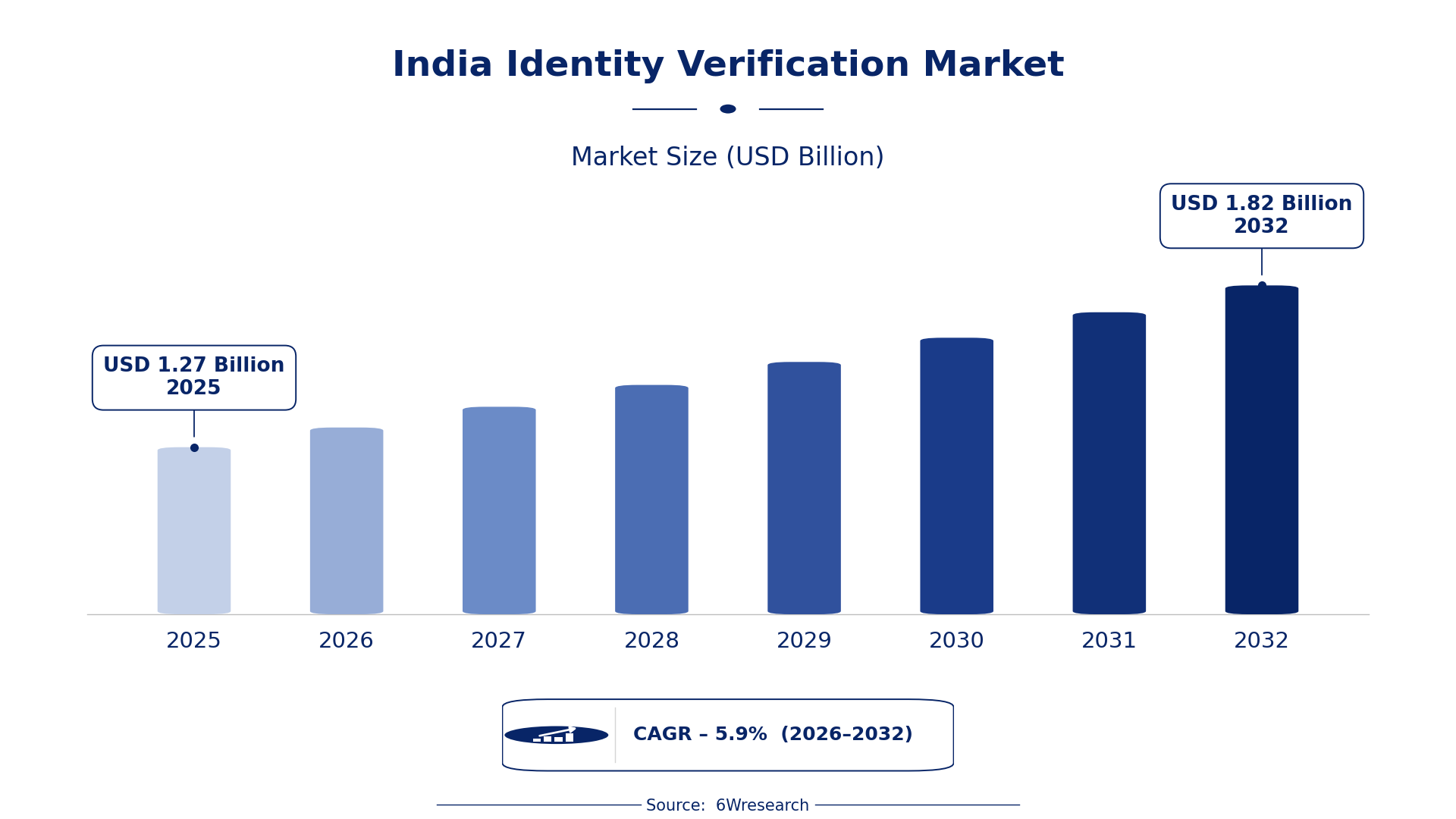
The India Identity Verification Market was estimated at USD 1269 Million in 2025 and is projected to reach USD 1822 Million by 2032, growing at a CAGR of 5.9% from 2026 to 2032.
India Identity Verification Market Synopsis
The India Identity Verification market has gained traction, driven by the rapid expansion of digital transactions. As the economy increasingly shifts toward online interactions, businesses face a mounting pressure to adopt advanced identity verification technologies to mitigate fraud risks.
Looking ahead, the market is set for substantial growth, primarily fueled by the digital economy's evolution. With escalating regulatory mandates and heightened consumer expectations surrounding security, demand for innovative solutions such as biometrics and AI-driven checks will likely surge.
India Identity Verification Market Year-wise Growth Rate and Key Drivers
This graph illustrates the annual growth rates of the India Identity Verification Market from 2021 to 2032, highlighting a steady upward trajectory and projected expansion over the forecast period.
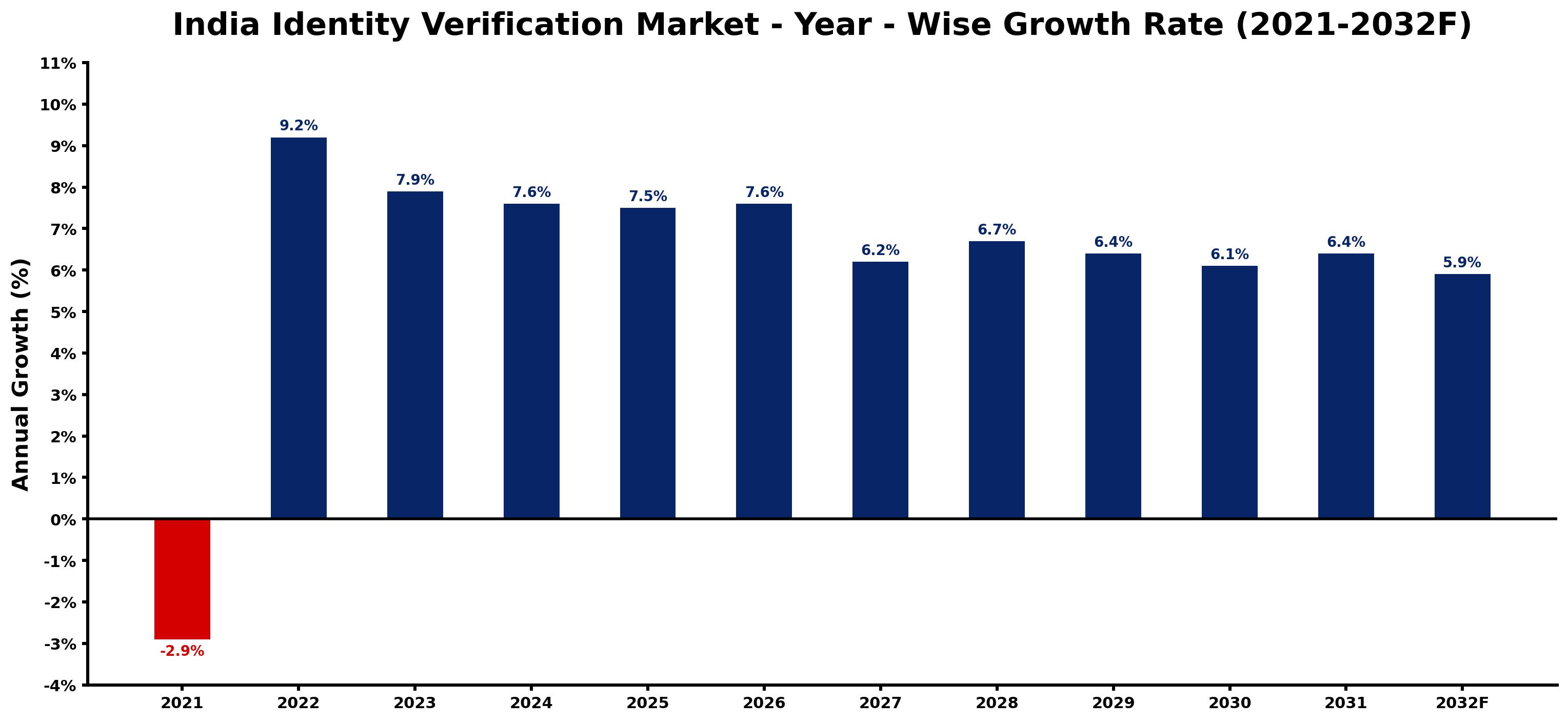
The table below presents the year‑wise growth rates along with the key drivers influencing the market
| Year | Growth Rate | Major Drivers |
| 2021 | -2.9% | Delayed Aadhaar enrollment drives down user participation. |
| 2022 | 9.2% | Aadhaar-linked services enhancing digital verification reliability. |
| 2023 | 7.9% | Increased biometric authentication regulations by UIDAI. |
| 2024 | 7.6% | Surge in online banking growth drives identity verification needs. |
| 2025 | 7.5% | Rising cybersecurity threats push demand for verification services. |
| 2026 | 7.6% | Government initiatives promoting digital identities in public services. |
| 2027 | 6.2% | Growing awareness of data privacy rights among citizens. |
| 2028 | 6.7% | Digital onboarding mandates for new businesses emerging. |
| 2029 | 6.4% | Rising mobile internet penetration increasing verification service usage. |
| 2030 | 6.1% | Influence of AI on more efficient identity checks processes. |
| 2031 | 6.4% | Increasing cross-border transactions requiring robust identity measures. |
| 2032 | 5.9% | Regulatory push for enhanced KYC compliance in banking. |
Note: Market size estimations and growth projections presented in this report are based on 6Wresearch's proprietary forecasting methodology, utilizing the latest available industry data, government publications, and primary research inputs.
India Identity Verification Market Key Takeaways
Below are some of the specific key takeaways from the market, including:
- Escalating digital transaction volumes are driving the necessity for reliable identity verification.
- Regulatory compliance remains a critical factor influencing market growth in various sectors.
- Innovative technologies like biometric recognition are increasingly being adopted.
- COVID-19 has significantly accelerated the shift to digital services, boosting the need for verification solutions.
- Consumer trust is paramount, compelling businesses to enhance their identity verification processes.
Evaluation of Restraints in India Identity Verification Market
Despite the promising growth trajectory, the India Identity Verification market faces notable constraints. Ensuring the accuracy and security of verification processes is a persistent challenge. Companies must contend with identity theft and the legitimacy of data sources utilized in verification, which often complicates compliance with rigorous regulatory standards. These hurdles necessitate a focus on creating user-friendly systems that do not sacrifice security, complicating the implementation of effective identity verification solutions.
India Identity Verification Market Trends
In recent times, the trend toward using AI and machine learning in identity verification is gaining ground. These technologies enable more accurate, automated checks, minimizing human error. Additionally, biometric solutions are becoming mainstream, with facial recognition and fingerprint scanning rapidly integrating into user experiences. The demand for omnichannel verification methods is also rising, allowing businesses to verify identities across multiple platforms seamlessly.
India Identity Verification Market Opportunities
The India Identity Verification market is ripe with opportunities for growth and investment. Companies venturing into the biometric sphere stand to gain significant traction, especially in financial services where robust verification processes are indispensable. Additionally, leveraging AI technologies can provide a competitive edge, enabling businesses to offer superior customer experiences while meeting regulatory requirements efficiently.
Government Initiatives in the India Identity Verification Market
Government policies and initiatives are shaping the India Identity Verification market significantly, particularly in enhancing security and regulatory compliance. As digital services proliferate, the Indian government is focused on frameworks that promote secure identity verification methods across sectors, which is paramount for maintaining consumer trust in digital transactions.
- A recent initiative launched in 2023 introduced stricter regulations for digital identity verification processes in the financial sector.
- Currently, the government is implementing a national biometric database to streamline identity verification for various public services.
- Plans are underway for a public-private partnership aimed at enhancing cybersecurity measures for identity verification by 2025.
- A regulatory framework was introduced in late 2022 that mandates the use of secure identity verification technologies in e-commerce.
- The government is currently developing an online platform to centralize and simplify identity verification for businesses across sectors.
Future Insights of the India Identity Verification Market
As we look toward 2026-2032, the India Identity Verification market is expected to evolve significantly. The transition to a digital-first economy will continue to drive demand for innovative verification solutions. Enhanced regulatory frameworks will shape technological advancements, pushing businesses to adopt more secure and efficient verification methods. The integration of AI and biometric technologies will not only bolster security but also enhance customer experiences, paving the way for sustained market growth.
India Identity Verification Market Latest Developments
The past year has seen notable developments within the India Identity Verification market, reflecting a strong push towards enhanced security and regulatory compliance. Companies are investing heavily in innovative technologies to meet rising consumer expectations and stringent regulations.
- A new document verification tool was launched in early 2023, aimed at improving the efficiency of onboarding processes in the fintech sector.
- An ongoing initiative that began in Q1 2023 focuses on integrating biometric solutions within government services for identity verification.
- Upcoming plans for a comprehensive identity management system are set to be unveiled by mid-2026, targeting both public and private sectors.
- A major partnership between fintech firms to co-develop an AI-driven identity verification solution is currently underway and expected to be completed by late 2023.
- In early 2023, a leading technology vendor announced enhancements to their identity verification platform, emphasizing machine learning capabilities to streamline operations.
India Identity Verification Market - Key Attractiveness of the Report
- 10 Years of Market Numbers
- Historical Data Starting from 2022 to 2025
- Base Year: 2025
- Forecast Data until 2032
- Key Performance Indicators Impacting the Market
- Major Upcoming Developments and Projects
Key Highlights of the Report:
- India Identity Verification Market Outlook
- Market Size of India Identity Verification Market, 2025
- Forecast of India Identity Verification Market, 2032
- Historical Data and Forecast of India Identity Verification Revenues & Volume for the Period 2022-2032F
- India Identity Verification Market Trend Evolution
- India Identity Verification Market Drivers and Challenges
- India Identity Verification Price Trends
- India Identity Verification Porter's Five Forces
- India Identity Verification Industry Life Cycle
- Historical Data and Forecast of India Identity Verification Market Revenues & Volume By Component for the Period 2022-2032F
- Historical Data and Forecast of India Identity Verification Market Revenues & Volume By Solutions for the Period 2022-2032F
- Historical Data and Forecast of India Identity Verification Market Revenues & Volume By Services for the Period 2022-2032F
- Historical Data and Forecast of India Identity Verification Market Revenues & Volume By Type for the Period 2022-2032F
- Historical Data and Forecast of India Identity Verification Market Revenues & Volume By Biometric for the Period 2022-2032F
- Historical Data and Forecast of India Identity Verification Market Revenues & Volume By Non-Biometric for the Period 2022-2032F
- Historical Data and Forecast of India Identity Verification Market Revenues & Volume By Vertical for the Period 2022-2032F
- Historical Data and Forecast of India Identity Verification Market Revenues & Volume By BFSI for the Period 2022-2032F
- Historical Data and Forecast of India Identity Verification Market Revenues & Volume By Retail for the Period 2022-2032F
- Historical Data and Forecast of India Identity Verification Market Revenues & Volume By eCommerce for the Period 2022-2032F
- Historical Data and Forecast of India Identity Verification Market Revenues & Volume By Gaming for the Period 2022-2032F
- Historical Data and Forecast of India Identity Verification Market Revenues & Volume By Gambling for the Period 2022-2032F
- Historical Data and Forecast of India Identity Verification Market Revenues & Volume By Application for the Period 2022-2032F
- Historical Data and Forecast of India Identity Verification Market Revenues & Volume By Access Control and User Monitoring for the Period 2022-2032F
- Historical Data and Forecast of India Identity Verification Market Revenues & Volume By KYC, KYB, and Onboarding for the Period 2022-2032F
- Historical Data and Forecast of India Identity Verification Market Revenues & Volume By Identity Fraud Compliance and Forensics for the Period 2022-2032F
- Historical Data and Forecast of India Identity Verification Market Revenues & Volume By Deployment Mode for the Period 2022-2032F
- Historical Data and Forecast of India Identity Verification Market Revenues & Volume By Cloud for the Period 2022-2032F
- Historical Data and Forecast of India Identity Verification Market Revenues & Volume By On-Premises for the Period 2022-2032F
- Historical Data and Forecast of India Identity Verification Market Revenues & Volume By Organization Size for the Period 2022-2032F
- Historical Data and Forecast of India Identity Verification Market Revenues & Volume By Large Enterprises for the Period 2022-2032F
- Historical Data and Forecast of India Identity Verification Market Revenues & Volume By Small and Medium-Sized Enterprises (SMEs) for the Period 2022-2032F
- India Identity Verification Import Export Trade Statistics
- Market Opportunity Assessment By Component
- Market Opportunity Assessment By Type
- Market Opportunity Assessment By Vertical
- Market Opportunity Assessment By Application
- Market Opportunity Assessment By Deployment Mode
- Market Opportunity Assessment By Organization Size
- India Identity Verification Top Companies Market Share
- India Identity Verification Competitive Benchmarking By Technical and Operational Parameters
- India Identity Verification Company Profiles
- India Identity Verification Key Strategic Recommendations






































