India Image Recognition Market Size & Growth Rate (2026-2032)
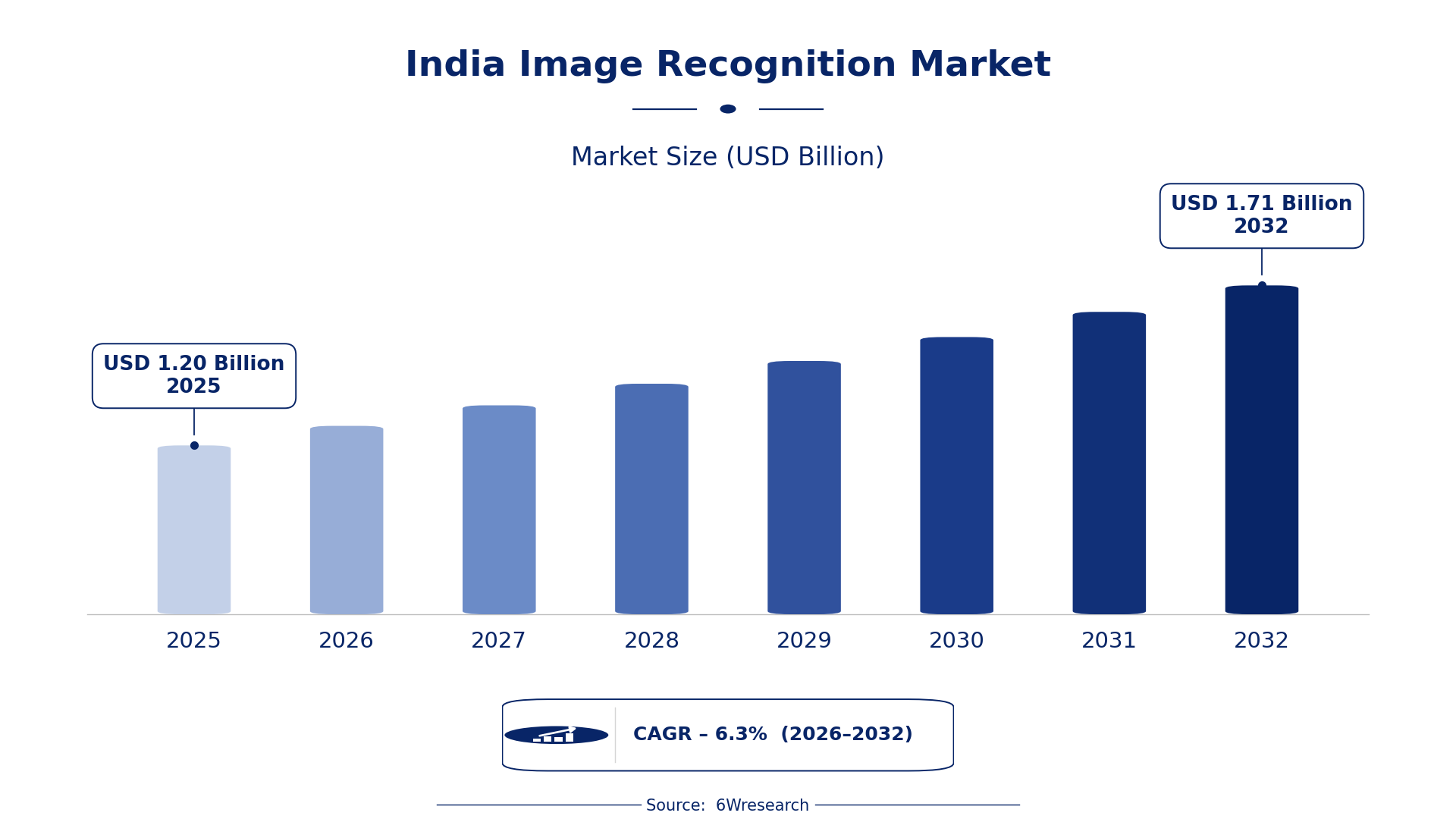
The India Image Recognition Market was estimated at USD 1196 Million in 2025 and is projected to reach USD 1706 Million by 2032, growing at a CAGR of 6.3% from 2026 to 2032.
India Image Recognition Market Synopsis
The surge in AI and machine learning applications across various sectors is fundamentally reshaping the India Image Recognition Market. With increasing investments in technology by both private and public sectors, industries such as e-commerce and healthcare are rapidly adopting image recognition capabilities to enhance operational efficiencies.
Applications such as facial recognition for security and automated quality control in manufacturing are gaining traction. Notably, the government’s interest in integrating image recognition for surveillance and public safety further amplifies the technology’s importance in India's socio-economic fabric.
India Image Recognition Market Year-wise Growth Rate and Key Drivers
This graph illustrates the annual growth rates of the India Image Recognition Market from 2021 to 2032, highlighting a steady upward trajectory and projected expansion over the forecast period.
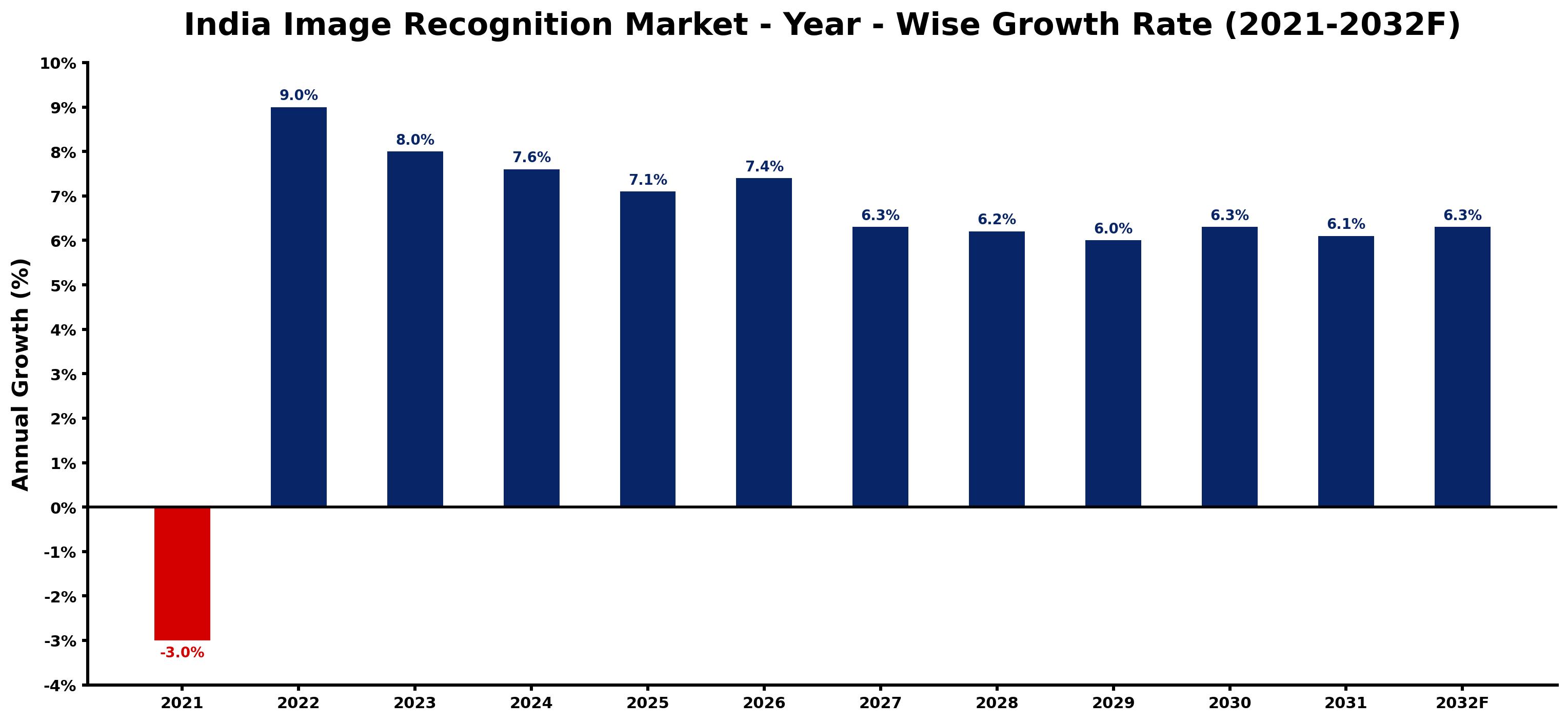
The table below presents the year‑wise growth rates along with the key drivers influencing the market
| Year | Growth Rate | Major Drivers |
| 2021 | -3.0% | National Digital Health Mission delayed image recognition implementation. |
| 2022 | 9.0% | Growing e-commerce driving need for automated image tagging |
| 2023 | 8.0% | Increased adoption of AI-driven surveillance systems in cities |
| 2024 | 7.6% | Rise in mobile payment solutions requiring visual recognition |
| 2025 | 7.1% | Government support for smart farming technologies boosting demand |
| 2026 | 7.4% | Healthcare sector's adoption of remote patient image analysis |
| 2027 | 6.3% | Increased smartphone penetration fostering image recognition applications |
| 2028 | 6.2% | Educational institutions investing in AI for learning enhancement |
| 2029 | 6.0% | Rising tech startups focused on visual AI innovations |
| 2030 | 6.3% | Boost in social media platforms utilizing image analytics |
| 2031 | 6.1% | Local regulations promoting secure digital asset identification |
| 2032 | 6.3% | Growing use of augmented reality in retail experiences |
Note: Market size estimations and growth projections presented in this report are based on 6Wresearch's proprietary forecasting methodology, utilizing the latest available industry data, government publications, and primary research inputs.
India Image Recognition Market Key Takeaways
Below are some of the specific key takeaways from the market, including:
- The market is being driven by rising demand for computer vision technology across various sectors.
- Image recognition applications in security, retail, and healthcare are witnessing significant growth.
- Government initiatives aimed at enhancing public safety are boosting technology adoption.
- Challenges related to accuracy and scalability remain critical hurdles for industry players.
- COVID-19 has accelerated the adoption of contactless technologies, including image recognition.
Evaluation of Restraints in India Image Recognition Market
The India Image Recognition Market is grappling with issues that impede its full potential. Foremost among these is the challenge of achieving high accuracy across diverse applications. Many systems struggle with biases and inconsistencies that can lead to unreliable outcomes. on top of that, the need for extensive datasets for training these systems complicates scalability, as acquiring quality data can be resource-intensive and time-consuming. These factors not only hinder market growth but also create apprehensions among potential adopters.
India Image Recognition Market Trends
Several trends are currently shaping the India Image Recognition Market. The rise of e-commerce has led to a growing need for visual search capabilities, allowing consumers to find products through images. In healthcare, the technology is being utilized for diagnostics and patient monitoring, showcasing its versatility. Additionally, the integration of image recognition with IoT devices is creating new opportunities for automation and security in various sectors.
India Image Recognition Market Opportunities
Emerging opportunities in the India Image Recognition Market are substantial. Industries like retail are increasingly looking to incorporate advanced image recognition technologies to enhance customer experiences and streamline operations. The government’s initiatives in public safety and surveillance also present a unique avenue for growth. on top of that, as AI technology continues to mature, businesses are likely to invest in image recognition systems that can operate with greater accuracy and speed, opening doors for innovative applications.
Government Initiatives in the India Image Recognition Market
Government policy is shaping the India Image Recognition Market significantly, focusing on enhancing public safety and fostering technological advancement. With strategic initiatives aimed at integrating AI technologies into everyday operations, the regulatory environment is becoming increasingly supportive. These initiatives not only aim to improve security but also encourage innovation in the private sector.
- A recently completed initiative involved the launch of a national surveillance program utilizing image recognition technology to enhance urban safety.
- Currently, there is an ongoing effort to implement AI-driven solutions in public transportation systems, focusing on security and efficiency.
- A planned initiative aims to roll out a public-private partnership program that will expand the use of image recognition in rural healthcare settings by 2028.
- The government is also developing a regulatory framework to ensure the ethical use of AI in surveillance and data management.
- A project aimed at upgrading digital infrastructure to support AI technologies is currently in the pilot phase.
Future Insights of the India Image Recognition Market
Looking ahead to 2026-2032, the India Image Recognition Market is set to experience noteworthy transformations. The convergence of AI with other technologies, such as IoT and big data analytics, will likely enhance the capabilities and applications of image recognition systems. As organizations seek to improve operational efficiencies and security measures, the market will continue to attract investment, driving innovation and expanding its reach across various sectors.
India Image Recognition Market Latest Developments
Recent activity in the India Image Recognition Market has indicated a strong momentum toward technological adoption and innovation. The last 12-14 months have seen businesses increasingly prioritize contactless solutions and automation, largely influenced by the pandemic. This shift is pushing companies to explore advanced image recognition technologies to remain competitive.
- A leading technology vendor launched a new image recognition software aimed at the retail sector, which began rollout in early 2025.
- An initiative that started in mid-2025 focuses on enhancing facial recognition capabilities for public safety applications, currently underway.
- A major company announced plans for an upcoming expansion of its image recognition services in the automotive industry, expected to begin in Q3 2026.
- Research and development efforts are ongoing to improve the accuracy and scalability of image recognition systems, aiming for completion by late 2026.
- Another project is exploring partnerships with healthcare providers to implement AI-driven diagnostics using image recognition, set to launch in early 2027.
India Image Recognition Market - Key Attractiveness of the Report
- 10 Years of Market Numbers
- Historical Data Starting from 2022 to 2025
- Base Year: 2025
- Forecast Data until 2032
- Key Performance Indicators Impacting the Market
- Major Upcoming Developments and Projects
Key Highlights of the Report:
- India Image Recognition Market Outlook
- Market Size of India Image Recognition Market, 2025
- Forecast of India Image Recognition Market, 2032
- Historical Data and Forecast of India Image Recognition Revenues & Volume for the Period 2022-2032F
- India Image Recognition Market Trend Evolution
- India Image Recognition Market Drivers and Challenges
- India Image Recognition Price Trends
- India Image Recognition Porter's Five Forces
- India Image Recognition Industry Life Cycle
- Historical Data and Forecast of India Image Recognition Market Revenues & Volume By Technology for the Period 2022-2032F
- Historical Data and Forecast of India Image Recognition Market Revenues & Volume By Digital Image Processing for the Period 2022-2032F
- Historical Data and Forecast of India Image Recognition Market Revenues & Volume By Facial Recognition for the Period 2022-2032F
- Historical Data and Forecast of India Image Recognition Market Revenues & Volume By Pattern Recognition for the Period 2022-2032F
- Historical Data and Forecast of India Image Recognition Market Revenues & Volume By Deployment Mode for the Period 2022-2032F
- Historical Data and Forecast of India Image Recognition Market Revenues & Volume By On-premises for the Period 2022-2032F
- Historical Data and Forecast of India Image Recognition Market Revenues & Volume By Cloud for the Period 2022-2032F
- Historical Data and Forecast of India Image Recognition Market Revenues & Volume By Component for the Period 2022-2032F
- Historical Data and Forecast of India Image Recognition Market Revenues & Volume By Hardware for the Period 2022-2032F
- Historical Data and Forecast of India Image Recognition Market Revenues & Volume By Software for the Period 2022-2032F
- Historical Data and Forecast of India Image Recognition Market Revenues & Volume By Services for the Period 2022-2032F
- Historical Data and Forecast of India Image Recognition Market Revenues & Volume By Application for the Period 2022-2032F
- Historical Data and Forecast of India Image Recognition Market Revenues & Volume By Scanning and Imaging for the Period 2022-2032F
- Historical Data and Forecast of India Image Recognition Market Revenues & Volume By Security and Surveillance for the Period 2022-2032F
- Historical Data and Forecast of India Image Recognition Market Revenues & Volume By Image Search for the Period 2022-2032F
- Historical Data and Forecast of India Image Recognition Market Revenues & Volume By Augmented Reality for the Period 2022-2032F
- Historical Data and Forecast of India Image Recognition Market Revenues & Volume By Marketing and Advertising for the Period 2022-2032F
- India Image Recognition Import Export Trade Statistics
- Market Opportunity Assessment By Technology
- Market Opportunity Assessment By Deployment Mode
- Market Opportunity Assessment By Component
- Market Opportunity Assessment By Application
- India Image Recognition Top Companies Market Share
- India Image Recognition Competitive Benchmarking By Technical and Operational Parameters
- India Image Recognition Company Profiles
- India Image Recognition Key Strategic Recommendations






































