India Immunology Market Size, Share & Growth Rate
The India Immunology Market was estimated at USD 1272 Million in 2025 and is projected to reach USD 1824 Million by 2032, growing at a CAGR of 5.3% from 2026 to 2032. This robust growth trajectory is primarily driven by the escalating prevalence of autoimmune diseases, which are becoming increasingly prevalent in the Indian population. Furthermore, the market is buoyed by advancements in immunotherapies, an increase in healthcare expenditure, and a growing inclination towards personalized medicine and biologics.
India Immunology Market Year-wise Growth Rate and Key Drivers
This graph highlights how the India Immunology Market has steadily grown over the years, supported by major growth factors.
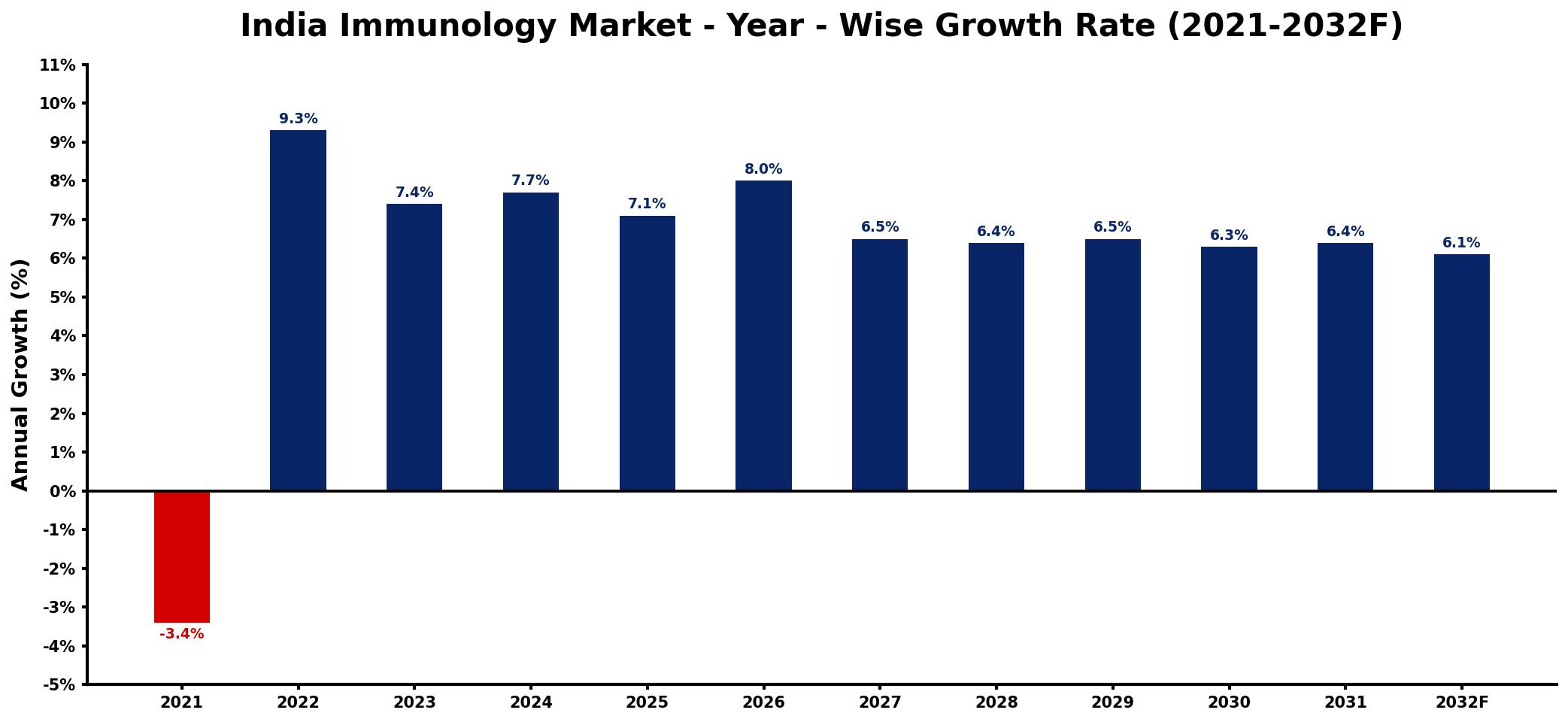
The table below presents the year‑wise growth rates along with the key drivers influencing the market
| Year | Growth Rate | Major Drivers |
| 2021 | -3.4% | decreased investment in healthcare sector |
| 2022 | 9.3% | rising demand for biotechnology solutions |
| 2023 | 7.4% | growth in personalized medicine applications |
| 2024 | 7.7% | increased funding for research initiatives |
| 2025 | 7.1% | expansion of healthcare infrastructure projects |
| 2026 | 8.0% | advancements in diagnostic technologies |
| 2027 | 6.5% | increased focus on preventive care |
| 2028 | 6.4% | emergence of new therapeutic approaches |
| 2029 | 6.5% | growing interest in clinical trials |
| 2030 | 6.3% | enhanced collaboration among research institutions |
| 2031 | 6.4% | rising public awareness about health |
| 2032 | 6.1% | development of innovative treatment modalities |
Note: Market size estimations and growth projections presented in this report are based on 6Wresearch's proprietary forecasting methodology, utilizing the latest available industry data, government publications, and primary research inputs.
India Immunology Market Synopsis
In recent years, the India Immunology Market has gained momentum, propelled by a greater focus on immunological disorders and innovative treatment modalities. As the pharmaceutical industry pivots towards biologics and targeted therapies, the landscape of immunology in India is set for significant transformation.
Looking ahead, the market is poised for sustained growth, reflecting not only the rising incidence of chronic diseases but also the burgeoning healthcare infrastructure that supports advanced therapeutic solutions. With an increasing awareness of immune system health and a robust pipeline of novel therapies, the future of immunology in India appears promising.
India Immunology Market Key Takeaways
- The market is on a growth trajectory, expected to reach USD 1824 Million by 2032.
- Drivers include rising autoimmune disease prevalence and increased healthcare investments.
- There is a notable shift towards personalized medicine and biologic treatments.
- Innovations in immunotherapies and diagnostic tools are fostering market expansion.
- Public and private sector collaboration is enhancing research and development efforts.
Evaluation of Restraints in India Immunology Market
Despite its promising growth, the India Immunology Market faces significant challenges. One of the primary restraints is the high cost associated with immunological drugs, which can limit accessibility for many patients. Additionally, disparities in healthcare infrastructure across urban and rural regions can hinder effective diagnosis and treatment. The COVID-19 pandemic has also impacted the market, as many healthcare resources were reallocated, potentially delaying the adoption of immunotherapy solutions.
India Immunology Market Trends
Current trends in the India Immunology Market reveal a shift towards biologic therapies, particularly monoclonal antibodies, which are gaining traction due to their specificity and efficacy. The emphasis on precision medicine is also shaping demand, leading to a more tailored approach in treating various immunological conditions. Furthermore, digital health technologies, including telemedicine and remote monitoring, are enhancing patient engagement and facilitating timely interventions.
India Immunology Market Opportunities
Significant growth opportunities lie in expanding research collaborations and investments in biopharmaceutical development. With the Indian governments push for innovation in healthcare, there is a ripe environment for startups and established companies alike to pioneer new therapeutic solutions. Additionally, addressing unmet needs in rural areas can create avenues for outreach programs and mobile health initiatives, ultimately broadening the market base.
Government Initiatives in the India Immunology Market
The Indian government is actively supporting the immunology sector through various initiatives aimed at enhancing healthcare access and research. Public spending on healthcare is increasing, along with incentives for biopharmaceutical companies to innovate. Programs encouraging clinical trials and partnerships between academia and industry further bolster the development of immunological therapies, aligning with broader public health objectives.
Future Insights of the India Immunology Market
Between 2026 and 2032, the India Immunology Market is expected to evolve significantly, with a stronger focus on integrative healthcare approaches and multi-disciplinary strategies. Advancements in genomic research will likely drive the development of more effective and personalized treatment options. Additionally, increased public awareness around autoimmune and chronic diseases will stimulate demand for immunology drugs, ensuring a robust market landscape for years to come.
India Immunology Market Latest Developments (2025 - 2026)
Recent developments within the India Immunology Market have highlighted a surge in partnerships aimed at innovating treatment solutions for autoimmune disorders. Collaborations between pharmaceutical companies and research institutions are focused on enhancing the efficacy of existing therapies. Moreover, the recovery of elective treatments post-pandemic is expected to drive demand further, signaling a return to routine healthcare practices.
India Immunology Market - Key Attractiveness of the Report
- 10 Years of Market Numbers
- Historical Data Starting from 2022 to 2025
- Base Year: 2025
- Forecast Data until 2032
- Key Performance Indicators Impacting the Market
- Major Upcoming Developments and Projects
Key Highlights of the Report:
- India Immunology Market Outlook
- Market Size of India Immunology Market, 2025
- Forecast of India Immunology Market, 2032
- Historical Data and Forecast of India Immunology Revenues & Volume for the Period 2022-2032F
- India Immunology Market Trend Evolution
- India Immunology Market Drivers and Challenges
- India Immunology Price Trends
- India Immunology Porter's Five Forces
- India Immunology Industry Life Cycle
- Historical Data and Forecast of India Immunology Market Revenues & Volume By Drug Class for the Period 2022-2032F
- Historical Data and Forecast of India Immunology Market Revenues & Volume By Monoclonal Antibody (mAb) for the Period 2022-2032F
- Historical Data and Forecast of India Immunology Market Revenues & Volume By Fusion Proteins for the Period 2022-2032F
- Historical Data and Forecast of India Immunology Market Revenues & Volume By Immunosuppressants for the Period 2022-2032F
- Historical Data and Forecast of India Immunology Market Revenues & Volume By Polyclonal Antibody (pAb) for the Period 2022-2032F
- Historical Data and Forecast of India Immunology Market Revenues & Volume By Others for the Period 2022-2032F
- Historical Data and Forecast of India Immunology Market Revenues & Volume By Disease Indication for the Period 2022-2032F
- Historical Data and Forecast of India Immunology Market Revenues & Volume By Rheumatoid Arthritis for the Period 2022-2032F
- Historical Data and Forecast of India Immunology Market Revenues & Volume By Psoriatic Arthritis for the Period 2022-2032F
- Historical Data and Forecast of India Immunology Market Revenues & Volume By Plaque Psoriasis for the Period 2022-2032F
- Historical Data and Forecast of India Immunology Market Revenues & Volume By Ankylosing Spondylitis for the Period 2022-2032F
- Historical Data and Forecast of India Immunology Market Revenues & Volume By Inflammatory Bowel Disease for the Period 2022-2032F
- Historical Data and Forecast of India Immunology Market Revenues & Volume By Prophylaxis of Organ Rejection for the Period 2022-2032F
- Historical Data and Forecast of India Immunology Market Revenues & Volume By Others for the Period 2022-2032F
- Historical Data and Forecast of India Immunology Market Revenues & Volume By Distribution Channel for the Period 2022-2032F
- Historical Data and Forecast of India Immunology Market Revenues & Volume By Hospital Pharmacies for the Period 2022-2032F
- Historical Data and Forecast of India Immunology Market Revenues & Volume By Retail Pharmacies for the Period 2022-2032F
- Historical Data and Forecast of India Immunology Market Revenues & Volume By Online Pharmacies for the Period 2022-2032F
- India Immunology Import Export Trade Statistics
- Market Opportunity Assessment By Drug Class
- Market Opportunity Assessment By Disease Indication
- Market Opportunity Assessment By Distribution Channel
- India Immunology Top Companies Market Share
- India Immunology Competitive Benchmarking By Technical and Operational Parameters
- India Immunology Company Profiles
- India Immunology Key Strategic Recommendations






































