Morocco Immunology Market Size, Share & Growth Rate
The Morocco Immunology Market was estimated at USD 361 Million in 2025 and is projected to reach USD 494 Million by 2032, growing at a CAGR of 4.6% from 2026 to 2032. This growth trajectory is primarily fueled by the increasing incidence of autoimmune diseases, which is prompting healthcare providers to seek more effective diagnostic and therapeutic options. Additionally, greater public awareness of immunological disorders and the government's commitment to enhancing healthcare infrastructure further support market expansion.
Morocco Immunology Market Year-wise Growth Rate and Key Drivers
This graph highlights how the Morocco Immunology Market has steadily grown over the years, supported by major growth factors.
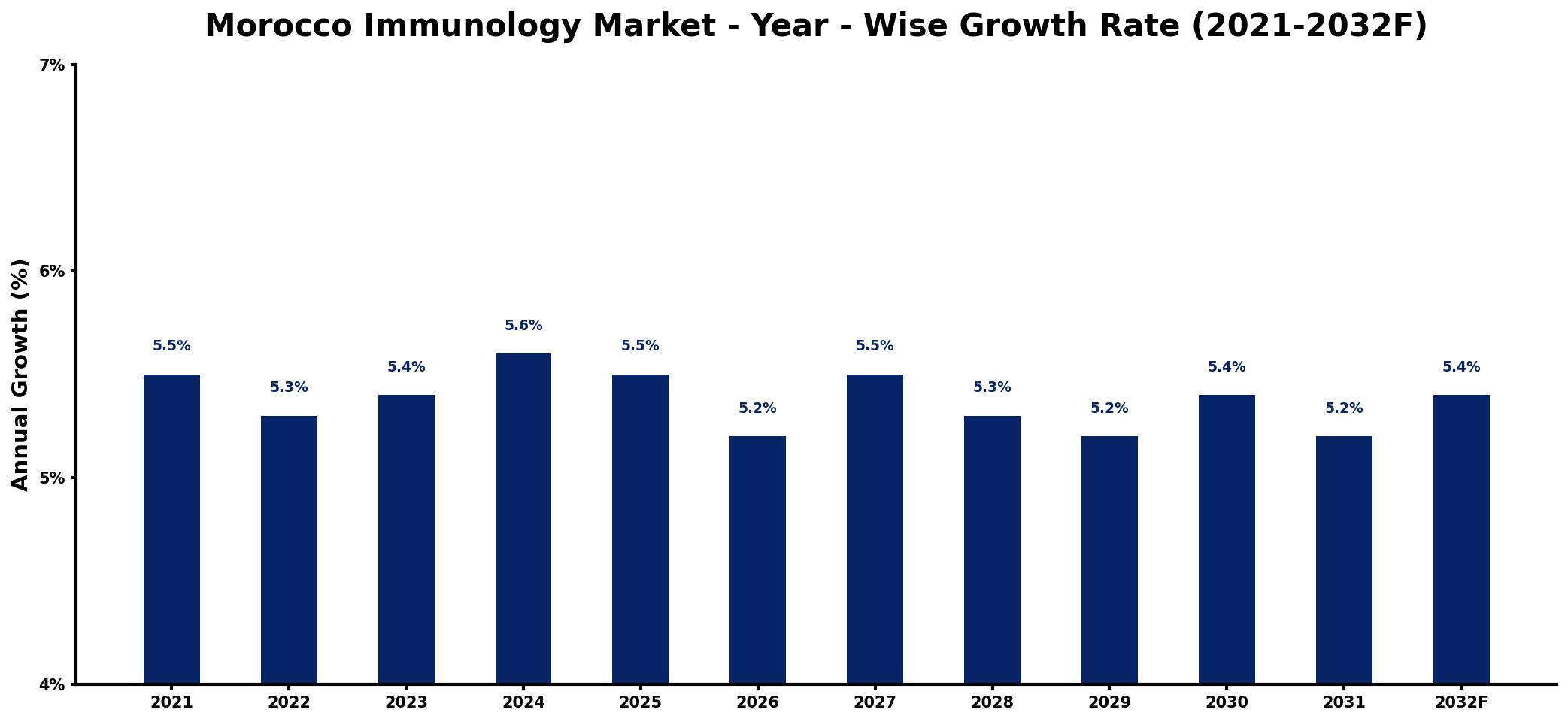
The table below presents the year‑wise growth rates along with the key drivers influencing the market
| Year | Growth Rate | Major Drivers |
| 2021 | 5.5% | Increased healthcare investment initiatives |
| 2022 | 5.3% | Rising prevalence of autoimmune diseases |
| 2023 | 5.4% | Expansion of healthcare infrastructure |
| 2024 | 5.6% | Growth in biotechnology sector innovation |
| 2025 | 5.5% | Surge in patient awareness campaigns |
| 2026 | 5.2% | Emergence of new treatment options |
| 2027 | 5.5% | Strengthening of public health policies |
| 2028 | 5.3% | Increased collaboration among research institutions |
| 2029 | 5.2% | increased domestic production output |
| 2030 | 5.4% | Advancements in diagnostic technologies |
| 2031 | 5.2% | Rising demand for preventive healthcare |
| 2032 | 5.4% | enhanced product quality standards |
Note: Market size estimations and growth projections presented in this report are based on 6Wresearch's proprietary forecasting methodology, utilizing the latest available industry data, government publications, and primary research inputs.
Morocco Immunology Market Synopsis
A notable force shaping the Morocco Immunology Market is the increasing demand for advanced immunotherapy options. With patients and healthcare professionals alike recognizing the benefits of targeted therapies, there's a palpable shift toward innovative solutions in treating complex immunological conditions.
Moreover, the growing emphasis on personalized medicine is significantly influencing the market landscape. The integration of genetic testing and biomarker analysis into treatment plans is helping healthcare providers tailor therapies, ultimately improving patient outcomes and satisfaction.
Morocco Immunology Market Key Takeaways
- The market is witnessing substantial growth driven by rising autoimmune disease prevalence.
- There is an increasing focus on personalized immunology treatments through advancements in technology.
- Government policies are actively promoting vaccination programs, boosting public health initiatives.
- Investment opportunities are emerging from the need for innovative therapies and diagnostic tools.
- Challenges remain, including healthcare access disparities, especially in rural regions.
Evaluation of Restraints in Morocco Immunology Market
Despite the optimistic outlook for the Morocco Immunology Market, several constraints hinder growth. Limited access to advanced immunological treatments in rural areas poses a significant challenge, as these regions often lack the necessary healthcare infrastructure and resources. Additionally, many patients and healthcare professionals are not fully aware of the latest developments in immunology, which can impede the adoption of innovative therapies. High treatment costs further exacerbate these issues, potentially restricting market expansion and access to care.
Morocco Immunology Market Trends
Current trends indicate a marked increase in the demand for immunotherapy for conditions such as cancer and autoimmune diseases. This trend is largely driven by a growing preference for targeted treatments that offer fewer side effects compared to traditional therapies. Furthermore, advancements in biotechnology are paving the way for new treatment modalities, including personalized medicine approaches that leverage genetic and biomarker insights. A heightened focus on preventive health measures, particularly vaccination campaigns, is also shaping demand within the market.
Morocco Immunology Market Opportunities
Significant investment opportunities are emerging within the Morocco Immunology Market, particularly in the development of innovative therapies and diagnostic solutions. The rising prevalence of autoimmune diseases and infectious conditions underscores the need for effective treatments tailored to the Moroccan population. Collaborations with local healthcare providers can enhance distribution networks and improve patient access, creating a competitive edge for companies willing to engage with the market's specific demands and challenges.
Government Initiatives in the Morocco Immunology Market
The Moroccan government has been proactive in enhancing the healthcare landscape through initiatives like the National Immunization Program (NIP). This program ensures widespread access to essential vaccines, significantly impacting public health. By prioritizing vaccination campaigns, particularly in underserved areas, the government aims to improve overall health outcomes and reduce the prevalence of infectious diseases. Such public health efforts are critical for fostering a more robust immunology market in the region.
Future Insights of the Morocco Immunology Market
Looking ahead to 2026-2032, the Morocco Immunology Market is poised for steady growth, driven by increasing awareness of immunotherapy benefits and rising healthcare investments. Continuous advancements in research and technology will likely lead to more innovative treatments, catering to the needs of an evolving patient population. However, addressing the challenges of healthcare accessibility, especially in rural regions, will be essential for unlocking the market's full potential and ensuring comprehensive care for all patients.
Morocco Immunology Market Latest Developments (2025 - 2026)
Recent developments in the Morocco Immunology Market reflect a growing commitment to enhancing treatment accessibility and public health initiatives. Several health campaigns have been launched to promote awareness of immunological disorders and the benefits of advanced therapies. Furthermore, there is a notable increase in partnerships between public health institutions and private sector players aimed at developing localized solutions tailored to the Moroccan populations needs.
Morocco Immunology Market - Key Attractiveness of the Report
- 10 Years of Market Numbers
- Historical Data Starting from 2022 to 2025
- Base Year: 2025
- Forecast Data until 2032
- Key Performance Indicators Impacting the Market
- Major Upcoming Developments and Projects
Key Highlights of the Report:
- Morocco Immunology Market Outlook
- Market Size of Morocco Immunology Market, 2025
- Forecast of Morocco Immunology Market, 2032
- Historical Data and Forecast of Morocco Immunology Revenues & Volume for the Period 2022-2032F
- Morocco Immunology Market Trend Evolution
- Morocco Immunology Market Drivers and Challenges
- Morocco Immunology Price Trends
- Morocco Immunology Porter's Five Forces
- Morocco Immunology Industry Life Cycle
- Historical Data and Forecast of Morocco Immunology Market Revenues & Volume By Drug Class for the Period 2022-2032F
- Historical Data and Forecast of Morocco Immunology Market Revenues & Volume By Monoclonal Antibody (mAb) for the Period 2022-2032F
- Historical Data and Forecast of Morocco Immunology Market Revenues & Volume By Fusion Proteins for the Period 2022-2032F
- Historical Data and Forecast of Morocco Immunology Market Revenues & Volume By Immunosuppressants for the Period 2022-2032F
- Historical Data and Forecast of Morocco Immunology Market Revenues & Volume By Polyclonal Antibody (pAb) for the Period 2022-2032F
- Historical Data and Forecast of Morocco Immunology Market Revenues & Volume By Others for the Period 2022-2032F
- Historical Data and Forecast of Morocco Immunology Market Revenues & Volume By Disease Indication for the Period 2022-2032F
- Historical Data and Forecast of Morocco Immunology Market Revenues & Volume By Rheumatoid Arthritis for the Period 2022-2032F
- Historical Data and Forecast of Morocco Immunology Market Revenues & Volume By Psoriatic Arthritis for the Period 2022-2032F
- Historical Data and Forecast of Morocco Immunology Market Revenues & Volume By Plaque Psoriasis for the Period 2022-2032F
- Historical Data and Forecast of Morocco Immunology Market Revenues & Volume By Ankylosing Spondylitis for the Period 2022-2032F
- Historical Data and Forecast of Morocco Immunology Market Revenues & Volume By Inflammatory Bowel Disease for the Period 2022-2032F
- Historical Data and Forecast of Morocco Immunology Market Revenues & Volume By Prophylaxis of Organ Rejection for the Period 2022-2032F
- Historical Data and Forecast of Morocco Immunology Market Revenues & Volume By Others for the Period 2022-2032F
- Historical Data and Forecast of Morocco Immunology Market Revenues & Volume By Distribution Channel for the Period 2022-2032F
- Historical Data and Forecast of Morocco Immunology Market Revenues & Volume By Hospital Pharmacies for the Period 2022-2032F
- Historical Data and Forecast of Morocco Immunology Market Revenues & Volume By Retail Pharmacies for the Period 2022-2032F
- Historical Data and Forecast of Morocco Immunology Market Revenues & Volume By Online Pharmacies for the Period 2022-2032F
- Morocco Immunology Import Export Trade Statistics
- Market Opportunity Assessment By Drug Class
- Market Opportunity Assessment By Disease Indication
- Market Opportunity Assessment By Distribution Channel
- Morocco Immunology Top Companies Market Share
- Morocco Immunology Competitive Benchmarking By Technical and Operational Parameters
- Morocco Immunology Company Profiles
- Morocco Immunology Key Strategic Recommendations






































