India Industrial Computers Market Summary
The india industrial computers market was estimated at USD 1047 Million in 2025 and is projected to reach USD 1508 Million by 2032, growing at a CAGR of 7.5% from 2026 to 2032.
India Industrial Computers Market Year-wise Growth Rate and Key Drivers
This graph highlights how the India Industrial Computers Market has steadily grown over the past five years, supported by major growth factors.
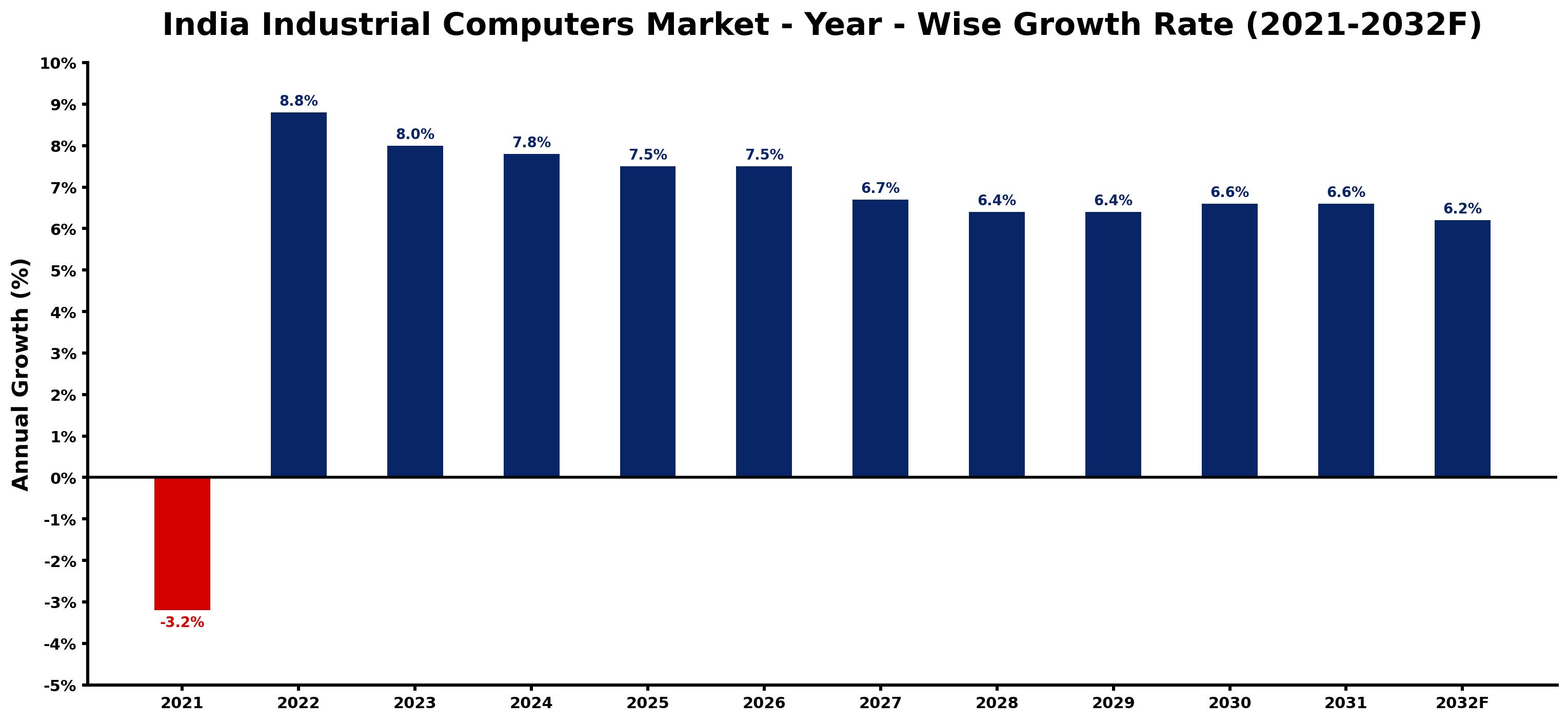
The table below presents the year wise growth rates along with the key drivers influencing the market
| Year | Growth Rate | Major Drivers |
| 2021 | -3.2% | Supply chain disruptions due to pandemicrelated lockdowns hindered production and delayed project implementations in various sectors. |
| 2022 | 8.8% | Increased manufacturing activities led to higher demand for robust computing solutions. |
| 2023 | 8.0% | Regional industrial hubs focused on efficiency, pushing for advanced computer technologies. |
| 2024 | 7.8% | Emerging sectors like renewable energy require specialized computing for operational excellence. |
| 2025 | 7.5% | Transition towards Industry 4.0 emphasized integration of IoT in manufacturing processes. |
| 2026 | 7.5% | Challenges in legacy systems prompted firms to upgrade to next-gen industrial computers. |
| 2027 | 6.7% | Supply chain disruptions encouraged local manufacturers to invest in operational resilience. |
| 2028 | 6.4% | Cybersecurity threats necessitated robust industrial computing to safeguard sensitive data. |
| 2029 | 6.4% | Government focus on smart cities created opportunities for intelligent industrial solutions. |
| 2030 | 6.6% | Sustainability goals pushed industries towards energy-efficient computing solutions. |
| 2031 | 6.6% | Collaboration between tech firms and industries enhanced customized solutions for complex needs. |
| 2032 | 6.2% | Global shifts in trade dynamics encouraged domestic production capabilities and local sourcing. |
Note - Market size estimations and growth projections presented in this report are based on 6Wresearch's advanced forecasting approach, validated with industry datasets as of June 2026.
India Industrial Computers Market Synopsis
The India Industrial Computers Market is projected to reach 7.5% and witness significant growth during the forecast period (2026-2032). The market is driven by the increasing adoption of the Industrial Internet of Things (IIoT) and technological advancements across various sectors. As industries increasingly integrate advanced technologies such as artificial intelligence (AI) and machine learning (ML), the demand for robust industrial computing solutions is on the rise. Furthermore, government initiatives such as Make In India and Digital India provide an encouraging framework for manufacturing growth, further stimulating the industrial computers market in India.
India Industrial Computers Market Growth Drivers
Several factors are propelling the growth of the India Industrial Computers Market. The key drivers include:
- Growing Acceptance of IIoT: The rise in IIoT adoption across multiple sectors enhances investment in infrastructure equipped with embedded systems. This transition supports the deployment of high-performance ruggedized PCs, which offer operators and engineers the versatility to manage operations efficiently from remote locations.
- Technological Advancements: Rapid advancements in technology, including the proliferation of AI and ML, have led to an increased demand for high-performance computing systems that can effectively process vast amounts of data. This trend is particularly pertinent in manufacturing, where real-time data processing is essential.
- Rising Adoption of Cloud Computing Services: The integration of cloud computing with industrial PCs allows organizations to manage production-related data cost-effectively. Enhanced connectivity enables the linking of distributed resources, facilitating real-time analytics without necessitating physical connections, thus lowering operational costs.
- Government Initiatives: Initiatives like Make In India and Digital India play a critical role in nurturing the manufacturing ecosystem. Such programs offer favorable policies and incentives, encouraging the development and deployment of industrial computers.
- Demand for Rugged Computing Solutions: Industries operating under harsh conditions increasingly require ruggedized computers capable of withstanding extreme temperatures and dust accumulation. These specialized systems ensure continuity in operations, ultimately leading to cost savings and enhanced productivity for end users.
India Industrial Computers Market Challenges and Restraints
Despite the positive outlook, the India Industrial Computers Market faces several challenges that could hinder growth. These challenges include:
- High Initial Investment: The cost associated with acquiring advanced industrial computing systems can be substantial. Small and medium enterprises may find it challenging to justify such investments, potentially limiting market penetration.
- Skill Gap and Training Needs: The implementation of advanced technologies often requires a workforce skilled in operating and maintaining sophisticated systems. The current skill gap in the workforce may slow adoption rates.
- Regulatory Challenges: Navigating the regulatory landscape can be complex for industries aiming to adopt new technologies. Compliance with various standards can pose challenges, particularly for smaller firms.
- Data Security Concerns: With the rise of IIoT and interconnected systems, concerns surrounding data security have escalated. Companies need to invest in robust security measures, which can divert resources from other critical areas.
- Rapid Technological Changes: The fast pace of technological developments means that companies must continuously adapt to remain competitive. Frequent upgrades may strain budgets and resources, impacting overall stability in operations.
India Industrial Computers Market Government Investment and Initiatives
The Indian government has undertaken several initiatives to bolster the industrial sector, indirectly benefiting the industrial computers market. Programs such as Make In India promote local manufacturing, attracting investments that enhance technological capabilities within the country. Digital India focuses on improving infrastructure and internet connectivity, thereby enabling seamless integration of digital and physical systems in manufacturing processes.
These initiatives encourage public and private sector collaboration, resulting in enhanced research and development in industrial computing technologies. Additionally, government support for startups and innovation in the tech space promotes the development of customized solutions tailored to local industry needs, thereby fostering growth and resilience within the industrial computers market.
India Industrial Computers Market Latest Developments (May 2025 - June 2026)
Recent developments in the India Industrial Computers Market reflect a shift towards more integrated and automated solutions. Various industries are increasingly focusing on the adoption of cloud-based industrial computing systems to drive efficiency and reduce costs. There has been a marked increase in collaboration between technology providers and manufacturers, leading to the creation of customized solutions that enhance operational effectiveness.
Moreover, advancements in rugged computing technologies are becoming more pronounced, with enhancements in durability, processing power, and energy efficiency. This trend is particularly relevant in sectors that operate in challenging environments. The push for sustainability and energy efficiency is also influencing product development, as companies are seeking solutions that align with global sustainability goals.
India Industrial Computers Market - Key Attractiveness of the Report
- 10 Years of Market Numbers
- Historical Data Starting from 2022 to 2025
- Base Year: 2025
- Forecast Data until 2032
- Key Performance Indicators Impacting the Market
- Major Upcoming Developments and Projects
Key Highlights of the Report:
- India Industrial Computers Market Outlook
- Market Size of India Industrial Computers Market, 2025
- Forecast of India Industrial Computers Market, 2032
- Historical Data and Forecast of India Industrial Computers Revenues & Volume for the Period 2022-2032F
- India Industrial Computers Market Trend Evolution
- India Industrial Computers Market Drivers and Challenges
- India Industrial Computers Price Trends
- India Industrial Computers Porter's Five Forces
- India Industrial Computers Industry Life Cycle
- Historical Data and Forecast of India Industrial Computers Market Revenues & Volume By Type for the Period 2022-2032F
- Historical Data and Forecast of India Industrial Computers Market Revenues & Volume By Panel for the Period 2022-2032F
- Historical Data and Forecast of India Industrial Computers Market Revenues & Volume By Box for the Period 2022-2032F
- Historical Data and Forecast of India Industrial Computers Market Revenues & Volume By Embedded for the Period 2022-2032F
- Historical Data and Forecast of India Industrial Computers Market Revenues & Volume By Din Rail for the Period 2022-2032F
- Historical Data and Forecast of India Industrial Computers Market Revenues & Volume By Rack Mount for the Period 2022-2032F
- Historical Data and Forecast of India Industrial Computers Market Revenues & Volume By Thin Client for the Period 2022-2032F
- Historical Data and Forecast of India Industrial Computers Market Revenues & Volume By Technology for the Period 2022-2032F
- Historical Data and Forecast of India Industrial Computers Market Revenues & Volume By Resistive for the Period 2022-2032F
- Historical Data and Forecast of India Industrial Computers Market Revenues & Volume By Capacitive for the Period 2022-2032F
- Historical Data and Forecast of India Industrial Computers Market Revenues & Volume By Others for the Period 2022-2032F
- Historical Data and Forecast of India Industrial Computers Market Revenues & Volume By ?End Use for the Period 2022-2032F
- Historical Data and Forecast of India Industrial Computers Market Revenues & Volume By Automotive for the Period 2022-2032F
- Historical Data and Forecast of India Industrial Computers Market Revenues & Volume By Chemicals for the Period 2022-2032F
- Historical Data and Forecast of India Industrial Computers Market Revenues & Volume By Electronics for the Period 2022-2032F
- Historical Data and Forecast of India Industrial Computers Market Revenues & Volume By Oil & Gas for the Period 2022-2032F
- Historical Data and Forecast of India Industrial Computers Market Revenues & Volume By Food & Beverages for the Period 2022-2032F
- Historical Data and Forecast of India Industrial Computers Market Revenues & Volume By Pharmaceuticals for the Period 2022-2032F
- Historical Data and Forecast of India Industrial Computers Market Revenues & Volume By Others for the Period 2022-2032F
- India Industrial Computers Import Export Trade Statistics
- Market Opportunity Assessment By Type
- Market Opportunity Assessment By Technology
- Market Opportunity Assessment By ?End Use
- India Industrial Computers Top Companies Market Share
- India Industrial Computers Competitive Benchmarking By Technical and Operational Parameters
- India Industrial Computers Company Profiles
- India Industrial Computers Key Strategic Recommendations






































