India Industrial Machinery Market Size, Share & Growth Rate
The India Industrial Machinery Market was estimated at USD 802 Million in 2025 and is projected to reach USD 1151 Million by 2032, growing at a CAGR of 5.3% from 2026 to 2032. This upward trajectory is fueled by a combination of rapid industrialization, government initiatives like "Make in India," and a significant shift toward automation and advanced manufacturing practices. As organizations prioritize efficiency and productivity, demand for innovative machinery is surging, positioning India as a burgeoning hub for industrial machinery solutions.
India Industrial Machinery Market Year-wise Growth Rate and Key Drivers
This graph highlights how the India Industrial Machinery Market has steadily grown over the years, supported by major growth factors.
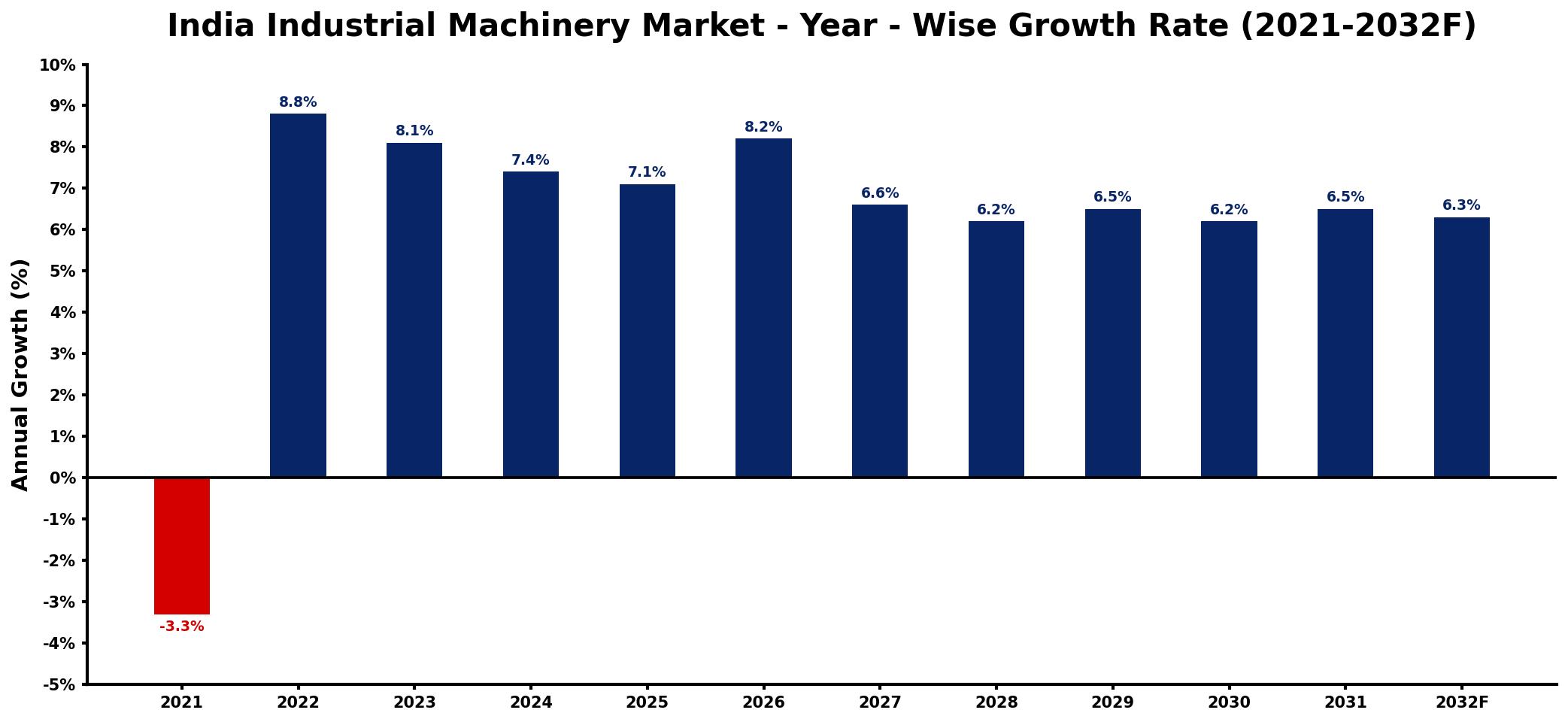
The table below presents the year‑wise growth rates along with the key drivers influencing the market
| Year | Growth Rate | Major Drivers |
| 2021 | -3.3% | decreased investment in infrastructure projects |
| 2022 | 8.8% | surge in renewable energy initiatives |
| 2023 | 8.1% | expansion of manufacturing capabilities |
| 2024 | 7.4% | increased demand for automation solutions |
| 2025 | 7.1% | growth in export-oriented industries |
| 2026 | 8.2% | rising adoption of smart technologies |
| 2027 | 6.6% | enhanced focus on sustainable practices |
| 2028 | 6.2% | development of urban infrastructure projects |
| 2029 | 6.5% | growing interest in robotics applications |
| 2030 | 6.2% | enhanced product quality standards |
| 2031 | 6.5% | increased funding for research initiatives |
| 2032 | 6.3% | rising demand for customized solutions |
Note: Market size estimations and growth projections presented in this report are based on 6Wresearch's proprietary forecasting methodology, utilizing the latest available industry data, government publications, and primary research inputs.
India Industrial Machinery Market Synopsis
The India industrial machinery market is witnessing transformative momentum, emerging from the shadows of the COVID-19 pandemic into a phase characterized by robust growth. Key drivers include increased spending on advanced machinery and an expanding workforce keen to embrace Industry 4.0 technologies, which are reshaping manufacturing landscapes.
With a favorable regulatory environment and rising foreign direct investments, the market is poised for sustained expansion. Companies are responding to changing consumer demands and competitive pressures by innovating and enhancing production capabilities, thereby solidifying India's position in the global industrial machinery arena.
India Industrial Machinery Market Key Takeaways
- The market is projected to grow significantly, influenced by rising investments in advanced manufacturing technologies.
- Government initiatives are fostering a conducive environment for domestic manufacturing, leading to increased machinery demand.
- Technological advancements are driving the adoption of automation and smart machinery across various sectors.
- Investment in vocational training is crucial to address the skill gap in operating sophisticated machinery.
- The market is recovering and adapting post-pandemic, emphasizing efficiency and productivity improvements.
Evaluation of Restraints in India Industrial Machinery Market
While the India industrial machinery market holds great potential, it is not without its challenges. The rapid technological advancements in the sector necessitate continuous adaptation from manufacturers and suppliers. Many companies struggle to keep pace with the integration of automation and AI, which are becoming standard expectations. Additionally, the initial capital investment needed for advanced machinery can be a significant barrier, particularly for small and medium-sized enterprises. The skills gap remains a pressing concern, as there is an increasing need for trained personnel to operate and maintain new technologies effectively. Addressing these constraints is vital for harnessing the full potential of the market.
India Industrial Machinery Market Trends
Several current and emerging trends are shaping the demand for industrial machinery in India. The integration of Internet of Things (IoT) technology is becoming commonplace, leading to smarter and more connected machinery. Additionally, sustainability is gaining traction, with industries increasingly focusing on energy-efficient solutions and practices. Robotics and automation are reshaping operational efficiencies, driving companies to invest heavily in these technologies. Furthermore, the ongoing push towards renewable energy sources is generating demand for specialized machinery in solar, wind, and waste management sectors, underscoring a shift toward more sustainable manufacturing approaches.
India Industrial Machinery Market Opportunities
Growth opportunities within the India industrial machinery market are abundant, particularly in the realm of automation and Industry 4.0 solutions. Companies that innovate and leverage technology can capture a significant share of the evolving market landscape. Furthermore, partnerships and collaborations between domestic and international firms can facilitate knowledge transfer and enhance production capabilities. The increasing focus on renewable energy and environmentally friendly practices also presents new avenues for growth, as industries seek to align with global sustainability standards. Investing in training and development will not only improve skill levels but also position companies to capitalize on future demands.
Government Initiatives in the India Industrial Machinery Market
The Indian government plays a pivotal role in shaping the industrial machinery landscape through various initiatives aimed at promoting local manufacturing and attracting foreign investment. The "Make in India" campaign is a prime example of efforts to strengthen domestic production capabilities while facilitating global partnerships. In addition, relaxed regulatory policies towards foreign direct investments are expected to enhance the market environment. Other initiatives include investments in infrastructure development and technology parks, which will ultimately bolster the industrial machinery sector's growth and competitiveness on both domestic and international fronts.
Future Insights of the India Industrial Machinery Market
Looking ahead to 2026-2032, the India industrial machinery market is set to evolve rapidly, driven by technological advancements and a robust focus on automation. As industries prioritize efficiency and cost-effectiveness, the demand for innovative machinery solutions is likely to surge. The integration of AI, IoT, and sustainable practices will play a significant role in shaping future investments. Additionally, as the global economy stabilizes post-pandemic, we anticipate a resurgence in manufacturing activities, further propelling market growth. Companies that invest in technological capabilities and workforce development will be well-positioned to thrive in this dynamic environment.
India Industrial Machinery Market Latest Developments (2025 - 2026)
Recent developments in the India industrial machinery sector highlight a trend towards automation and efficiency. Companies are increasingly adopting smart technologies and robotics to enhance production processes. In addition, several industry collaborations have emerged aimed at knowledge sharing and innovation. The government is also rolling out new infrastructure projects which are expected to boost demand for industrial machinery. Overall, the market appears poised for a period of dynamic growth and adaptation as businesses continue to navigate post-pandemic recovery.
India Industrial Machinery Market - Key Attractiveness of the Report
- 10 Years of Market Numbers
- Historical Data Starting from 2022 to 2025
- Base Year: 2025
- Forecast Data until 2032
- Key Performance Indicators Impacting the Market
- Major Upcoming Developments and Projects
Key Highlights of the Report:
- India Industrial Machinery Market Outlook
- Market Size of India Industrial Machinery Market, 2025
- Forecast of India Industrial Machinery Market, 2032
- Historical Data and Forecast of India Industrial Machinery Revenues & Volume for the Period 2022-2032F
- India Industrial Machinery Market Trend Evolution
- India Industrial Machinery Market Drivers and Challenges
- India Industrial Machinery Price Trends
- India Industrial Machinery Porter's Five Forces
- India Industrial Machinery Industry Life Cycle
- Historical Data and Forecast of India Industrial Machinery Market Revenues & Volume By Application for the Period 2022-2032F
- Historical Data and Forecast of India Industrial Machinery Market Revenues & Volume By Agriculture for the Period 2022-2032F
- Historical Data and Forecast of India Industrial Machinery Market Revenues & Volume By Construction for the Period 2022-2032F
- Historical Data and Forecast of India Industrial Machinery Market Revenues & Volume By Packaging for the Period 2022-2032F
- Historical Data and Forecast of India Industrial Machinery Market Revenues & Volume By Food Processing for the Period 2022-2032F
- Historical Data and Forecast of India Industrial Machinery Market Revenues & Volume By Mining for the Period 2022-2032F
- Historical Data and Forecast of India Industrial Machinery Market Revenues & Volume By Semiconductor Manufacturing for the Period 2022-2032F
- India Industrial Machinery Import Export Trade Statistics
- Market Opportunity Assessment By Application
- India Industrial Machinery Top Companies Market Share
- India Industrial Machinery Competitive Benchmarking By Technical and Operational Parameters
- India Industrial Machinery Company Profiles
- India Industrial Machinery Key Strategic Recommendations






































