India IoT Data Management Market Size & Growth Rate (2026-2032)
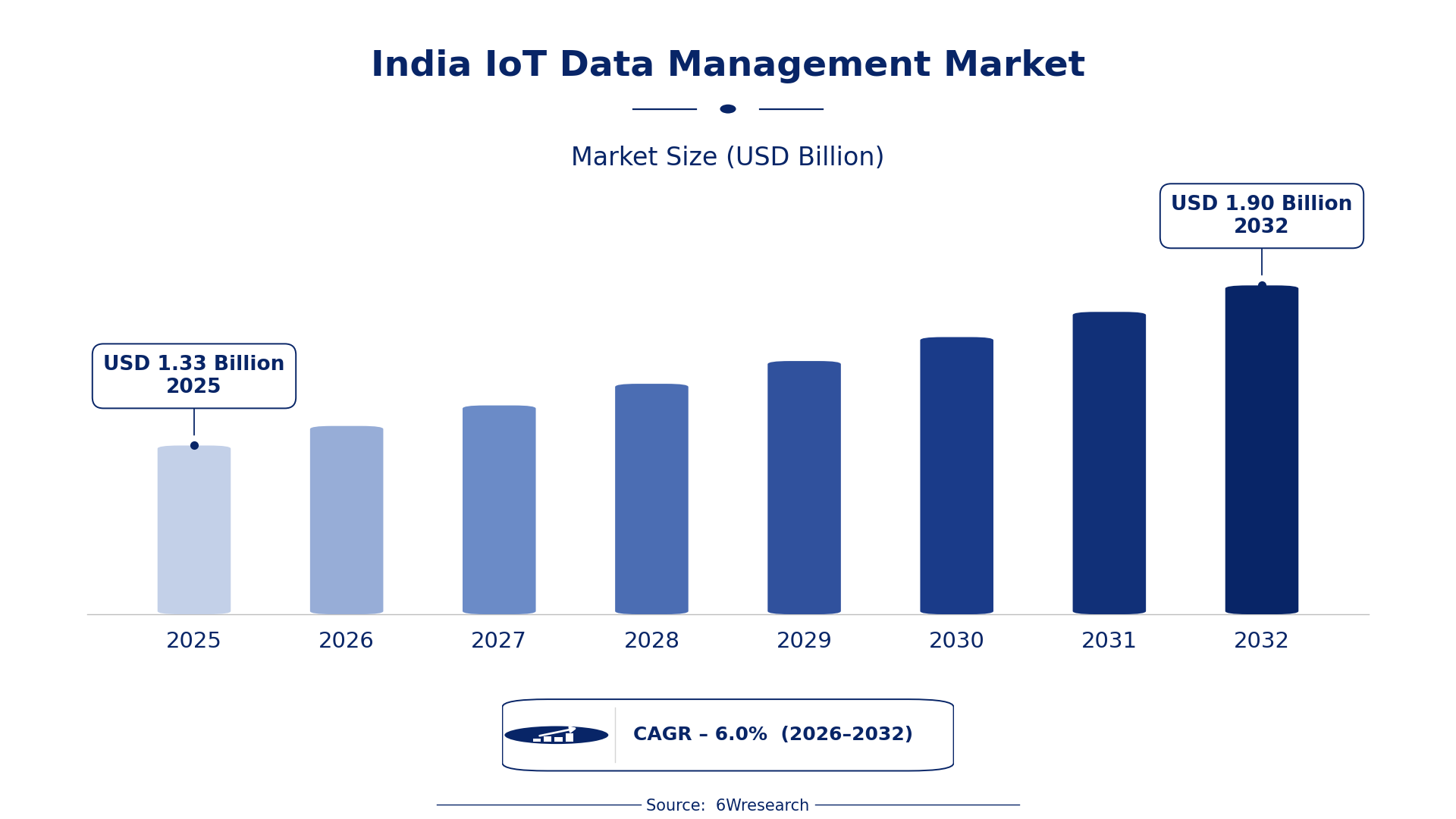
The India IoT Data Management Market was estimated at USD 1328 Million in 2025 and is projected to reach USD 1895 Million by 2032, growing at a CAGR of 6.0% from 2026 to 2032.
India IoT Data Management Market Synopsis
The demand for effective IoT data management solutions in India is rapidly increasing as organizations strive to harness the wealth of data generated by connected devices. Companies are recognizing that without robust data management strategies, they risk losing out on valuable insights that can inform decision-making and enhance operational efficiency.
As more industries adopt IoT technologies, the challenges surrounding data collection, storage, and analysis are becoming more pronounced. The need for secure, scalable, and efficient data management solutions is critical to enable businesses to thrive in this competitive environment.
India IoT Data Management Market Year-wise Growth Rate and Key Drivers
This graph illustrates the annual growth rates of the India IoT Data Management Market from 2021 to 2032, highlighting a steady upward trajectory and projected expansion over the forecast period.
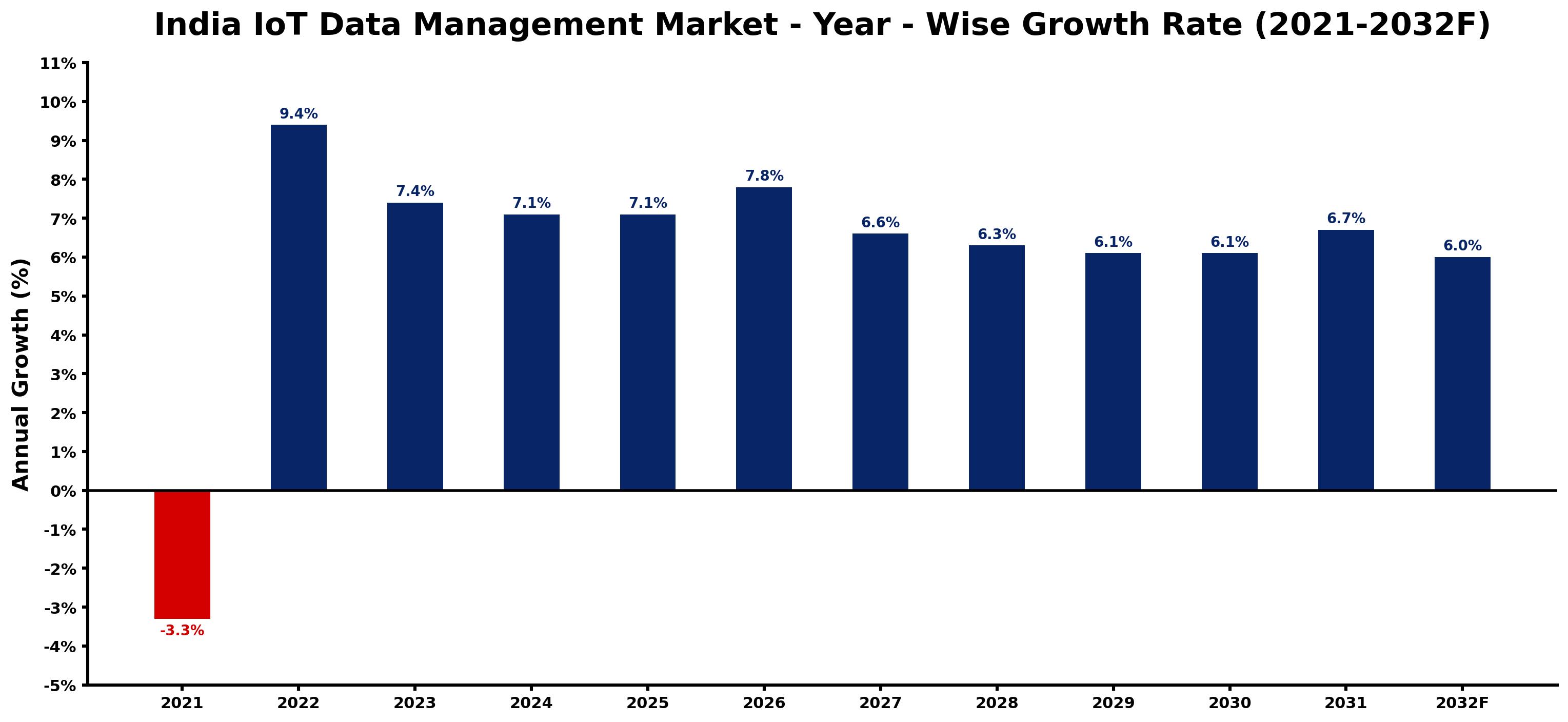
The table below presents the year‑wise growth rates along with the key drivers influencing the market
| Year | Growth Rate | Major Drivers |
| 2021 | -3.3% | Pandemic disruptions reduced IoT investment budgets significantly. |
| 2022 | 9.4% | Increase in smart agriculture initiatives using IoT solutions. |
| 2023 | 7.4% | Rising urbanization driving need for smart city infrastructure. |
| 2024 | 7.1% | Growing device connectivity due to 5G rollout across India. |
| 2025 | 7.1% | Large-scale government projects promoting IoT in logistics. |
| 2026 | 7.8% | Expanding fintech sector requiring enhanced IoT data security. |
| 2027 | 6.6% | Surge in health tech adoption leveraging IoT data management. |
| 2028 | 6.3% | Regulatory support for IoT in renewable energy systems. |
| 2029 | 6.1% | Upsurge in remote monitoring solutions for agriculture sector. |
| 2030 | 6.1% | Increased IoT investment from Indian telecom companies. |
| 2031 | 6.7% | Emergence of smart homes increasing IoT data utilization. |
| 2032 | 6.0% | Growth of electric vehicles boosting IoT telemetry needs. |
Note: Market size estimations and growth projections presented in this report are based on 6Wresearch's proprietary forecasting methodology, utilizing the latest available industry data, government publications, and primary research inputs.
India IoT Data Management Market Key Takeaways
Below are some of the specific key takeaways from the market, including:
- Rapid growth fueled by the increasing volume of IoT-generated data across various sectors.
- Integration with big data and cloud technologies is enhancing data handling capabilities.
- Real-time analytics are becoming essential for competitive advantage.
- Businesses are prioritizing data security and compliance in their IoT strategies.
- Investment in IoT infrastructure is expanding to address connectivity challenges.
Evaluation of Restraints in India IoT Data Management Market
Despite the promising growth trajectory, several factors are hindering the progress of the IoT data management market in India. A lack of consistent cellular network coverage remains a significant barrier, particularly in remote areas where stable connectivity is essential for effective data transmission. This limitation can lead to gaps in data availability, which directly affects decision-making processes.
on top of that, the sensitivity of data being transmitted, especially in applications like telematics, raises concerns about data security. Businesses face hurdles related to the initial investment required for implementing comprehensive data management solutions, which can deter smaller enterprises from fully adopting IoT technologies.
India IoT Data Management Market Trends
The integration of artificial intelligence and machine learning into data management processes is gaining traction, enabling organizations to automate data analysis and derive actionable insights. This trend is coupled with a growing emphasis on edge computing, where data processing occurs closer to the source, reducing latency and improving responsiveness.
Additionally, the focus on regulatory compliance is driving the adoption of more sophisticated data management frameworks. Organizations are investing in solutions that not only meet current regulations but also adapt to future compliance requirements, ensuring sustainable growth in a complex regulatory environment.
India IoT Data Management Market Opportunities
The potential for growth in the India IoT data management market is substantial, particularly as more industries begin to recognize the value of data-driven decision-making. Industries such as healthcare, manufacturing, and transportation are increasingly adopting IoT solutions, creating demand for tailored data management approaches.
Investment in smart city initiatives also presents significant opportunities. As urban areas develop and integrate IoT technologies for infrastructure management, the demand for reliable data management solutions will continue to rise, providing avenues for innovation and expansion.
Government Initiatives in the India IoT Data Management Market
Government policy is playing a crucial role in shaping the IoT data management market in India. With a focus on enhancing digital infrastructure and regulatory frameworks, public sector initiatives are designed to facilitate the growth of IoT technologies. These efforts are essential for ensuring that businesses can operate efficiently and securely in an increasingly data-centric world.
- A national digital infrastructure upgrade programme recently launched aims to improve connectivity in rural and urban areas, enhancing data transmission capabilities.
- Current initiatives are underway to establish a regulatory framework for data privacy and security, addressing concerns surrounding IoT data management.
- A planned public-private initiative expected to expand telecom infrastructure access by 2028 will support IoT device connectivity.
- Ongoing government efforts to promote research and development in IoT technologies are enhancing innovation in data management solutions.
- A newly proposed policy framework to incentivize investments in IoT data management solutions is anticipated to be introduced by late 2025.
Future Insights of the India IoT Data Management Market
Looking ahead to 2026-2032, the India IoT data management market is expected to continue its upward trajectory. As businesses increasingly adopt IoT solutions, the demand for efficient data management practices will intensify. Companies that prioritize innovation in data analytics and security will likely gain a competitive edge.
The convergence of IoT with advanced technologies such as AI and blockchain will further transform data management strategies, enabling organizations to harness real-time insights and enhance operational efficiency. As the regulatory environment matures, businesses will be better equipped to navigate compliance challenges, paving the way for sustainable growth.
India IoT Data Management Market Latest Developments
In the past year, the India IoT data management market has seen a flurry of activity as companies strive to enhance their data capabilities. The emphasis on security, integration, and real-time analytics is driving innovation across the sector. Businesses are actively seeking partnerships and solutions that align with their evolving data management needs.
- A major technology vendor launched an advanced analytics platform in early 2025, aimed at improving data processing speeds for IoT applications.
- An initiative that began in mid-2025 focuses on developing standardized protocols for IoT data security, ensuring consistency across various sectors.
- A rollout expected to begin in Q3 2025 aims to enhance cloud-based data management services for small and medium enterprises.
- Recently completed in late 2025, a collaborative project between industry stakeholders aimed to create a centralized IoT data exchange platform.
- Upcoming training programs for businesses scheduled for 2026 will focus on best practices in IoT data management and compliance.
India IoT Data Management Market - Key Attractiveness of the Report
- 10 Years of Market Numbers
- Historical Data Starting from 2022 to 2025
- Base Year: 2025
- Forecast Data until 2032
- Key Performance Indicators Impacting the Market
- Major Upcoming Developments and Projects
Key Highlights of the Report:
- India IoT Data Management Market Outlook
- Market Size of India IoT Data Management Market, 2025
- Forecast of India IoT Data Management Market, 2032
- Historical Data and Forecast of India IoT Data Management Revenues & Volume for the Period 2022-2032F
- India IoT Data Management Market Trend Evolution
- India IoT Data Management Market Drivers and Challenges
- India IoT Data Management Price Trends
- India IoT Data Management Porter's Five Forces
- India IoT Data Management Industry Life Cycle
- Historical Data and Forecast of India IoT Data Management Market Revenues & Volume By Solution for the Period 2022-2032F
- Historical Data and Forecast of India IoT Data Management Market Revenues & Volume By Data integration for the Period 2022-2032F
- Historical Data and Forecast of India IoT Data Management Market Revenues & Volume By Data analytics and visualization for the Period 2022-2032F
- Historical Data and Forecast of India IoT Data Management Market Revenues & Volume By Metadata management for the Period 2022-2032F
- Historical Data and Forecast of India IoT Data Management Market Revenues & Volume By Data security for the Period 2022-2032F
- Historical Data and Forecast of India IoT Data Management Market Revenues & Volume By Data migration for the Period 2022-2032F
- Historical Data and Forecast of India IoT Data Management Market Revenues & Volume By Others (data governance, data quality, and data orchestration) for the Period 2022-2032F
- Historical Data and Forecast of India IoT Data Management Market Revenues & Volume By Component for the Period 2022-2032F
- Historical Data and Forecast of India IoT Data Management Market Revenues & Volume By Solutions for the Period 2022-2032F
- Historical Data and Forecast of India IoT Data Management Market Revenues & Volume By Services for the Period 2022-2032F
- Historical Data and Forecast of India IoT Data Management Market Revenues & Volume By Service for the Period 2022-2032F
- Historical Data and Forecast of India IoT Data Management Market Revenues & Volume By Managed services for the Period 2022-2032F
- Historical Data and Forecast of India IoT Data Management Market Revenues & Volume By Consulting services for the Period 2022-2032F
- Historical Data and Forecast of India IoT Data Management Market Revenues & Volume By Support and maintenance services for the Period 2022-2032F
- Historical Data and Forecast of India IoT Data Management Market Revenues & Volume By Deployment Type for the Period 2022-2032F
- Historical Data and Forecast of India IoT Data Management Market Revenues & Volume By Public cloud for the Period 2022-2032F
- Historical Data and Forecast of India IoT Data Management Market Revenues & Volume By Private cloud for the Period 2022-2032F
- Historical Data and Forecast of India IoT Data Management Market Revenues & Volume By Hybrid cloud for the Period 2022-2032F
- Historical Data and Forecast of India IoT Data Management Market Revenues & Volume By Organization Size for the Period 2022-2032F
- Historical Data and Forecast of India IoT Data Management Market Revenues & Volume By Small and Medium-sized Enterprises (SMEs) for the Period 2022-2032F
- Historical Data and Forecast of India IoT Data Management Market Revenues & Volume By Large enterprises for the Period 2022-2032F
- Historical Data and Forecast of India IoT Data Management Market Revenues & Volume By Application Area for the Period 2022-2032F
- Historical Data and Forecast of India IoT Data Management Market Revenues & Volume By Smart energy and utilities for the Period 2022-2032F
- Historical Data and Forecast of India IoT Data Management Market Revenues & Volume By Smart manufacturing for the Period 2022-2032F
- Historical Data and Forecast of India IoT Data Management Market Revenues & Volume By Building and home automation for the Period 2022-2032F
- Historical Data and Forecast of India IoT Data Management Market Revenues & Volume By Smart healthcare for the Period 2022-2032F
- Historical Data and Forecast of India IoT Data Management Market Revenues & Volume By Smart retail for the Period 2022-2032F
- Historical Data and Forecast of India IoT Data Management Market Revenues & Volume By Smart mobility and transportation for the Period 2022-2032F
- Historical Data and Forecast of India IoT Data Management Market Revenues & Volume By Connected logistics for the Period 2022-2032F
- Historical Data and Forecast of India IoT Data Management Market Revenues & Volume By Others for the Period 2022-2032F
- India IoT Data Management Import Export Trade Statistics
- Market Opportunity Assessment By Solution
- Market Opportunity Assessment By Component
- Market Opportunity Assessment By Service
- Market Opportunity Assessment By Deployment Type
- Market Opportunity Assessment By Organization Size
- Market Opportunity Assessment By Application Area
- India IoT Data Management Top Companies Market Share
- India IoT Data Management Competitive Benchmarking By Technical and Operational Parameters
- India IoT Data Management Company Profiles
- India IoT Data Management Key Strategic Recommendations






































