India Licensed Merchandise Market Size, Share & Growth Rate
The India Licensed Merchandise Market was estimated at USD 1318 Million in 2025 and is projected to reach USD 1881 Million by 2032, growing at a CAGR of 5.2% from 2026 to 2032. This growth trajectory is fueled by an increasing appetite among consumers for products that resonate with their favorite entertainment properties, sports teams, and cultural icons. As both domestic and international franchises expand their influence, the demand for licensed products is expected to rise significantly, complemented by the robust growth of e-commerce channels enhancing product accessibility.
India Licensed Merchandise Market Year-wise Growth Rate and Key Drivers
This graph highlights how the India Licensed Merchandise Market has steadily grown over the years, supported by major growth factors.
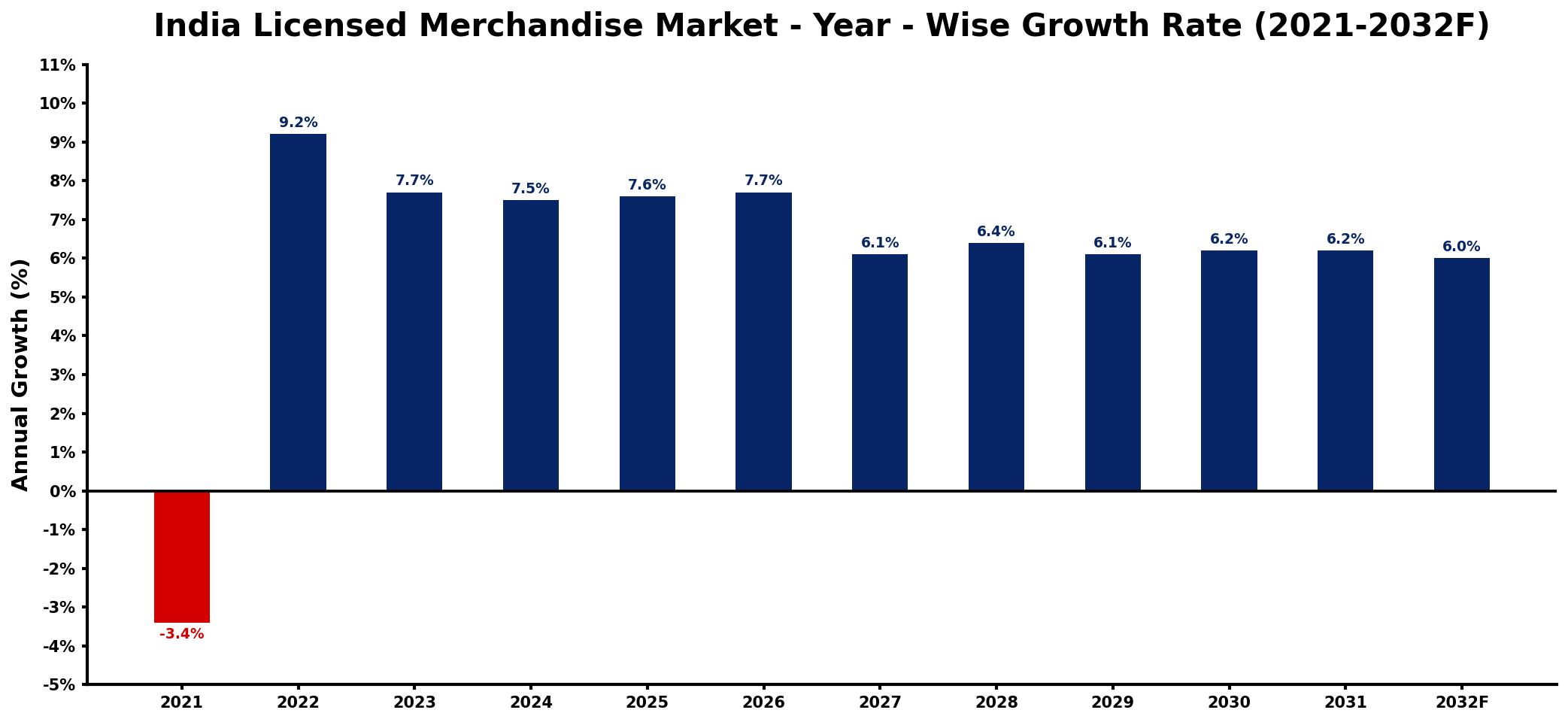
The table below presents the year‑wise growth rates along with the key drivers influencing the market
| Year | Growth Rate | Major Drivers |
| 2021 | -3.4% | decrease in consumer spending habits |
| 2022 | 9.2% | rise in brand collaborations popularity |
| 2023 | 7.7% | growing online retail platforms emergence |
| 2024 | 7.5% | increase in youth consumer engagement |
| 2025 | 7.6% | expansion of entertainment industry partnerships |
| 2026 | 7.7% | enhanced marketing strategies adoption |
| 2027 | 6.1% | broadening of cultural licensing opportunities |
| 2028 | 6.4% | growth in experiential retail concepts |
| 2029 | 6.1% | increased focus on sustainability initiatives |
| 2030 | 6.2% | development of innovative product designs |
| 2031 | 6.2% | growing commercial sector adoption |
| 2032 | 6.0% | escalating demand for unique experiences |
Note: Market size estimations and growth projections presented in this report are based on 6Wresearch's proprietary forecasting methodology, utilizing the latest available industry data, government publications, and primary research inputs.
India Licensed Merchandise Market Synopsis
In India, the licensed merchandise market has evolved into a vibrant sector, reflecting the diverse preferences of consumers who seek to express their fandom through various products. From apparel and toys to collectibles and home décor, the array of licensed goods available is constantly expanding, catering to a wide audience of fans spanning different age groups.
The landscape is increasingly characterized by strategic collaborations between manufacturers and entertainment brands, resulting in innovative and localized merchandise. This trend allows for a rich tapestry of options that resonate with Indian consumers, while also promoting cultural relevance in the merchandise being offered.
India Licensed Merchandise Market Key Takeaways
- Significant projected growth fueled by increasing consumer engagement with entertainment franchises.
- Rise of e-commerce platforms facilitates wider distribution and accessibility of licensed products.
- Collaboration between brands and entertainment studios is enhancing product variety and appeal.
- Localized merchandise is gaining traction, catering to the unique preferences of Indian consumers.
- Counterfeit concerns necessitate strict adherence to intellectual property laws, impacting market dynamics.
Evaluation of Restraints in India Licensed Merchandise Market
Despite the optimistic outlook for the India licensed merchandise market, several restraints must be navigated. The complexities surrounding copyright and intellectual property rights pose significant challenges for manufacturers and retailers. Navigating the maze of licensing requirements can be cumbersome, and the ongoing battle against counterfeit products undermines the efforts of legitimate players in the market. As brands seek to protect their intellectual property, the industry must address these challenges to maintain consumer trust and ensure sustainable growth.
India Licensed Merchandise Market Trends
Current trends in the India licensed merchandise market highlight a growing intersection of technology and consumer engagement. Augmented reality experiences are emerging, allowing fans to interact with licensed products in novel ways. Social media platforms are also pivotal in driving merchandise sales, as influencers and brands connect directly with potential buyers. Additionally, sustainability is becoming a crucial focus, with consumers increasingly seeking ethically sourced and environmentally friendly products.
India Licensed Merchandise Market Opportunities
The opportunities for growth in the India licensed merchandise market are abundant. As the appetite for unique and culturally relevant products grows, manufacturers can capitalize on localized collaborations that resonate with regional consumers. Expanding into niche markets, such as traditional Indian characters and folklore, presents a fresh avenue for innovation. Furthermore, investment in omnichannel retail strategies can enhance customer experiences and drive brand loyalty.
Government Initiatives in the India Licensed Merchandise Market
The Indian government has been active in promoting the creative and entertainment industries, recognizing their potential to contribute significantly to economic growth. Initiatives aimed at enhancing intellectual property protection are being implemented, which could provide a more secure environment for companies operating in the licensed merchandise sector. Additionally, public spending on entertainment and culture is rising, potentially spurring the demand for licensed products connected to local arts and heritage.
Future Insights of the India Licensed Merchandise Market
Looking ahead to the period from 2026 to 2032, the India licensed merchandise market is poised for robust growth driven by evolving consumer behaviors and preferences. As the landscape of entertainment continues to expand, new franchises will emerge, capturing the interest of younger audiences and leading to increased merchandise opportunities. Enhanced distribution channels, particularly through digital platforms, will further facilitate market penetration, enabling brands to reach a more extensive customer base.
India Licensed Merchandise Market Latest Developments (2025 - 2026)
The licensed merchandise market in India is witnessing dynamic shifts, with brands increasingly exploring strategic partnerships to develop exclusive product lines. Innovative marketing campaigns leveraging social media and influencer collaborations are gaining traction, contributing to heightened consumer engagement. Furthermore, the introduction of localized merchandise continues to gain momentum, reflecting the diverse cultural landscape of India while appealing to a broad demographic.
India Licensed Merchandise Market - Key Attractiveness of the Report
- 10 Years of Market Numbers
- Historical Data Starting from 2022 to 2025
- Base Year: 2025
- Forecast Data until 2032
- Key Performance Indicators Impacting the Market
- Major Upcoming Developments and Projects
Key Highlights of the Report:
- India Licensed Merchandise Market Outlook
- Market Size of India Licensed Merchandise Market, 2025
- Forecast of India Licensed Merchandise Market, 2032
- Historical Data and Forecast of India Licensed Merchandise Revenues & Volume for the Period 2022-2032F
- India Licensed Merchandise Market Trend Evolution
- India Licensed Merchandise Market Drivers and Challenges
- India Licensed Merchandise Price Trends
- India Licensed Merchandise Porter's Five Forces
- India Licensed Merchandise Industry Life Cycle
- Historical Data and Forecast of India Licensed Merchandise Market Revenues & Volume By Product Type for the Period 2022-2032F
- Historical Data and Forecast of India Licensed Merchandise Market Revenues & Volume By Apparel and Footwear for the Period 2022-2032F
- Historical Data and Forecast of India Licensed Merchandise Market Revenues & Volume By Accessories and Gifts for the Period 2022-2032F
- Historical Data and Forecast of India Licensed Merchandise Market Revenues & Volume By Toys and Games for the Period 2022-2032F
- Historical Data and Forecast of India Licensed Merchandise Market Revenues & Volume By Others for the Period 2022-2032F
- Historical Data and Forecast of India Licensed Merchandise Market Revenues & Volume By for the Period 2022-2032F
- Historical Data and Forecast of India Licensed Merchandise Market Revenues & Volume By Distribution Channel for the Period 2022-2032F
- Historical Data and Forecast of India Licensed Merchandise Market Revenues & Volume By Online Stores for the Period 2022-2032F
- Historical Data and Forecast of India Licensed Merchandise Market Revenues & Volume By Supermarkets and Hypermarkets for the Period 2022-2032F
- Historical Data and Forecast of India Licensed Merchandise Market Revenues & Volume By Departmental Stores for the Period 2022-2032F
- Historical Data and Forecast of India Licensed Merchandise Market Revenues & Volume By Specialty Stores for the Period 2022-2032F
- Historical Data and Forecast of India Licensed Merchandise Market Revenues & Volume By Others for the Period 2022-2032F
- Historical Data and Forecast of India Licensed Merchandise Market Revenues & Volume By for the Period 2022-2032F
- Historical Data and Forecast of India Licensed Merchandise Market Revenues & Volume By Price Range for the Period 2022-2032F
- Historical Data and Forecast of India Licensed Merchandise Market Revenues & Volume By Premium for the Period 2022-2032F
- Historical Data and Forecast of India Licensed Merchandise Market Revenues & Volume By Economic for the Period 2022-2032F
- Historical Data and Forecast of India Licensed Merchandise Market Revenues & Volume By for the Period 2022-2032F
- Historical Data and Forecast of India Licensed Merchandise Market Revenues & Volume By End-User for the Period 2022-2032F
- Historical Data and Forecast of India Licensed Merchandise Market Revenues & Volume By Men for the Period 2022-2032F
- Historical Data and Forecast of India Licensed Merchandise Market Revenues & Volume By Women for the Period 2022-2032F
- Historical Data and Forecast of India Licensed Merchandise Market Revenues & Volume By Children for the Period 2022-2032F
- India Licensed Merchandise Import Export Trade Statistics
- Market Opportunity Assessment By Product Type
- Market Opportunity Assessment By Distribution Channel
- Market Opportunity Assessment By Price Range
- Market Opportunity Assessment By End-User
- India Licensed Merchandise Top Companies Market Share
- India Licensed Merchandise Competitive Benchmarking By Technical and Operational Parameters
- India Licensed Merchandise Company Profiles
- India Licensed Merchandise Key Strategic Recommendations






































