India Low Power Wide Area Network Market Size & Growth Rate (2026-2032)
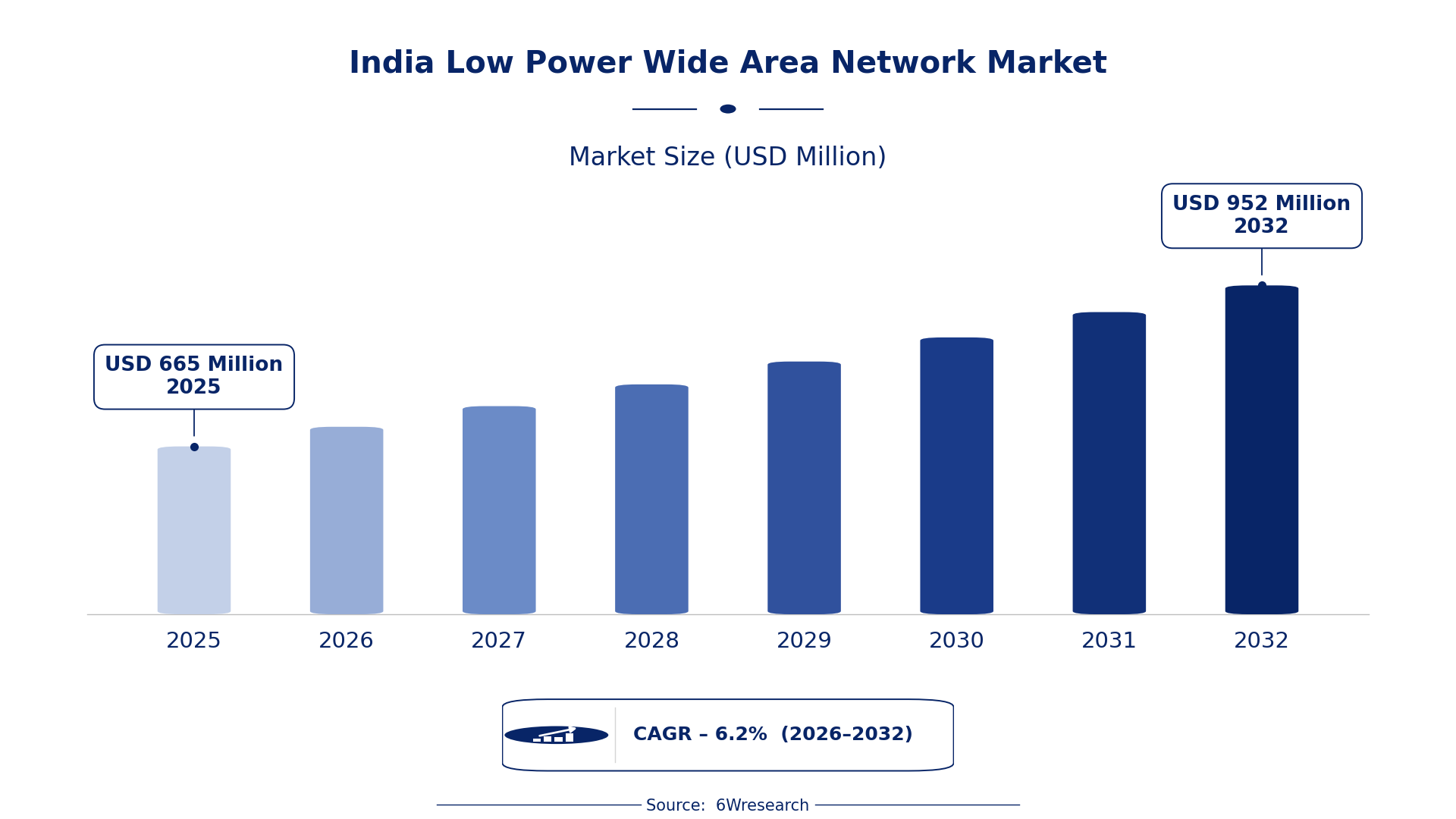
The India Low Power Wide Area Network Market was estimated at USD 665 Million in 2025 and is projected to reach USD 952 Million by 2032, growing at a CAGR of 6.2% from 2026 to 2032.
India Low Power Wide Area Network Market Synopsis
The India Low Power Wide Area Network (LPWAN) market has witnessed significant traction in recent years, driven by the surge in Internet of Things (IoT) applications. As industries across the country increasingly adopt smart technologies, LPWAN is set to become a backbone for various sectors, including agriculture, utilities, and logistics.
Looking ahead, the market is expected to transition from a phase of early adoption to widespread implementation. The focus will shift toward enhancing network coverage and interoperability, essential for maximizing the benefits of IoT deployments across both urban and rural landscapes.
India Low Power Wide Area Network Market Year-wise Growth Rate and Key Drivers
This graph illustrates the annual growth rates of the India Low Power Wide Area Network Market from 2021 to 2032, highlighting a steady upward trajectory and projected expansion over the forecast period.
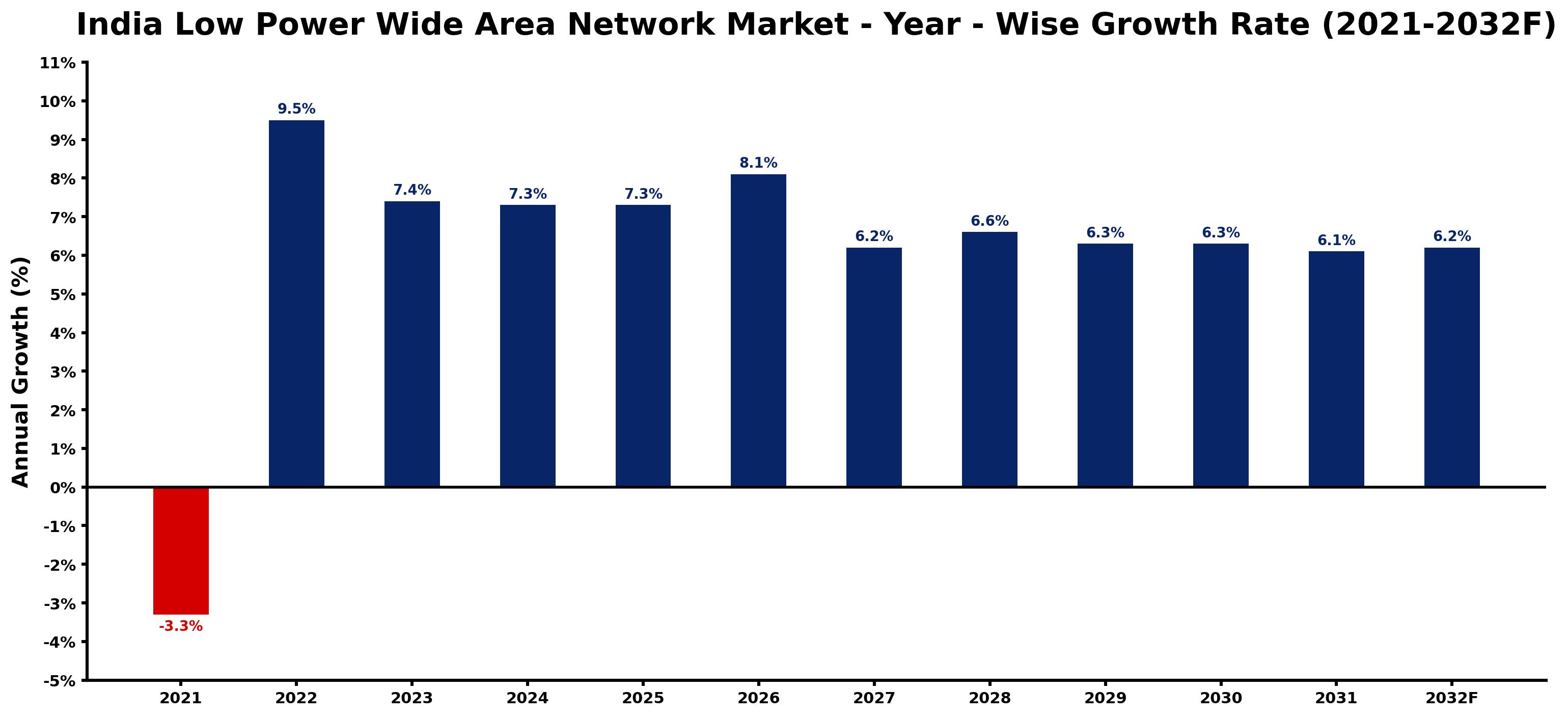
The table below presents the year‑wise growth rates along with the key drivers influencing the market
| Year | Growth Rate | Major Drivers |
| 2021 | -3.3% | Delayed implementation of PM-WANI initiative in India. |
| 2022 | 9.5% | Government incentives for LPWAN deployment in agriculture. |
| 2023 | 7.4% | Increase in smart metering initiatives by Indian utilities. |
| 2024 | 7.3% | Regulatory support for widespread IoT applications in healthcare. |
| 2025 | 7.3% | Launch of international LPWAN standards by Telecom Regulatory Authority. |
| 2026 | 8.1% | Growing emphasis on smart city projects in metropolitan areas. |
| 2027 | 6.2% | Increased investment in LPWAN infrastructure by private telecom companies. |
| 2028 | 6.6% | Government-backed initiatives for environmental monitoring solutions. |
| 2029 | 6.3% | Rising interest in remote asset management for energy sectors. |
| 2030 | 6.3% | Adoption of LPWAN for precision farming technologies. |
| 2031 | 6.1% | Growth in wildlife monitoring programs supported by government. |
| 2032 | 6.2% | Expanding demand for smart irrigation systems in agriculture. |
Note: Market size estimations and growth projections presented in this report are based on 6Wresearch's proprietary forecasting methodology, utilizing the latest available industry data, government publications, and primary research inputs.
India Low Power Wide Area Network Market Key Takeaways
Below are some of the specific key takeaways from the market, including:
- The expansion of IoT applications is a major driver for LPWAN growth in India.
- Technologies like LoRa and Sigfox are at the forefront of enabling various applications.
- Government initiatives aimed at digitalization are bolstering market momentum.
- Network coverage, especially in rural regions, remains a challenge that needs addressing.
- Interoperability between different LPWAN technologies is crucial for broader adoption.
Evaluation of Restraints in India Low Power Wide Area Network Market
The growth of the LPWAN market in India is hindered by several key limitations. A primary concern is the challenge of expanding network coverage to remote areas, where connectivity remains inconsistent. This creates barriers for IoT applications that depend on reliable communication. Additionally, the lack of interoperability between diverse LPWAN technologies complicates integration efforts, making it difficult for businesses to adopt a unified approach.
India Low Power Wide Area Network Market Trends
Several current and emerging trends are shaping the LPWAN market in India. The increasing emphasis on smart city initiatives has led to heightened investments in IoT solutions, driving demand for LPWAN technologies. Furthermore, as industries recognize the value of data-driven decision-making, the integration of analytics with LPWAN solutions is becoming more prevalent, enhancing operational efficiency.
Another noteworthy trend is the growing interest in sustainability and environmental monitoring. LPWAN can facilitate real-time data collection on environmental parameters, aiding efforts in smart agriculture and pollution control.
India Low Power Wide Area Network Market Opportunities
Investment opportunities within the LPWAN market are abundant, particularly in sectors where connectivity has traditionally lagged. Smart agriculture presents an immediate avenue for growth, allowing farmers to monitor conditions and optimize resource usage. Similarly, the utility sector's shift towards smart metering can significantly increase the demand for LPWAN solutions. As companies explore private networks for greater data security, opportunities for tailored LPWAN solutions will likely expand.
Government Initiatives in the India Low Power Wide Area Network Market
The Indian government plays a crucial role in shaping the LPWAN market through various initiatives aimed at promoting digital transformation. Policies focused on smart cities and national digital infrastructure enhancement directly impact the adoption of LPWAN technologies. As urbanization accelerates, these initiatives are critical for ensuring that the necessary connectivity frameworks are in place.
- A national digital infrastructure upgrade programme launched in 2023 is expected to enhance connectivity, supporting LPWAN expansion.
- Ongoing smart city projects throughout 2025 are integrating IoT solutions with LPWAN, encouraging broader adoption.
- A planned public-private partnership initiative slated for 2026 aims to bolster telecom infrastructure and increase LPWAN access.
- Regulatory frameworks established in 2024 support transparent billing practices in smart metering applications, enhancing user trust.
Future Insights of the India Low Power Wide Area Network Market
Looking towards 2026-2032, the LPWAN market in India is set to experience transformative growth. With increasing IoT adoption, coupled with governmental support, more industries will integrate LPWAN into their operational frameworks. Enhanced focus on sustainability and smart solutions will drive innovations in technology, leading to a more interconnected and efficient ecosystem. As the market matures, collaboration among stakeholders will be essential to overcome current challenges and capitalize on emerging opportunities.
India Low Power Wide Area Network Market Latest Developments
Recent activity in the India LPWAN market has shown a marked increase in innovation and collaboration. Companies are actively pursuing partnerships and technology integrations to enhance their LPWAN offerings. This trend reflects a concerted effort to address the growing demand for reliable IoT connectivity across various sectors.
- A major technology vendor launched an advanced LPWAN solution in early 2025, targeting smart agriculture applications.
- An ongoing pilot project focused on smart metering is currently underway, showcasing the benefits of LPWAN in utility management.
- A strategic partnership between telecom operators aimed at improving LPWAN coverage in rural areas is anticipated to finalize by mid-2025.
- Upcoming initiatives planned for late 2026 seek to establish a nationwide LPWAN framework for asset tracking in logistics.
India Low Power Wide Area Network Market - Key Attractiveness of the Report
- 10 Years of Market Numbers
- Historical Data Starting from 2022 to 2025
- Base Year: 2025
- Forecast Data until 2032
- Key Performance Indicators Impacting the Market
- Major Upcoming Developments and Projects
Key Highlights of the Report:
- India Low Power Wide Area Network Market Outlook
- Market Size of India Low Power Wide Area Network Market, 2025
- Forecast of India Low Power Wide Area Network Market, 2032
- Historical Data and Forecast of India Low Power Wide Area Network Revenues & Volume for the Period 2022-2032F
- India Low Power Wide Area Network Market Trend Evolution
- India Low Power Wide Area Network Market Drivers and Challenges
- India Low Power Wide Area Network Price Trends
- India Low Power Wide Area Network Porter's Five Forces
- India Low Power Wide Area Network Industry Life Cycle
- Historical Data and Forecast of India Low Power Wide Area Network Market Revenues & Volume By Connectivity Technology for the Period 2022-2032F
- Historical Data and Forecast of India Low Power Wide Area Network Market Revenues & Volume By SIGFOX for the Period 2022-2032F
- Historical Data and Forecast of India Low Power Wide Area Network Market Revenues & Volume By LoRaWAN for the Period 2022-2032F
- Historical Data and Forecast of India Low Power Wide Area Network Market Revenues & Volume By Weigthless for the Period 2022-2032F
- Historical Data and Forecast of India Low Power Wide Area Network Market Revenues & Volume By Others for the Period 2022-2032F
- Historical Data and Forecast of India Low Power Wide Area Network Market Revenues & Volume By Verticals for the Period 2022-2032F
- Historical Data and Forecast of India Low Power Wide Area Network Market Revenues & Volume By Agriculture for the Period 2022-2032F
- Historical Data and Forecast of India Low Power Wide Area Network Market Revenues & Volume By Smart Logistic and Transportation for the Period 2022-2032F
- Historical Data and Forecast of India Low Power Wide Area Network Market Revenues & Volume By Healthcare for the Period 2022-2032F
- Historical Data and Forecast of India Low Power Wide Area Network Market Revenues & Volume By Industrial Manufacturing for the Period 2022-2032F
- Historical Data and Forecast of India Low Power Wide Area Network Market Revenues & Volume By Oil and Gas for the Period 2022-2032F
- Historical Data and Forecast of India Low Power Wide Area Network Market Revenues & Volume By Consumer Electronics for the Period 2022-2032F
- Historical Data and Forecast of India Low Power Wide Area Network Market Revenues & Volume By Others for the Period 2022-2032F
- Historical Data and Forecast of India Low Power Wide Area Network Market Revenues & Volume By Application for the Period 2022-2032F
- Historical Data and Forecast of India Low Power Wide Area Network Market Revenues & Volume By Smart Waste Management for the Period 2022-2032F
- Historical Data and Forecast of India Low Power Wide Area Network Market Revenues & Volume By Smart Buildings for the Period 2022-2032F
- Historical Data and Forecast of India Low Power Wide Area Network Market Revenues & Volume By Smart Gas and Water Metering for the Period 2022-2032F
- Historical Data and Forecast of India Low Power Wide Area Network Market Revenues & Volume By Smart Streetlights for the Period 2022-2032F
- Historical Data and Forecast of India Low Power Wide Area Network Market Revenues & Volume By Smart Parking for the Period 2022-2032F
- Historical Data and Forecast of India Low Power Wide Area Network Market Revenues & Volume By Livestock Monitoring for the Period 2022-2032F
- Historical Data and Forecast of India Low Power Wide Area Network Market Revenues & Volume By Others for the Period 2022-2032F
- Historical Data and Forecast of India Low Power Wide Area Network Market Revenues & Volume By Network Deployment for the Period 2022-2032F
- Historical Data and Forecast of India Low Power Wide Area Network Market Revenues & Volume By Public Sector for the Period 2022-2032F
- Historical Data and Forecast of India Low Power Wide Area Network Market Revenues & Volume By Private Sector for the Period 2022-2032F
- Historical Data and Forecast of India Low Power Wide Area Network Market Revenues & Volume By Technology Service for the Period 2022-2032F
- Historical Data and Forecast of India Low Power Wide Area Network Market Revenues & Volume By Managed Services for the Period 2022-2032F
- Historical Data and Forecast of India Low Power Wide Area Network Market Revenues & Volume By Professional Services for the Period 2022-2032F
- India Low Power Wide Area Network Import Export Trade Statistics
- Market Opportunity Assessment By Connectivity Technology
- Market Opportunity Assessment By Verticals
- Market Opportunity Assessment By Application
- Market Opportunity Assessment By Network Deployment
- Market Opportunity Assessment By Technology Service
- India Low Power Wide Area Network Top Companies Market Share
- India Low Power Wide Area Network Competitive Benchmarking By Technical and Operational Parameters
- India Low Power Wide Area Network Company Profiles
- India Low Power Wide Area Network Key Strategic Recommendations






































