India LTE IoT Market Size & Growth Rate (2026-2032)
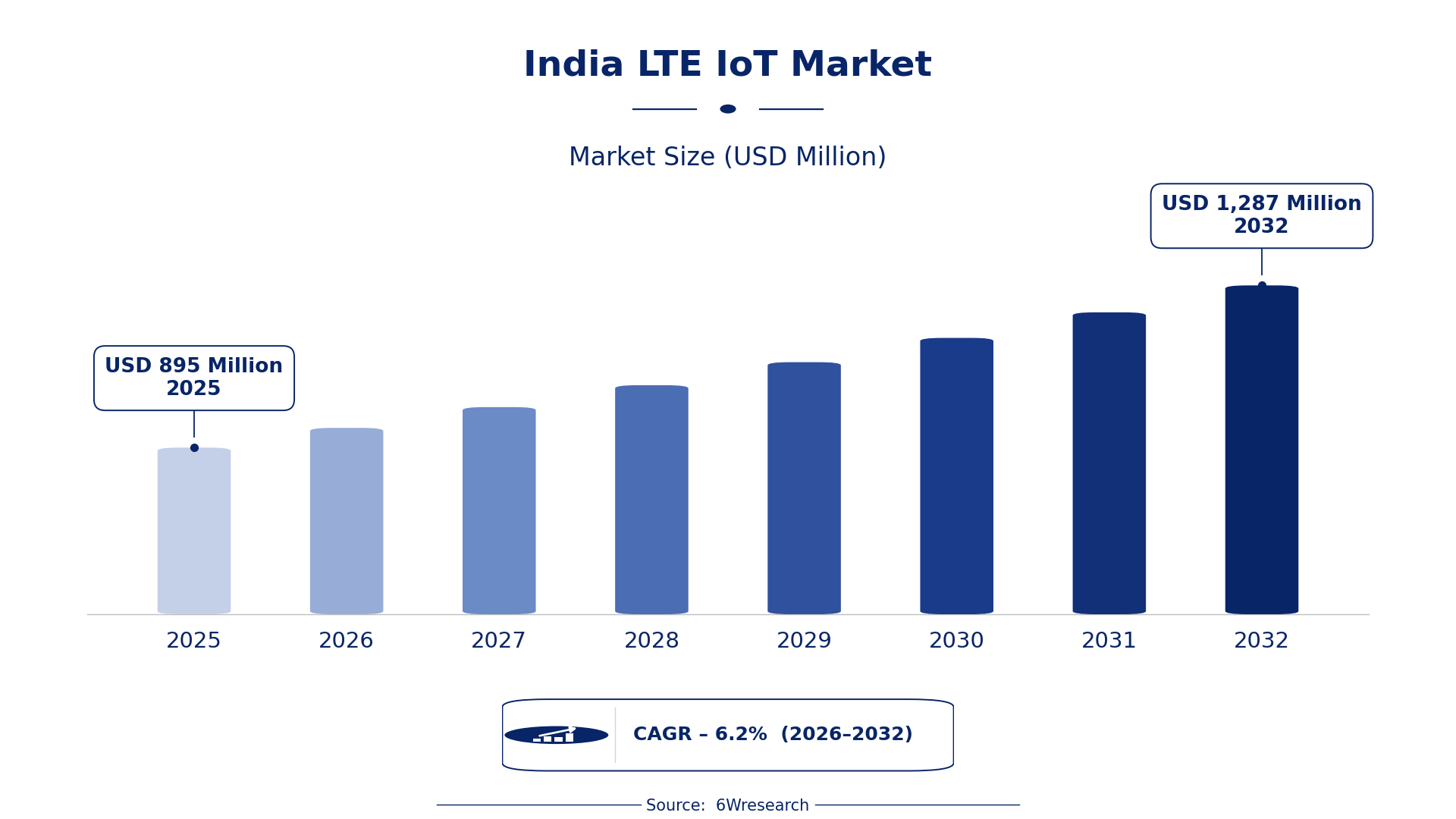
The India LTE IoT Market was estimated at USD 895 Million in 2025 and is projected to reach USD 1287 Million by 2032, growing at a CAGR of 6.2% from 2026 to 2032.
India LTE IoT Market Synopsis
The India LTE IoT Market is currently witnessing an upsurge in interest, particularly as sectors like agriculture and healthcare adapt rapidly to new technologies. This momentum, however, comes with its challenges as the market seeks to establish a more reliable framework for growth, ensuring it can meet the demands of various industries.
As India's IoT ecosystem expands, the LTE IoT market is stepping into a critical role, providing the connectivity needed for diverse applications. The drive for smart city initiatives complements this growth, aligning public and private sector efforts to harness the benefits of connectivity in a way that responds to real-world challenges.
India LTE IoT Market Year-wise Growth Rate and Key Drivers
This graph illustrates the annual growth rates of the India LTE IoT Market from 2021 to 2032, highlighting a steady upward trajectory and projected expansion over the forecast period.
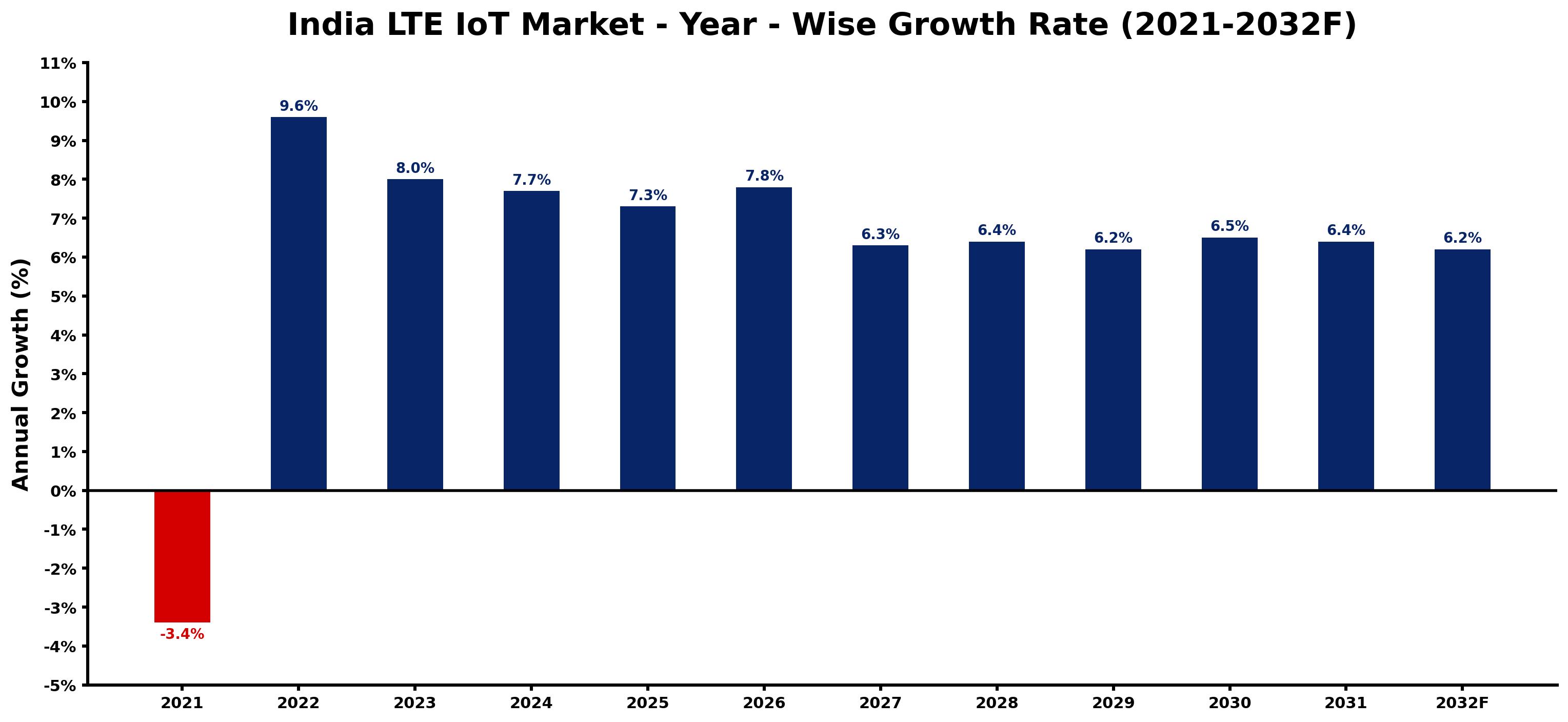
The table below presents the year‑wise growth rates along with the key drivers influencing the market
| Year | Growth Rate | Major Drivers |
| 2021 | -3.4% | Tougher regulations by TRAI stifling new IoT deployments |
| 2022 | 9.6% | Government push for smart agriculture solutions in India. |
| 2023 | 8.0% | Growing adoption of smart meters by Indian utilities. |
| 2024 | 7.7% | Increased IoT investments by Indian manufacturing firms. |
| 2025 | 7.3% | Surge in demand for smart city initiatives in India. |
| 2026 | 7.8% | Launch of India’s National Digital Communication Policy 2021. |
| 2027 | 6.3% | Rising interest in drone technology for logistics operations. |
| 2028 | 6.4% | Implementation of IoT in Indian rail infrastructure projects. |
| 2029 | 6.2% | Growth in smart grid technologies within Indian utilities. |
| 2030 | 6.5% | Emergence of health-tech startups driving IoT solutions. |
| 2031 | 6.4% | Local initiatives for AI and ML in IoT development. |
| 2032 | 6.2% | Increased focus on home automation products in India. |
Note: Market size estimations and growth projections presented in this report are based on 6Wresearch's proprietary forecasting methodology, utilizing the latest available industry data, government publications, and primary research inputs.
India LTE IoT Market Key Takeaways
Below are some of the specific key takeaways from the market, including:
- India is rapidly adopting LTE IoT technologies to enhance operational efficiencies in key sectors.
- Government initiatives are crucial for fostering a conducive environment for IoT deployments.
- Device compatibility and power efficiency remain significant hurdles for broader adoption.
- The COVID-19 pandemic has accelerated the need for remote monitoring solutions in various industries.
- Major players are focused on developing innovative technologies tailored to local market needs.
Evaluation of Restraints in India LTE IoT Market
Despite the growth potential, several restraints hinder the India LTE IoT market. A major concern is device compatibility; many IoT solutions struggle to integrate with existing infrastructure, leading to inefficiencies. Furthermore, network coverage poses challenges, especially in rural areas, limiting the reach of IoT applications. Additionally, power efficiency remains a top priority as devices require long operational lifespans on minimal energy. Data security also looms large, with growing concerns regarding the privacy and integrity of transmitted information that need to be addressed to foster greater trust in IoT systems.
India LTE IoT Market Trends
Several trends are shaping the India LTE IoT Market. The integration of LTE-M and NB-IoT technologies is on the rise, as these solutions provide the low-power, wide-area capabilities necessary for effective IoT communication. There's an increasing focus on smart agriculture, where IoT applications optimize resource use, significantly enhancing productivity. In the healthcare sector, solutions for remote monitoring and telemedicine are gaining traction, driven by the demand for more responsive healthcare delivery systems.
India LTE IoT Market Opportunities
The India LTE IoT market presents a range of opportunities for growth and investment. The smart cities initiative is likely to fuel demand for connected infrastructure, paving the way for innovative IoT applications. Agriculture stands out as a significant area where investments can lead to substantial efficiency gains. The healthcare sector also offers vast potential, particularly for remote monitoring solutions. As businesses and government agencies increasingly adopt IoT technologies, there will be ample room for companies that provide tailored solutions addressing specific industry challenges.
Government Initiatives in the India LTE IoT Market
Government policies are instrumental in shaping the India LTE IoT market. As the country pushes for a digital transformation, various public initiatives aim to support and foster the IoT ecosystem. By prioritizing smart city development, the government not only facilitates investment in necessary infrastructure but also creates a favorable environment for innovation and collaboration between sectors.
- A national digital infrastructure upgrade programme was recently completed, aimed at enhancing connectivity for IoT applications across urban and rural areas.
- Currently, a multi-agency task force is working on regulatory frameworks to address data privacy and security concerns related to IoT deployments.
- Ongoing initiatives are focused on incentivizing research and development in IoT technology, with partnerships between government bodies and private sectors.
- A planned public-private initiative aims to expand the IoT infrastructure for agriculture by 2026, focusing on smart farming technologies.
Future Insights of the India LTE IoT Market
From 2026 to 2032, the India LTE IoT market is expected to evolve significantly. As more sectors embrace IoT solutions, we anticipate a surge in investment in related technologies, particularly in areas like smart cities and healthcare. Greater collaboration between public and private sectors will likely yield innovative projects that address local challenges while fostering economic growth. The continuous advancement of LTE technologies will further enhance connectivity, enabling a broader range of applications and use cases.
India LTE IoT Market Latest Developments
In the past year, the India LTE IoT market has seen considerable activity as organizations strive to adapt to shifting demands and leverage new technologies. Recent partnerships and innovations indicate a focused effort on making IoT solutions more accessible and effective for various sectors, underscoring the market's potential for growth.
- A major technology vendor launched a new IoT platform in Q1 2025, designed to facilitate seamless integration with existing systems.
- A leading regional operator initiated a rollout of LTE-M services in mid-2025, targeting urban centers to boost IoT connectivity.
- An ongoing initiative focused on developing low-cost sensors for agriculture started in early 2025 and remains underway, aimed at enhancing crop monitoring.
- By late 2025, a public-private partnership is expected to establish new smart city projects, enhancing urban infrastructure with IoT capabilities.
India LTE IoT Market - Key Attractiveness of the Report
- 10 Years of Market Numbers
- Historical Data Starting from 2022 to 2025
- Base Year: 2025
- Forecast Data until 2032
- Key Performance Indicators Impacting the Market
- Major Upcoming Developments and Projects
Key Highlights of the Report:
- India LTE IoT Market Outlook
- Market Size of India LTE IoT Market, 2025
- Forecast of India LTE IoT Market, 2032
- Historical Data and Forecast of India LTE IoT Revenues & Volume for the Period 2022-2032F
- India LTE IoT Market Trend Evolution
- India LTE IoT Market Drivers and Challenges
- India LTE IoT Price Trends
- India LTE IoT Porter's Five Forces
- India LTE IoT Industry Life Cycle
- Historical Data and Forecast of India LTE IoT Market Revenues & Volume By Technology for the Period 2022-2032F
- Historical Data and Forecast of India LTE IoT Market Revenues & Volume By NB-IoT for the Period 2022-2032F
- Historical Data and Forecast of India LTE IoT Market Revenues & Volume By LTE-M for the Period 2022-2032F
- Historical Data and Forecast of India LTE IoT Market Revenues & Volume By Service for the Period 2022-2032F
- Historical Data and Forecast of India LTE IoT Market Revenues & Volume By Professional Services for the Period 2022-2032F
- Historical Data and Forecast of India LTE IoT Market Revenues & Volume By Managed Services for the Period 2022-2032F
- Historical Data and Forecast of India LTE IoT Market Revenues & Volume By Industry for the Period 2022-2032F
- Historical Data and Forecast of India LTE IoT Market Revenues & Volume By Manufacturing for the Period 2022-2032F
- Historical Data and Forecast of India LTE IoT Market Revenues & Volume By Energy and utilities for the Period 2022-2032F
- Historical Data and Forecast of India LTE IoT Market Revenues & Volume By Transportation and logistics for the Period 2022-2032F
- Historical Data and Forecast of India LTE IoT Market Revenues & Volume By Healthcare for the Period 2022-2032F
- Historical Data and Forecast of India LTE IoT Market Revenues & Volume By Agriculture for the Period 2022-2032F
- India LTE IoT Import Export Trade Statistics
- Market Opportunity Assessment By Technology
- Market Opportunity Assessment By Service
- Market Opportunity Assessment By Industry
- India LTE IoT Top Companies Market Share
- India LTE IoT Competitive Benchmarking By Technical and Operational Parameters
- India LTE IoT Company Profiles
- India LTE IoT Key Strategic Recommendations






































