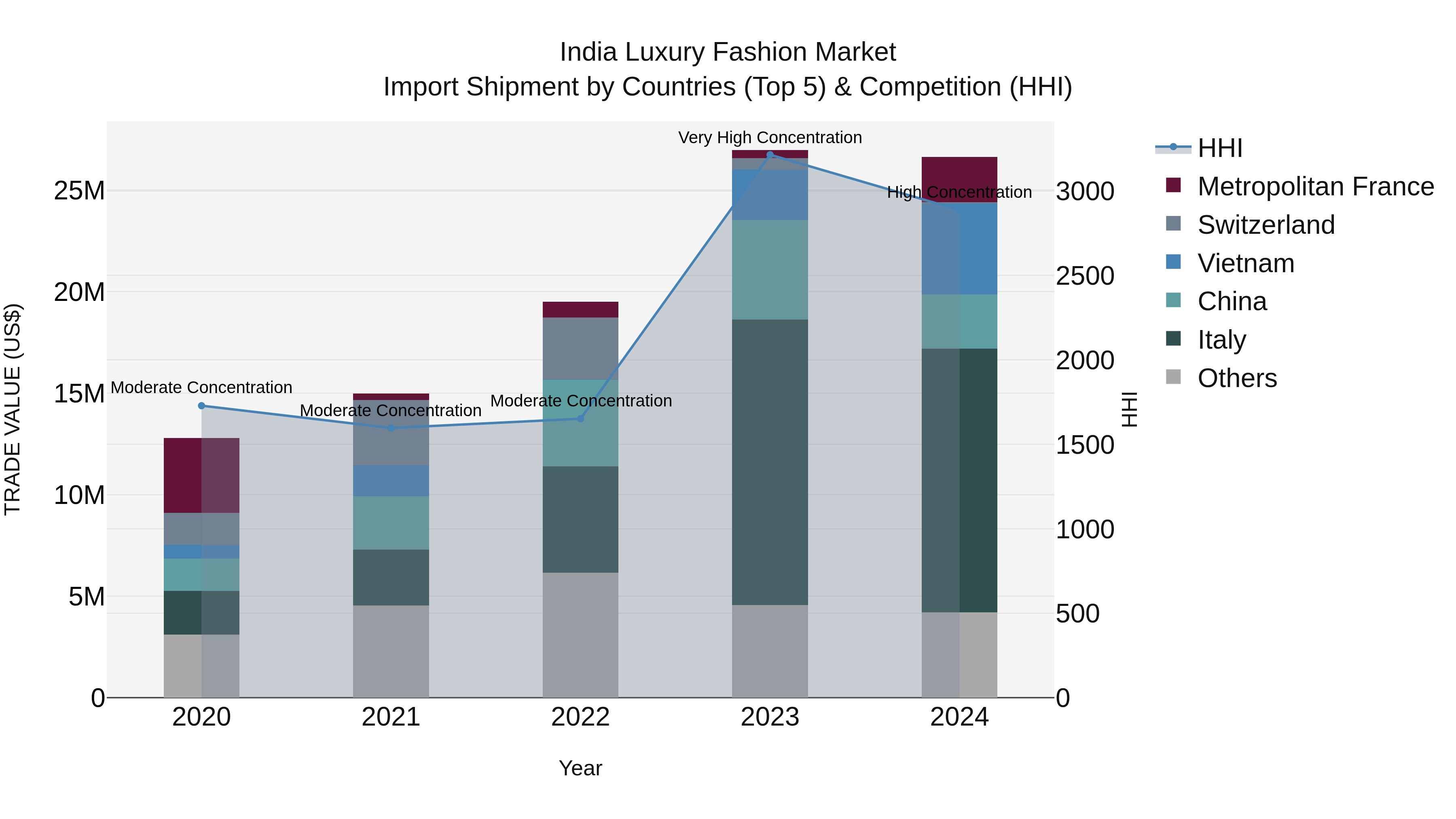
India Luxury Fashion Market Top 5 Importing Countries and Market Competition (HHI) Analysis
Despite a slight decline in growth rate from 2023 to 2024, India`s luxury fashion import market continues to thrive with a high concentration of shipments coming from top exporting countries such as Italy, Vietnam, China, Metropolitan France, and Indonesia. The impressive 20.14% CAGR from 2020 to 2024 indicates sustained demand for luxury fashion goods in India. The market`s shift from very high concentration in 2023 to high concentration in 2024 suggests evolving dynamics and opportunities for both domestic and international fashion brands to capitalize on the growing luxury segment in the Indian market.
India Luxury Fashion Market Synopsis
The India Luxury Fashion Market has been experiencing significant growth due to the increasing purchasing power of the population, changing lifestyles, and evolving fashion preferences. Luxury brands are expanding their presence in India, both through physical stores and online platforms, catering to the growing demand for high-end fashion products. The market is characterized by a mix of international luxury brands and Indian designer labels, offering a wide range of products including apparel, accessories, footwear, and jewelry. Key cities like Mumbai, Delhi, and Bangalore serve as major hubs for luxury fashion retail, attracting affluent consumers and tourists alike. With a young and fashion-conscious demographic driving the demand for luxury goods, the India Luxury Fashion Market is poised for continued expansion and innovation in the coming years.
India Luxury Fashion Market Trends
The India Luxury Fashion Market is experiencing significant growth driven by increasing disposable incomes, changing lifestyles, and a growing desire for luxury goods among the younger population. With the rise of social media and e-commerce platforms, luxury fashion brands are increasingly focusing on digital marketing and online sales to reach a wider audience. The market also presents opportunities for customization and personalization, as consumers seek unique and exclusive products. Collaborations between luxury brands and Indian designers or artists are becoming more common, catering to the local tastes and preferences. Additionally, there is a growing interest in sustainability and ethical practices, leading to a rise in demand for eco-friendly and socially responsible luxury fashion options in the Indian market.
India Luxury Fashion Market Challenges
The India Luxury Fashion Market faces several challenges, including intense competition from both domestic and international luxury brands, a lack of established luxury retail infrastructure in tier II and tier III cities, and price sensitivity among Indian consumers. Additionally, high import duties and complex regulations on luxury goods hinder the growth of the market. The presence of a large unorganized market for counterfeit luxury products also poses a threat to the authenticity and exclusivity of genuine luxury brands in India. Furthermore, the rapidly evolving consumer preferences and the need for brands to adapt to local cultural nuances make it challenging for luxury fashion companies to establish a strong foothold in the Indian market.
India Luxury Fashion Market Investment Opportunities
The India Luxury Fashion Market is primarily driven by the increasing disposable income and purchasing power of the affluent middle class population. Rapid urbanization and a growing young demographic with a keen interest in fashion trends are also contributing to the market growth. Furthermore, the influence of social media platforms and digital marketing strategies has played a significant role in creating awareness and desire for luxury fashion brands among consumers. The rising number of international luxury brands entering the Indian market and the expansion of luxury retail outlets across major cities are further fueling the growth of the luxury fashion market in India. Additionally, the shift towards online shopping and the convenience of e-commerce platforms have made luxury fashion more accessible to a wider consumer base, driving overall market demand.
India Luxury Fashion Market Government Polices
The Indian luxury fashion market is influenced by various government policies aimed at promoting the growth of the sector. These policies include the relaxation of Foreign Direct Investment (FDI) regulations, allowing foreign luxury brands to set up wholly-owned retail stores in India. Additionally, the implementation of the Goods and Services Tax (GST) has streamlined the tax structure, making it easier for luxury fashion brands to operate in the country. The government`s Make in India initiative also encourages domestic manufacturing of luxury goods, providing opportunities for local artisans and designers. Overall, these policies are aimed at attracting more investment, boosting domestic production, and enhancing the competitiveness of the Indian luxury fashion market on a global scale.
India Luxury Fashion Market Future Outlook
The future outlook for the India Luxury Fashion Market appears promising, driven by a growing consumer base with increasing disposable income and a burgeoning interest in luxury goods. The market is expected to witness significant growth as global luxury brands continue to expand their presence in the country, catering to the evolving tastes and preferences of Indian consumers. With the rise of e-commerce platforms and digital marketing strategies, luxury fashion brands have greater accessibility to reach a wider audience across India`s diverse demographics. Additionally, the emphasis on sustainability and ethical practices in the fashion industry is likely to influence consumer choices, leading to a demand for more environmentally conscious luxury brands. Overall, the India Luxury Fashion Market is poised for steady growth and innovation in the coming years.
Key Highlights of the Report:
- India Luxury Fashion Market Outlook
- Market Size of India Luxury Fashion Market, 2024
- Forecast of India Luxury Fashion Market, 2031
- Historical Data and Forecast of India Luxury Fashion Revenues & Volume for the Period 2021- 2031
- India Luxury Fashion Market Trend Evolution
- India Luxury Fashion Market Drivers and Challenges
- India Luxury Fashion Price Trends
- India Luxury Fashion Porter's Five Forces
- India Luxury Fashion Industry Life Cycle
- Historical Data and Forecast of India Luxury Fashion Market Revenues & Volume By Product Type for the Period 2021- 2031
- Historical Data and Forecast of India Luxury Fashion Market Revenues & Volume By Clothing and Apparel for the Period 2021- 2031
- Historical Data and Forecast of India Luxury Fashion Market Revenues & Volume By Footwear for the Period 2021- 2031
- Historical Data and Forecast of India Luxury Fashion Market Revenues & Volume By Accessories for the Period 2021- 2031
- Historical Data and Forecast of India Luxury Fashion Market Revenues & Volume By Distribution Channel for the Period 2021- 2031
- Historical Data and Forecast of India Luxury Fashion Market Revenues & Volume By Store-Based for the Period 2021- 2031
- Historical Data and Forecast of India Luxury Fashion Market Revenues & Volume By Non-Store Based for the Period 2021- 2031
- Historical Data and Forecast of India Luxury Fashion Market Revenues & Volume By End User for the Period 2021- 2031
- Historical Data and Forecast of India Luxury Fashion Market Revenues & Volume By Men for the Period 2021- 2031
- Historical Data and Forecast of India Luxury Fashion Market Revenues & Volume By Women for the Period 2021- 2031
- Historical Data and Forecast of India Luxury Fashion Market Revenues & Volume By Unisex for the Period 2021- 2031
- India Luxury Fashion Import Export Trade Statistics
- Market Opportunity Assessment By Product Type
- Market Opportunity Assessment By Distribution Channel
- Market Opportunity Assessment By End User
- India Luxury Fashion Top Companies Market Share
- India Luxury Fashion Competitive Benchmarking By Technical and Operational Parameters
- India Luxury Fashion Company Profiles
- India Luxury Fashion Key Strategic Recommendations