India Luxury Perfume Market Top 5 Importing Countries and Market Competition (HHI) Analysis
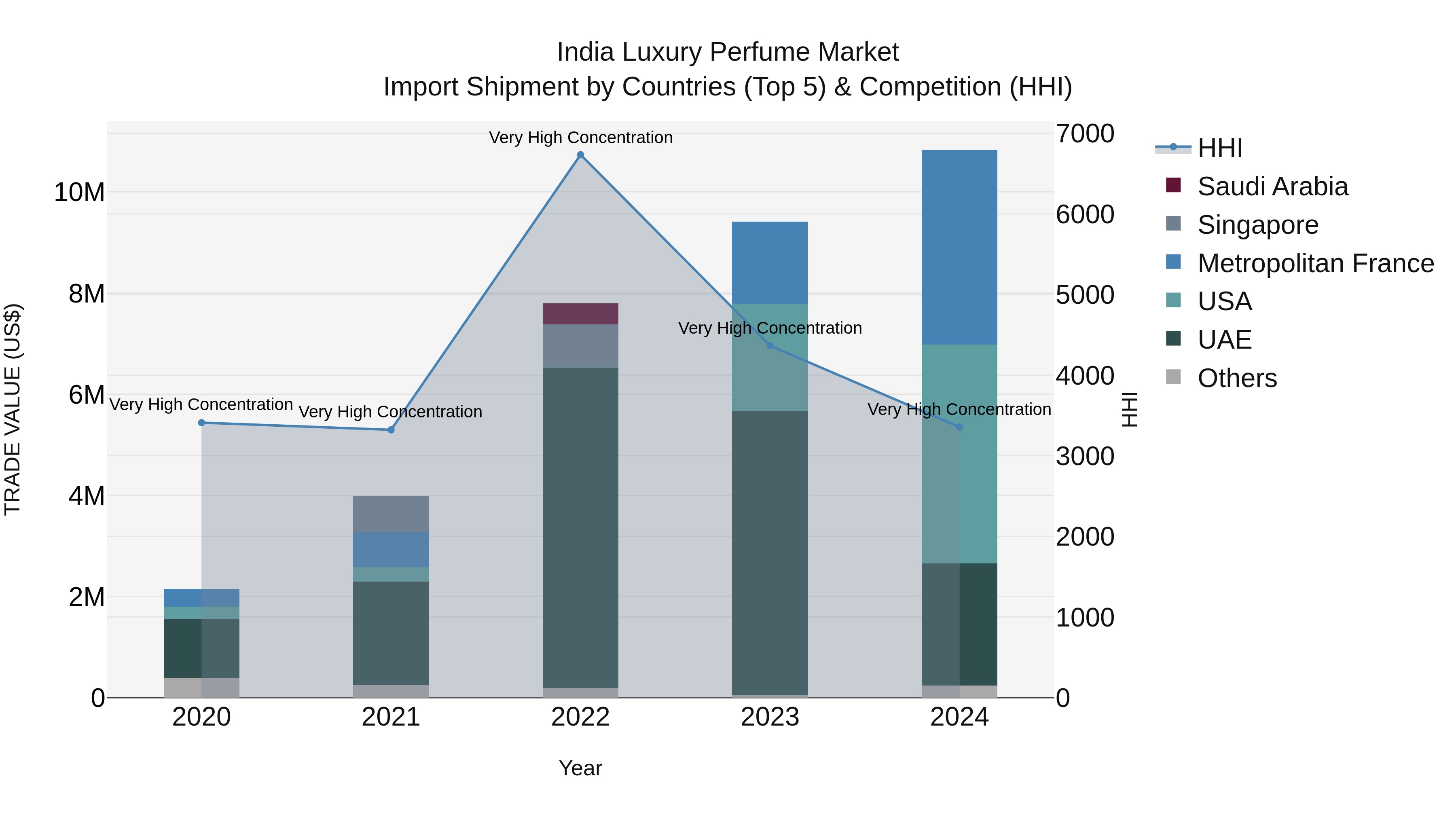
India`s luxury perfume import shipments saw significant growth in 2024, with top exporting countries including the USA, Metropolitan France, UAE, Mauritius, and the Netherlands. The high Herfindahl-Hirschman Index (HHI) indicates a concentrated market, while the impressive compound annual growth rate (CAGR) of 49.79% from 2020 to 2024 reflects robust expansion. The growth rate of 15.0% from 2023 to 2024 highlights the continued momentum in the luxury perfume market in India, signaling opportunities for both domestic and international players to capitalize on the growing demand for high-end fragrances.
India Luxury Perfume Market Synopsis
The India luxury perfume market is experiencing significant growth driven by increasing disposable incomes, changing consumer preferences, and a growing awareness of international luxury brands. The market is characterized by a diverse range of high-end fragrances offered by both domestic and international players, catering to a wide range of consumer segments. Key trends in the market include a shift towards premium and niche perfumes, the rising popularity of personalized and customized fragrances, and the expanding retail presence of luxury perfume brands in urban centers and online platforms. With a large and increasingly affluent consumer base, the India luxury perfume market presents lucrative opportunities for companies looking to tap into the country`s evolving fragrance landscape and capitalize on the growing demand for luxury personal care products.
India Luxury Perfume Market Trends
The India Luxury Perfume Market is experiencing growth due to increasing disposable incomes, changing lifestyles, and a growing preference for premium fragrances. Consumers are becoming more discerning and willing to invest in luxury perfumes as a form of self-expression and personal grooming. Key trends include a rising demand for niche and artisanal fragrances, sustainable and eco-friendly products, and customization options. Opportunities lie in tapping into the growing online retail sector, expanding distribution channels to reach tier 2 and tier 3 cities, and collaborating with popular influencers and celebrities for marketing campaigns. With the market expected to continue expanding, there is potential for international luxury perfume brands to establish a stronger presence in India by offering unique and exclusive products tailored to local preferences.
India Luxury Perfume Market Challenges
In the India Luxury Perfume Market, some of the key challenges include high import duties and taxes on luxury perfumes, which result in increased prices for consumers. Additionally, there is a lack of awareness and understanding among Indian consumers about luxury perfumes compared to other beauty products. Limited availability of authentic luxury perfume brands and counterfeit products in the market also pose challenges for both consumers and legitimate brands. Furthermore, the preference for traditional attars and local fragrance options among Indian consumers adds another layer of competition for luxury perfume brands. Building brand loyalty and trust in a market with diverse preferences and price sensitivities presents a significant challenge for luxury perfume companies looking to establish a strong presence in India.
India Luxury Perfume Market Investment Opportunities
The drivers propelling the India Luxury Perfume Market include the growing disposable income and expanding middle-class population, leading to an increase in consumer spending on luxury goods. The rising influence of social media and celebrity endorsements is also fueling the demand for luxury perfumes among the younger demographic. Additionally, the shift towards premiumization and the preference for exclusive and niche fragrances are driving the growth of the luxury perfume market in India. Furthermore, the increasing awareness about personal grooming and self-care, as well as the desire for sophisticated and unique scents, are contributing to the surge in demand for luxury perfumes in the country. Overall, these factors are creating a favorable environment for the growth of the India Luxury Perfume Market.
India Luxury Perfume Market Government Polices
The Indian luxury perfume market is influenced by government policies related to import duties and regulations on the use of certain ingredients. The government imposes high import duties on luxury perfumes, impacting the pricing and accessibility of international brands in the market. Additionally, regulations on the use of certain ingredients in perfumes, such as animal-derived musk, may affect product formulations and marketing strategies of luxury perfume brands operating in India. As the government continues to focus on promoting domestic industries and sustainable practices, luxury perfume companies need to navigate these policies to establish a strong presence in the Indian market while ensuring compliance with regulatory requirements.
India Luxury Perfume Market Future Outlook
The future outlook for the India Luxury Perfume Market appears promising, driven by factors such as a growing middle-class population with increasing disposable income, changing consumer preferences towards premium and niche fragrances, and a rising trend of personal grooming and luxury lifestyle. The market is expected to witness continued growth as international luxury perfume brands expand their presence in India, leveraging digital marketing strategies and omnichannel distribution to reach a wider audience. Additionally, the demand for sustainable and natural ingredients in perfumes is likely to shape the market landscape, with consumers becoming more conscious of eco-friendly and ethical practices. Overall, the India Luxury Perfume Market is poised for steady growth and innovation, offering opportunities for both established players and new entrants to capitalize on the evolving consumer trends.
Key Highlights of the Report:
- India Luxury Perfume Market Outlook
- Market Size of India Luxury Perfume Market, 2024
- Forecast of India Luxury Perfume Market, 2031
- Historical Data and Forecast of India Luxury Perfume Revenues & Volume for the Period 2021- 2031
- India Luxury Perfume Market Trend Evolution
- India Luxury Perfume Market Drivers and Challenges
- India Luxury Perfume Price Trends
- India Luxury Perfume Porter's Five Forces
- India Luxury Perfume Industry Life Cycle
- Historical Data and Forecast of India Luxury Perfume Market Revenues & Volume By End User for the Period 2021- 2031
- Historical Data and Forecast of India Luxury Perfume Market Revenues & Volume By Men for the Period 2021- 2031
- Historical Data and Forecast of India Luxury Perfume Market Revenues & Volume By Women for the Period 2021- 2031
- Historical Data and Forecast of India Luxury Perfume Market Revenues & Volume By Unisex for the Period 2021- 2031
- Historical Data and Forecast of India Luxury Perfume Market Revenues & Volume By Distribution Channel for the Period 2021- 2031
- Historical Data and Forecast of India Luxury Perfume Market Revenues & Volume By Supermarkets for the Period 2021- 2031
- Historical Data and Forecast of India Luxury Perfume Market Revenues & Volume By Hypermarkets for the Period 2021- 2031
- Historical Data and Forecast of India Luxury Perfume Market Revenues & Volume By Specialty Stores for the Period 2021- 2031
- Historical Data and Forecast of India Luxury Perfume Market Revenues & Volume By Online retail for the Period 2021- 2031
- India Luxury Perfume Import Export Trade Statistics
- Market Opportunity Assessment By End User
- Market Opportunity Assessment By Distribution Channel
- India Luxury Perfume Top Companies Market Share
- India Luxury Perfume Competitive Benchmarking By Technical and Operational Parameters
- India Luxury Perfume Company Profiles
- India Luxury Perfume Key Strategic Recommendations






































