India Manufacturing Analytics Market Size & Growth Rate (2026-2032)
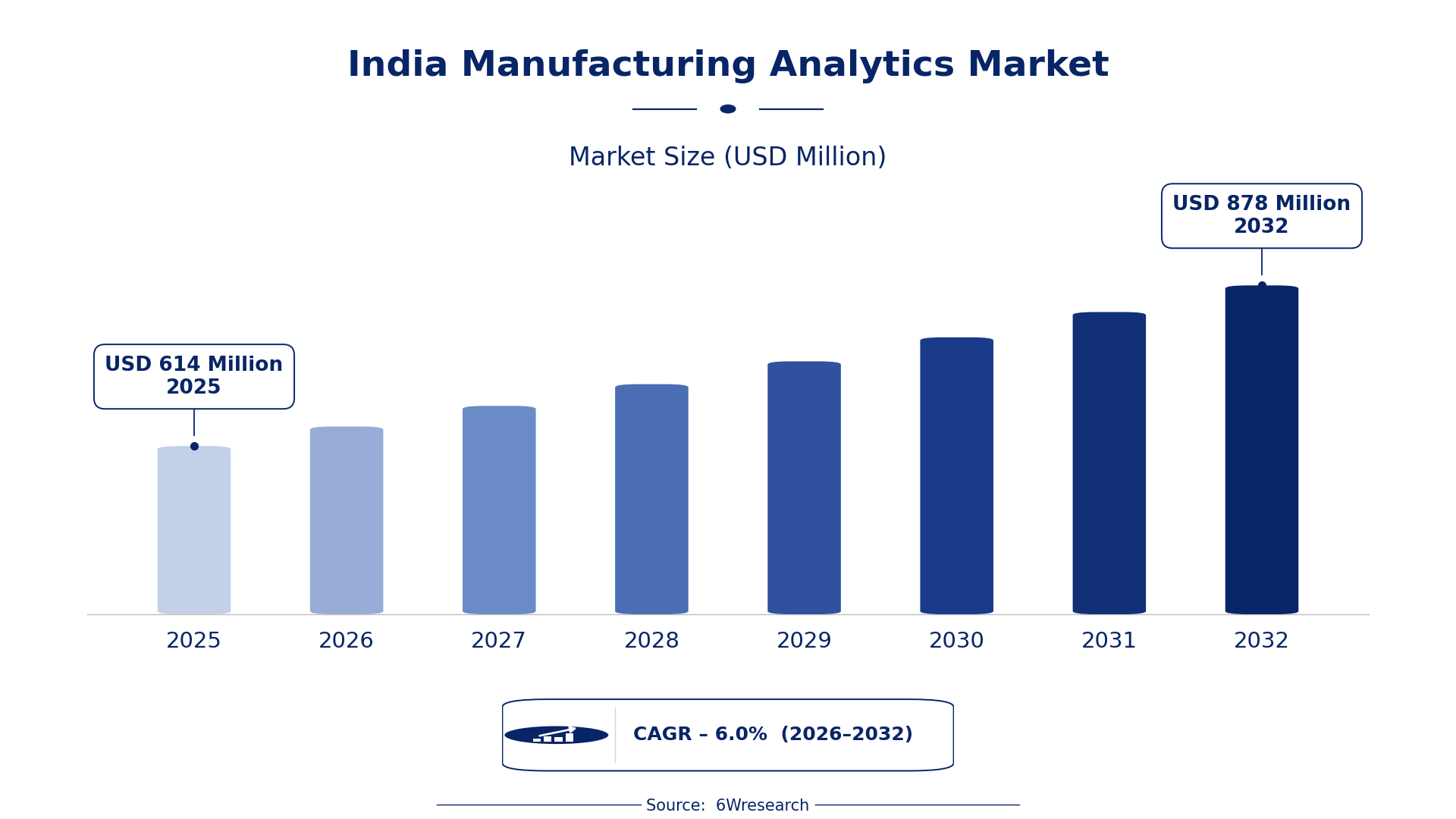
The India Manufacturing Analytics Market was estimated at USD 614 Million in 2025 and is projected to reach USD 878 Million by 2032, growing at a CAGR of 6.0% from 2026 to 2032.
India Manufacturing Analytics Market Synopsis
The manufacturing sector in India is increasingly adopting analytics to drive operational efficiency and cost-effectiveness. Companies are now prioritizing data-driven strategies to enhance production processes, with a strong focus on improving product quality and minimizing downtime.
As organizations integrate technologies such as the Industrial Internet of Things (IIoT), they gain valuable insights into their operations. This trend is reshaping how manufacturers respond to market demands, ensuring they remain competitive in a fast-paced environment.
India Manufacturing Analytics Market Year-wise Growth Rate and Key Drivers
This graph illustrates the annual growth rates of the India Manufacturing Analytics Market from 2021 to 2032, highlighting a steady upward trajectory and projected expansion over the forecast period.
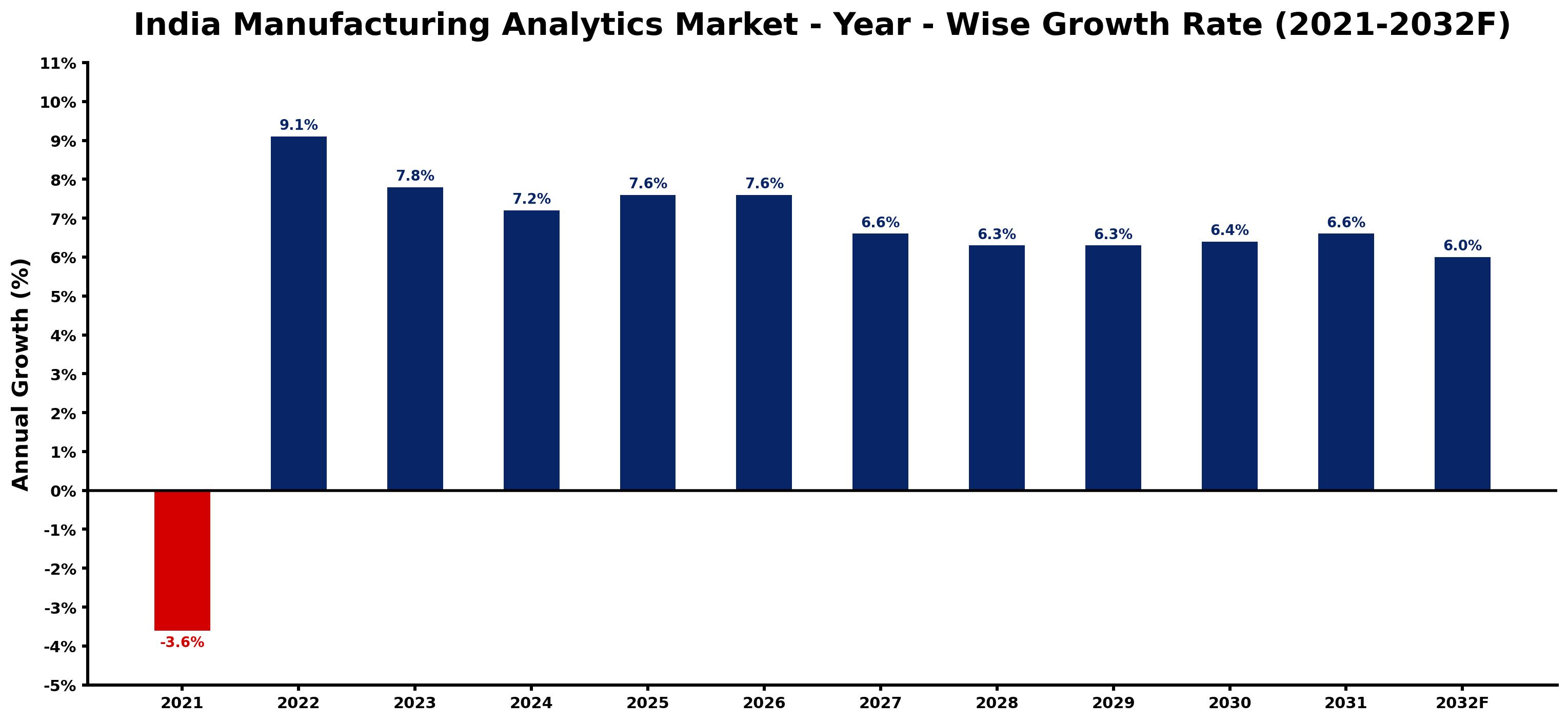
The table below presents the year‑wise growth rates along with the key drivers influencing the market
| Year | Growth Rate | Major Drivers |
| 2021 | -3.6% | Delayed government incentives under Make in India scheme |
| 2022 | 9.1% | Government incentives for Industry 4.0 adoption |
| 2023 | 7.8% | Increased investment in digital transformation by manufacturers |
| 2024 | 7.2% | Emergence of AI-driven predictive maintenance solutions |
| 2025 | 7.6% | Strengthening of MSME capabilities through analytics tools |
| 2026 | 7.6% | Surge in IoT device implementations in factories |
| 2027 | 6.6% | Focus on sustainability drives analytics adoption |
| 2028 | 6.3% | Integration of advanced analytics in supply chain management |
| 2029 | 6.3% | Growing emphasis on operational resilience post-pandemic |
| 2030 | 6.4% | Increased labor productivity monitoring through analytics |
| 2031 | 6.6% | Boost in smart manufacturing training programs initiated |
| 2032 | 6.0% | Demand for data-driven decision-making in machinery upgrades |
Note: Market size estimations and growth projections presented in this report are based on 6Wresearch's proprietary forecasting methodology, utilizing the latest available industry data, government publications, and primary research inputs.
India Manufacturing Analytics Market Key Takeaways
Below are some of the specific key takeaways from the market, including:
- The market is driven by the need for operational optimization and cost reduction in manufacturing processes.
- Advanced analytics solutions enhance predictive maintenance, inventory management, and demand forecasting.
- Challenges include integrating analytics with legacy systems and ensuring data quality across disparate sources.
- The COVID-19 pandemic accelerated the adoption of analytics for supply chain visibility and operational resilience.
- Key players are continuously innovating to provide tailored solutions that meet specific manufacturing needs.
Evaluation of Restraints in India Manufacturing Analytics Market
The India Manufacturing Analytics market faces notable constraints primarily stemming from the traditional manufacturing framework. Many companies are still entrenched in outdated systems that hinder the effective implementation of advanced analytics. The lack of standardized data formats and quality issues arising from multiple data sources further complicate efforts to derive actionable insights.
on top of that, there’s a pressing need for workforce upskilling to harness the potential of advanced analytics tools. Without addressing these challenges, manufacturers risk missing out on significant efficiency gains and competitive advantages.
India Manufacturing Analytics Market Trends
Current trends indicate a marked shift towards integrating AI and machine learning into manufacturing analytics. These technologies enable predictive analytics that can forecast equipment failures before they occur, thus reducing downtime. on top of that, there is a growing emphasis on real-time data collection, enabling manufacturers to respond swiftly to changes in market conditions.
Sustainability is also becoming a key focus area. Companies are using analytics to optimize resource utilization, reduce waste, and enhance energy efficiency. As environmental regulations tighten, manufacturing analytics will be crucial in helping organizations achieve their sustainability goals.
India Manufacturing Analytics Market Opportunities
The expansion of digital infrastructure presents significant growth opportunities within the India Manufacturing Analytics market. As manufacturers increasingly adopt smart technologies, the demand for sophisticated analytics solutions will rise. Companies that can provide seamless integration of analytics into existing systems will stand to gain a competitive edge.
Additionally, there is an opportunity to target small and medium enterprises (SMEs) that are beginning to recognize the value of analytics. Tailored solutions that cater to the specific needs of these businesses can drive further market penetration.
Government Initiatives in the India Manufacturing Analytics Market
The Indian government is actively fostering the growth of the manufacturing analytics market through various initiatives aimed at modernizing the sector. These initiatives are designed to enhance technological adoption, boost productivity, and strengthen supply chain management. By prioritizing policies that support data-driven manufacturing, the government seeks to position India as a global manufacturing hub.
- A national digital infrastructure upgrade program currently in its rollout phase aims to improve connectivity and data access for manufacturers.
- A regulatory framework introduced in 2025 mandates the integration of analytics in supply chain processes to enhance efficiency.
- A recently launched initiative focuses on providing training programs for the workforce to upskill in advanced analytics tools.
- A planned public-private initiative expected to expand access to analytics solutions for SMEs is set to begin in 2026.
- Current efforts to promote investment in smart manufacturing technologies reflect the government’s commitment to innovation.
Future Insights of the India Manufacturing Analytics Market
From 2026 to 2032, the India Manufacturing Analytics market is set to experience substantial growth. As companies increasingly recognize the value of data-driven decision-making, investments in analytics will surge. The integration of advanced technologies such as AI and machine learning will further enhance analytics capabilities, leading to smarter manufacturing processes.
on top of that, as sustainability becomes a core business objective, analytics will play a critical role in helping manufacturers minimize their environmental impact while maximizing efficiency. The next few years promise to be transformative for the industry, with analytics at the forefront of this evolution.
India Manufacturing Analytics Market Latest Developments
In the past year, the India Manufacturing Analytics market has seen a flurry of activity as companies ramp up their analytics capabilities. The focus has shifted towards leveraging advanced technologies to enhance operational efficiency and product quality. Many organizations are also exploring partnerships to broaden their analytics offerings and improve market reach.
- A major technology vendor launched a new suite of analytics tools in early 2025, aimed at improving real-time data analysis for manufacturers.
- An ongoing initiative that began in Q3 2025 focuses on integrating IIoT solutions with existing analytics platforms to optimize supply chain operations.
- A partnership between leading firms to develop a shared analytics platform is currently underway, expected to enhance collaborative manufacturing efforts.
- A comprehensive training program for manufacturing personnel in analytics tools is planned to start in late 2026.
- A pilot project showcasing the impact of predictive maintenance analytics was completed in mid-2025, demonstrating significant cost savings for participating manufacturers.
India Manufacturing Analytics Market - Key Attractiveness of the Report
- 10 Years of Market Numbers
- Historical Data Starting from 2022 to 2025
- Base Year: 2025
- Forecast Data until 2032
- Key Performance Indicators Impacting the Market
- Major Upcoming Developments and Projects
Key Highlights of the Report:
- India Manufacturing Analytics Market Outlook
- Market Size of India Manufacturing Analytics Market, 2025
- Forecast of India Manufacturing Analytics Market, 2032
- Historical Data and Forecast of India Manufacturing Analytics Revenues & Volume for the Period 2022-2032F
- India Manufacturing Analytics Market Trend Evolution
- India Manufacturing Analytics Market Drivers and Challenges
- India Manufacturing Analytics Price Trends
- India Manufacturing Analytics Porter's Five Forces
- India Manufacturing Analytics Industry Life Cycle
- Historical Data and Forecast of India Manufacturing Analytics Market Revenues & Volume By Type for the Period 2022-2032F
- Historical Data and Forecast of India Manufacturing Analytics Market Revenues & Volume By Software for the Period 2022-2032F
- Historical Data and Forecast of India Manufacturing Analytics Market Revenues & Volume By Service for the Period 2022-2032F
- Historical Data and Forecast of India Manufacturing Analytics Market Revenues & Volume By Deployment Models for the Period 2022-2032F
- Historical Data and Forecast of India Manufacturing Analytics Market Revenues & Volume By On-premises for the Period 2022-2032F
- Historical Data and Forecast of India Manufacturing Analytics Market Revenues & Volume By On-demand for the Period 2022-2032F
- Historical Data and Forecast of India Manufacturing Analytics Market Revenues & Volume By Applications for the Period 2022-2032F
- Historical Data and Forecast of India Manufacturing Analytics Market Revenues & Volume By Predictive maintenance & asset management for the Period 2022-2032F
- Historical Data and Forecast of India Manufacturing Analytics Market Revenues & Volume By Inventory management for the Period 2022-2032F
- Historical Data and Forecast of India Manufacturing Analytics Market Revenues & Volume By Supply chain planning & procurement for the Period 2022-2032F
- Historical Data and Forecast of India Manufacturing Analytics Market Revenues & Volume By Energy management for the Period 2022-2032F
- Historical Data and Forecast of India Manufacturing Analytics Market Revenues & Volume By Emergency management for the Period 2022-2032F
- Historical Data and Forecast of India Manufacturing Analytics Market Revenues & Volume By Sales & customer management for the Period 2022-2032F
- Historical Data and Forecast of India Manufacturing Analytics Market Revenues & Volume By Other applications for the Period 2022-2032F
- Historical Data and Forecast of India Manufacturing Analytics Market Revenues & Volume By Industry Vertical for the Period 2022-2032F
- Historical Data and Forecast of India Manufacturing Analytics Market Revenues & Volume By Automotive & aerospace manufacturing for the Period 2022-2032F
- Historical Data and Forecast of India Manufacturing Analytics Market Revenues & Volume By Electronics equipment manufacturing for the Period 2022-2032F
- Historical Data and Forecast of India Manufacturing Analytics Market Revenues & Volume By Food & beverages manufacturing for the Period 2022-2032F
- Historical Data and Forecast of India Manufacturing Analytics Market Revenues & Volume By Chemicals & materials manufacturing for the Period 2022-2032F
- Historical Data and Forecast of India Manufacturing Analytics Market Revenues & Volume By Machinery & industrial equipment manufacturing for the Period 2022-2032F
- Historical Data and Forecast of India Manufacturing Analytics Market Revenues & Volume By Pharma and life sciences for the Period 2022-2032F
- Historical Data and Forecast of India Manufacturing Analytics Market Revenues & Volume By Paper, pulp, plastic and rubber manufacturing for the Period 2022-2032F
- Historical Data and Forecast of India Manufacturing Analytics Market Revenues & Volume By Others for the Period 2022-2032F
- India Manufacturing Analytics Import Export Trade Statistics
- Market Opportunity Assessment By Type
- Market Opportunity Assessment By Deployment Models
- Market Opportunity Assessment By Applications
- Market Opportunity Assessment By Industry Vertical
- India Manufacturing Analytics Top Companies Market Share
- India Manufacturing Analytics Competitive Benchmarking By Technical and Operational Parameters
- India Manufacturing Analytics Company Profiles
- India Manufacturing Analytics Key Strategic Recommendations






































