India MLOps Market Size & Growth Rate (2026-2032)
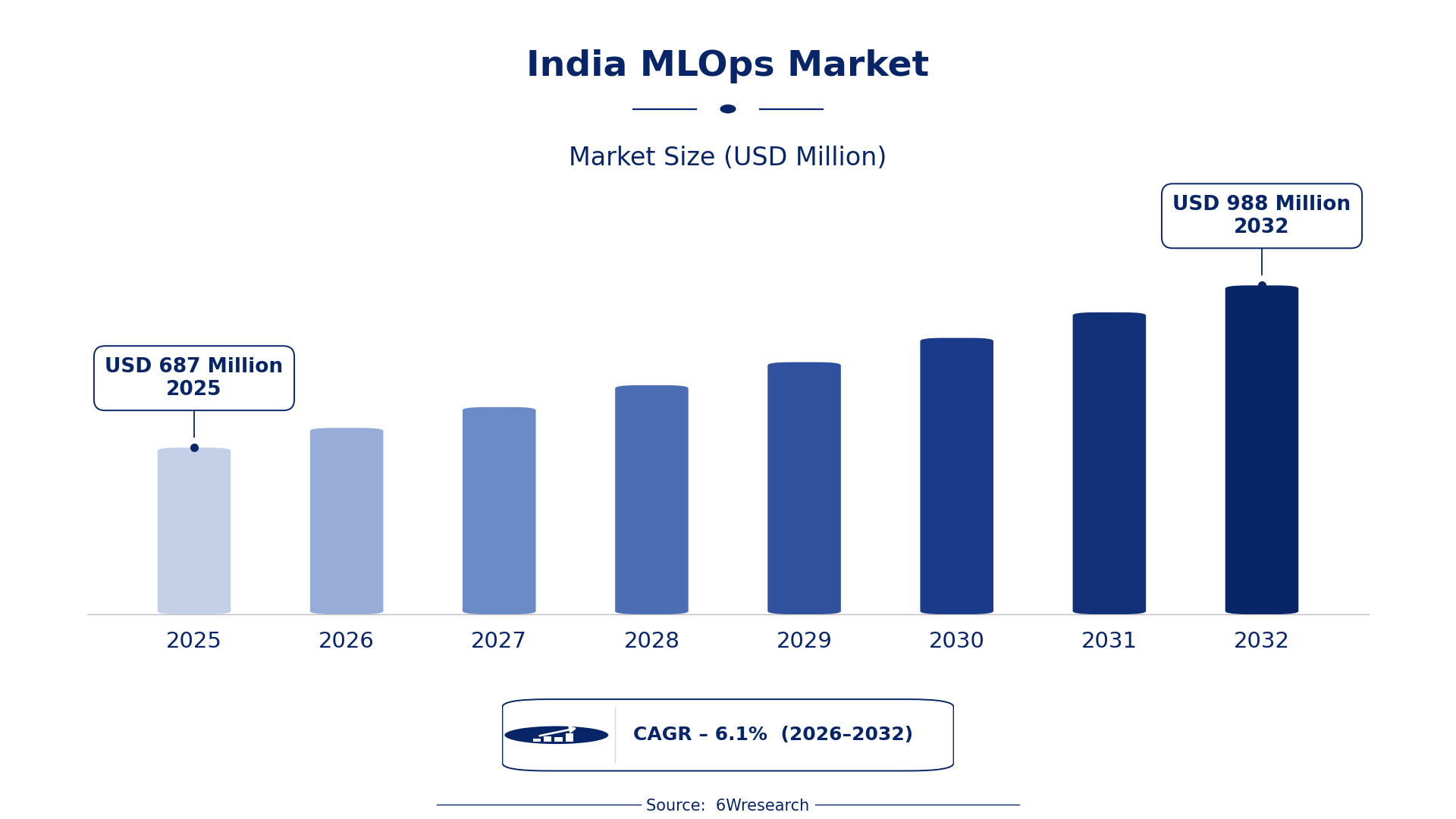
The India MLOps Market was estimated at USD 687 Million in 2025 and is projected to reach USD 988 Million by 2032, growing at a CAGR of 6.1% from 2026 to 2032.
India MLOps Market Synopsis
The increasing adoption of machine learning and artificial intelligence across various sectors is the primary force propelling the India MLOps market. As organizations increasingly rely on these technologies, the demand for efficient deployment and management of ML models becomes critical.
MLOps enables businesses to streamline their operations, ensuring that models not only perform optimally but also adhere to compliance and governance standards. As investment in AI and ML surges, the role of MLOps is becoming indispensable for organizations seeking to harness the full potential of their data.
India MLOps Market Year-wise Growth Rate and Key Drivers
This graph illustrates the annual growth rates of the India MLOps Market from 2021 to 2032, highlighting a steady upward trajectory and projected expansion over the forecast period.
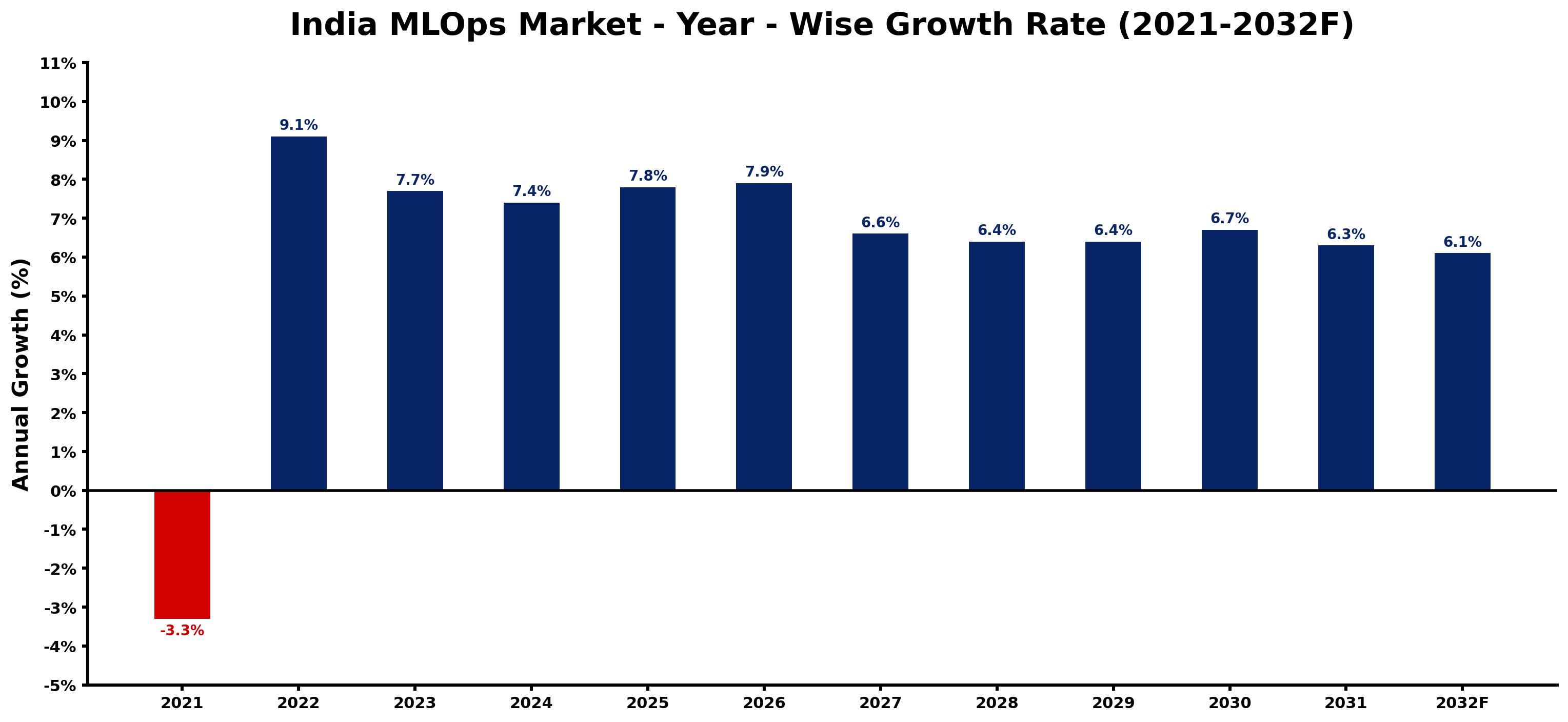
The table below presents the year‑wise growth rates along with the key drivers influencing the market
| Year | Growth Rate | Major Drivers |
| 2021 | -3.3% | Government policy delaying AI infrastructure investments in India |
| 2022 | 9.1% | India's Digital India initiative boosting AI and ML adoption. |
| 2023 | 7.7% | Government prioritizing AI research funding through NITI Aayog. |
| 2024 | 7.4% | Surge in tech startups leveraging MLOps for competitive edge. |
| 2025 | 7.8% | Rapid growth of e-commerce driving need for MLOps solutions. |
| 2026 | 7.9% | Rising importance of data security regulations influencing MLOps investment. |
| 2027 | 6.6% | Increased cloud infrastructure investments enhancing MLOps capabilities. |
| 2028 | 6.4% | Growing talent pool in AI/ML from Indian educational institutes. |
| 2029 | 6.4% | Enhanced focus on smart cities fueling analytics and MLOps. |
| 2030 | 6.7% | Market demand for automated AI compliance tools expanding. |
| 2031 | 6.3% | Burgeoning healthcare sector requires MLOps for data insights. |
| 2032 | 6.1% | Adoption of edge computing driving new MLOps applications. |
Note: Market size estimations and growth projections presented in this report are based on 6Wresearch's proprietary forecasting methodology, utilizing the latest available industry data, government publications, and primary research inputs.
India MLOps Market Key Takeaways
Below are some of the specific key takeaways from the market, including:
- The market is driven by the need for efficient machine learning model deployment and management.
- Challenges include complexity in model management and a shortage of skilled professionals.
- COVID-19 has accelerated the demand for AI solutions, further boosting the MLOps market.
- Government initiatives are actively shaping the regulatory environment for MLOps practices.
- Investment opportunities are emerging in sectors such as healthcare, finance, and retail.
Evaluation of Restraints in India MLOps Market
Despite its growth potential, the India MLOps market is hindered by several challenges. The complexity of machine learning models creates barriers to effective deployment. Companies often struggle with data pipelines, version control, and maintaining model consistency, which can slow down operations. on top of that, the scarcity of skilled MLOps professionals complicates these issues, as businesses find it difficult to source talent with the necessary expertise. The lack of standardized processes across the industry further exacerbates these challenges, making it imperative for organizations to invest in training and development.
India MLOps Market Trends
Several trends are shaping the India MLOps market today. The integration of automated tools for model monitoring and management is becoming increasingly common, enabling businesses to maintain performance without constant manual oversight. Additionally, the rise of low-code and no-code platforms is democratizing access to MLOps capabilities, allowing non-technical users to participate in AI initiatives.
Another notable trend is the emphasis on compliance and data governance. As regulations evolve, organizations are prioritizing solutions that not only enhance operational efficiency but also ensure adherence to industry standards. This focus is driving innovations in MLOps technologies that integrate compliance features directly into the deployment pipeline.
India MLOps Market Opportunities
Investment opportunities are plentiful in the India MLOps market, particularly in sectors that have traditionally lagged in AI adoption. Healthcare, for instance, is ripe for MLOps solutions that can enhance diagnostic accuracy and operational efficiency. The financial sector also presents opportunities, with a growing need for automated risk assessment and fraud detection models.
Startups focusing on niche MLOps solutions are emerging, presenting avenues for investment and collaboration. As businesses continue to seek competitive advantages through AI, the demand for tailored MLOps services will likely expand, providing lucrative prospects for firms that can offer specialized knowledge and innovative technologies.
Government Initiatives in the India MLOps Market
The Indian government is actively shaping the MLOps market through various initiatives aimed at enhancing digital infrastructure and promoting AI adoption. As the regulatory landscape evolves, these initiatives are critical for ensuring that businesses can operate within a supportive framework while advancing their MLOps capabilities.
- A national digital infrastructure upgrade programme launched in late 2025 aims to enhance connectivity for AI-driven applications.
- Current initiatives include a public-private partnership focusing on developing AI talent, which remains underway.
- A regulatory framework introduced in 2025 mandates data transparency and security protocols for AI deployments.
- Upcoming plans include a strategic roadmap for AI integration in government services, expected to commence in early 2026.
- Ongoing efforts to establish AI research hubs across major cities to foster innovation and collaboration among enterprises.
Future Insights of the India MLOps Market
Looking ahead to 2026-2032, the India MLOps market is set for substantial growth driven by increasing investments in AI technologies. As businesses become more reliant on data-driven decision-making, the need for effective MLOps will intensify. Innovations in automation and compliance will also play a significant role in shaping the future landscape of this market.
on top of that, as organizations strive to scale their AI initiatives, the demand for customizable MLOps solutions that cater to specific industry needs will rise. This presents a promising opportunity for firms that can adapt quickly and deliver solutions that enhance model performance and governance.
India MLOps Market Latest Developments
Over the past year, the India MLOps market has witnessed dynamic developments as businesses accelerate their AI strategies. The focus on streamlining operations and enhancing model performance has led to several key advancements in technology and partnerships.
- A major technology vendor launched a new MLOps platform designed to simplify the deployment process, with rollout completed in early 2025.
- An initiative that began in mid-2025 focuses on developing a certification program for MLOps professionals, currently underway.
- A leading regional operator is expanding its MLOps services to include specialized support for the healthcare sector, expected to launch by mid-2026.
- In Q1 2025, a collaboration between industry players aimed at enhancing interoperability of MLOps tools was announced and remains ongoing.
- Upcoming in late 2026, a consortium is set to launch a research project aimed at developing best practices for MLOps implementation across industries.
India MLOps Market - Key Attractiveness of the Report
- 10 Years of Market Numbers
- Historical Data Starting from 2022 to 2025
- Base Year: 2025
- Forecast Data until 2032
- Key Performance Indicators Impacting the Market
- Major Upcoming Developments and Projects
Key Highlights of the Report:
- India MLOps Market Outlook
- Market Size of India MLOps Market, 2025
- Forecast of India MLOps Market, 2032
- Historical Data and Forecast of India MLOps Revenues & Volume for the Period 2022-2032F
- India MLOps Market Trend Evolution
- India MLOps Market Drivers and Challenges
- India MLOps Price Trends
- India MLOps Porter's Five Forces
- India MLOps Industry Life Cycle
- Historical Data and Forecast of India MLOps Market Revenues & Volume By Component for the Period 2022-2032F
- Historical Data and Forecast of India MLOps Market Revenues & Volume By Platform for the Period 2022-2032F
- Historical Data and Forecast of India MLOps Market Revenues & Volume By Services for the Period 2022-2032F
- Historical Data and Forecast of India MLOps Market Revenues & Volume By Deployment Mode for the Period 2022-2032F
- Historical Data and Forecast of India MLOps Market Revenues & Volume By Cloud for the Period 2022-2032F
- Historical Data and Forecast of India MLOps Market Revenues & Volume By On-premises for the Period 2022-2032F
- Historical Data and Forecast of India MLOps Market Revenues & Volume By Organization Size for the Period 2022-2032F
- Historical Data and Forecast of India MLOps Market Revenues & Volume By Large Enterprises for the Period 2022-2032F
- Historical Data and Forecast of India MLOps Market Revenues & Volume By SMEs for the Period 2022-2032F
- Historical Data and Forecast of India MLOps Market Revenues & Volume By Vertical for the Period 2022-2032F
- Historical Data and Forecast of India MLOps Market Revenues & Volume By BFSI for the Period 2022-2032F
- Historical Data and Forecast of India MLOps Market Revenues & Volume By Healthcare and Life Sciences for the Period 2022-2032F
- Historical Data and Forecast of India MLOps Market Revenues & Volume By Retail and eCommerce for the Period 2022-2032F
- Historical Data and Forecast of India MLOps Market Revenues & Volume By Telecom for the Period 2022-2032F
- India MLOps Import Export Trade Statistics
- Market Opportunity Assessment By Component
- Market Opportunity Assessment By Deployment Mode
- Market Opportunity Assessment By Organization Size
- Market Opportunity Assessment By Vertical
- India MLOps Top Companies Market Share
- India MLOps Competitive Benchmarking By Technical and Operational Parameters
- India MLOps Company Profiles
- India MLOps Key Strategic Recommendations






































