India Mobile Application Security Market Size & Growth Rate (2026-2032)
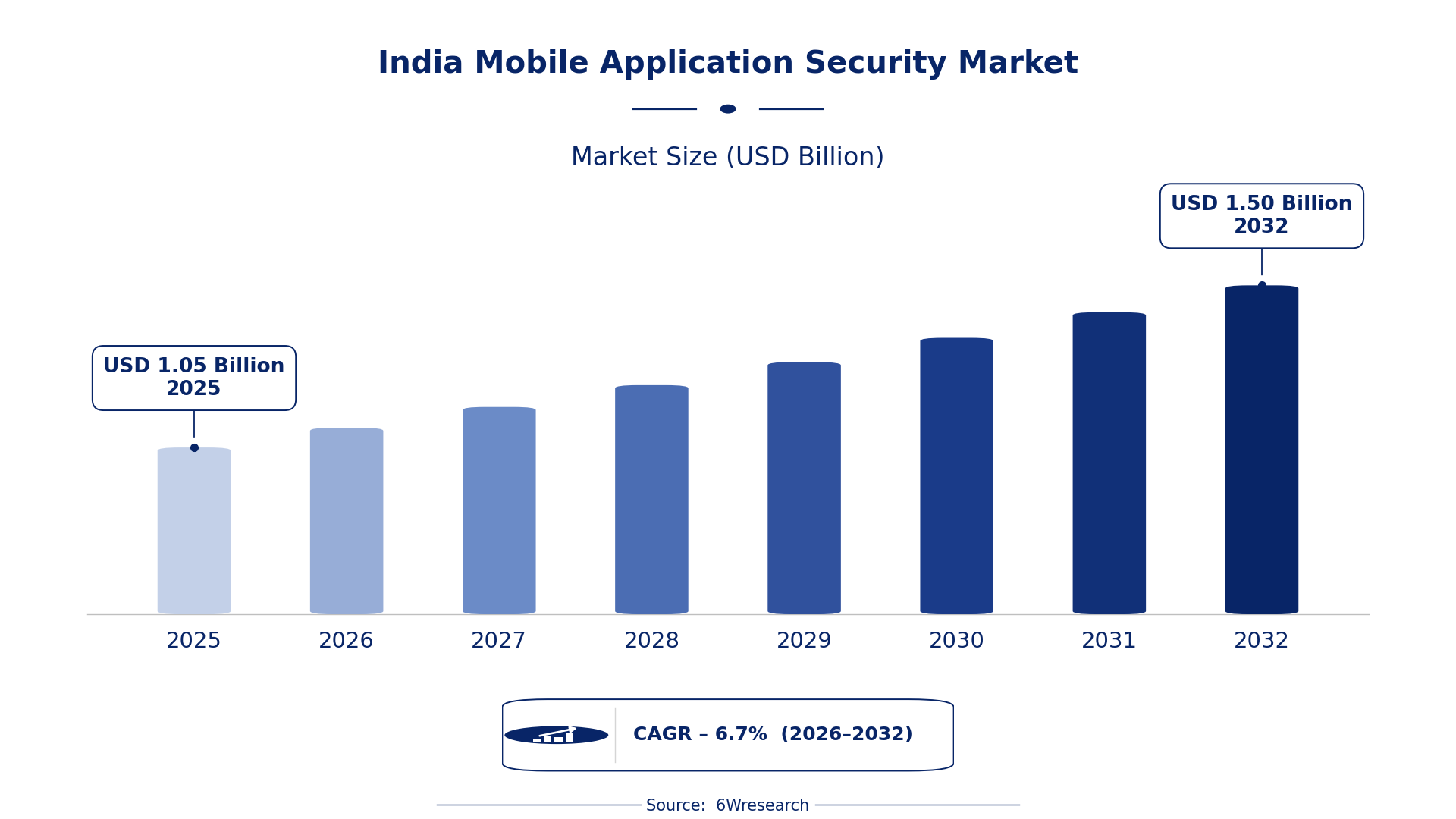
The India Mobile Application Security Market was estimated at USD 1047 Million in 2025 and is projected to reach USD 1505 Million by 2032, growing at a CAGR of 6.7% from 2026 to 2032.
India Mobile Application Security Market Synopsis
The rise of mobile applications in India has made the need for application security more critical than ever. With increasing dependency on apps for everything from banking to social networking, vulnerabilities pose severe risks to both personal and business data.
As organizations prioritize user safety and data integrity, the mobile application security market is expected to flourish. Companies are keenly aware that a single breach can tarnish reputation and customer trust, prompting investments in advanced security solutions.
India Mobile Application Security Market Year-wise Growth Rate and Key Drivers
This graph illustrates the annual growth rates of the India Mobile Application Security Market from 2021 to 2032, highlighting a steady upward trajectory and projected expansion over the forecast period.
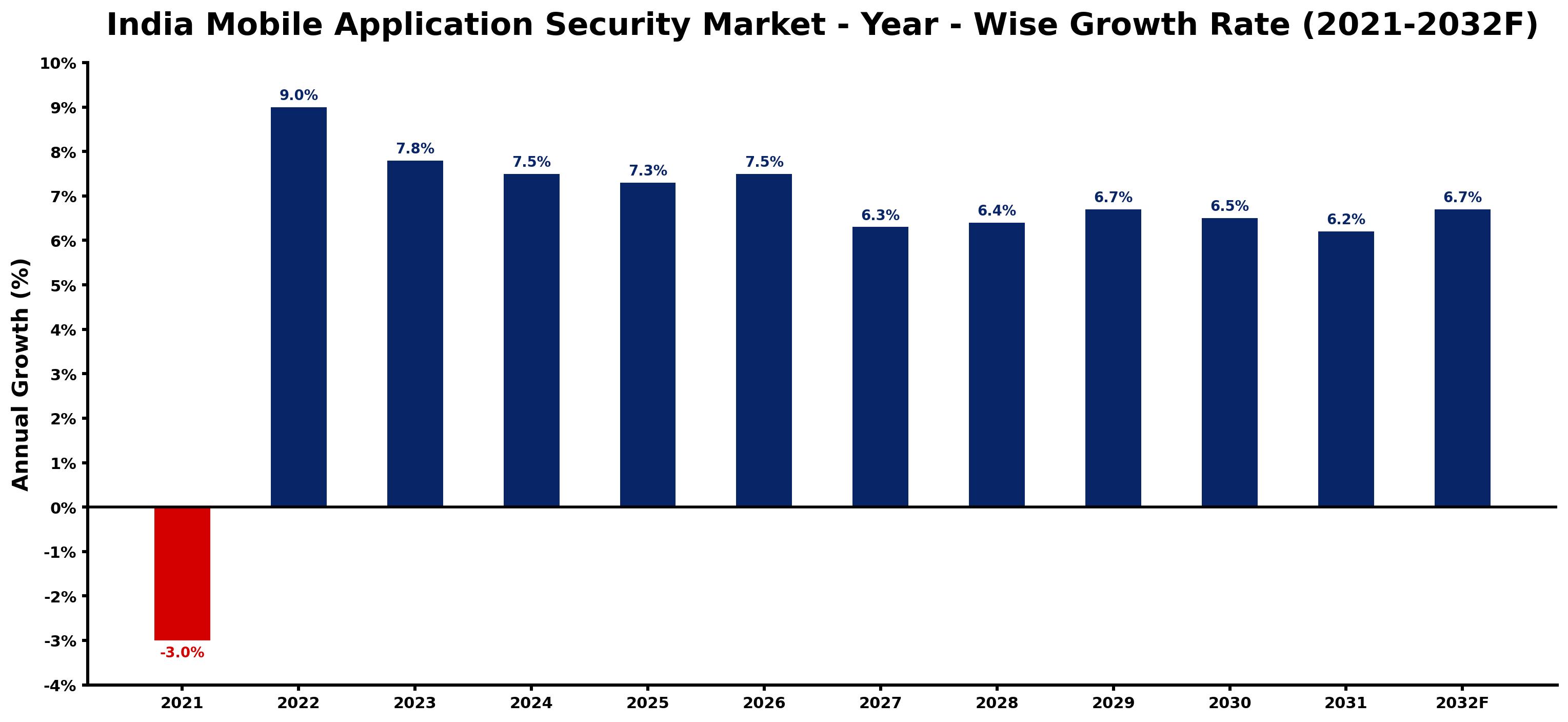
The table below presents the year‑wise growth rates along with the key drivers influencing the market
| Year | Growth Rate | Major Drivers |
| 2021 | -3.0% | Cybersecurity policies from MeitY hindered local app development. |
| 2022 | 9.0% | Government's Digital India initiative boosting app security focus |
| 2023 | 7.8% | Increased mobile banking adoption raising security concerns |
| 2024 | 7.5% | Rising cyber threats prompting investment in mobile security |
| 2025 | 7.3% | Massive smartphone penetration leading to demand for app protection |
| 2026 | 7.5% | Regulatory guidelines for data privacy enhancing security measures |
| 2027 | 6.3% | Growing e-commerce reliance driving mobile app security need |
| 2028 | 6.4% | Startups prioritizing mobile security in app development phase |
| 2029 | 6.7% | Awareness campaigns educating users on mobile app vulnerabilities |
| 2030 | 6.5% | Surge in remote work boosting mobile security solutions |
| 2031 | 6.2% | Partnerships between tech firms for mobile security advancements |
| 2032 | 6.7% | Emerging tech like AI enhancing mobile application security |
Note: Market size estimations and growth projections presented in this report are based on 6Wresearch's proprietary forecasting methodology, utilizing the latest available industry data, government publications, and primary research inputs.
India Mobile Application Security Market Key Takeaways
Below are some of the specific key takeaways from the market, including:
- The market is driven by the increasing volume of mobile app downloads and usage across various sectors.
- Organizations are implementing robust security measures to combat the growing threat of cyberattacks.
- Compliance with evolving data protection regulations is pushing businesses to invest in mobile application security.
- The demand for cross-platform security solutions is rising due to the diverse mobile ecosystem.
- Innovative technologies like AI and machine learning are increasingly incorporated into security solutions.
Evaluation of Restraints in India Mobile Application Security Market
The mobile application security market in India faces several challenges that hinder its growth. One major restraint is the fragmented nature of the mobile ecosystem, primarily dominated by the Android and iOS platforms. Each platform has unique security features and requirements, complicating the development of universal security solutions. on top of that, the fast-paced evolution of cyber threats demands constant vigilance and innovation, which can strain resources for many organizations. Compliance with emerging user privacy regulations further complicates efforts to secure mobile applications.
India Mobile Application Security Market Trends
Several key trends are shaping the India Mobile Application Security Market. First, an increased reliance on remote work has led businesses to prioritize mobile security solutions. The proliferation of IoT devices is also contributing to the complexity of application security, as these devices often serve as entry points for cybercriminals. on top of that, organizations are showing a growing interest in security-as-a-service models, which allow for scalable security solutions without the overhead of extensive in-house infrastructure. Additionally, the integration of AI and machine learning in security protocols is becoming a norm, enhancing threat detection capabilities.
India Mobile Application Security Market Opportunities
There are compelling opportunities within the India Mobile Application Security Market that companies can exploit. The increasing number of start-ups in the tech sector is a goldmine for tailored security solutions. on top of that, as industries like finance, healthcare, and e-commerce continue to expand their mobile applications, there’s heightened demand for specialized security protocols. Investing in training and resources for developers on security best practices also presents an avenue for growth, fostering a security-conscious development culture.
Government Initiatives in the India Mobile Application Security Market
Government policy is playing a crucial role in shaping the mobile application security landscape in India. Regulators are increasingly aware of the need to protect citizens from cyber threats and are actively pursuing initiatives to enhance security measures across the mobile application sector. With data privacy and protection as top priorities, the government is expected to introduce stringent regulations that will further influence market dynamics.
- A national cybersecurity strategy was launched in early 2023, focusing on improving the overall security posture of mobile applications.
- Currently ongoing is the implementation of the Data Protection Bill, which mandates stricter data handling protocols for mobile applications.
- A planned public-private partnership aimed at boosting cybersecurity education is expected to roll out by 2026, targeting developers and IT professionals.
- The Ministry of Electronics and Information Technology is developing a mobile app security framework as part of its Digital India initiative.
- New guidelines for app developers were introduced in late 2023 to enhance security practices during app development.
Future Insights of the India Mobile Application Security Market
Looking ahead to 2026-2032, the India Mobile Application Security Market is set for substantial growth. With the burgeoning digital economy and continued expansion of mobile applications across sectors, investment in security solutions will become even more critical. As businesses prioritize protecting user data and complying with regulatory demands, the market will likely see an influx of innovative security technologies. Additionally, the trend towards cloud-based solutions will reshape how security is delivered, making it more accessible for businesses of all sizes.
India Mobile Application Security Market Latest Developments
In the past year, the India Mobile Application Security Market has witnessed dynamic activity as companies ramp up efforts to secure their applications. The focus has shifted towards adopting advanced technologies and innovative approaches to counter the increasing sophistication of cyber threats. As threats evolve, so do the responses from security providers, leading to a flurry of developments within the sector.
- A major tech vendor launched an advanced code scanning solution in Q2 2023, enhancing detection capabilities against known vulnerabilities.
- In mid-2023, a leading security firm announced a partnership with a telecommunications provider to implement security solutions across a range of mobile applications.
- An initiative that began in early 2023 and remains underway aims to provide cybersecurity training programs for app developers across India.
- A rollout expected to begin in early 2024 will introduce a new mobile threat intelligence platform designed for businesses.
- In late 2023, a regional operator upgraded its security frameworks to align with new data privacy regulations ahead of the impending compliance deadline.
India Mobile Application Security Market - Key Attractiveness of the Report
- 10 Years of Market Numbers
- Historical Data Starting from 2022 to 2025
- Base Year: 2025
- Forecast Data until 2032
- Key Performance Indicators Impacting the Market
- Major Upcoming Developments and Projects
Key Highlights of the Report:
- India Mobile Application Security Market Outlook
- Market Size of India Mobile Application Security Market, 2025
- Forecast of India Mobile Application Security Market, 2032
- Historical Data and Forecast of India Mobile Application Security Revenues & Volume for the Period 2022-2032F
- India Mobile Application Security Market Trend Evolution
- India Mobile Application Security Market Drivers and Challenges
- India Mobile Application Security Price Trends
- India Mobile Application Security Porter's Five Forces
- India Mobile Application Security Industry Life Cycle
- Historical Data and Forecast of India Mobile Application Security Market Revenues & Volume By Solution for the Period 2022-2032F
- Historical Data and Forecast of India Mobile Application Security Market Revenues & Volume By Antivirus & Antitheft for the Period 2022-2032F
- Historical Data and Forecast of India Mobile Application Security Market Revenues & Volume By Data Recovery for the Period 2022-2032F
- Historical Data and Forecast of India Mobile Application Security Market Revenues & Volume By Others for the Period 2022-2032F
- Historical Data and Forecast of India Mobile Application Security Market Revenues & Volume By Deployment Type for the Period 2022-2032F
- Historical Data and Forecast of India Mobile Application Security Market Revenues & Volume By Cloud for the Period 2022-2032F
- Historical Data and Forecast of India Mobile Application Security Market Revenues & Volume By On Premise for the Period 2022-2032F
- Historical Data and Forecast of India Mobile Application Security Market Revenues & Volume By Industry Vertical for the Period 2022-2032F
- Historical Data and Forecast of India Mobile Application Security Market Revenues & Volume By BFSI for the Period 2022-2032F
- Historical Data and Forecast of India Mobile Application Security Market Revenues & Volume By Healthcare for the Period 2022-2032F
- Historical Data and Forecast of India Mobile Application Security Market Revenues & Volume By IT & Telecom for the Period 2022-2032F
- Historical Data and Forecast of India Mobile Application Security Market Revenues & Volume By Manufacturing for the Period 2022-2032F
- Historical Data and Forecast of India Mobile Application Security Market Revenues & Volume By Government and Public Sector for the Period 2022-2032F
- Historical Data and Forecast of India Mobile Application Security Market Revenues & Volume By Retail & E-commerce for the Period 2022-2032F
- Historical Data and Forecast of India Mobile Application Security Market Revenues & Volume By Others for the Period 2022-2032F
- India Mobile Application Security Import Export Trade Statistics
- Market Opportunity Assessment By Solution
- Market Opportunity Assessment By Deployment Type
- Market Opportunity Assessment By Industry Vertical
- India Mobile Application Security Top Companies Market Share
- India Mobile Application Security Competitive Benchmarking By Technical and Operational Parameters
- India Mobile Application Security Company Profiles
- India Mobile Application Security Key Strategic Recommendations






































