India Motherboard Market Growth Rate Analysis (2021 - 2031)
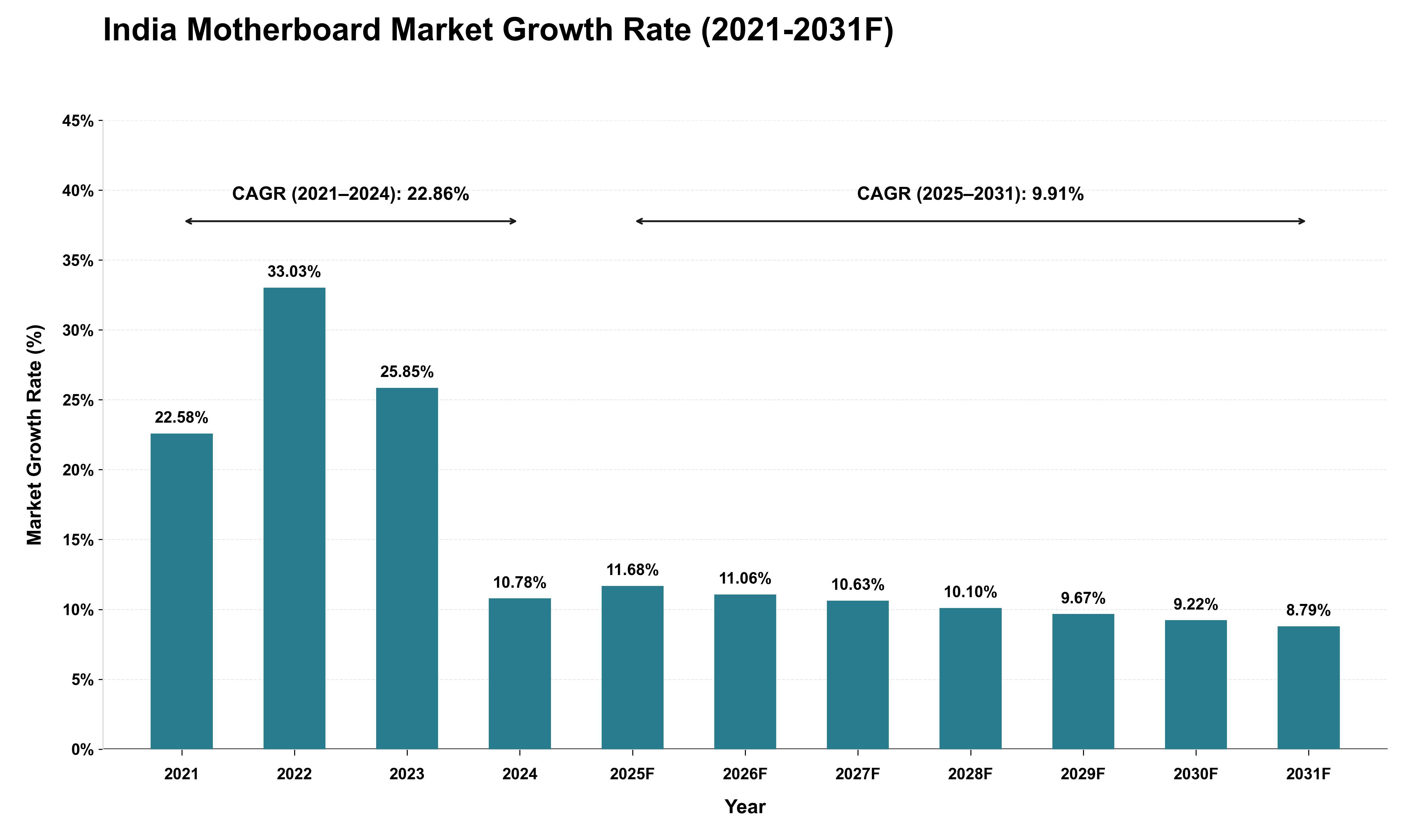
The India motherboard market experienced significant growth from 2021 to 2024, with a historical CAGR of 22.86%, driven primarily by surging end-use demand in sectors such as consumer electronics and gaming, alongside the post-pandemic digital transformation that accelerated technology adoption. The peak growth in 2022 (33.03%) reflected heightened consumer spending and supply chain recovery following global disruptions, while the subsequent decline to 10.78% in 2024 indicated a normalization phase as supply chains stabilized and inventory levels adjusted. Looking ahead to the forecast period (2025-2031), the CAGR is projected to moderate to 9.91%, reflecting a shift towards more sustainable growth patterns influenced by evolving technological advancements and increased competition within the semiconductor industry. This anticipated deceleration aligns with broader macroeconomic cycles, where demand stabilizes as markets mature and consumers adapt to new technologies, ultimately reshaping import reliance dynamics in the sector.
Key Highlights of the Report:
- India Motherboard Market Outlook
- Market Size of India Motherboard Market, 2024
- Forecast of India Motherboard Market, 2031
- Historical Data and Forecast of India Motherboard Revenues & Volume for the Period 2021- 2031
- India Motherboard Market Trend Evolution
- India Motherboard Market Drivers and Challenges
- India Motherboard Price Trends
- India Motherboard Porter's Five Forces
- India Motherboard Industry Life Cycle
- Historical Data and Forecast of India Motherboard Market Revenues & Volume By Form for the Period 2021- 2031
- Historical Data and Forecast of India Motherboard Market Revenues & Volume By ATX for the Period 2021- 2031
- Historical Data and Forecast of India Motherboard Market Revenues & Volume By Micro-ATX for the Period 2021- 2031
- Historical Data and Forecast of India Motherboard Market Revenues & Volume By Mini ITX for the Period 2021- 2031
- Historical Data and Forecast of India Motherboard Market Revenues & Volume By Model for the Period 2021- 2031
- Historical Data and Forecast of India Motherboard Market Revenues & Volume By Industrial for the Period 2021- 2031
- Historical Data and Forecast of India Motherboard Market Revenues & Volume By Commercial for the Period 2021- 2031
- India Motherboard Import Export Trade Statistics
- Market Opportunity Assessment By Form
- Market Opportunity Assessment By Model
- India Motherboard Top Companies Market Share
- India Motherboard Competitive Benchmarking By Technical and Operational Parameters
- India Motherboard Company Profiles
- India Motherboard Key Strategic Recommendations






































