India MVNO Market Size & Growth Rate (2026-2032)
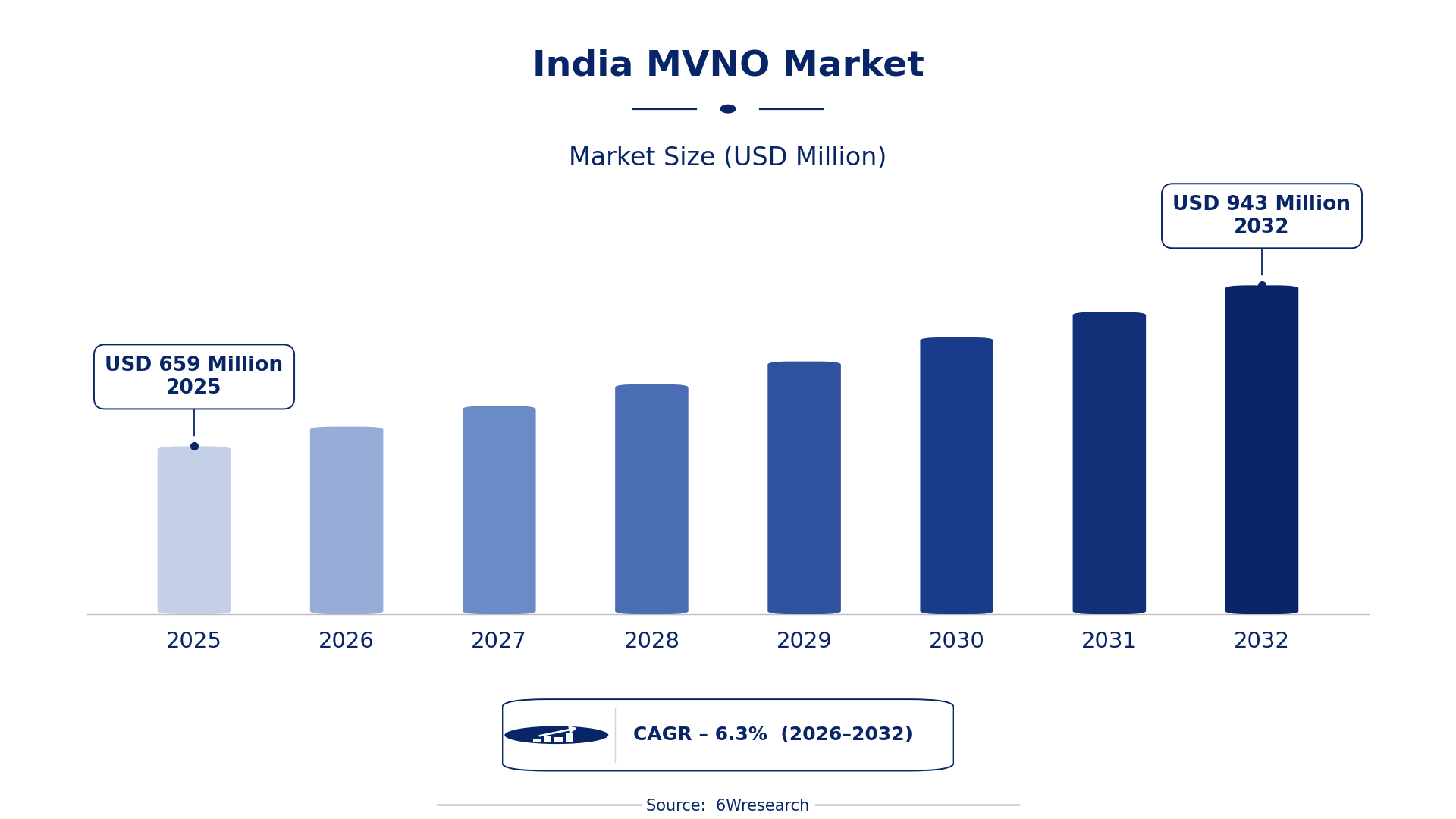
The India MVNO Market was estimated at USD 659 Million in 2025 and is projected to reach USD 943 Million by 2032, growing at a CAGR of 6.3% from 2026 to 2032.
India MVNO Market Synopsis
The driving force behind the India MVNO market is the increasing consumer demand for customized mobile services. As users become more discerning about their telecom options, MVNOs are stepping up to provide tailored solutions that meet specific needs.
These operators are not just competing on price; they are also innovating service offerings that attract niche segments, such as youth or enterprise customers. With established telecom giants leasing their infrastructure, MVNOs have a solid foundation to build upon.
India MVNO Market Year-wise Growth Rate and Key Drivers
This graph illustrates the annual growth rates of the India MVNO Market from 2021 to 2032, highlighting a steady upward trajectory and projected expansion over the forecast period.
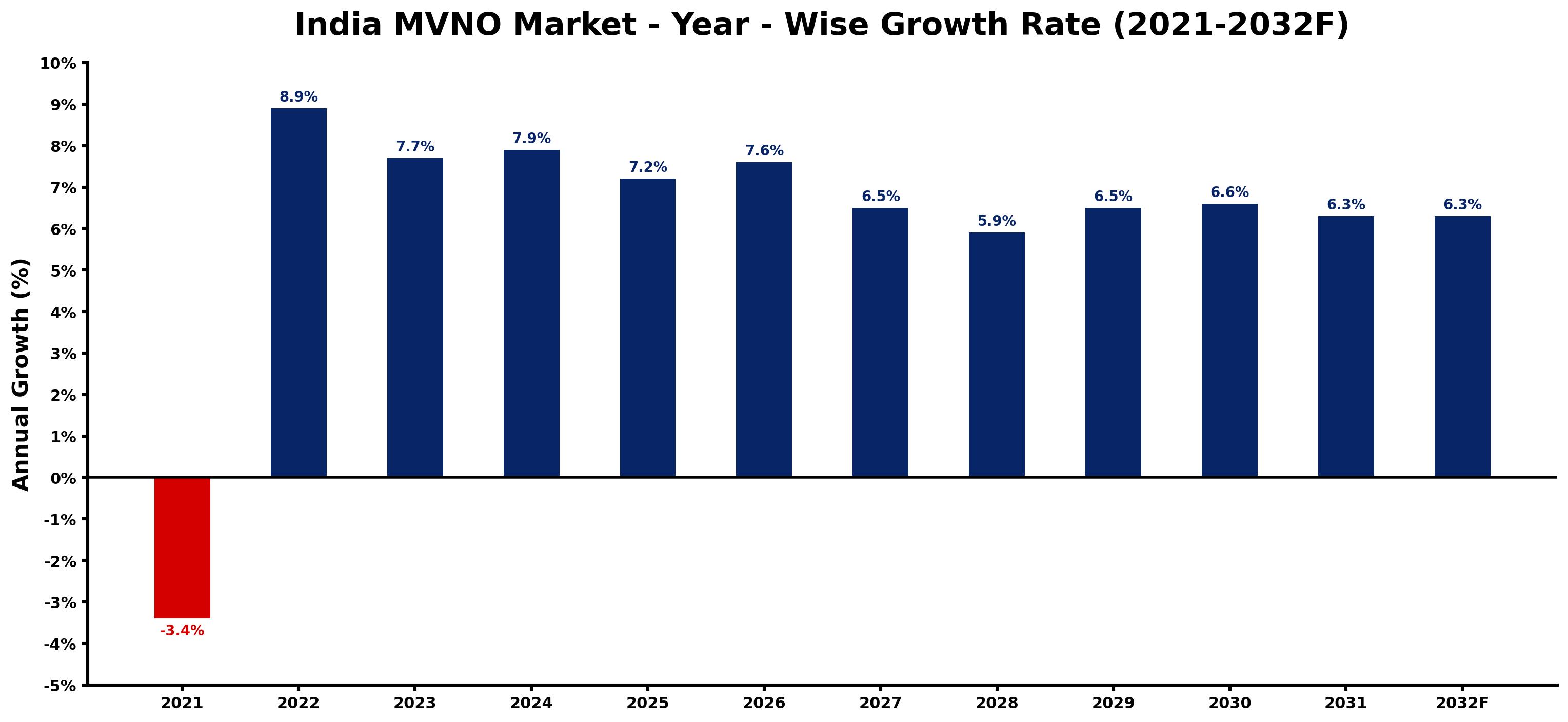
The table below presents the year‑wise growth rates along with the key drivers influencing the market
| Year | Growth Rate | Major Drivers |
| 2021 | -3.4% | TRAI's regulatory changes hindered MVNO licensing process. |
| 2022 | 8.9% | Growing digital payments adoption boosts mobile data usage. |
| 2023 | 7.7% | Government's Digital India initiative drives mobile connectivity expansion. |
| 2024 | 7.9% | Rise in youth population increases demand for affordable tariffs. |
| 2025 | 7.2% | Emergence of 5G technology enhances mobile service options. |
| 2026 | 7.6% | Increased smartphone affordability expands market access for users. |
| 2027 | 6.5% | Rural connectivity initiatives drive MVNO customer base growth. |
| 2028 | 5.9% | Enhanced data privacy regulations boost user trust in MVNOs. |
| 2029 | 6.5% | Partnerships with local content providers attract more subscribers. |
| 2030 | 6.6% | Launch of innovative IoT services by MVNOs increases demand. |
| 2031 | 6.3% | Increased competition among MVNOs lowers service costs for consumers. |
| 2032 | 6.3% | Focus on sustainable business practices appeals to eco-conscious users. |
Note: Market size estimations and growth projections presented in this report are based on 6Wresearch's proprietary forecasting methodology, utilizing the latest available industry data, government publications, and primary research inputs.
India MVNO Market Key Takeaways
Below are some of the specific key takeaways from the market, including:
- The increasing demand for personalized mobile plans is reshaping service offerings.
- Competitive pricing strategies are crucial for MVNOs to capture market share.
- Emerging digital services are becoming integral to MVNO business models.
- The COVID-19 pandemic has highlighted the need for flexible mobile solutions.
- Partnerships with established operators are vital for MVNO growth in India.
Evaluation of Restraints in India MVNO Market
Despite its potential, the India MVNO market faces significant hurdles. One of the most pressing issues is the challenge of data quality and integration. MVNOs often struggle to collect and analyze data from diverse sources, making it difficult to deliver precise services. on top of that, the lack of skilled data scientists hampers the ability to extract valuable insights from network analytics. These limitations can slow growth and impact service delivery, making it essential for MVNOs to invest in better data management and analytics capabilities.
India MVNO Market Trends
One noticeable trend is the increasing adoption of mobile financial services. As digital payments become more prevalent, MVNOs are finding ways to integrate these services into their offerings, catering to a tech-savvy consumer base. Another trend is the focus on data-driven customer engagement strategies, where MVNOs utilize analytics to personalize services further.
Additionally, sustainability in operations is gaining traction, with MVNOs looking to enhance their green credentials. This not only appeals to environmentally conscious consumers but also aligns with global sustainability goals.
India MVNO Market Opportunities
Genuine growth opportunities are emerging in sectors like e-commerce and education. MVNOs can develop partnerships with these industries to provide bundled services, tapping into new revenue streams. Additionally, the rise of remote working and digital learning creates a demand for dedicated mobile solutions tailored to these segments.
Investments in IoT and smart devices present another frontier. As connectivity becomes a prerequisite for more devices, MVNOs that position themselves as enablers for IoT applications will likely see growth.
Government Initiatives in the India MVNO Market
Government policies are crucial in shaping the India MVNO market. A supportive regulatory environment fosters innovation, while initiatives aimed at expanding telecom infrastructure enhance market accessibility. Recent efforts to streamline licensing processes and promote competition in the telecom sector are paving the way for MVNOs to thrive.
- A national digital infrastructure upgrade programme is currently underway, focused on improving connectivity across rural and urban areas.
- A regulatory framework introduced in 2025 mandates billing transparency, benefitting consumers and enhancing trust in MVNO services.
- A recently completed initiative aimed at simplifying the licensing process for new entrants has opened doors for aspiring MVNOs.
- Current discussions are exploring the establishment of a public-private partnership to expand network access in underserved regions.
- Planned initiatives for 2028 include investment incentives for green telecom technologies, encouraging sustainable practices among operators.
Future Insights of the India MVNO Market
Looking ahead to 2026-2032, the India MVNO market is set for robust expansion. With increasing smartphone penetration and a growing internet user base, more consumers will seek tailored mobile solutions. The demand for innovative services, particularly in finance and IoT, will further drive market growth.
As competition intensifies, MVNOs that effectively leverage partnerships and data analytics will likely emerge as leaders in niche markets. The focus on customer experience and service quality will remain paramount, shaping the strategies of successful operators.
India MVNO Market Latest Developments
In the past 12-14 months, the India MVNO market has seen significant activity, driven by a mix of new service launches and strategic partnerships. Operators are increasingly focusing on enhancing their service offerings to meet evolving customer demands.
- A major technology vendor announced a partnership with several MVNOs to enhance their data analytics capabilities, an initiative that began in early 2025 and remains ongoing.
- A leading regional operator launched an innovative mobile plan specifically designed for small businesses in mid-2025, offering customized solutions.
- Plans for a new customer engagement platform aimed at improving user experience are expected to roll out by Q3 2026.
- A recent expansion into rural markets by an MVNO took place in early 2025, focusing on affordable data plans.
- An initiative to integrate mobile payment solutions into MVNO offerings is currently underway, expected to enhance service value by late 2026.
India MVNO Market - Key Attractiveness of the Report
- 10 Years of Market Numbers
- Historical Data Starting from 2022 to 2025
- Base Year: 2025
- Forecast Data until 2032
- Key Performance Indicators Impacting the Market
- Major Upcoming Developments and Projects
Key Highlights of the Report:
- India MVNO Market Outlook
- Market Size of India MVNO Market, 2025
- Forecast of India MVNO Market, 2032
- Historical Data and Forecast of India MVNO Revenues & Volume for the Period 2022-2032F
- India MVNO Market Trend Evolution
- India MVNO Market Drivers and Challenges
- India MVNO Price Trends
- India MVNO Porter's Five Forces
- India MVNO Industry Life Cycle
- Historical Data and Forecast of India MVNO Market Revenues & Volume By Operational Model for the Period 2022-2032F
- Historical Data and Forecast of India MVNO Market Revenues & Volume By Reseller for the Period 2022-2032F
- Historical Data and Forecast of India MVNO Market Revenues & Volume By Service Operator for the Period 2022-2032F
- Historical Data and Forecast of India MVNO Market Revenues & Volume By Full MVNO for the Period 2022-2032F
- Historical Data and Forecast of India MVNO Market Revenues & Volume By Organization Size for the Period 2022-2032F
- Historical Data and Forecast of India MVNO Market Revenues & Volume By SMES for the Period 2022-2032F
- Historical Data and Forecast of India MVNO Market Revenues & Volume By Large Enterprise for the Period 2022-2032F
- Historical Data and Forecast of India MVNO Market Revenues & Volume By Subscriber for the Period 2022-2032F
- Historical Data and Forecast of India MVNO Market Revenues & Volume By Consumer for the Period 2022-2032F
- Historical Data and Forecast of India MVNO Market Revenues & Volume By Enterprise for the Period 2022-2032F
- India MVNO Import Export Trade Statistics
- Market Opportunity Assessment By Operational Model
- Market Opportunity Assessment By Organization Size
- Market Opportunity Assessment By Subscriber
- India MVNO Top Companies Market Share
- India MVNO Competitive Benchmarking By Technical and Operational Parameters
- India MVNO Company Profiles
- India MVNO Key Strategic Recommendations






































