India Narrow Woven Fabrics Market Summary
The india narrow woven fabrics market was estimated at USD 699 Million in 2025 and is projected to reach USD 1004 Million by 2032, growing at a CAGR of 7.7% from 2026 to 2032.
India Narrow Woven Fabrics Market Year-wise Growth Rate and Key Drivers
This graph highlights how the India Narrow Woven Fabrics Market has steadily grown over the years, supported by major growth factors.
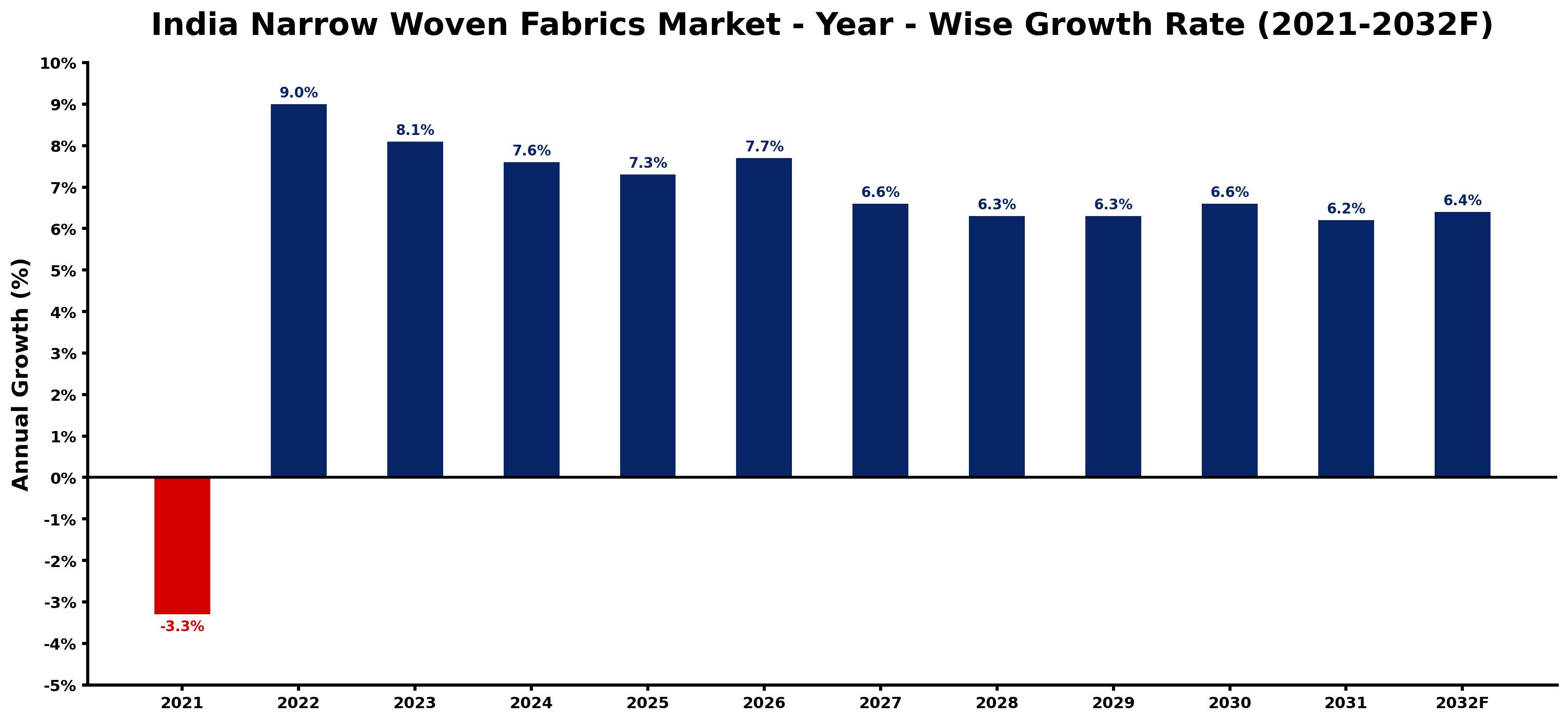
The table below presents the year wise growth rates along with the key drivers influencing the market
| Year | Growth Rate | Major Drivers |
| 2021 | -3.3% | Severe supply chain disruptions hampered production capabilities, leading to heightened costs and diminished market activity. |
| 2022 | 9.0% | Small-scale manufacturers began embracing eco-friendly materials, capturing niche market segments effectively. |
| 2023 | 8.1% | Urbanization accelerated infrastructure projects, driving the need for durable woven fabrics. |
| 2024 | 7.6% | E-commerce platforms expanded, making narrow woven fabrics more accessible to consumers nationwide. |
| 2025 | 7.3% | Fashion trends began to favor traditional textiles, enhancing the appeal of narrow weaves. |
| 2026 | 7.7% | Innovative techniques in weaving improved production efficiency, attracting larger investments into the sector. |
| 2027 | 6.6% | Sustainability narratives gained traction, leading brands to incorporate eco-friendly woven options. |
| 2028 | 6.3% | Regional collaborations focused on developing indigenous textile clusters to enhance local production. |
| 2029 | 6.3% | Technological integration in weaving machinery allowed for customization and improved product offerings. |
| 2030 | 6.6% | Market dynamics shifted as consumer preferences leaned towards personalized fabric solutions. |
| 2031 | 6.2% | Export markets expanded due to favorable trade agreements, increasing international competitiveness. |
| 2032 | 6.4% | Investment in R&D flourished, driving innovations in design and fabric performance to new heights. |
Note - Market size estimations and growth projections presented in this report are based on 6Wresearch's advanced forecasting approach, validated with industry datasets as of June 2026.
India Narrow Woven Fabrics Market Synopsis
The India Narrow Woven Fabrics Market is projected to reach 7.7% and witness significant growth during the forecast period (2026-2032). India stands as a prominent player in the global arena of narrow woven fabric production and consumption. Its rich textile heritage, developed over centuries, has evolved from traditional hand weaving to sophisticated manufacturing processes in modern mills. The array of applications for narrow woven fabrics in India encompasses apparel, industrial use, home furnishings, and accessories, thus contributing significantly to overall production volumes. This sector remains highly fragmented, with a predominance of small-scale manufacturers who tailor their offerings to meet specific market demands.
India Narrow Woven Fabrics Market Growth Drivers
A multitude of factors is propelling the growth trajectory of the India Narrow Woven Fabrics Market. Firstly, the increase in disposable income among consumers has heightened the demand for high-quality fabrics, driving growth in both domestic and export markets. Secondly, favorable government policies, such as tax incentives and trade agreements, have created an environment conducive to expansion. Moreover, the fashion design sector in India has seen a surge in interest toward innovative materials, including technical textiles, thereby enhancing demand for narrow woven fabrics. Additionally, significant investments in research and development by leading manufacturers are fostering innovation and technological advancements within the industry. Lastly, there is a growing recognition of environmental sustainability among consumers, which is influencing manufacturing practices and product offerings.
India Narrow Woven Fabrics Market Challenges and Restraints
Despite the promising outlook, the India Narrow Woven Fabrics Market faces several challenges. Quality assurance remains a critical concern, as the lack of standardization and inadequate testing infrastructure in certain mills can compromise product quality. This issue is often exacerbated by the absence of a skilled labor force, resulting in higher labor costs and operational inefficiencies. Furthermore, limited access to credit facilities can impede business growth for small and medium-sized enterprises (SMEs), leading to potential cash flow challenges. The market is also experiencing intensified competition from synthetic fibers, which can impact the profitability of traditional weavers and manufacturers. These obstacles, if not addressed, could hinder the expected growth of the sector.
India Narrow Woven Fabrics Market Government Investment and Initiatives
The Indian government has been proactive in fostering the growth of the narrow woven fabrics sector through various initiatives. Policies aimed at increasing textile production and exports have been implemented, promoting investment in modernizing textile mills and upgrading technology. Moreover, government incentives designed to encourage sustainability in textile manufacturing are gaining momentum, aligning with global trends toward environmentally friendly production. Initiatives such as the "Make in India" campaign and tax exemptions for textile exports have bolstered the framework within which the narrow woven fabrics market operates. Additionally, public spending on infrastructure development, including transport facilities and logistics, is enhancing the industry's operational capabilities.
India Narrow Woven Fabrics Market Latest Developments (May 2025 - June 2026)
The period from May 2025 to June 2026 has witnessed noteworthy developments within the India Narrow Woven Fabrics Market. The industry has experienced a gradual recovery from the downturn caused by the COVID-19 pandemic, with businesses reporting improved demand across various sectors. A renewed emphasis on domestic production capabilities has led to increased investment in advanced weaving technologies. Concurrently, collaborations between textile manufacturers and fashion designers have introduced innovative fabric applications, driving consumer interest. Furthermore, awareness regarding sustainability and eco-friendly production methods has surged, prompting manufacturers to adapt their operations accordingly. These trends indicate a positive shift toward a more resilient and adaptive narrow woven fabrics market in India.
India Narrow Woven Fabrics Market - Key Attractiveness of the Report
- 10 Years of Market Numbers
- Historical Data Starting from 2022 to 2025
- Base Year: 2025
- Forecast Data until 2032
- Key Performance Indicators Impacting the Market
- Major Upcoming Developments and Projects
Key Highlights of the Report:
- India Narrow Woven Fabrics Market Outlook
- Market Size of India Narrow Woven Fabrics Market, 2025
- Forecast of India Narrow Woven Fabrics Market, 2032
- Historical Data and Forecast of India Narrow Woven Fabrics Revenues & Volume for the Period 2022-2032F
- India Narrow Woven Fabrics Market Trend Evolution
- India Narrow Woven Fabrics Market Drivers and Challenges
- India Narrow Woven Fabrics Price Trends
- India Narrow Woven Fabrics Porter's Five Forces
- India Narrow Woven Fabrics Industry Life Cycle
- Historical Data and Forecast of India Narrow Woven Fabrics Market Revenues & Volume By Type for the Period 2022-2032F
- Historical Data and Forecast of India Narrow Woven Fabrics Market Revenues & Volume By Polyester for the Period 2022-2032F
- Historical Data and Forecast of India Narrow Woven Fabrics Market Revenues & Volume By Nylon for the Period 2022-2032F
- Historical Data and Forecast of India Narrow Woven Fabrics Market Revenues & Volume By PP for the Period 2022-2032F
- Historical Data and Forecast of India Narrow Woven Fabrics Market Revenues & Volume By Applications for the Period 2022-2032F
- Historical Data and Forecast of India Narrow Woven Fabrics Market Revenues & Volume By Garments for the Period 2022-2032F
- Historical Data and Forecast of India Narrow Woven Fabrics Market Revenues & Volume By Home Furnishing for the Period 2022-2032F
- Historical Data and Forecast of India Narrow Woven Fabrics Market Revenues & Volume By Other for the Period 2022-2032F
- India Narrow Woven Fabrics Import Export Trade Statistics
- Market Opportunity Assessment By Type
- Market Opportunity Assessment By Applications
- India Narrow Woven Fabrics Top Companies Market Share
- India Narrow Woven Fabrics Competitive Benchmarking By Technical and Operational Parameters
- India Narrow Woven Fabrics Company Profiles
- India Narrow Woven Fabrics Key Strategic Recommendations






































