India Network Slicing Market Size, Share & Growth Rate
The India Network Slicing Market was estimated at USD 901 Million in 2025 and is projected to reach USD 1301 Million by 2032, growing at a CAGR of 5.4% from 2026 to 2032. This anticipated growth is primarily fueled by the rapid expansion of 5G networks, which necessitate customized network solutions to meet diverse service requirements. As telecom operators explore innovative ways to optimize resource allocation and enhance quality of service, network slicing emerges as a vital enabler for various sectors, including healthcare and manufacturing.
India Network Slicing Market Year-wise Growth Rate and Key Drivers
This graph highlights how the India Network Slicing Market has steadily grown over the years, supported by major growth factors.
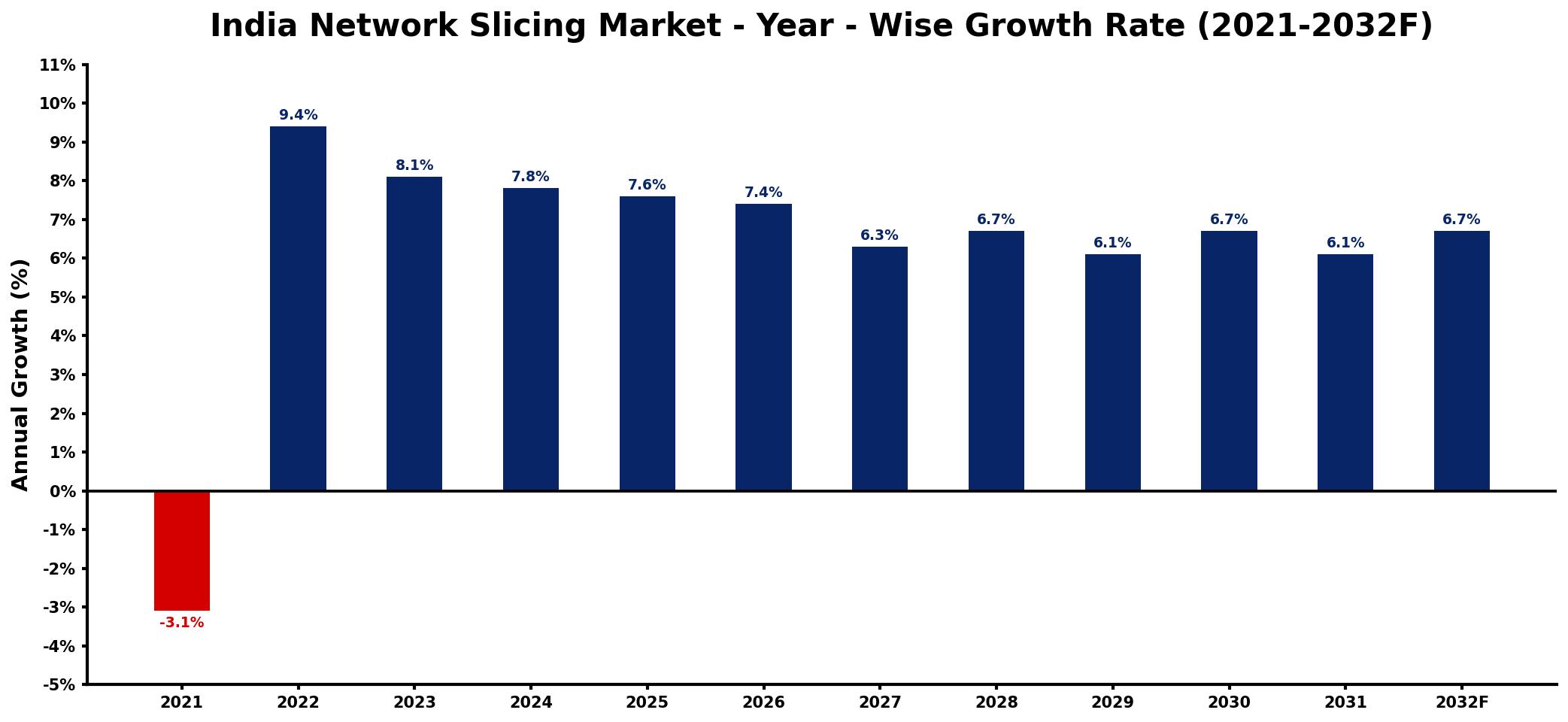
The table below presents the year‑wise growth rates along with the key drivers influencing the market
| Year | Growth Rate | Major Drivers |
| 2021 | -3.1% | decreased investment in telecom infrastructure |
| 2022 | 9.4% | rising demand for mobile connectivity |
| 2023 | 8.1% | expansion of 5G applications market |
| 2024 | 7.8% | increased enterprise digital transformation efforts |
| 2025 | 7.6% | growing interest in IoT solutions |
| 2026 | 7.4% | enhanced focus on cybersecurity measures |
| 2027 | 6.3% | adoption of smart city initiatives |
| 2028 | 6.7% | growth in cloud computing services |
| 2029 | 6.1% | increased collaboration among telecom operators |
| 2030 | 6.7% | surge in demand for automation |
| 2031 | 6.1% | rising end-use demand growth |
| 2032 | 6.7% | rising investments in edge computing |
Note: Market size estimations and growth projections presented in this report are based on 6Wresearch's proprietary forecasting methodology, utilizing the latest available industry data, government publications, and primary research inputs.
India Network Slicing Market Synopsis
The most significant force currently shaping the India Network Slicing Market is the impending rollout of 5G technology, which is revolutionizing how network resources are allocated and managed. With its capability to offer tailored services, network slicing facilitates the specific needs of multiple industries, from ultra-reliable communications to massive IoT applications.
As demand for customized network solutions rises, operators face the challenge of efficiently managing complex resource allocation while ensuring performance and scalability. The ongoing shift toward digital services and remote connectivity further intensifies the need for flexible and reliable network infrastructures that can adapt to various user requirements.
India Network Slicing Market Key Takeaways
- Network slicing is critical in optimizing resource allocation for diverse applications in India.
- The shift toward 5G networks is a key driver of market growth.
- Sectors like healthcare and manufacturing require ultra-reliable low-latency communications.
- Dynamic resource allocation has proven essential during the COVID-19 pandemic, highlighting the technology's importance.
- India's network slicing market is expected to experience significant growth, reflecting the demand for tailored network solutions.
Evaluation of Restraints in India Network Slicing Market
Despite the promising prospects, the India Network Slicing Market faces several restraints that could hinder its growth. The complexity of effectively managing and allocating resources across various network slices poses a significant challenge. Ensuring robust performance, maintaining isolation between different slices, and achieving scalability to meet diverse application demands require sophisticated technological solutions. Moreover, the need for substantial investment in infrastructure and talent may also act as a barrier for operators attempting to deploy these advanced solutions.
India Network Slicing Market Trends
Several trends are emerging in the India Network Slicing Market, notably the increasing integration of artificial intelligence (AI) and machine learning (ML) in network management. These technologies enhance the ability to automate resource allocation and optimize network performance. Additionally, there is a growing focus on sustainability and energy efficiency, with operators seeking to minimize their carbon footprint while delivering high-quality services.
Furthermore, the demand for industry-specific solutions is rising, as businesses seek to implement tailored services that cater to their unique operational requirements. This trend is especially pronounced in sectors that rely heavily on connectivity, such as smart cities and autonomous vehicles.
India Network Slicing Market Opportunities
The India Network Slicing Market presents numerous growth opportunities, particularly as the 5G rollout accelerates. Companies that innovate in the customization of network slices to cater to specific industries will likely find themselves at the forefront of this market. Moreover, partnerships between telecom operators and technology providers could foster the development of advanced solutions that enhance user experience. Investments in research and development focused on simplifying network management and improving reliability will also prove advantageous as demand for tailored connectivity solutions grows.
Government Initiatives in the India Network Slicing Market
The Indian government has recognized the importance of advanced telecommunications technologies, including network slicing, in driving economic growth and innovation. Initiatives aimed at enhancing digital infrastructure, promoting the adoption of 5G technology, and encouraging public-private partnerships are vital to creating a conducive environment for the network slicing market. Furthermore, policies that support research and development in telecommunications technology will play a significant role in accelerating market growth.
Future Insights of the India Network Slicing Market
Looking ahead to 2026-2032, the India Network Slicing Market is poised for substantial evolution as 5G networks become increasingly prevalent. The growing demand for customized network solutions will drive innovation and lead to more efficient resource management practices. As industries adapt to new technologies and connectivity paradigms, network slicing will emerge as an essential strategy for meeting their unique requirements. With investment and technological advancements, the market is set to flourish, opening new avenues for operators and businesses alike.
India Network Slicing Market Latest Developments (2025 - 2026)
In recent months, the India Network Slicing Market has seen significant industry direction toward implementing advanced slicing techniques. Operators have begun collaborating with technology partners to enhance their slicing capabilities, focusing on improving quality of service and user experience. Additionally, discussions around regulatory frameworks that support the deployment of 5G technologies have intensified, providing a clearer pathway for network slicing integration. These developments reflect a commitment to leveraging network slicing as a key differentiator in the competitive telecommunications landscape.
India Network Slicing Market - Key Attractiveness of the Report
- 10 Years of Market Numbers
- Historical Data Starting from 2022 to 2025
- Base Year: 2025
- Forecast Data until 2032
- Key Performance Indicators Impacting the Market
- Major Upcoming Developments and Projects
Key Highlights of the Report:
- India Network Slicing Market Outlook
- Market Size of India Network Slicing Market, 2025
- Forecast of India Network Slicing Market, 2032
- Historical Data and Forecast of India Network Slicing Revenues & Volume for the Period 2022-2032F
- India Network Slicing Market Trend Evolution
- India Network Slicing Market Drivers and Challenges
- India Network Slicing Price Trends
- India Network Slicing Porter's Five Forces
- India Network Slicing Industry Life Cycle
- Historical Data and Forecast of India Network Slicing Market Revenues & Volume By Component for the Period 2022-2032F
- Historical Data and Forecast of India Network Slicing Market Revenues & Volume By Solution for the Period 2022-2032F
- Historical Data and Forecast of India Network Slicing Market Revenues & Volume By Services (Professional & Managed) for the Period 2022-2032F
- Historical Data and Forecast of India Network Slicing Market Revenues & Volume By End User for the Period 2022-2032F
- Historical Data and Forecast of India Network Slicing Market Revenues & Volume By Telecom Operators for the Period 2022-2032F
- Historical Data and Forecast of India Network Slicing Market Revenues & Volume By Enterprises for the Period 2022-2032F
- Historical Data and Forecast of India Network Slicing Market Revenues & Volume By Application for the Period 2022-2032F
- Historical Data and Forecast of India Network Slicing Market Revenues & Volume By Manufacturing for the Period 2022-2032F
- Historical Data and Forecast of India Network Slicing Market Revenues & Volume By Government for the Period 2022-2032F
- Historical Data and Forecast of India Network Slicing Market Revenues & Volume By Automotive for the Period 2022-2032F
- Historical Data and Forecast of India Network Slicing Market Revenues & Volume By Media and Entertainment for the Period 2022-2032F
- India Network Slicing Import Export Trade Statistics
- Market Opportunity Assessment By Component
- Market Opportunity Assessment By End User
- Market Opportunity Assessment By Application
- India Network Slicing Top Companies Market Share
- India Network Slicing Competitive Benchmarking By Technical and Operational Parameters
- India Network Slicing Company Profiles
- India Network Slicing Key Strategic Recommendations






































