India Oil and Gas Cloud Applications Market Size & Growth Rate (2026-2032)
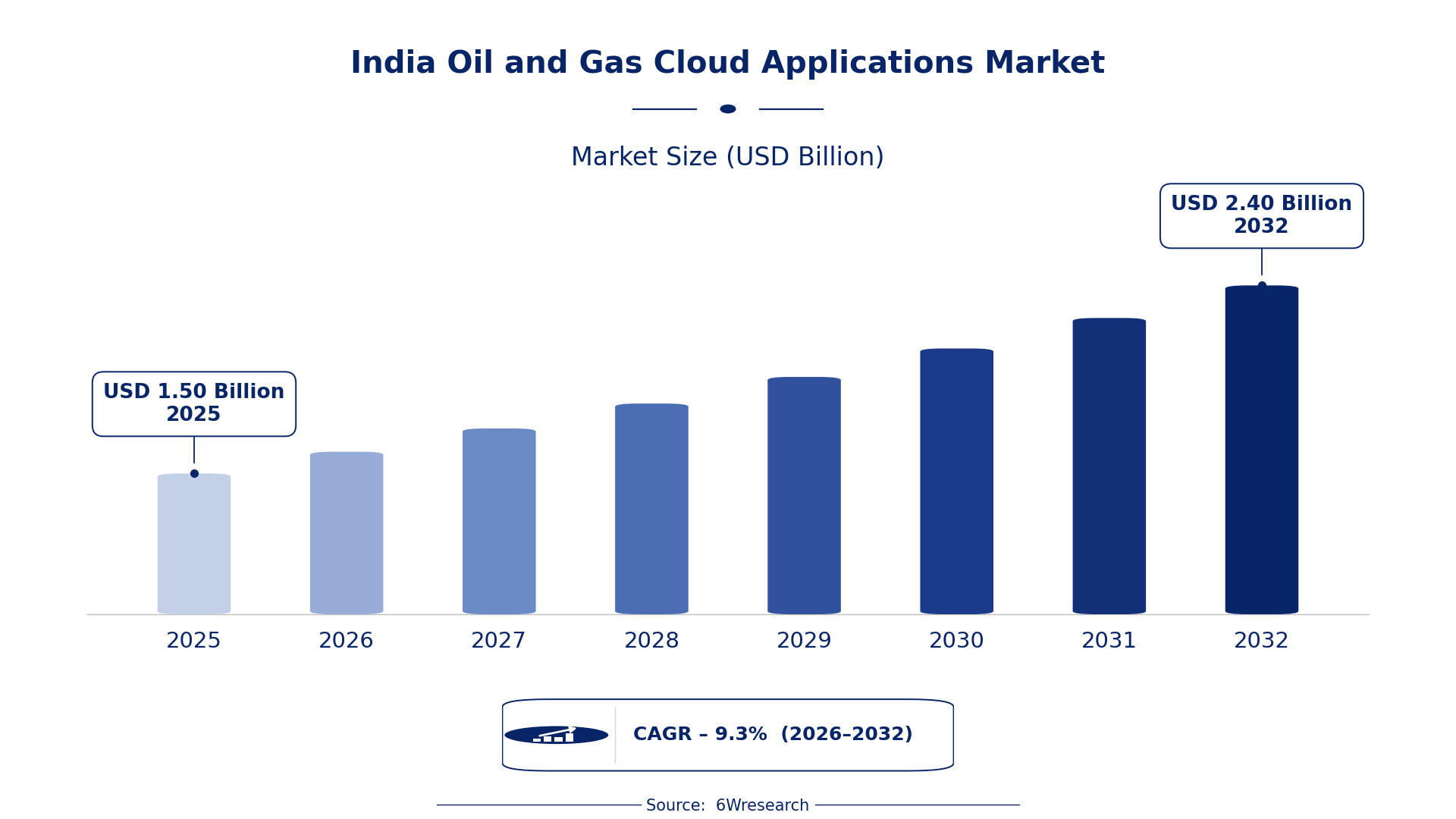
The India Oil and Gas Cloud Applications Market was estimated at USD 1500 Million in 2025 and is projected to reach USD 2402 Million by 2032, growing at a CAGR of 9.3% from 2026 to 2032.
India Oil and Gas Cloud Applications Market Synopsis
The adoption of cloud applications within India's oil and gas sector has gained momentum as companies seek to enhance operational efficiency and reduce costs. However, the market is on the brink of a more profound transformation, driven by the increasing demand for real-time data analytics and improved collaboration tools.
As oil and gas companies pivot towards digital solutions, cloud applications are becoming essential to their strategic framework. This shift is not merely a trend; it's a necessity for survival in a highly competitive and data-driven environment.
India Oil and Gas Cloud Applications Market Year-wise Growth Rate and Key Drivers
This graph illustrates the annual growth rates of the India Oil and Gas Cloud Applications Market from 2021 to 2032, highlighting a steady upward trajectory and projected expansion over the forecast period.
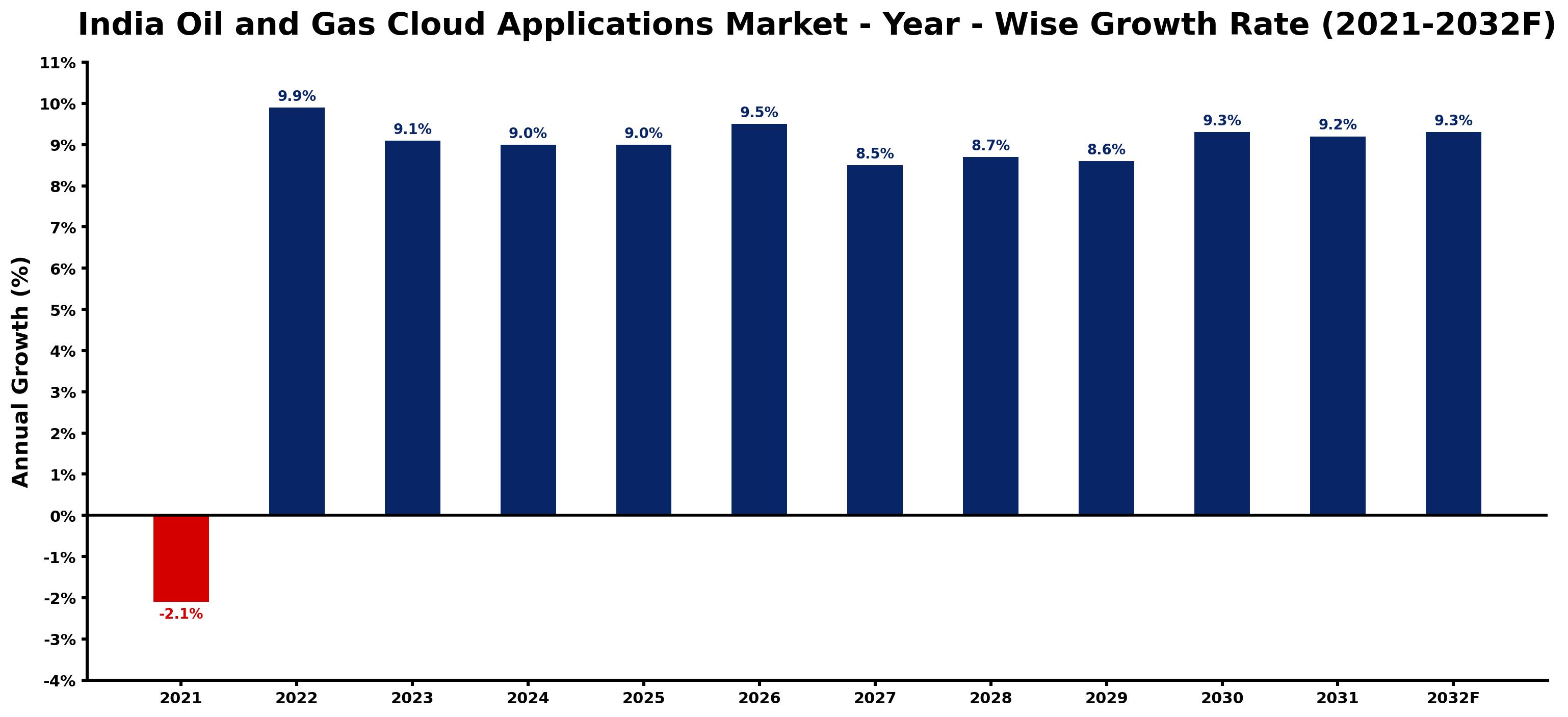
The table below presents the year‑wise growth rates along with the key drivers influencing the market
| Year | Growth Rate | Major Drivers |
| 2021 | -2.1% | Delayed implementation of OLA (Operational Lifecycle Automation) policy |
| 2022 | 9.9% | Government initiatives to enhance digital oilfield technologies |
| 2023 | 9.1% | Growing adoption of AI for predictive maintenance solutions |
| 2024 | 9.0% | Increased investment in upstream data analytics capabilities |
| 2025 | 9.0% | Enhanced regulatory compliance requirements driving cloud adoption |
| 2026 | 9.5% | BharatNet initiative boosts rural oil supply chain efficiency |
| 2027 | 8.5% | Emergence of 5G technology improving real-time monitoring |
| 2028 | 8.7% | Focus on sustainable practices spurring cloud innovations |
| 2029 | 8.6% | Rise in data-driven decision making in oil exploration |
| 2030 | 9.3% | Partnerships with tech firms advancing cloud integration efforts |
| 2031 | 9.2% | Regulatory push for transparency in oil asset management |
| 2032 | 9.3% | Growing reliance on cloud for remote operational support |
Note: Market size estimations and growth projections presented in this report are based on 6Wresearch's proprietary forecasting methodology, utilizing the latest available industry data, government publications, and primary research inputs.
India Oil and Gas Cloud Applications Market Key Takeaways
Below are some of the specific key takeaways from the market, including:
- The market is witnessing a steady growth trajectory as cloud applications become integral to operations.
- Real-time data analytics and remote monitoring are key drivers of cloud adoption in the sector.
- Companies face challenges related to data privacy and infrastructure reliability.
- The COVID-19 pandemic has accelerated the demand for cloud solutions, proving essential for operational continuity.
- Government initiatives are increasingly supporting the digital transformation of the oil and gas sector.
Evaluation of Restraints in India Oil and Gas Cloud Applications Market
While the market is poised for growth, several constraints hinder its potential. Data privacy remains a pressing concern, as companies grapple with the regulatory landscape governing local and international data protection laws. The challenge of scaling cloud infrastructure to meet fluctuating demands also looms large, impacting service reliability. Additionally, the need to manage costs effectively in a price-sensitive environment poses a significant hurdle for many players in the sector.
India Oil and Gas Cloud Applications Market Trends
Current trends indicate a surge in the adoption of advanced analytics, which allows for predictive maintenance and enhanced decision-making processes. The industry is also witnessing an uptick in remote collaboration tools, driven by a need for operational continuity amid workforce constraints. Sustainability is becoming a key theme, with cloud applications facilitating greener operations through improved resource management.
India Oil and Gas Cloud Applications Market Opportunities
Opportunities abound in cloud applications for the oil and gas sector. Companies that invest in tailored solutions for supply chain management and exploration can gain a competitive edge. on top of that, partnerships with technology providers can unlock innovative solutions that enhance safety and efficiency. As regulatory support increases, firms that align their strategies with government initiatives will find fertile ground for growth.
Government Initiatives in the India Oil and Gas Cloud Applications Market
The Indian government is actively shaping the oil and gas sector through various initiatives that prioritize digital transformation. Regulatory frameworks are evolving to support the integration of cloud solutions, ensuring compliance while promoting innovation. This environment is crucial for industry players aiming to enhance their operational capabilities through cloud applications.
- A national digital infrastructure upgrade programme now in its rollout phase aims to enhance connectivity and data access in the oil and gas sector.
- A regulatory framework introduced in 2025 mandating billing transparency is currently being implemented to improve operational clarity.
- A planned public-private initiative expected to expand telecom infrastructure access by 2028 will facilitate better cloud connectivity.
- The establishment of a task force focusing on data protection and privacy regulations is underway, enhancing compliance efforts for cloud adoption.
- Recent efforts to streamline approvals for cloud-based projects are aimed at accelerating the deployment of new technologies in the sector.
Future Insights of the India Oil and Gas Cloud Applications Market
Looking ahead to 2026-2032, the India Oil and Gas Cloud Applications Market is set to flourish, driven by an insatiable appetite for digital transformation. As companies invest in cloud technologies, the focus will increasingly shift towards enhancing operational efficiencies and reducing environmental impact. The interplay between technological advancements and regulatory support will define the next phase of growth, making it imperative for stakeholders to stay ahead of the curve.
India Oil and Gas Cloud Applications Market Latest Developments
Recent developments in the India Oil and Gas Cloud Applications Market reflect a strategic pivot towards cloud-based solutions that enhance operational resilience. The past 12-14 months have seen significant advancements as companies strive to optimize processes and embrace digital transformation.
- A leading regional operator began implementing an advanced cloud-based analytics platform in early 2025, aimed at improving operational efficiency.
- In Q3 2025, a major technology vendor launched a suite of collaborative tools designed specifically for remote monitoring and data sharing in the oil and gas sector.
- An initiative that started in mid-2025 focuses on integrating IoT with cloud applications to enhance real-time data collection and analysis capabilities.
- Plans are underway for a rollout expected to begin in the second half of 2026, introducing new cloud-based safety management solutions across the industry.
- A pilot project launched in late 2025 is testing the effectiveness of cloud applications in optimizing supply chain logistics for oil distribution.
India Oil and Gas Cloud Applications Market - Key Attractiveness of the Report
- 10 Years of Market Numbers
- Historical Data Starting from 2022 to 2025
- Base Year: 2025
- Forecast Data until 2032
- Key Performance Indicators Impacting the Market
- Major Upcoming Developments and Projects
Key Highlights of the Report:
- India Oil and Gas Cloud Applications Market Outlook
- Market Size of India Oil and Gas Cloud Applications Market, 2025
- Forecast of India Oil and Gas Cloud Applications Market, 2032
- Historical Data and Forecast of India Oil and Gas Cloud Applications Revenues & Volume for the Period 2022-2032F
- India Oil and Gas Cloud Applications Market Trend Evolution
- India Oil and Gas Cloud Applications Market Drivers and Challenges
- India Oil and Gas Cloud Applications Price Trends
- India Oil and Gas Cloud Applications Porter's Five Forces
- India Oil and Gas Cloud Applications Industry Life Cycle
- Historical Data and Forecast of India Oil and Gas Cloud Applications Market Revenues & Volume By Component for the Period 2022-2032F
- Historical Data and Forecast of India Oil and Gas Cloud Applications Market Revenues & Volume By Solution for the Period 2022-2032F
- Historical Data and Forecast of India Oil and Gas Cloud Applications Market Revenues & Volume By Services for the Period 2022-2032F
- Historical Data and Forecast of India Oil and Gas Cloud Applications Market Revenues & Volume By Deployment Type for the Period 2022-2032F
- Historical Data and Forecast of India Oil and Gas Cloud Applications Market Revenues & Volume By Private for the Period 2022-2032F
- Historical Data and Forecast of India Oil and Gas Cloud Applications Market Revenues & Volume By Public Cloud for the Period 2022-2032F
- Historical Data and Forecast of India Oil and Gas Cloud Applications Market Revenues & Volume By Operation for the Period 2022-2032F
- Historical Data and Forecast of India Oil and Gas Cloud Applications Market Revenues & Volume By Upstream for the Period 2022-2032F
- Historical Data and Forecast of India Oil and Gas Cloud Applications Market Revenues & Volume By Midstream for the Period 2022-2032F
- Historical Data and Forecast of India Oil and Gas Cloud Applications Market Revenues & Volume By Downstream for the Period 2022-2032F
- India Oil and Gas Cloud Applications Import Export Trade Statistics
- Market Opportunity Assessment By Component
- Market Opportunity Assessment By Deployment Type
- Market Opportunity Assessment By Operation
- India Oil and Gas Cloud Applications Top Companies Market Share
- India Oil and Gas Cloud Applications Competitive Benchmarking By Technical and Operational Parameters
- India Oil and Gas Cloud Applications Company Profiles
- India Oil and Gas Cloud Applications Key Strategic Recommendations






































