India Oil and Gas Hydraulic Equipment Market Size, Share & Growth Rate
The India Oil and Gas Hydraulic Equipment Market was estimated at USD 1447 Million in 2025 and is projected to reach USD 2079 Million by 2032, growing at a CAGR of 5.3% from 2026 to 2032. This promising trajectory is primarily driven by the continuous expansion of the oil and gas sector in India, fueled by significant investments in exploration and production activities. The increasing adoption of advanced hydraulic technologies further enhances operational efficiency, aligning with the industrys demands for safety and reliability.
India Oil and Gas Hydraulic Equipment Market Year-wise Growth Rate and Key Drivers
This graph highlights how the India Oil and Gas Hydraulic Equipment Market has steadily grown over the years, supported by major growth factors.
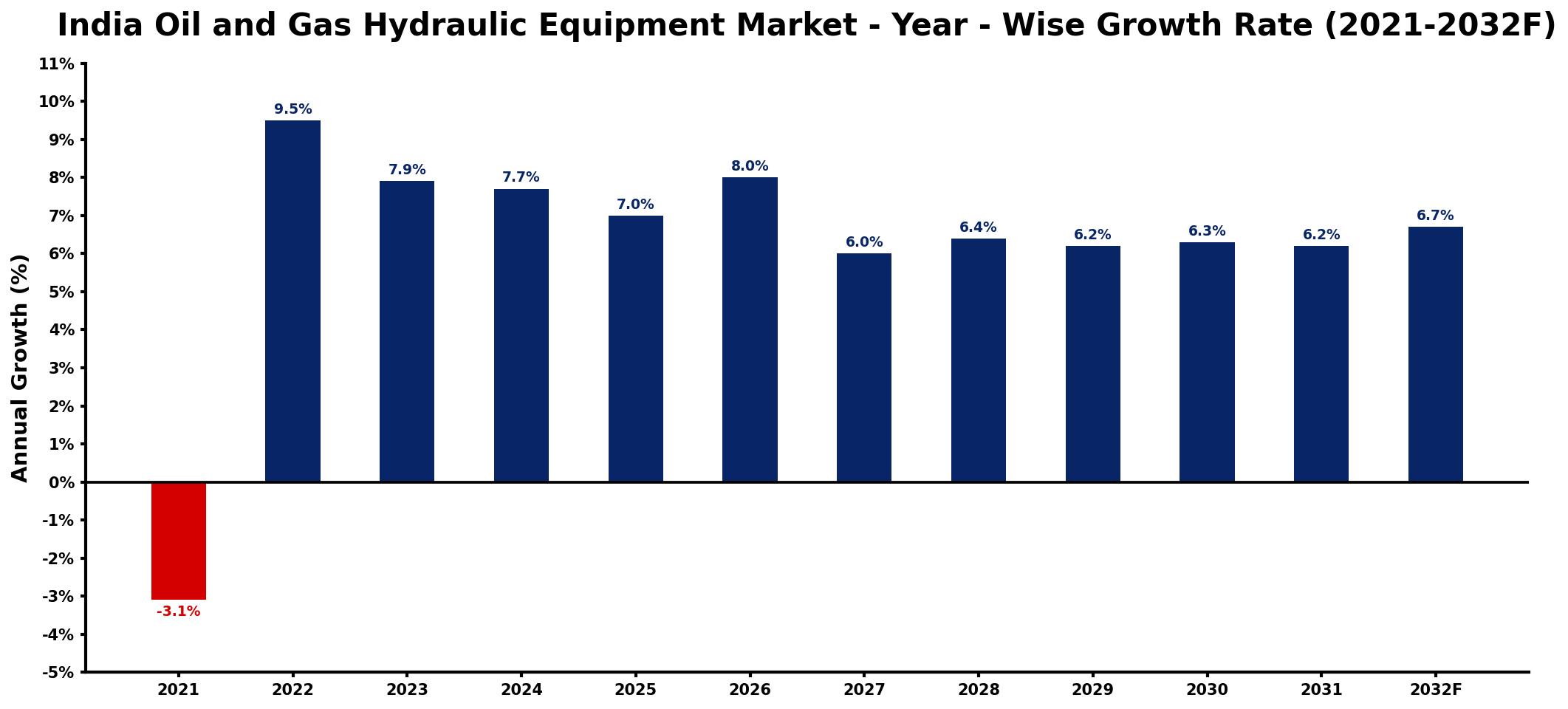
The table below presents the year‑wise growth rates along with the key drivers influencing the market
| Year | Growth Rate | Major Drivers |
| 2021 | -3.1% | decrease in industrial investments |
| 2022 | 9.5% | increase in renewable energy projects |
| 2023 | 7.9% | expansion of infrastructure development |
| 2024 | 7.7% | growth in energy transition initiatives |
| 2025 | 7.0% | rising demand for automation technologies |
| 2026 | 8.0% | enhanced focus on sustainability practices |
| 2027 | 6.0% | development of new energy sources |
| 2028 | 6.4% | increased government funding programs |
| 2029 | 6.2% | adoption of advanced manufacturing techniques |
| 2030 | 6.3% | emphasis on digital transformation strategies |
| 2031 | 6.2% | surge in private sector investments |
| 2032 | 6.7% | growing importance of energy security |
Note: Market size estimations and growth projections presented in this report are based on 6Wresearch's proprietary forecasting methodology, utilizing the latest available industry data, government publications, and primary research inputs.
India Oil and Gas Hydraulic Equipment Market Synopsis
The India oil and gas hydraulic equipment market is witnessing a surge in demand due to the growing emphasis on efficient drilling and production techniques. Hydraulic systems are integral to various applications, including well intervention and production activities, making them vital for the operational backbone of the industry.
With technological advancements such as smart control and electro-hydraulic systems, operators are now able to optimize their processes significantly. These innovations not only enhance operational safety but also cater to the evolving needs of the sector, allowing for more precise and effective hydraulic solutions.
India Oil and Gas Hydraulic Equipment Market Key Takeaways
- The market is set to grow substantially, fueled by increasing investments in the oil and gas sector.
- Technological advancements are enhancing the efficiency and safety of hydraulic systems in oilfield operations.
- The adoption of innovative hydraulic solutions is crucial for meeting the demands of evolving industry practices.
- Government initiatives aimed at boosting domestic oil and gas production are positively impacting market growth.
- Companies are focusing on tailored hydraulic solutions to better serve the unique needs of the Indian market.
Evaluation of Restraints in India Oil and Gas Hydraulic Equipment Market
Despite the promising outlook, the India oil and gas hydraulic equipment market faces notable restraints that could hinder its growth. Volatility in global oil prices creates uncertainty, making it difficult for companies to make long-term investment decisions. Geopolitical tensions can also impact exploration and production activities, leading to fluctuations in demand for hydraulic equipment. Additionally, the increasing global shift towards renewable energy sources poses a long-term challenge, compelling manufacturers to adapt and innovate to remain relevant in a changing energy landscape.
India Oil and Gas Hydraulic Equipment Market Trends
Several key trends are shaping the India oil and gas hydraulic equipment market. The integration of digital control technologies is becoming more prevalent, allowing operators to monitor and manage hydraulic systems more effectively. Furthermore, the development of subsea hydraulic solutions is gaining traction, driven by the expansion of offshore drilling activities. These trends reflect the industry's commitment to enhancing operational efficiency while addressing safety and environmental concerns.
India Oil and Gas Hydraulic Equipment Market Opportunities
The India oil and gas hydraulic equipment market is ripe with opportunities for growth and investment. As the government continues to promote policies aimed at enhancing domestic production, there is significant potential for hydraulic equipment providers to introduce innovative solutions tailored to local needs. Moreover, expanding offshore exploration projects will require advanced hydraulic technologies, presenting manufacturers with a platform to leverage their expertise and expand their market presence.
Government Initiatives in the India Oil and Gas Hydraulic Equipment Market
The Indian government is actively promoting initiatives aimed at boosting domestic oil and gas production, which significantly impacts the hydraulic equipment market. Policies facilitating foreign investment are expected to drive further technological advancements and infrastructure development. Additionally, government programs focusing on sustainable practices and efficiency improvements in the sector may provide favorable conditions for the adoption of innovative hydraulic solutions.
Future Insights of the India Oil and Gas Hydraulic Equipment Market
Looking ahead to 2026-2032, the India oil and gas hydraulic equipment market is expected to witness robust growth, bolstered by technological advancements and government support. As the industry increasingly prioritizes safety, efficiency, and environmental considerations, manufacturers will likely focus on developing cutting-edge hydraulic solutions. This period may also see further investment in renewable energy initiatives, necessitating hydraulic applications in hybrid systems, thus broadening market opportunities.
India Oil and Gas Hydraulic Equipment Market Latest Developments (2025 - 2026)
The India oil and gas hydraulic equipment market is experiencing dynamic developments, particularly in the adoption of advanced hydraulic systems. Companies are exploring collaborations aimed at enhancing technology integration, leading to improved operational efficiencies. Additionally, there is a growing emphasis on research and development to innovate hydraulic solutions that cater to both traditional oil and gas applications and emerging renewable energy sectors.
India Oil and Gas Hydraulic Equipment Market - Key Attractiveness of the Report
- 10 Years of Market Numbers
- Historical Data Starting from 2022 to 2025
- Base Year: 2025
- Forecast Data until 2032
- Key Performance Indicators Impacting the Market
- Major Upcoming Developments and Projects
Key Highlights of the Report:
- India Oil and Gas Hydraulic Equipment Market Outlook
- Market Size of India Oil and Gas Hydraulic Equipment Market, 2025
- Forecast of India Oil and Gas Hydraulic Equipment Market, 2032
- Historical Data and Forecast of India Oil and Gas Hydraulic Equipment Revenues & Volume for the Period 2022-2032F
- India Oil and Gas Hydraulic Equipment Market Trend Evolution
- India Oil and Gas Hydraulic Equipment Market Drivers and Challenges
- India Oil and Gas Hydraulic Equipment Price Trends
- India Oil and Gas Hydraulic Equipment Porter's Five Forces
- India Oil and Gas Hydraulic Equipment Industry Life Cycle
- Historical Data and Forecast of India Oil and Gas Hydraulic Equipment Market Revenues & Volume By Sector for the Period 2022-2032F
- Historical Data and Forecast of India Oil and Gas Hydraulic Equipment Market Revenues & Volume By Upstream for the Period 2022-2032F
- Historical Data and Forecast of India Oil and Gas Hydraulic Equipment Market Revenues & Volume By Mid-stream for the Period 2022-2032F
- Historical Data and Forecast of India Oil and Gas Hydraulic Equipment Market Revenues & Volume By Downstream for the Period 2022-2032F
- Historical Data and Forecast of India Oil and Gas Hydraulic Equipment Market Revenues & Volume By Location for the Period 2022-2032F
- Historical Data and Forecast of India Oil and Gas Hydraulic Equipment Market Revenues & Volume By Onshore for the Period 2022-2032F
- Historical Data and Forecast of India Oil and Gas Hydraulic Equipment Market Revenues & Volume By Offshore for the Period 2022-2032F
- Historical Data and Forecast of India Oil and Gas Hydraulic Equipment Market Revenues & Volume By Application for the Period 2022-2032F
- Historical Data and Forecast of India Oil and Gas Hydraulic Equipment Market Revenues & Volume By Drill Floor Hydraulics for the Period 2022-2032F
- Historical Data and Forecast of India Oil and Gas Hydraulic Equipment Market Revenues & Volume By Ballast Control System for the Period 2022-2032F
- Historical Data and Forecast of India Oil and Gas Hydraulic Equipment Market Revenues & Volume By Deck Crane Systems for the Period 2022-2032F
- Historical Data and Forecast of India Oil and Gas Hydraulic Equipment Market Revenues & Volume By Motion Compensation Systems for the Period 2022-2032F
- Historical Data and Forecast of India Oil and Gas Hydraulic Equipment Market Revenues & Volume By Top Drives for the Period 2022-2032F
- Historical Data and Forecast of India Oil and Gas Hydraulic Equipment Market Revenues & Volume By Manifolds for the Period 2022-2032F
- Historical Data and Forecast of India Oil and Gas Hydraulic Equipment Market Revenues & Volume By Winches for the Period 2022-2032F
- Historical Data and Forecast of India Oil and Gas Hydraulic Equipment Market Revenues & Volume By Others for the Period 2022-2032F
- India Oil and Gas Hydraulic Equipment Import Export Trade Statistics
- Market Opportunity Assessment By Sector
- Market Opportunity Assessment By Location
- Market Opportunity Assessment By Application
- India Oil and Gas Hydraulic Equipment Top Companies Market Share
- India Oil and Gas Hydraulic Equipment Competitive Benchmarking By Technical and Operational Parameters
- India Oil and Gas Hydraulic Equipment Company Profiles
- India Oil and Gas Hydraulic Equipment Key Strategic Recommendations






































