India Oil Country Tubular Goods Market Top 5 Importing Countries and Market Competition (HHI) Analysis
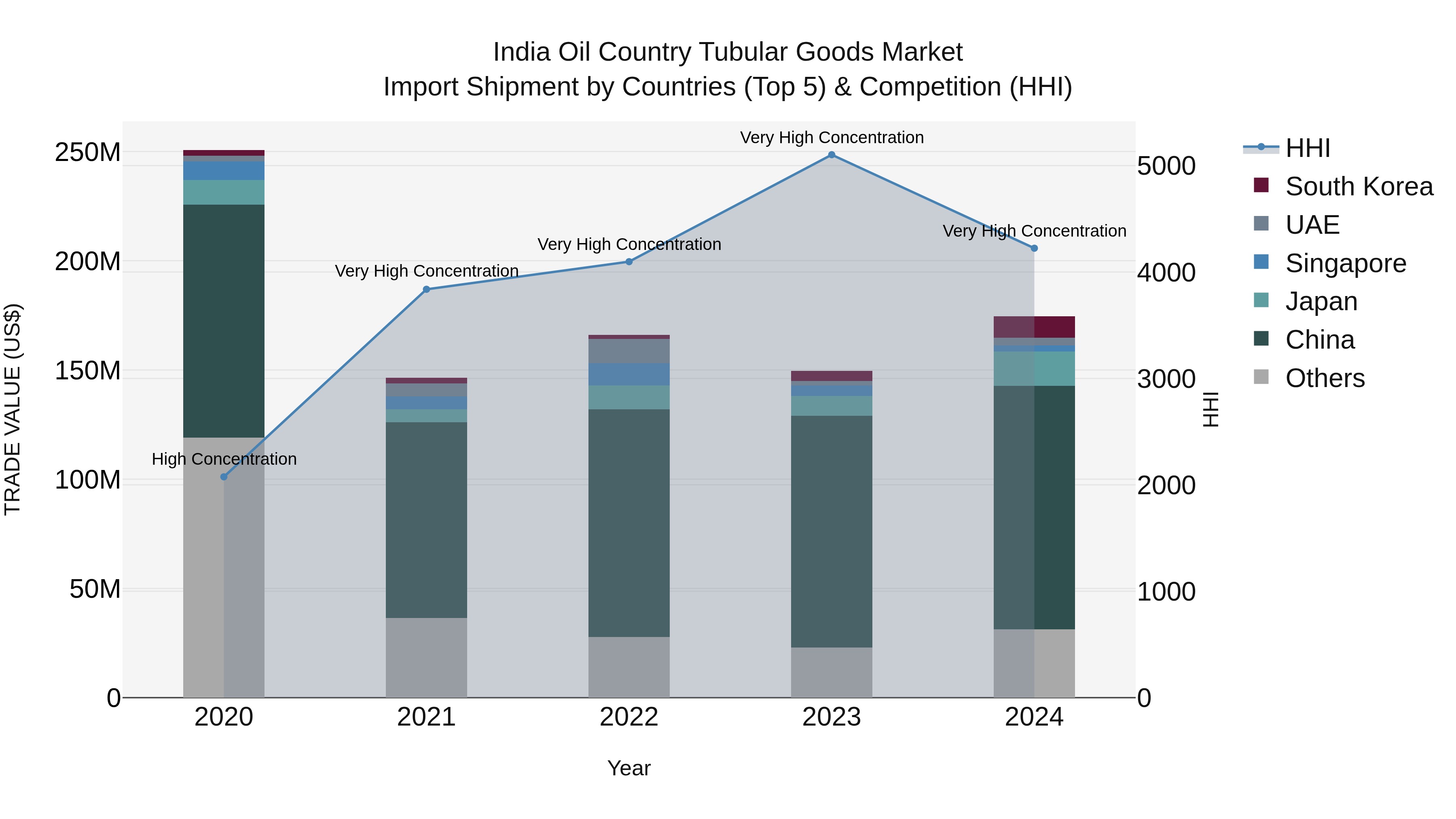
India`s import shipments of oil country tubular goods in 2024 continued to be dominated by top exporting countries such as China, Japan, South Korea, Thailand, and Metropolitan France. Despite a high concentration level indicated by the Herfindahl-Hirschman Index (HHI), the market experienced a negative compound annual growth rate (CAGR) of -8.65% from 2020 to 2024. However, there was a notable growth spurt in 2024 with a growth rate of 16.63% compared to the previous year, showcasing potential opportunities and shifts in the market landscape.
India Oil Country Tubular Goods Market Synopsis
The India oil country tubular goods (OCTG) market is expected to witness significant growth on account of rising investments in exploration & production activities coupled with improving crude oil prices and increasing demand from end users such as gas & energy companies as well as engineering procurement construction contractors. Moreover, numerous upcoming projects related to deepwater drilling operations will drive further demand for OCTG products over the forecast period. India?s OCTG market size was estimated at US$ 3184 million and is expected to reach US$ 5155 million by expanding at a CAGR of 10%. By product type, seamless pipe dominated the India OCTG industry accounting for more than 55% revenue share in 2025 owing its robust performance characteristics compared to welded pipes under extreme pressure conditions that arise from high temperature or corrosive environments encountered while carrying out underground drilling operations or transporting natural gas through pipelines situated offshore or onshore locations respectively.
Market Drivers of the market
In the India oil country tubular goods market, the key drivers revolve around the country`s increasing oil and gas exploration and production activities. As India strives to enhance its energy security, there is a heightened demand for oil country tubular goods, such as pipes and casings, in the oil and gas sector.
Challenges of the Market
In the oil country tubular goods (OCTG) market, India has witnessed increased demand due to the growth of the oil and gas exploration sector. Nevertheless, the industry faces challenges related to volatile oil prices and geopolitical uncertainties, impacting investments in exploration and production activities. Moreover, the country`s reliance on imports for some specialized OCTG products poses supply chain risks.
Covid-19 Impact on the Market
The oil country tubular goods (OCTG) market in India faced a downturn during the pandemic. As the global oil industry struggled with low prices and reduced drilling activities, the demand for OCTG products declined sharply. Many oil and gas projects were put on hold or delayed, adversely affecting the market.
Key Players of the Market
In the India oil country tubular goods market, significant key players include Tata Steel Ltd, Jindal Pipes Limited, Maharashtra Seamless Limited, and Essar Steel India Ltd.
Key Highlights of the Report:
- India Oil Country Tubular Goods Market Outlook
- Market Size of India Oil Country Tubular Goods Market, 2024
- Forecast of India Oil Country Tubular Goods Market, 2031
- Historical Data and Forecast of India Oil Country Tubular Goods Revenues & Volume for the Period 2021-2031
- India Oil Country Tubular Goods Market Trend Evolution
- India Oil Country Tubular Goods Market Drivers and Challenges
- India Oil Country Tubular Goods Price Trends
- India Oil Country Tubular Goods Porter's Five Forces
- India Oil Country Tubular Goods Industry Life Cycle
- Historical Data and Forecast of India Oil Country Tubular Goods Market Revenues & Volume By Manufacturing Process for the Period 2021-2031
- Historical Data and Forecast of India Oil Country Tubular Goods Market Revenues & Volume By Seamless for the Period 2021-2031
- Historical Data and Forecast of India Oil Country Tubular Goods Market Revenues & Volume By Electric Resistance Welded for the Period 2021-2031
- Historical Data and Forecast of India Oil Country Tubular Goods Market Revenues & Volume By Grade for the Period 2021-2031
- Historical Data and Forecast of India Oil Country Tubular Goods Market Revenues & Volume By Premium Grade for the Period 2021-2031
- Historical Data and Forecast of India Oil Country Tubular Goods Market Revenues & Volume By API Grade for the Period 2021-2031
- India Oil Country Tubular Goods Import Export Trade Statistics
- Market Opportunity Assessment By Manufacturing Process
- Market Opportunity Assessment By Grade
- India Oil Country Tubular Goods Top Companies Market Share
- India Oil Country Tubular Goods Competitive Benchmarking By Technical and Operational Parameters
- India Oil Country Tubular Goods Company Profiles
- India Oil Country Tubular Goods Key Strategic Recommendations






































