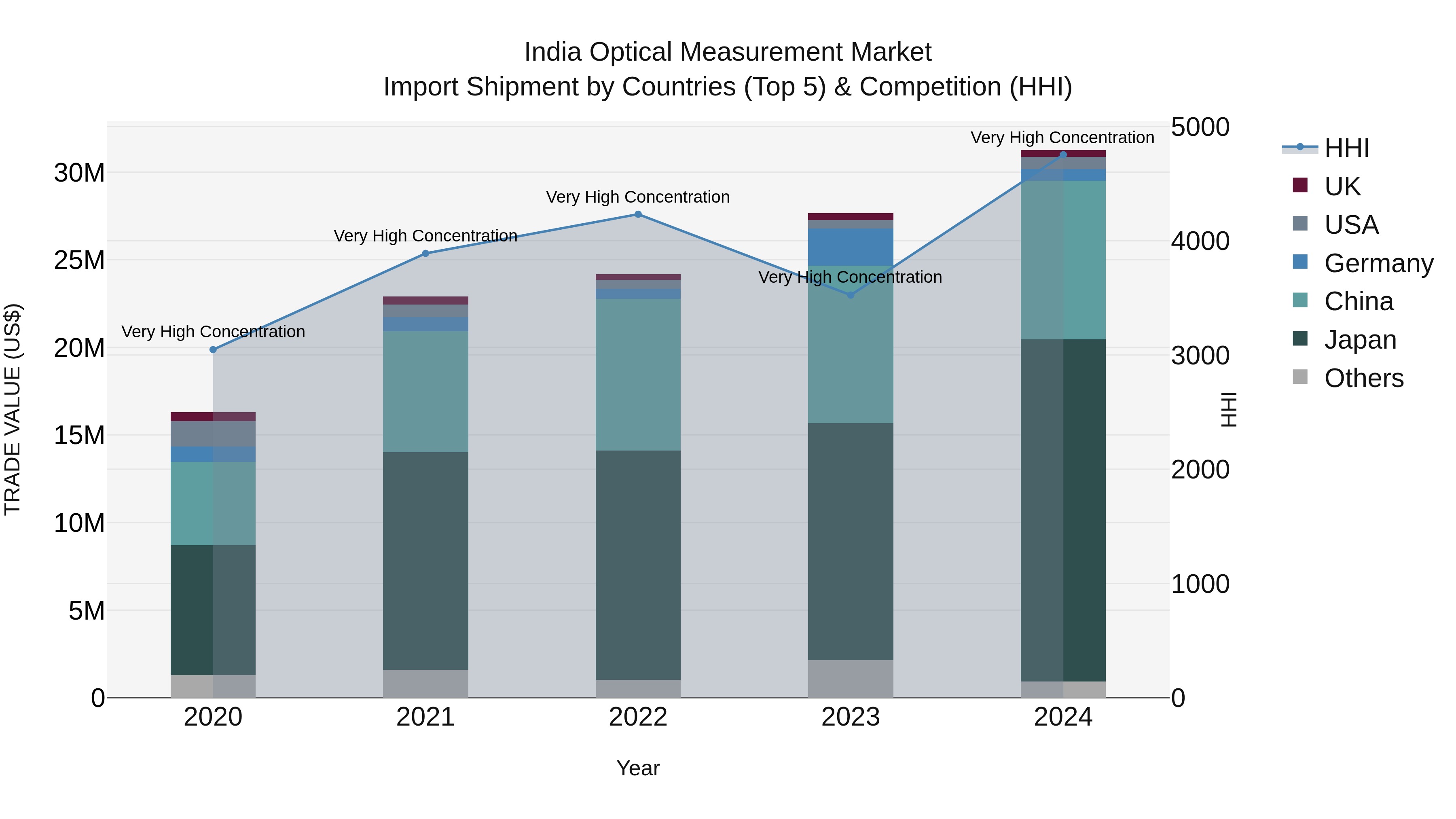
India Optical Measurement Market Top 5 Importing Countries and Market Competition (HHI) Analysis
India`s optical measurement import shipments in 2024 continued to be dominated by top exporting countries such as Japan, China, USA, Germany, and the UK. The high Herfindahl-Hirschman Index (HHI) indicates a concentrated market. The impressive compound annual growth rate (CAGR) of 17.69% from 2020 to 2024 showcases a robust upward trend in imports. Furthermore, the growth rate of 12.96% from 2023 to 2024 highlights sustained momentum in the sector, reflecting a positive outlook for the industry.
India Optical Measurement Market Synopsis
The optical measurement market in India is forecasted to grow with a CAGR of around 8% owing to rapid advancements in industrial automation technology, particularly in the automotive manufacturing sector which requires accurate measurements for quality control purposes. Additionally, the rising research activities & use of advanced technologies are projected to drive the India optical measurement industry over the coming years.
Market Drivers of the market
The optical measurement market in India is experiencing robust growth due to several driving factors. As industries continue to embrace automation and precision manufacturing processes, the demand for accurate and efficient measurement systems has surged. Optical measurement solutions, such as laser trackers, coordinate measuring machines (CMMs), and 3D scanners, offer non-contact, high-speed measurement capabilities, making them ideal for diverse applications in automotive, aerospace, and engineering sectors. Moreover, the need for quality control and inspection in various manufacturing processes has led to the adoption of optical measurement systems, further propelling the market`s expansion.
Challenges of the Market
The optical measurement market in India is experiencing steady growth, driven by advancements in technology and increased adoption in various industries. However, the market faces certain challenges. One of the primary challenges is the high initial cost of optical measurement systems, which may deter small and medium-sized enterprises from investing in these solutions. Moreover, the lack of skilled professionals proficient in operating and interpreting optical measurement data poses a significant challenge. The need for specialized training and expertise in handling complex optical instruments hinders efficient utilization and adoption of the technology. Additionally, the presence of alternative measurement techniques and technologies, such as coordinate measuring machines and non-contact 3D scanners, may present competition to the optical measurement market in certain applications.
Covid-19 Impact on the Market
The optical measurement market in India experienced a temporary slowdown during the initial phase of the pandemic due to the suspension of non-essential industrial activities and disruptions in the supply chain. However, as the economy gradually reopened, the market started to recover, driven by the growing demand for quality control and inspection solutions in essential sectors like pharmaceuticals, medical devices, and electronics. The need for social distancing and remote working also led to increased interest in automated and contactless optical measurement systems, boosting the adoption of advanced technologies.
Key Players of the Market
The optical measurement market in India is witnessing substantial growth owing to advancements in technology and the increasing adoption of optical measurement solutions in various industries such as automotive, aerospace, and electronics. Key players in this market include well-established companies like Hexagon AB, Zeiss International, Faro Technologies, and Nikon Metrology. These companies offer a wide range of optical measurement devices and systems, including laser trackers, coordinate measuring machines (CMMs), optical comparators, and 3D scanners.
Key Highlights of the Report:
- India Optical Measurement Market Outlook
- Market Size of India Optical Measurement Market, 2024
- Forecast of India Optical Measurement Market, 2031
- Historical Data and Forecast of India Optical Measurement Revenues & Volume for the Period 2021-2031
- India Optical Measurement Market Trend Evolution
- India Optical Measurement Market Drivers and Challenges
- India Optical Measurement Price Trends
- India Optical Measurement Porter's Five Forces
- India Optical Measurement Industry Life Cycle
- Historical Data and Forecast of India Optical Measurement Market Revenues & Volume By Offering for the Period 2021-2031
- Historical Data and Forecast of India Optical Measurement Market Revenues & Volume By Hardware for the Period 2021-2031
- Historical Data and Forecast of India Optical Measurement Market Revenues & Volume By Software for the Period 2021-2031
- Historical Data and Forecast of India Optical Measurement Market Revenues & Volume By Services for the Period 2021-2031
- Historical Data and Forecast of India Optical Measurement Market Revenues & Volume By Component for the Period 2021-2031
- Historical Data and Forecast of India Optical Measurement Market Revenues & Volume By Autocollimators for the Period 2021-2031
- Historical Data and Forecast of India Optical Measurement Market Revenues & Volume By Measuring Microscopes for the Period 2021-2031
- Historical Data and Forecast of India Optical Measurement Market Revenues & Volume By Profile Projectors for the Period 2021-2031
- Historical Data and Forecast of India Optical Measurement Market Revenues & Volume By Optical Digitizers and Scanners for the Period 2021-2031
- Historical Data and Forecast of India Optical Measurement Market Revenues & Volume By Coordinate Measuring Machines for the Period 2021-2031
- Historical Data and Forecast of India Optical Measurement Market Revenues & Volume By Video Measuring Machines for the Period 2021-2031
- Historical Data and Forecast of India Optical Measurement Market Revenues & Volume By Vertical for the Period 2021-2031
- Historical Data and Forecast of India Optical Measurement Market Revenues & Volume By Automotive for the Period 2021-2031
- Historical Data and Forecast of India Optical Measurement Market Revenues & Volume By Aerospace & Defense for the Period 2021-2031
- Historical Data and Forecast of India Optical Measurement Market Revenues & Volume By Energy and Power for the Period 2021-2031
- Historical Data and Forecast of India Optical Measurement Market Revenues & Volume By Electronics Manufacturing for the Period 2021-2031
- Historical Data and Forecast of India Optical Measurement Market Revenues & Volume By Industrial for the Period 2021-2031
- Historical Data and Forecast of India Optical Measurement Market Revenues & Volume By Others for the Period 2021-2031
- India Optical Measurement Import Export Trade Statistics
- Market Opportunity Assessment By Offering
- Market Opportunity Assessment By Component
- Market Opportunity Assessment By Vertical
- India Optical Measurement Top Companies Market Share
- India Optical Measurement Competitive Benchmarking By Technical and Operational Parameters
- India Optical Measurement Company Profiles
- India Optical Measurement Key Strategic Recommendations






































