India Packaged Water Market Top 5 Importing Countries and Market Competition (HHI) Analysis
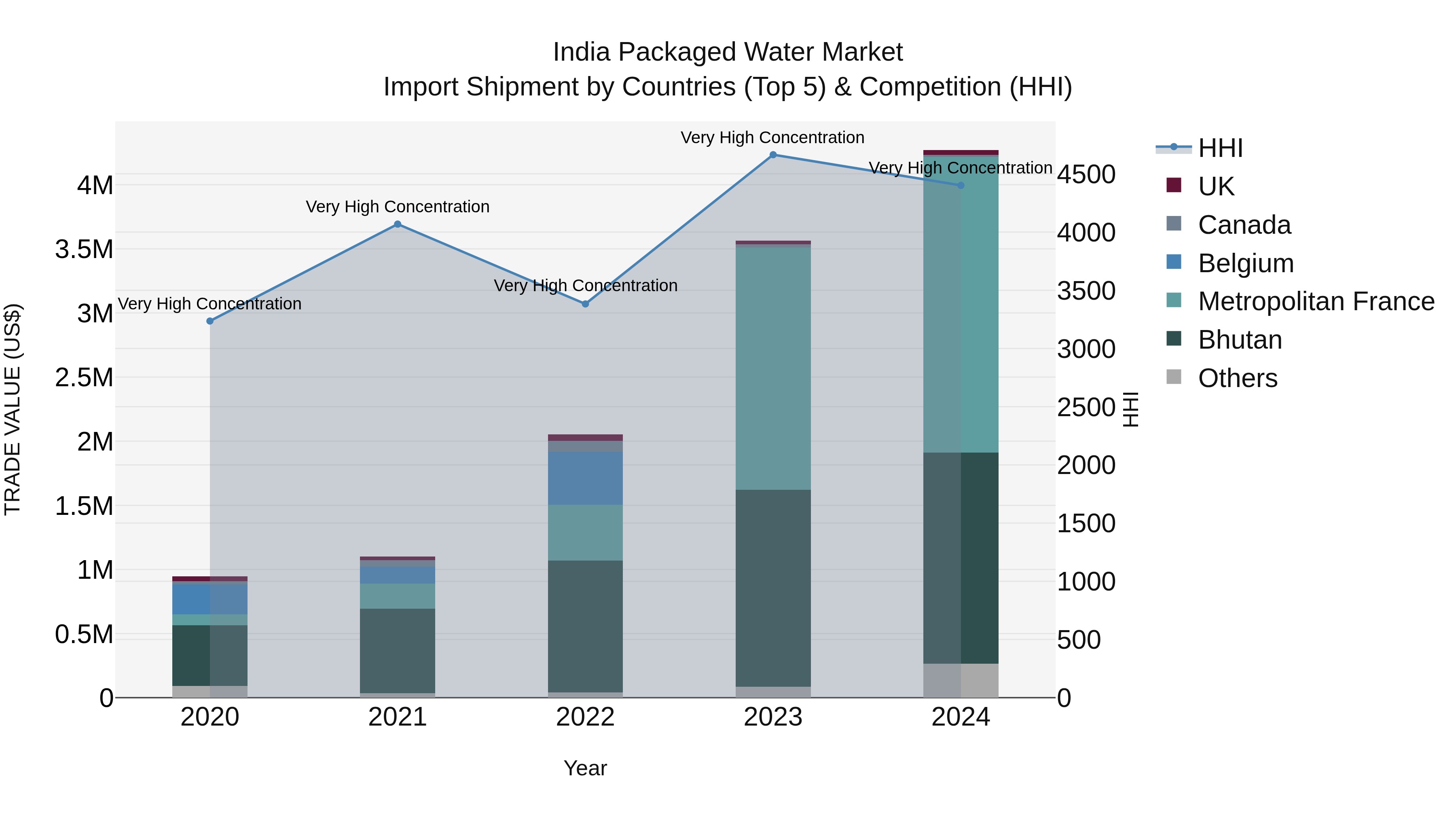
India`s packaged water import market saw significant growth in 2024, with top exporting countries including Metropolitan France, Bhutan, Netherlands, Italy, and UAE. The market exhibited high concentration with a high Herfindahl-Hirschman Index (HHI). The compound annual growth rate (CAGR) from 2020 to 2024 was an impressive 45.77%, indicating a strong upward trend. Furthermore, the growth rate from 2023 to 2024 stood at 19.84%, underscoring the continued expansion and demand for imported packaged water in India.
India Packaged water Market Overview
The India packaged water market has been experiencing significant growth due to factors such as increasing health consciousness among consumers, a rise in disposable income, and the convenience of packaged water. The market is highly competitive with numerous local and international players offering a wide range of products including bottled water, flavored water, and functional water. Key players in the market focus on product innovation, branding, and distribution strategies to gain a competitive edge. The market is also influenced by factors such as changing consumer preferences, regulatory requirements, and sustainability concerns related to plastic packaging. Overall, the India packaged water market is poised for continued growth driven by urbanization, lifestyle changes, and increasing awareness about the importance of safe drinking water.
India Packaged water Market Trends and Opportunities
The India Packaged water market is witnessing significant growth due to increasing health consciousness, convenience, and growing urbanization. Consumers are opting for packaged water over tap water due to concerns about water quality and safety. The market is also benefiting from the rising demand for on-the-go hydration solutions, particularly in busy urban areas. Key trends include the introduction of innovative packaging formats such as eco-friendly bottles and pouches, as well as the emergence of flavored and functional water variants. Moreover, the expansion of distribution networks, e-commerce platforms, and marketing strategies are creating new opportunities for market players to reach a wider consumer base and drive sales. Overall, the India Packaged water market presents a promising landscape for growth and innovation.
India Packaged water Market Challenges
In the India Packaged water market, some of the key challenges faced include intense competition among numerous brands leading to price wars and pressure on profit margins. Another challenge is the issue of water quality and safety concerns, as consumers are becoming more conscious about the source and purity of the packaged water they are consuming. Additionally, the high cost of packaging materials, transportation, and distribution in a geographically vast country like India poses logistical challenges for companies operating in this market. Furthermore, evolving consumer preferences towards more sustainable and eco-friendly packaging solutions present a challenge for companies to adapt and innovate to meet these changing demands while maintaining cost-effectiveness. Overall, companies in the India Packaged water market must navigate these challenges effectively to stay competitive and meet consumer expectations.
India Packaged water Market Drivers
The India Packaged water market is primarily driven by factors such as increasing health consciousness among consumers, growing concerns regarding water contamination and the lack of access to clean drinking water in many parts of the country. Additionally, the convenience and portability of packaged water make it a popular choice for on-the-go hydration. The rise in disposable income levels and changing consumer lifestyles have also contributed to the market growth, as more people opt for ready-to-drink water options. Furthermore, the aggressive marketing strategies adopted by companies, innovative packaging solutions, and the expanding distribution networks have played a significant role in driving the demand for packaged water in India.
India Packaged water Market Government Policy
Government policies related to the India Packaged water Market include regulations set by the Food Safety and Standards Authority of India (FSSAI) to ensure the quality and safety of packaged drinking water. FSSAI has established standards for labeling, packaging, and testing of packaged water products to protect consumer health. Additionally, the Bureau of Indian Standards (BIS) has set guidelines for the quality and purity of packaged drinking water to maintain industry standards. The government also imposes regulations on licensing and compliance for packaged water manufacturers to ensure adherence to safety protocols and quality control measures. These policies aim to safeguard public health, promote consumer confidence, and regulate the growing packaged water market in India.
India Packaged water Market Future Outlook
The India Packaged water market is expected to witness steady growth in the coming years due to increasing awareness about the importance of clean and safe drinking water. The rising population, urbanization, and changing lifestyle preferences are driving the demand for convenient and portable drinking water solutions. With a growing focus on health and hygiene, consumers are likely to continue opting for packaged water as a safe and reliable option. Additionally, the government`s initiatives to improve access to clean drinking water in rural areas and the growing trend of e-commerce platforms offering a wide range of packaged water choices are expected to further boost market growth. However, the market may face challenges related to sustainability concerns and increasing competition from alternative beverages. Overall, the India Packaged water market is poised for expansion in the foreseeable future.
Key Highlights of the Report:
- India Packaged water Market Outlook
- Market Size of India Packaged water Market, 2024
- Forecast of India Packaged water Market, 2031
- Historical Data and Forecast of India Packaged water Revenues & Volume for the Period 2021- 2031
- India Packaged water Market Trend Evolution
- India Packaged water Market Drivers and Challenges
- India Packaged water Price Trends
- India Packaged water Porter's Five Forces
- India Packaged water Industry Life Cycle
- Historical Data and Forecast of India Packaged water Market Revenues & Volume By Product for the Period 2021- 2031
- Historical Data and Forecast of India Packaged water Market Revenues & Volume By Still for the Period 2021- 2031
- Historical Data and Forecast of India Packaged water Market Revenues & Volume By Carbonated for the Period 2021- 2031
- Historical Data and Forecast of India Packaged water Market Revenues & Volume By Flavored for the Period 2021- 2031
- Historical Data and Forecast of India Packaged water Market Revenues & Volume By Functional for the Period 2021- 2031
- India Packaged water Import Export Trade Statistics
- Market Opportunity Assessment By Product
- India Packaged water Top Companies Market Share
- India Packaged water Competitive Benchmarking By Technical and Operational Parameters
- India Packaged water Company Profiles
- India Packaged water Key Strategic Recommendations






































