India Passenger Car Motor Oil Market Top 5 Importing Countries and Market Competition (HHI) Analysis
India`s passenger car motor oil import market continues to see significant growth, with top exporting countries in 2024 being Hong Kong, China, Germany, Sweden, and Belgium. The market concentration, as measured by the HHI, has increased from high to very high in 2024, indicating a more consolidated market landscape. The impressive compound annual growth rate (CAGR) of 74.16% from 2020 to 2024 highlights the robust demand for motor oil in India. Moreover, the growth rate of 53.37% from 2023 to 2024 demonstrates the accelerating pace of expansion in the sector.
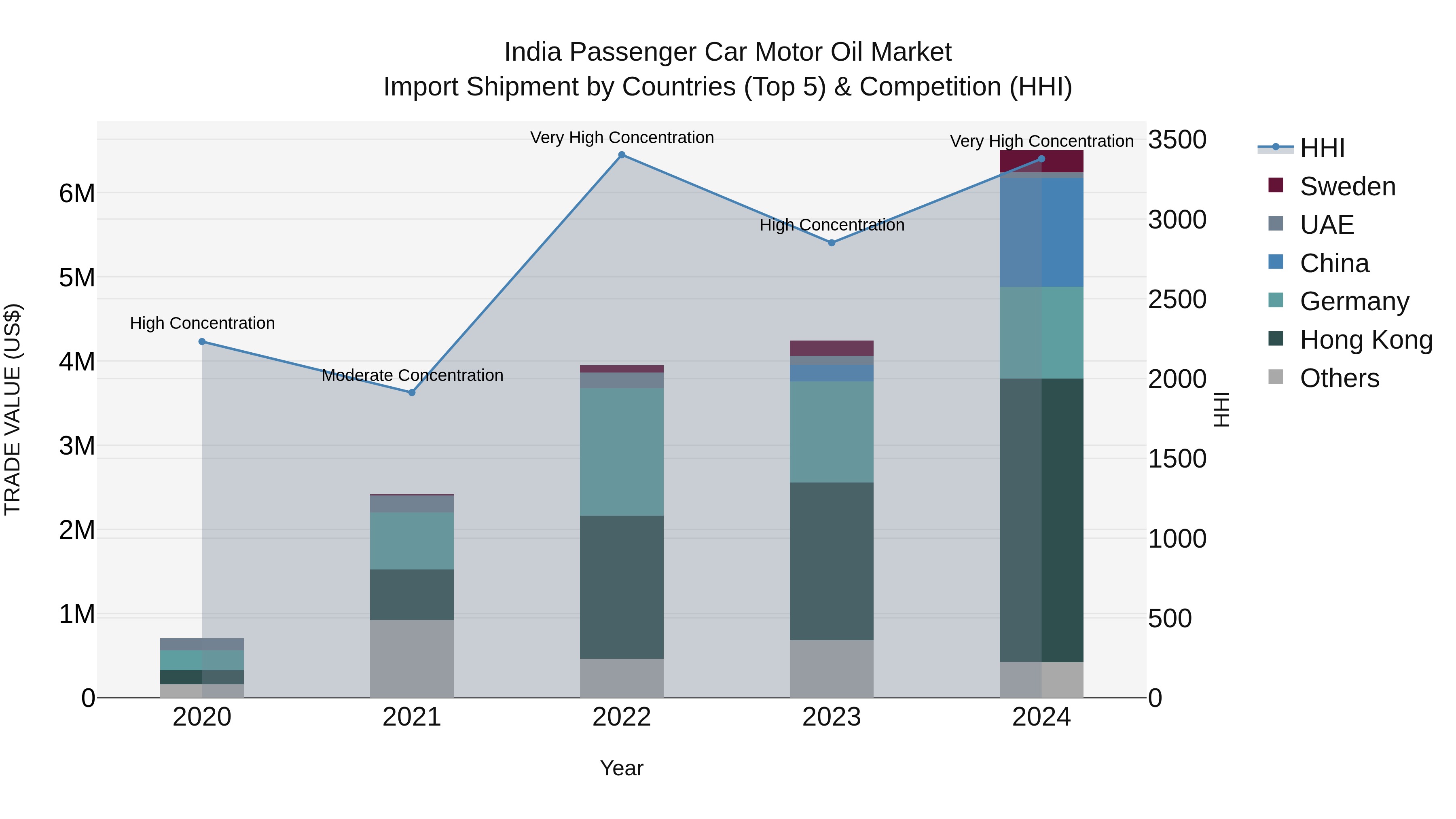
India Passenger Car Motor Oil Market Overview
The India passenger car motor oil market is witnessing steady growth due to factors such as increasing car ownership, expanding middle-class population, and rising disposable income. The market is highly competitive with major players like Castrol, Shell, and Mobil dominating the industry. Synthetic motor oils are gaining popularity in the market due to their superior performance and longer lifespan compared to conventional oils. The shift towards cleaner and more fuel-efficient vehicles is also driving the demand for high-quality motor oils that can improve engine efficiency and reduce emissions. Additionally, the growing awareness about the importance of regular maintenance and servicing of vehicles is further fueling the demand for passenger car motor oils in India. Overall, the market is expected to continue growing as the automotive industry in India expands and consumers prioritize vehicle performance and longevity.
India Passenger Car Motor Oil Market Trends
The India passenger car motor oil market is experiencing several key trends. One significant trend is the shift towards synthetic motor oils due to their superior performance and longer service intervals, driven by the increasing awareness among consumers about the benefits of synthetic oils. Additionally, the market is witnessing a growing demand for high-quality motor oils that meet the specifications of modern engines to enhance fuel efficiency and reduce emissions. Another trend is the emphasis on eco-friendly and sustainable motor oil products, with manufacturers introducing more environmentally friendly formulations. Furthermore, the rise of e-commerce platforms for purchasing motor oils is providing consumers with greater convenience and access to a wider range of products. Overall, these trends are shaping the India passenger car motor oil market towards more advanced, sustainable, and consumer-oriented products.
India Passenger Car Motor Oil Market Challenges
The India passenger car motor oil market faces several challenges, including intense competition among both domestic and international brands, price sensitivity of consumers, and the presence of counterfeit products in the market. Additionally, the lack of awareness among consumers about the importance of using high-quality motor oil for their vehicles and the varying quality standards across different brands pose challenges for market players. Fluctuating crude oil prices and the impact of government regulations on the automotive industry also contribute to the complexities of the market. To succeed in this competitive landscape, companies need to focus on product quality, brand positioning, and effective marketing strategies to differentiate themselves and gain market share.
India Passenger Car Motor Oil Market Investment Opportunities
The India passenger car motor oil market presents several investment opportunities due to the growing automotive industry in the country. With an increasing number of passenger cars on the roads, there is a rising demand for high-quality motor oils to ensure optimal performance and engine longevity. Investors can consider opportunities in manufacturing and distributing synthetic motor oils, which are gaining popularity for their superior protection and performance benefits. Additionally, there is potential for investments in developing environmentally friendly and energy-efficient motor oil products to cater to the growing sustainability trend in the automotive sector. Collaborating with major car manufacturers or service centers to supply motor oils tailored to specific vehicle models could also be a lucrative investment strategy in the competitive Indian market.
India Passenger Car Motor Oil Market Government Policy
The Indian government has implemented several policies related to the passenger car motor oil market to ensure quality standards and environmental sustainability. The Bureau of Indian Standards (BIS) has set specifications for motor oils to be sold in the country, including guidelines for viscosity, performance, and labeling. Additionally, the government has introduced policies to promote the use of environmentally friendly motor oils that comply with emission norms and reduce pollution. The implementation of Bharat Stage VI (BS-VI) emission standards has also had a significant impact on the passenger car motor oil market, as it requires vehicles to use cleaner fuels and lubricants to meet the stringent emission requirements. Overall, these policies aim to enhance the quality of motor oils, protect the environment, and ensure compliance with regulatory standards in the Indian passenger car motor oil market.
India Passenger Car Motor Oil Market Future Outlook
The future outlook for the India passenger car motor oil market looks promising, with expected growth driven by factors such as increasing vehicle ownership, rising disposable incomes, and expanding urbanization. The market is likely to witness a shift towards higher quality synthetic and semi-synthetic motor oils due to their superior performance and longer service intervals, influenced by the growing demand for fuel-efficient vehicles. Additionally, the rising awareness about the importance of regular maintenance and the increasing emphasis on vehicle longevity are expected to drive the demand for passenger car motor oils in India. Market players are likely to focus on product innovation, strategic partnerships, and marketing initiatives to capitalize on the growing automotive sector in the country and cater to the evolving consumer preferences.
Key Highlights of the Report:
- India Passenger Car Motor Oil Market Outlook
- Market Size of India Passenger Car Motor Oil Market,2024
- Forecast of India Passenger Car Motor Oil Market, 2031
- Historical Data and Forecast of India Passenger Car Motor Oil Revenues & Volume for the Period 2021-2031
- India Passenger Car Motor Oil Market Trend Evolution
- India Passenger Car Motor Oil Market Drivers and Challenges
- India Passenger Car Motor Oil Price Trends
- India Passenger Car Motor Oil Porter's Five Forces
- India Passenger Car Motor Oil Industry Life Cycle
- Historical Data and Forecast of India Passenger Car Motor Oil Market Revenues & Volume By Type for the Period 2021-2031
- Historical Data and Forecast of India Passenger Car Motor Oil Market Revenues & Volume By Synthetic for the Period 2021-2031
- Historical Data and Forecast of India Passenger Car Motor Oil Market Revenues & Volume By Conventional for the Period 2021-2031
- Historical Data and Forecast of India Passenger Car Motor Oil Market Revenues & Volume By Semi-Synthetic for the Period 2021-2031
- Historical Data and Forecast of India Passenger Car Motor Oil Market Revenues & Volume By High-Mileage for the Period 2021-2031
- Historical Data and Forecast of India Passenger Car Motor Oil Market Revenues & Volume By Viscosity Grade for the Period 2021-2031
- Historical Data and Forecast of India Passenger Car Motor Oil Market Revenues & Volume By 5W-30 for the Period 2021-2031
- Historical Data and Forecast of India Passenger Car Motor Oil Market Revenues & Volume By 10W-40 for the Period 2021-2031
- Historical Data and Forecast of India Passenger Car Motor Oil Market Revenues & Volume By 15W-50 for the Period 2021-2031
- Historical Data and Forecast of India Passenger Car Motor Oil Market Revenues & Volume By 0W-20 for the Period 2021-2031
- Historical Data and Forecast of India Passenger Car Motor Oil Market Revenues & Volume By Application for the Period 2021-2031
- Historical Data and Forecast of India Passenger Car Motor Oil Market Revenues & Volume By High Performance for the Period 2021-2031
- Historical Data and Forecast of India Passenger Car Motor Oil Market Revenues & Volume By Standard Driving for the Period 2021-2031
- Historical Data and Forecast of India Passenger Car Motor Oil Market Revenues & Volume By Long Mileage for the Period 2021-2031
- Historical Data and Forecast of India Passenger Car Motor Oil Market Revenues & Volume By Fuel Efficiency for the Period 2021-2031
- Historical Data and Forecast of India Passenger Car Motor Oil Market Revenues & Volume By End Use for the Period 2021-2031
- Historical Data and Forecast of India Passenger Car Motor Oil Market Revenues & Volume By Car Owners for the Period 2021-2031
- Historical Data and Forecast of India Passenger Car Motor Oil Market Revenues & Volume By Dealerships for the Period 2021-2031
- Historical Data and Forecast of India Passenger Car Motor Oil Market Revenues & Volume By Service Centers for the Period 2021-2031
- Historical Data and Forecast of India Passenger Car Motor Oil Market Revenues & Volume By Automotive for the Period 2021-2031
- India Passenger Car Motor Oil Import Export Trade Statistics
- Market Opportunity Assessment By Type
- Market Opportunity Assessment By Viscosity Grade
- Market Opportunity Assessment By Application
- Market Opportunity Assessment By End Use
- India Passenger Car Motor Oil Top Companies Market Share
- India Passenger Car Motor Oil Competitive Benchmarking By Technical and Operational Parameters
- India Passenger Car Motor Oil Company Profiles
- India Passenger Car Motor Oil Key Strategic Recommendations






































