India Photosensitive Semiconductor Device Market Size, Share & Growth Rate
The India Photosensitive Semiconductor Device Market was estimated at USD 685 Million in 2025 and is projected to reach USD 1116 Million by 2032, growing at a CAGR of 7.2% from 2026 to 2032. This growth trajectory is primarily driven by the rising integration of advanced imaging and detection technologies across consumer electronics, automotive applications, and industrial automation. Furthermore, the burgeoning demand for smart sensors in Internet of Things (IoT) solutions is expected to significantly boost the market, underscoring its critical role in the technology ecosystem.
India Photosensitive Semiconductor Device Market Year-wise Growth Rate and Key Drivers
This graph highlights how the India Photosensitive Semiconductor Device Market has steadily grown over the years, supported by major growth factors.
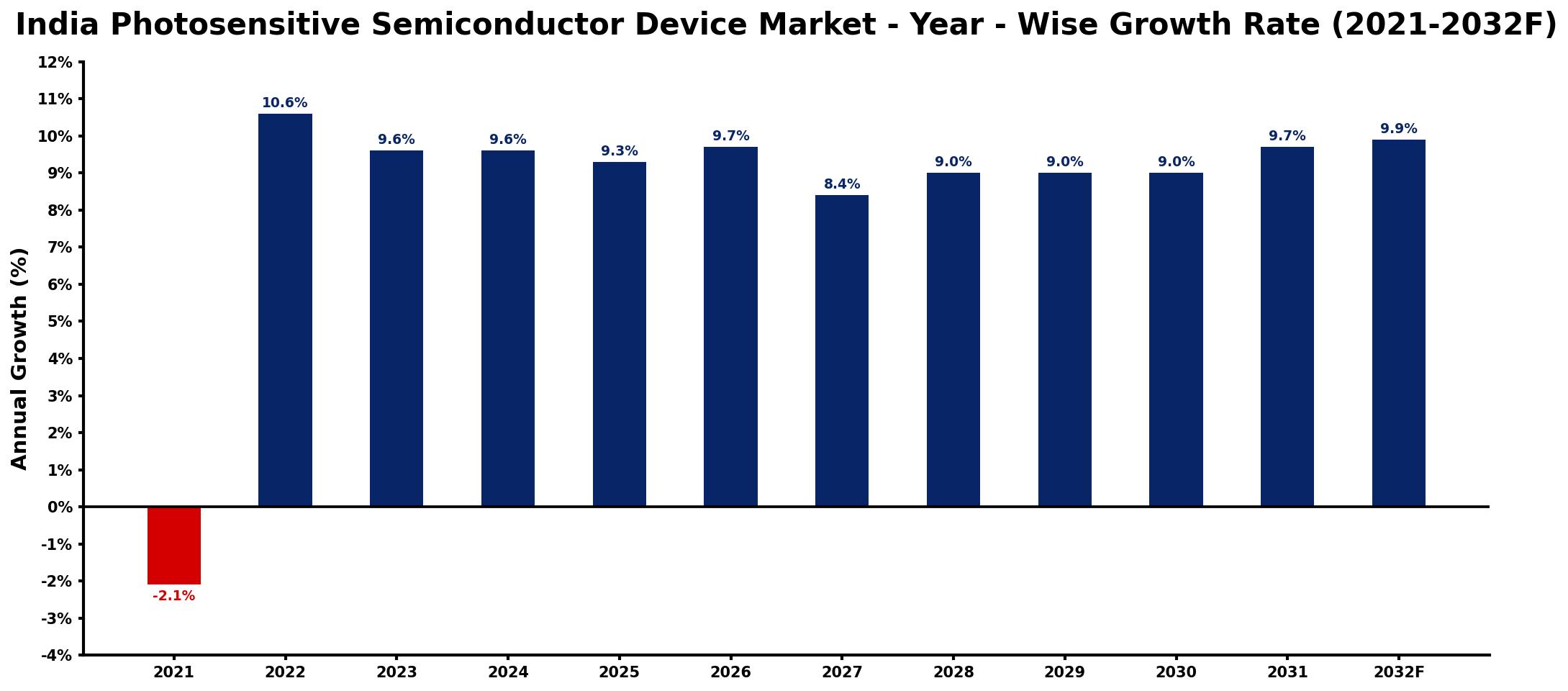
The table below presents the year‑wise growth rates along with the key drivers influencing the market
| Year | Growth Rate | Major Drivers |
| 2021 | -2.1% | Reduced investment in technology sectors |
| 2022 | 10.6% | Increased demand for renewable energy |
| 2023 | 9.6% | Growth in automotive electronics market |
| 2024 | 9.6% | Expansion of consumer electronics sector |
| 2025 | 9.3% | Emerging applications in IoT |
| 2026 | 9.7% | Rising interest in smart homes |
| 2027 | 8.4% | Advancements in telecommunications infrastructure |
| 2028 | 9.0% | Surge in industrial automation projects |
| 2029 | 9.0% | enhanced product quality standards |
| 2030 | 9.0% | Increase in electric vehicle adoption |
| 2031 | 9.7% | Development of smart city initiatives |
| 2032 | 9.9% | growing commercial sector adoption |
Note: Market size estimations and growth projections presented in this report are based on 6Wresearch's proprietary forecasting methodology, utilizing the latest available industry data, government publications, and primary research inputs.
India Photosensitive Semiconductor Device Market Synopsis
The increasing adoption of photosensitive semiconductor devices is the strongest force shaping the India Photosensitive Semiconductor Device Market. With applications ranging from smartphones to industrial automation, these devices are essential for enhancing light detection and imaging capabilities in various sectors.
Additionally, the automotive industry is contributing to market growth, particularly with the integration of image sensors and advanced driver-assistance systems (ADAS) in modern vehicles. As technology evolves, the need for innovative and high-performing semiconductor devices becomes more pronounced, ensuring robust market expansion.
India Photosensitive Semiconductor Device Market Key Takeaways
- The market is expected to experience consistent growth driven by the consumer electronics and automotive sectors.
- Technological advancements such as back-illuminated CMOS sensors are boosting adoption rates.
- Investment in research and development is vital for maintaining competitive edge amidst rapid innovations.
- The demand for photosensitive devices in IoT applications is a significant growth driver.
- Challenges related to local manufacturing and skilled workforce remain critical for market players.
Evaluation of Restraints in India Photosensitive Semiconductor Device Market
Despite its promising trajectory, the India Photosensitive Semiconductor Device Market faces several restraints that could hinder its growth. One significant barrier is the increasing competition from international manufacturers, which pressures domestic players to keep pricing competitive while maintaining product quality. Additionally, the complexities involved in semiconductor fabrication processes can deter small and medium-sized enterprises from entering the market. The rapid technological advancements also necessitate continuous innovation, creating challenges for manufacturers that may struggle with product obsolescence. Furthermore, the limited availability of skilled professionals in the semiconductor industry can hinder growth, making it crucial for companies to invest in training and skill development initiatives. Lastly, a heavy reliance on imported raw materials could affect production costs and overall market pricing, highlighting the need for a more robust local supply chain.
India Photosensitive Semiconductor Device Market Trends
Several current and emerging trends are shaping the India Photosensitive Semiconductor Device Market. The rise of automation in manufacturing processes emphasizes the need for high-precision imaging and detection technologies. Machine vision systems are becoming increasingly integral in various industries, enhancing operational efficiency and safety. Additionally, as consumers demand more advanced features in smartphones and cameras, the need for superior image sensors and photodiodes is escalating. The convergence of artificial intelligence with photosensitive devices is also gaining traction, leading to smarter applications in both consumer and industrial domains.
India Photosensitive Semiconductor Device Market Opportunities
The potential for growth and investment in the India Photosensitive Semiconductor Device Market is substantial. The expanding automotive sector, especially with the rise of electric and autonomous vehicles, presents significant opportunities for the integration of advanced imaging technologies. Similarly, the increasing application of IoT in various sectors, including agriculture and healthcare, is poised to drive demand for innovative photosensitive devices. Furthermore, as manufacturers focus on developing eco-friendly and energy-efficient products, there is an opportunity for companies to leverage sustainability as a competitive advantage in the market.
Government Initiatives in the India Photosensitive Semiconductor Device Market
The Indian government is actively promoting the semiconductor industry through various initiatives aimed at fostering indigenous manufacturing capabilities. Policies to incentivize research and development, along with public funding for technology startups, are becoming increasingly common. Additionally, the government has implemented programs to enhance the skill set of professionals in semiconductor technology, ensuring a more competent workforce. These initiatives are expected to stimulate growth within the photosensitive semiconductor device market and support its alignment with global technological standards.
Future Insights of the India Photosensitive Semiconductor Device Market
Looking ahead to the period from 2026 to 2032, the India Photosensitive Semiconductor Device Market is expected to experience robust growth fueled by technological advancements and increasing demand across multiple sectors. The integration of AI and machine learning with semiconductor devices will pave the way for innovative applications, particularly in automation and smart consumer products. Furthermore, as the emphasis on sustainability and energy efficiency rises, the market will likely see a shift toward environmentally friendly manufacturing processes and products. Overall, the future appears bright for the photosensitive semiconductor device industry in India, bolstered by strategic investments and evolving consumer preferences.
India Photosensitive Semiconductor Device Market Latest Developments (2025 - 2026)
In recent months, the India Photosensitive Semiconductor Device Market has witnessed a surge in collaborations among technology firms aimed at fostering innovation. Manufacturers are increasingly investing in cutting-edge research and development to create enhanced imaging solutions that meet the changing demands of the market. Additionally, there has been a noticeable rise in the adoption of photosensitive devices in healthcare, particularly due to the increasing reliance on telemedicine and remote monitoring solutions. As the industry stabilizes post-pandemic, these trends indicate a positive trajectory for the market moving forward.
India Photosensitive Semiconductor Device Market - Key Attractiveness of the Report
- 10 Years of Market Numbers
- Historical Data Starting from 2022 to 2025
- Base Year: 2025
- Forecast Data until 2032
- Key Performance Indicators Impacting the Market
- Major Upcoming Developments and Projects
Key Highlights of the Report:
- India Photosensitive Semiconductor Device Market Outlook
- Market Size of India Photosensitive Semiconductor Device Market, 2025
- Forecast of India Photosensitive Semiconductor Device Market, 2032
- Historical Data and Forecast of India Photosensitive Semiconductor Device Revenues & Volume for the Period 2022-2032F
- India Photosensitive Semiconductor Device Market Trend Evolution
- India Photosensitive Semiconductor Device Market Drivers and Challenges
- India Photosensitive Semiconductor Device Price Trends
- India Photosensitive Semiconductor Device Porter's Five Forces
- India Photosensitive Semiconductor Device Industry Life Cycle
- Historical Data and Forecast of India Photosensitive Semiconductor Device Market Revenues & Volume By Device for the Period 2022-2032F
- Historical Data and Forecast of India Photosensitive Semiconductor Device Market Revenues & Volume By Photocell for the Period 2022-2032F
- Historical Data and Forecast of India Photosensitive Semiconductor Device Market Revenues & Volume By Photodiode for the Period 2022-2032F
- Historical Data and Forecast of India Photosensitive Semiconductor Device Market Revenues & Volume By Phototransistor for the Period 2022-2032F
- Historical Data and Forecast of India Photosensitive Semiconductor Device Market Revenues & Volume By Photoresistor for the Period 2022-2032F
- Historical Data and Forecast of India Photosensitive Semiconductor Device Market Revenues & Volume By Photo IC for the Period 2022-2032F
- Historical Data and Forecast of India Photosensitive Semiconductor Device Market Revenues & Volume By End User for the Period 2022-2032F
- Historical Data and Forecast of India Photosensitive Semiconductor Device Market Revenues & Volume By Automotive and Transportation for the Period 2022-2032F
- Historical Data and Forecast of India Photosensitive Semiconductor Device Market Revenues & Volume By Consumer Electronics for the Period 2022-2032F
- Historical Data and Forecast of India Photosensitive Semiconductor Device Market Revenues & Volume By Aerospace and Defence for the Period 2022-2032F
- Historical Data and Forecast of India Photosensitive Semiconductor Device Market Revenues & Volume By Healthcare for the Period 2022-2032F
- Historical Data and Forecast of India Photosensitive Semiconductor Device Market Revenues & Volume By Industrial for the Period 2022-2032F
- Historical Data and Forecast of India Photosensitive Semiconductor Device Market Revenues & Volume By Security and Survelliance for the Period 2022-2032F
- India Photosensitive Semiconductor Device Import Export Trade Statistics
- Market Opportunity Assessment By Device
- Market Opportunity Assessment By End User
- India Photosensitive Semiconductor Device Top Companies Market Share
- India Photosensitive Semiconductor Device Competitive Benchmarking By Technical and Operational Parameters
- India Photosensitive Semiconductor Device Company Profiles
- India Photosensitive Semiconductor Device Key Strategic Recommendations






































