India Placenta Market Size, Share & Growth Rate
The India Placenta Market was estimated at USD 596 Million in 2025 and is projected to reach USD 850 Million by 2032, growing at a CAGR of 5.2% from 2026 to 2032. This growth trajectory is primarily fueled by the increasing demand for natural and organic ingredients within the cosmetic and personal care sectors. Consumer inclination towards regenerative medicine and holistic health approaches further strengthens this market's potential.
India Placenta Market Year-wise Growth Rate and Key Drivers
This graph highlights how the India Placenta Market has steadily grown over the years, supported by major growth factors.
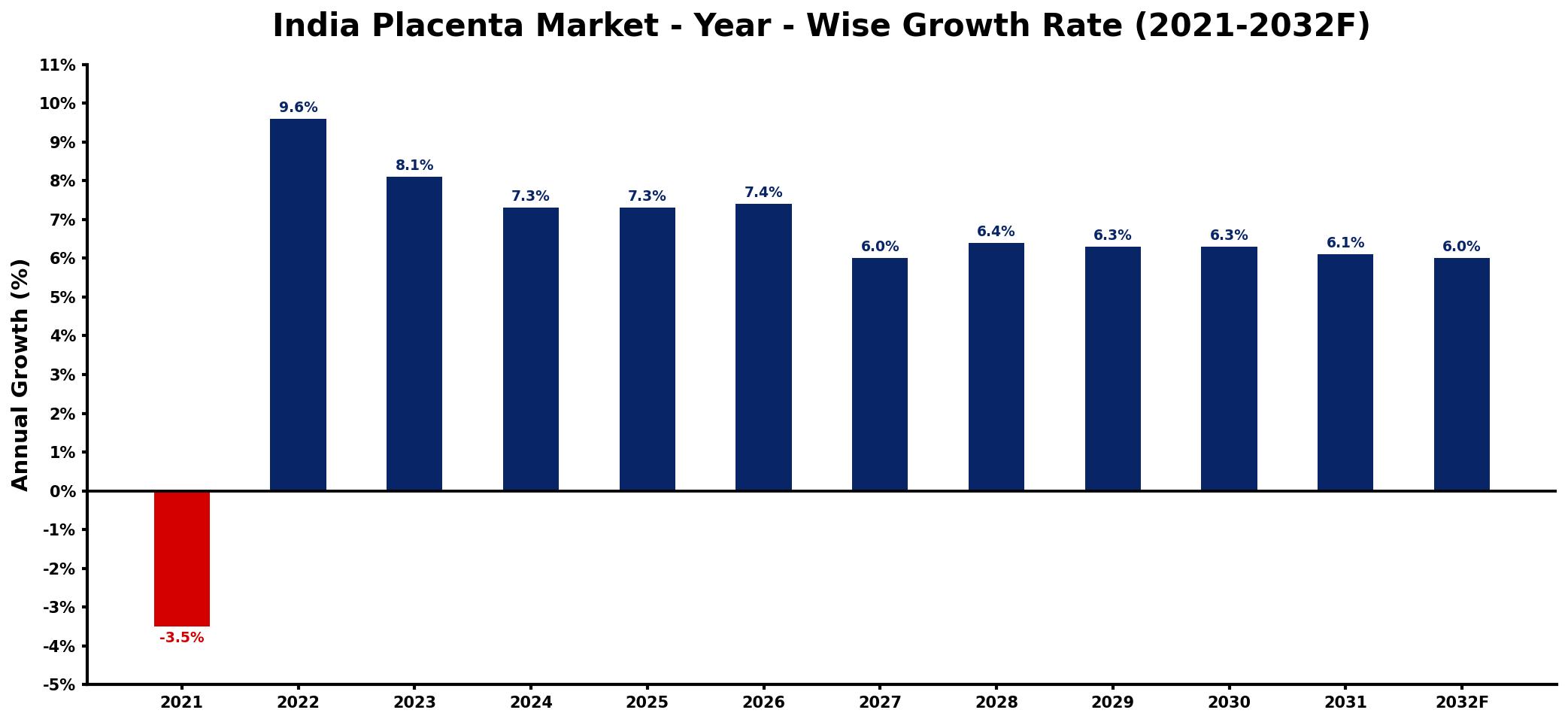
The table below presents the year‑wise growth rates along with the key drivers influencing the market
| Year | Growth Rate | Major Drivers |
| 2021 | -3.5% | decrease in consumer spending habits |
| 2022 | 9.6% | rise in wellness product investments |
| 2023 | 8.1% | expansion of skincare market trends |
| 2024 | 7.3% | increased demand for natural ingredients |
| 2025 | 7.3% | growth in health supplement applications |
| 2026 | 7.4% | surge in premium product offerings |
| 2027 | 6.0% | enhanced focus on holistic wellness |
| 2028 | 6.4% | growing interest in anti-aging solutions |
| 2029 | 6.3% | growing commercial sector adoption |
| 2030 | 6.3% | increase in research and development |
| 2031 | 6.1% | rising popularity of organic products |
| 2032 | 6.0% | strengthened distribution channel networks |
Note: Market size estimations and growth projections presented in this report are based on 6Wresearch's proprietary forecasting methodology, utilizing the latest available industry data, government publications, and primary research inputs.
India Placenta Market Synopsis
The Indian placenta market is witnessing a surge, particularly in the realms of cosmetics and traditional medicine. Placental extracts are gaining recognition for their skin-rejuvenating properties and potential health benefits, driving innovation in product formulation.
However, this growth is tempered by significant ethical considerations surrounding sourcing practices and regulatory compliance. As consumers become increasingly aware of sustainability, ensuring the quality and efficacy of these products is paramount for industry stakeholders.
India Placenta Market Key Takeaways
- Rapid growth driven by increasing consumer preference for natural beauty products.
- Placenta-derived products find extensive applications across cosmetics, pharmaceuticals, and healthcare.
- Ethical sourcing and regulatory compliance remain critical challenges for the industry.
- The impact of COVID-19 highlighted the necessity for robust supply chains and innovation.
- Upcoming trends focus on holistic health and sustainable sourcing practices.
Evaluation of Restraints in India Placenta Market
The India placenta market faces significant restraints that hinder its full potential. Ethical sourcing is a paramount concern, as stakeholders must navigate the delicate balance between the benefits of placenta-derived products and the moral implications of their extraction. Additionally, regulatory frameworks are often stringent, requiring rigorous compliance to ensure product safety and efficacy. Consumer perceptions also play a vital role; skepticism about the use of placenta in products can impact market growth. Stakeholders must invest in transparency and education to build trust and encourage wider acceptance.
India Placenta Market Trends
A notable trend in the India placenta market is the growing integration of innovative technology in product formulation, particularly within the cosmetic sector. Consumers increasingly favor products that combine efficacy with ethical practices, leading to a rise in demand for sustainably sourced placenta extracts. Additionally, as anti-aging and skin-health products gain traction, manufacturers are focusing on research and development to highlight the unique benefits of placental ingredients. The resurgence of traditional medicine practices also contributes to a renewed interest in placenta-based applications.
India Placenta Market Opportunities
The India placenta market presents several avenues for growth and investment. As consumers lean towards holistic wellness solutions, there's an opportunity for brands to innovate by developing new formulations that emphasize the regenerative properties of placenta. Expanding into emerging markets within India, particularly in tier 2 and tier 3 cities, can further enhance market reach. Collaborations with healthcare and wellness sectors may also open doors for placenta-derived products in nutraceuticals and supplements, catering to a broader audience looking for natural health enhancements.
Government Initiatives in the India Placenta Market
The Indian government is progressively promoting policies aimed at enhancing the biotechnology and pharmaceutical sectors, which includes the placenta market. Initiatives to foster sustainable practices and ethical sourcing are becoming more prevalent, providing a framework for stakeholders. There is also growing support for research and innovation in regenerative medicine, which aligns well with the applications of placenta-derived products. Such government backing could be pivotal in addressing ethical concerns while encouraging industry growth.
Future Insights of the India Placenta Market
Looking ahead, the India placenta market is expected to witness substantial evolution between 2026 and 2032. Advances in technology will likely drive further exploration of placental applications, enhancing both safety and effectiveness. As consumer consciousness regarding ethical practices continues to rise, brands that prioritize transparency and responsible sourcing will stand out. The market's growth will also depend on global trends influencing local consumer behavior, as demand for natural products remains robust amidst a broader shift towards wellness.
India Placenta Market Latest Developments (2025 - 2026)
Recent developments in the Indian placenta market indicate a strong shift towards innovation, particularly in cosmetic formulations that utilize placenta extracts. Companies are increasingly investing in sustainable sourcing practices and establishing partnerships with regulatory bodies to ensure compliance and consumer trust. Moreover, the impact of the COVID-19 pandemic has prompted many manufacturers to reevaluate their supply chains, focusing on resilience and adaptability in the face of future disruptions.
India Placenta Market - Key Attractiveness of the Report
- 10 Years of Market Numbers
- Historical Data Starting from 2022 to 2025
- Base Year: 2025
- Forecast Data until 2032
- Key Performance Indicators Impacting the Market
- Major Upcoming Developments and Projects
Key Highlights of the Report:
- India Placenta Market Outlook
- Market Size of India Placenta Market, 2025
- Forecast of India Placenta Market, 2032
- Historical Data and Forecast of India Placenta Revenues & Volume for the Period 2022-2032F
- India Placenta Market Trend Evolution
- India Placenta Market Drivers and Challenges
- India Placenta Price Trends
- India Placenta Porter's Five Forces
- India Placenta Industry Life Cycle
- Historical Data and Forecast of India Placenta Market Revenues & Volume By Type for the Period 2022-2032F
- Historical Data and Forecast of India Placenta Market Revenues & Volume By Porcine for the Period 2022-2032F
- Historical Data and Forecast of India Placenta Market Revenues & Volume By Equine for the Period 2022-2032F
- Historical Data and Forecast of India Placenta Market Revenues & Volume By Ovine for the Period 2022-2032F
- Historical Data and Forecast of India Placenta Market Revenues & Volume By Others for the Period 2022-2032F
- Historical Data and Forecast of India Placenta Market Revenues & Volume By Application for the Period 2022-2032F
- Historical Data and Forecast of India Placenta Market Revenues & Volume By Pharmaceuticals for the Period 2022-2032F
- Historical Data and Forecast of India Placenta Market Revenues & Volume By Cosmetics for the Period 2022-2032F
- Historical Data and Forecast of India Placenta Market Revenues & Volume By Supplements for the Period 2022-2032F
- Historical Data and Forecast of India Placenta Market Revenues & Volume By Others for the Period 2022-2032F
- India Placenta Import Export Trade Statistics
- Market Opportunity Assessment By Type
- Market Opportunity Assessment By Application
- India Placenta Top Companies Market Share
- India Placenta Competitive Benchmarking By Technical and Operational Parameters
- India Placenta Company Profiles
- India Placenta Key Strategic Recommendations






































