India Planting Equipment Market Size, Share & Growth Rate
The India Planting Equipment Market was estimated at USD 888 Million in 2025 and is projected to reach USD 1267 Million by 2032, growing at a CAGR of 5.2% from 2026 to 2032. This upward trend is largely driven by the mounting demand for food grains and crops with enhanced yields, fueled by a growing population. Additionally, government initiatives aimed at promoting mechanization in agriculture, such as PMKSY, play a pivotal role in this expansion, alongside increasing farmer awareness regarding modern farming techniques.
India Planting Equipment Market Year-wise Growth Rate and Key Drivers
This graph highlights how the India Planting Equipment Market has steadily grown over the years, supported by major growth factors.
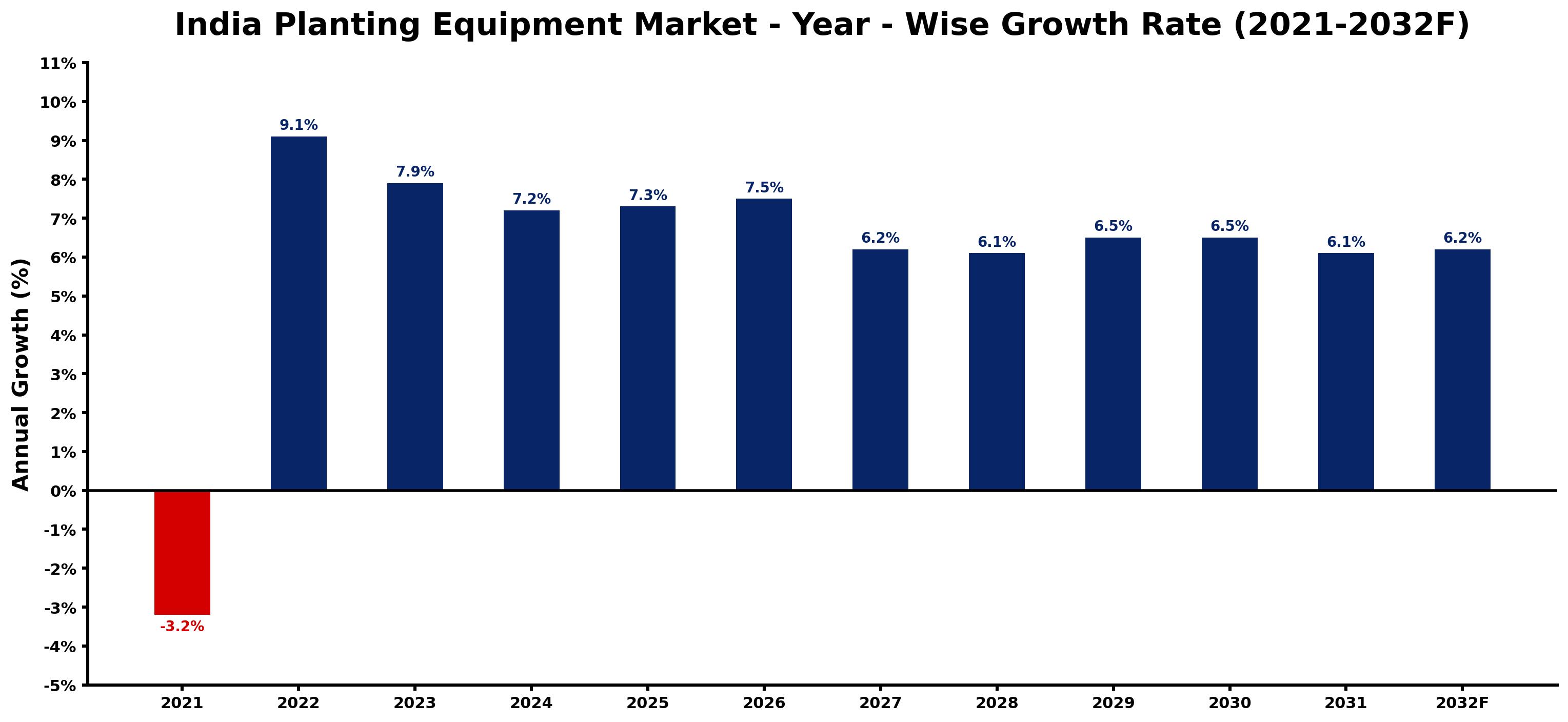
The table below presents the year‑wise growth rates along with the key drivers influencing the market
| Year | Growth Rate | Major Drivers |
| 2021 | -3.2% | Rising electricity demand across industries |
| 2022 | 9.1% | Increasing industrial automation investments |
| 2023 | 7.9% | Government infrastructure modernization initiatives |
| 2024 | 7.2% | Growing urbanization and commercial development |
| 2025 | 7.3% | Increasing industrial automation investments |
| 2026 | 7.5% | Growing urbanization and commercial development |
| 2027 | 6.2% | Rapid growth in telecom and data center sectors |
| 2028 | 6.1% | Growing renewable energy integration projects |
| 2029 | 6.5% | Growing urbanization and commercial development |
| 2030 | 6.5% | Increasing industrial infrastructure investments |
| 2031 | 6.1% | Expansion of transportation and logistics networks |
| 2032 | 6.2% | Rapid growth in telecom and data center sectors |
Note - Market size estimations and growth projections presented in this report are based on 6Wresearch’s advanced forecasting approach, validated with industry datasets as of June 2026.
India Planting Equipment Market Synopsis
The India Planting Equipment Market is poised for significant growth following a period of steady progress. Factors such as rising mechanization in agriculture and governmental support have positioned the market to capitalize on evolving agricultural practices. This momentum is expected to gather pace as technological advancements in planting equipment gain traction among Indian farmers.
Looking forward, the market is set to leverage increased disposable incomes and favorable economic conditions, which enable farmers to invest in advanced planting technologies. As these trends converge, the landscape of the planting equipment market in India is expected to transform, enhancing productivity and efficiency across the sector.
India Planting Equipment Market Key Takeaways
- The market is projected to grow significantly, reaching USD 1267 Million by 2032, fueled by strong agricultural demand.
- Government initiatives, such as PMKSY, are pivotal in promoting mechanization and adoption of advanced planting equipment.
- Increased disposable income is empowering farmers to invest in modern farming technologies.
- Challenges related to high initial costs and technical knowledge among rural populations remain significant.
- Strategic collaborations and new product launches by market players are anticipated to drive future growth.
Evaluation of Restraints in India Planting Equipment Market
Despite the promising growth trajectory, the India Planting Equipment Market faces notable restraints. High initial investment costs associated with the purchase and maintenance of planting equipment can deter many small-scale farmers. Additionally, a substantial portion of the rural population lacks the technical knowledge required to maximize the benefits of these advanced tools. This gap in understanding can lead to underutilization, thereby limiting the market's overall expansion. Addressing these issues will be crucial for unlocking the full potential of the planting equipment segment.
India Planting Equipment Market Trends
Current trends indicate a shift toward precision agriculture, where technology plays a vital role in enhancing planting efficiency. Smart farming tools equipped with GPS and IoT capabilities are increasingly being adopted, allowing for more accurate sowing and resource management. Moreover, the integration of drones and automated machinery is transforming traditional farming methods, pushing the demand for advanced planting equipment to new heights.
India Planting Equipment Market Opportunities
The opportunities for growth within the India Planting Equipment Market are multifaceted. As government initiatives continue to support mechanization, there is a growing market for innovative planting solutions tailored to various crop types. Additionally, the rise of agritech startups presents fresh opportunities for collaboration, innovation, and product development. There is also potential for expansion in underpenetrated rural areas, where increased awareness of modern farming practices can lead to enhanced adoption rates.
Government Initiatives in the India Planting Equipment Market
Government programs play a crucial role in facilitating the growth of the India Planting Equipment Market. Initiatives such as the Pradhan Mantri Krishi Sinchayee Yojana (PMKSY) aim to increase irrigation coverage and enhance crop productivity through the adoption of advanced machinery. Similarly, schemes like the Pradhan Mantri Fasal Bima Yojana (PMFBY) provide financial support, encouraging farmers to invest in modern planting equipment. These policies not only promote mechanization but also bolster the overall agricultural framework, thereby supporting market growth.
Future Insights of the India Planting Equipment Market
As we move towards 2032, the India Planting Equipment Market is expected to evolve significantly, driven by advancements in technology and sustained government support. The trend toward sustainable and efficient farming practices will continue to shape market dynamics, with a focus on reducing environmental impact. Furthermore, the anticipated rise in population and corresponding food demand will necessitate further investment in mechanization and productivity-enhancing tools. As these elements converge, the planting equipment sector will likely emerge as a key pillar in India's agricultural landscape.
India Planting Equipment Market Latest Developments (May 2025 - June 2026)
Recent developments in the India Planting Equipment Market reveal a focus on innovation and sustainability. Companies have been launching new products that integrate advanced technologies aimed at enhancing farming efficiency. Furthermore, collaborations between agritech firms and traditional manufacturers are becoming increasingly common, fostering a dynamic environment for product development. This period is marked by a growing emphasis on adapting equipment to meet the diverse needs of India's varied agricultural landscape.
India Planting Equipment Market - Key Attractiveness of the Report
- 10 Years of Market Numbers
- Historical Data Starting from 2022 to 2025
- Base Year: 2025
- Forecast Data until 2032
- Key Performance Indicators Impacting the Market
- Major Upcoming Developments and Projects
Key Highlights of the Report:
- India Planting Equipment Market Outlook
- Market Size of India Planting Equipment Market, 2025
- Forecast of India Planting Equipment Market, 2032
- Historical Data and Forecast of India Planting Equipment Revenues & Volume for the Period 2022-2032F
- India Planting Equipment Market Trend Evolution
- India Planting Equipment Market Drivers and Challenges
- India Planting Equipment Price Trends
- India Planting Equipment Porter's Five Forces
- India Planting Equipment Industry Life Cycle
- Historical Data and Forecast of India Planting Equipment Market Revenues & Volume By Type for the Period 2022-2032F
- Historical Data and Forecast of India Planting Equipment Market Revenues & Volume By Air seeders for the Period 2022-2032F
- Historical Data and Forecast of India Planting Equipment Market Revenues & Volume By Seed drills for the Period 2022-2032F
- Historical Data and Forecast of India Planting Equipment Market Revenues & Volume By Planters for the Period 2022-2032F
- Historical Data and Forecast of India Planting Equipment Market Revenues & Volume By Others for the Period 2022-2032F
- Historical Data and Forecast of India Planting Equipment Market Revenues & Volume By Design for the Period 2022-2032F
- Historical Data and Forecast of India Planting Equipment Market Revenues & Volume By Mechanical for the Period 2022-2032F
- Historical Data and Forecast of India Planting Equipment Market Revenues & Volume By Automatic for the Period 2022-2032F
- Historical Data and Forecast of India Planting Equipment Market Revenues & Volume By Crop Type for the Period 2022-2032F
- Historical Data and Forecast of India Planting Equipment Market Revenues & Volume By Cereals & grains for the Period 2022-2032F
- Historical Data and Forecast of India Planting Equipment Market Revenues & Volume By Oilseeds & pulses for the Period 2022-2032F
- Historical Data and Forecast of India Planting Equipment Market Revenues & Volume By Fruits & vegetables for the Period 2022-2032F
- Historical Data and Forecast of India Planting Equipment Market Revenues & Volume By Others for the Period 2022-2032F
- India Planting Equipment Import Export Trade Statistics
- Market Opportunity Assessment By Type
- Market Opportunity Assessment By Design
- Market Opportunity Assessment By Crop Type
- India Planting Equipment Top Companies Market Share
- India Planting Equipment Competitive Benchmarking By Technical and Operational Parameters
- India Planting Equipment Company Profiles
- India Planting Equipment Key Strategic Recommendations






































