India Platform as a Service (PaaS) Market Size & Growth Rate (2026-2032)
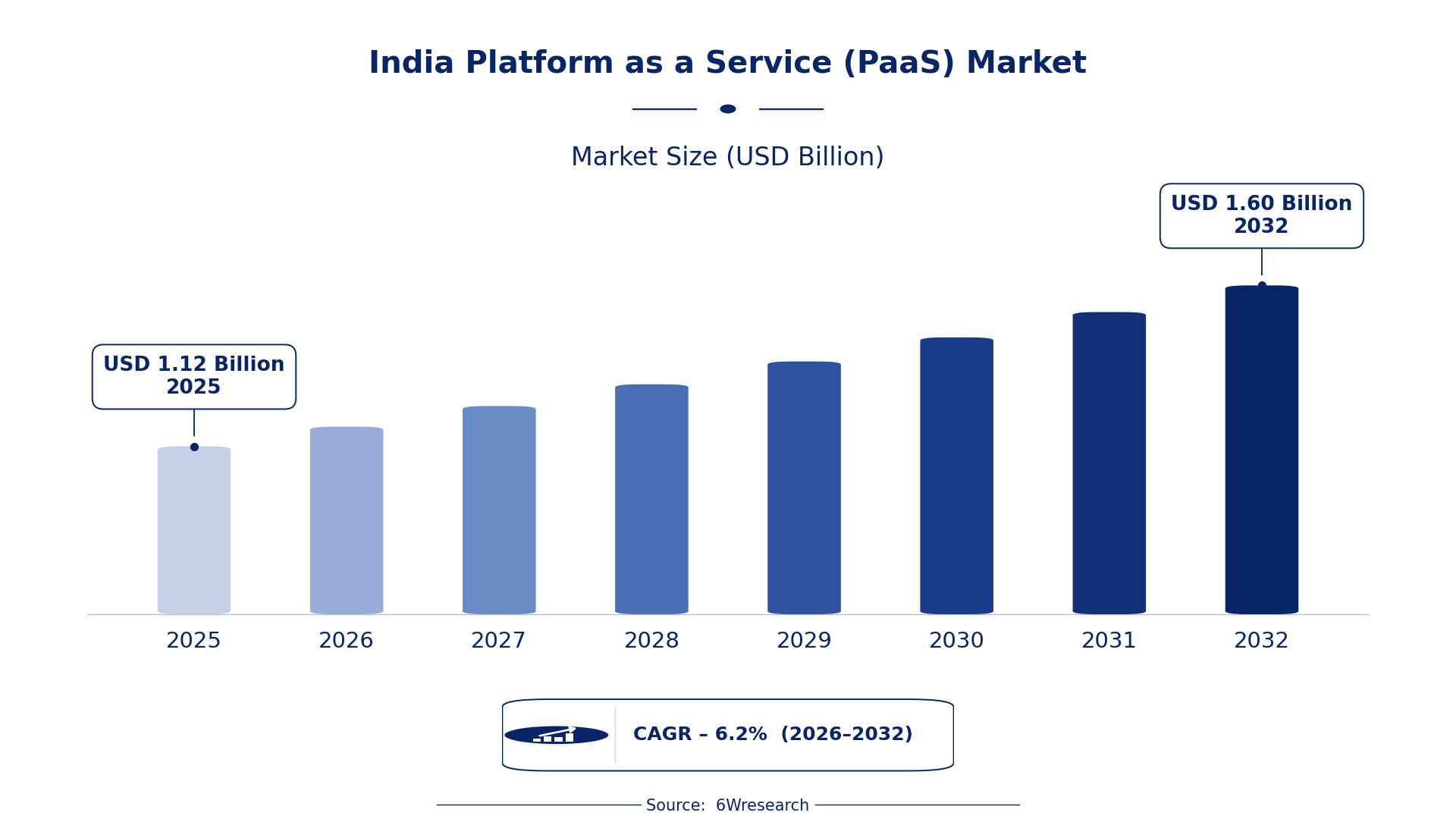
The India Platform as a Service (PaaS) Market was estimated at USD 1118 Million in 2025 and is projected to reach USD 1600 Million by 2032, growing at a CAGR of 6.2% from 2026 to 2032.
India Platform as a Service (PaaS) Market Synopsis
The demand for rapid application development is reshaping the India Platform as a Service (PaaS) market. Enterprises are increasingly adopting PaaS solutions to streamline their software development processes, effectively reducing time-to-market for new applications.
India's thriving startup ecosystem fuels the PaaS market's growth, as new companies leverage cloud-native applications to enhance agility. Established organizations are also recognizing the need to innovate, driving a shift towards cloud-based platforms that support scalable and efficient application deployment.
India Platform as a Service (PaaS) Market Year-wise Growth Rate and Key Drivers
This graph illustrates the annual growth rates of the India Platform as a Service (PaaS) Market from 2021 to 2032, highlighting a steady upward trajectory and projected expansion over the forecast period.
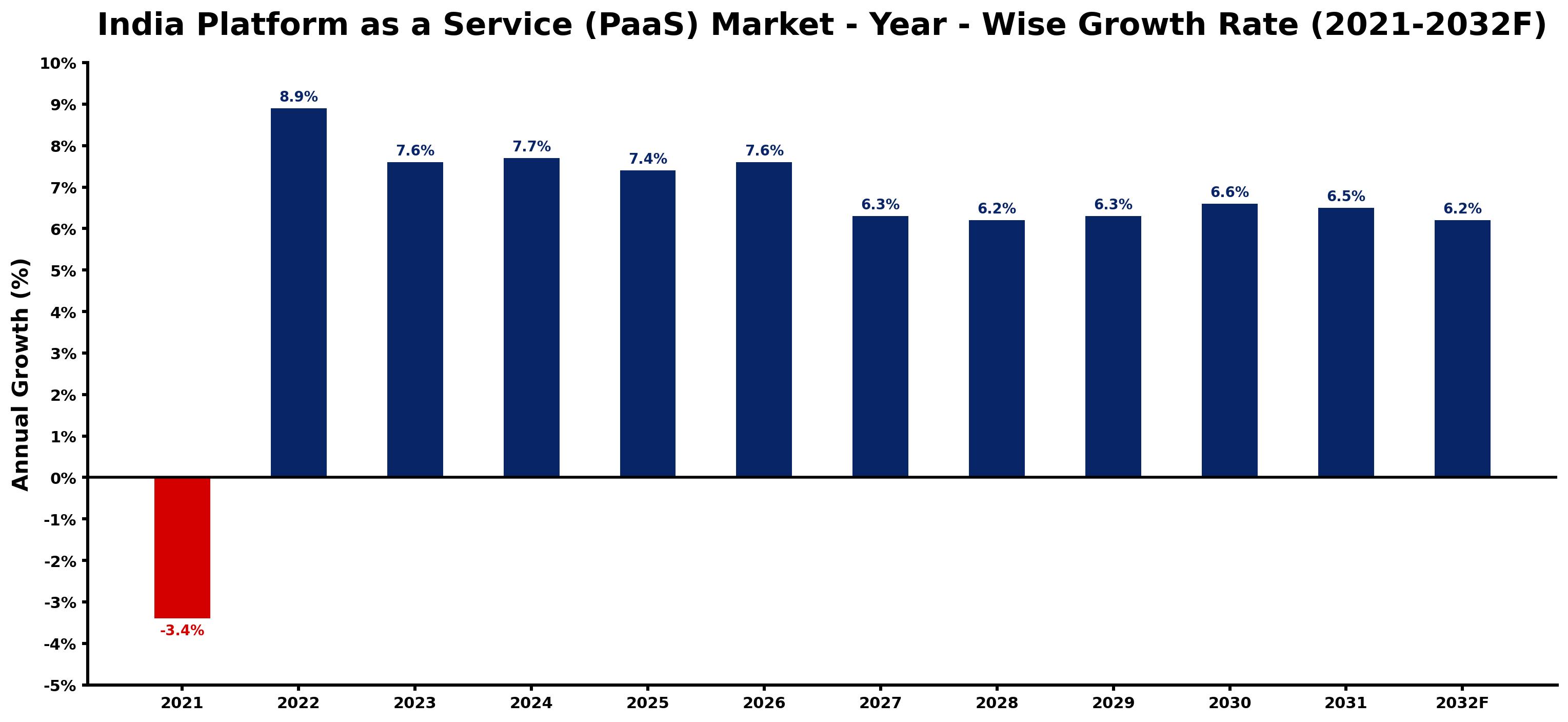
The table below presents the year‑wise growth rates along with the key drivers influencing the market
| Year | Growth Rate | Major Drivers |
| 2021 | -3.4% | Delayed cloud adoption due to local data residency regulations. |
| 2022 | 8.9% | Surge in AI applications driving platform demand locally |
| 2023 | 7.6% | Startup ecosystem growth enhancing PaaS service utilization |
| 2024 | 7.7% | Regulatory push for data localization increasing cloud adoption |
| 2025 | 7.4% | Increase in digital transformation investments by enterprises |
| 2026 | 7.6% | Growing fintech sector necessitating innovative cloud solutions |
| 2027 | 6.3% | Government incentives for IT infrastructure modernization boosting PaaS |
| 2028 | 6.2% | Rising e-commerce activity enhancing PaaS platform needs |
| 2029 | 6.3% | Increased cybersecurity concerns driving demand for PaaS solutions |
| 2030 | 6.6% | Emergence of IoT applications catalyzing platform expansion |
| 2031 | 6.5% | Digital healthcare solutions requiring robust PaaS capacities |
| 2032 | 6.2% | Education technology growth prompting cloud-based learning platforms |
Note: Market size estimations and growth projections presented in this report are based on 6Wresearch's proprietary forecasting methodology, utilizing the latest available industry data, government publications, and primary research inputs.
India Platform as a Service (PaaS) Market Key Takeaways
Below are some of the specific key takeaways from the market, including:
- The rise of cloud-native applications is driving PaaS adoption across various sectors in India.
- Startups are major contributors to the demand for efficient application development environments.
- Organizations face challenges in acquiring cloud talent amid increasing competition.
- COVID-19 accelerated the shift towards cloud-based solutions, cementing PaaS's role in digital transformation.
- Government initiatives are increasingly supporting the digital infrastructure needed for PaaS growth.
Evaluation of Restraints in India Platform as a Service (PaaS) Market
Talent acquisition remains a pressing issue for the PaaS market. Companies are often unable to find skilled professionals with the necessary cloud certifications and experience. This talent shortage limits the ability of organizations to fully utilize PaaS solutions. Additionally, smaller enterprises face budget constraints, making it difficult to invest in advanced PaaS offerings. The competitive landscape for cloud services further complicates efforts to deliver cost-effective solutions, hindering broader adoption.
India Platform as a Service (PaaS) Market Trends
One of the most notable trends is the increasing focus on low-code and no-code platforms. These solutions empower a broader range of users, from business analysts to non-technical staff, to participate in application development. Companies are also investing in AI and machine learning capabilities integrated within PaaS environments, enhancing automation and predictive analytics.
As security concerns rise, PaaS providers are prioritizing robust security frameworks, making compliance with industry regulations a key offering. The push for sustainable practices is also influencing PaaS development, as organizations seek environmentally friendly cloud solutions.
India Platform as a Service (PaaS) Market Opportunities
Growth opportunities abound for PaaS providers focused on niche markets such as healthcare, finance, and education. As these sectors increasingly adopt cloud solutions, PaaS offerings tailored to specific regulatory and operational needs will thrive. on top of that, the integration of Internet of Things (IoT) capabilities into PaaS solutions opens new avenues for application development that leverage real-time data analytics.
Investment in training programs to upskill cloud professionals will also create a more competent workforce, further fueling market expansion. Strategic partnerships between technology vendors and educational institutions could enhance the talent pool, addressing the current skills gap.
Government Initiatives in the India Platform as a Service (PaaS) Market
Government policy plays a crucial role in shaping the India Platform as a Service (PaaS) market. As India pushes towards digitalization, supportive public-sector initiatives are essential for fostering innovation. Regulatory frameworks that promote transparency and security in cloud services are increasingly prioritized, influencing market dynamics.
- A national digital infrastructure upgrade programme launched in 2023 aims to enhance connectivity and cloud access across urban and rural areas.
- Current initiatives include a cloud security framework being developed to address compliance and data protection standards.
- A planned public-private partnership is expected to roll out in 2025, focusing on expanding cloud computing access to small and medium enterprises (SMEs).
- Recent government tax incentives for tech startups are designed to encourage investment in cloud-based technologies.
- Ongoing discussions around regulatory policies for data localization are shaping how PaaS providers structure their services.
Future Insights of the India Platform as a Service (PaaS) Market
From 2026 to 2032, the India PaaS market is set for substantial growth driven by continued digital transformation across industries. As businesses increasingly prioritize agility, the shift towards cloud-native solutions will accelerate, creating a favorable environment for innovative PaaS offerings. Companies will likely invest heavily in automation and AI capabilities, reshaping the application development process.
The focus on user experience will also take precedence, with PaaS solutions evolving to better cater to diverse developer needs. As security remains paramount, PaaS providers that prioritize compliance and data protection will gain a competitive edge. This period promises to be transformative as organizations harness the full potential of cloud technologies.
India Platform as a Service (PaaS) Market Latest Developments
In the past year, the India Platform as a Service (PaaS) market has witnessed notable activity as companies adapt to evolving technology demands. With a focus on enhancing service offerings, many providers are introducing innovative features to attract a broader user base.
- A leading technology vendor launched a new PaaS solution in early 2025, emphasizing low-code development capabilities for rapid application creation.
- An initiative that began in Q3 2025 aims to integrate AI tools into existing PaaS platforms, enhancing user experience and efficiency.
- A major cloud provider is currently expanding its data center footprint across India, enabling faster and more reliable access to PaaS solutions.
- By mid-2026, a rollout is expected for a new partnership program designed to support startups and SMEs in adopting cloud technologies.
- Recent updates to cloud compliance standards have been released, with ongoing training sessions for developers and IT professionals.
India Platform as a Service (PaaS) Market - Key Attractiveness of the Report
- 10 Years of Market Numbers
- Historical Data Starting from 2022 to 2025
- Base Year: 2025
- Forecast Data until 2032
- Key Performance Indicators Impacting the Market
- Major Upcoming Developments and Projects
Key Highlights of the Report:
- India Platform as a Service (PaaS) Market Outlook
- Market Size of India Platform as a Service (PaaS) Market, 2025
- Forecast of India Platform as a Service (PaaS) Market, 2032
- Historical Data and Forecast of India Platform as a Service (PaaS) Revenues & Volume for the Period 2022-2032F
- India Platform as a Service (PaaS) Market Trend Evolution
- India Platform as a Service (PaaS) Market Drivers and Challenges
- India Platform as a Service (PaaS) Price Trends
- India Platform as a Service (PaaS) Porter's Five Forces
- India Platform as a Service (PaaS) Industry Life Cycle
- Historical Data and Forecast of India Platform as a Service (PaaS) Market Revenues & Volume By Type for the Period 2022-2032F
- Historical Data and Forecast of India Platform as a Service (PaaS) Market Revenues & Volume By Application PaaS (aPaaS) for the Period 2022-2032F
- Historical Data and Forecast of India Platform as a Service (PaaS) Market Revenues & Volume By Integration PaaS (iPaaS) for the Period 2022-2032F
- Historical Data and Forecast of India Platform as a Service (PaaS) Market Revenues & Volume By Database PaaS (dbPaaS) for the Period 2022-2032F
- Historical Data and Forecast of India Platform as a Service (PaaS) Market Revenues & Volume By Others for the Period 2022-2032F
- Historical Data and Forecast of India Platform as a Service (PaaS) Market Revenues & Volume By Deployment for the Period 2022-2032F
- Historical Data and Forecast of India Platform as a Service (PaaS) Market Revenues & Volume By Public for the Period 2022-2032F
- Historical Data and Forecast of India Platform as a Service (PaaS) Market Revenues & Volume By Private for the Period 2022-2032F
- Historical Data and Forecast of India Platform as a Service (PaaS) Market Revenues & Volume By Market Type for the Period 2022-2032F
- Historical Data and Forecast of India Platform as a Service (PaaS) Market Revenues & Volume By APaaS for the Period 2022-2032F
- Historical Data and Forecast of India Platform as a Service (PaaS) Market Revenues & Volume By IPaaS for the Period 2022-2032F
- Historical Data and Forecast of India Platform as a Service (PaaS) Market Revenues & Volume By DBPaaS for the Period 2022-2032F
- Historical Data and Forecast of India Platform as a Service (PaaS) Market Revenues & Volume By Organization Size for the Period 2022-2032F
- Historical Data and Forecast of India Platform as a Service (PaaS) Market Revenues & Volume By Large Enterprises for the Period 2022-2032F
- Historical Data and Forecast of India Platform as a Service (PaaS) Market Revenues & Volume By SMEs for the Period 2022-2032F
- Historical Data and Forecast of India Platform as a Service (PaaS) Market Revenues & Volume By Vertical for the Period 2022-2032F
- Historical Data and Forecast of India Platform as a Service (PaaS) Market Revenues & Volume By BFSI for the Period 2022-2032F
- Historical Data and Forecast of India Platform as a Service (PaaS) Market Revenues & Volume By Consumer goods and retail for the Period 2022-2032F
- Historical Data and Forecast of India Platform as a Service (PaaS) Market Revenues & Volume By Telecommunication for the Period 2022-2032F
- Historical Data and Forecast of India Platform as a Service (PaaS) Market Revenues & Volume By IT and ITeS for the Period 2022-2032F
- Historical Data and Forecast of India Platform as a Service (PaaS) Market Revenues & Volume By Manufacturing for the Period 2022-2032F
- Historical Data and Forecast of India Platform as a Service (PaaS) Market Revenues & Volume By Healthcare and life sciences for the Period 2022-2032F
- Historical Data and Forecast of India Platform as a Service (PaaS) Market Revenues & Volume By Energy and utility for the Period 2022-2032F
- Historical Data and Forecast of India Platform as a Service (PaaS) Market Revenues & Volume By Others for the Period 2022-2032F
- India Platform as a Service (PaaS) Import Export Trade Statistics
- Market Opportunity Assessment By Type
- Market Opportunity Assessment By Deployment
- Market Opportunity Assessment By Market Type
- Market Opportunity Assessment By Organization Size
- Market Opportunity Assessment By Vertical
- India Platform as a Service (PaaS) Top Companies Market Share
- India Platform as a Service (PaaS) Competitive Benchmarking By Technical and Operational Parameters
- India Platform as a Service (PaaS) Company Profiles
- India Platform as a Service (PaaS) Key Strategic Recommendations






































