India Polymers Market Top 5 Importing Countries and Market Competition (HHI) Analysis
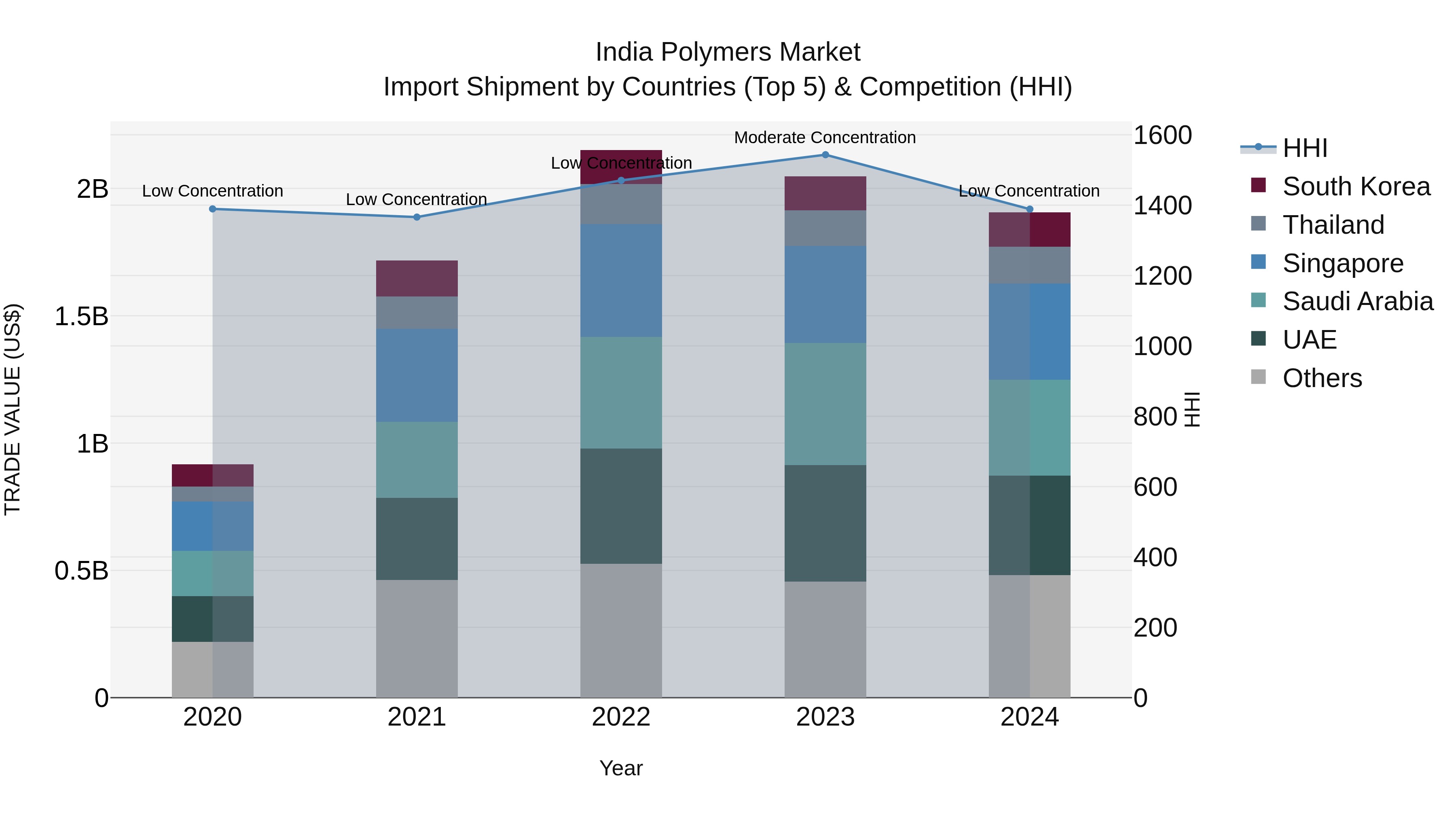
India`s polymer import shipments in 2024 saw a notable shift in the concentration of top exporting countries, with UAE, Singapore, Saudi Arabia, Thailand, and South Korea leading the pack. The Herfindahl-Hirschman Index (HHI) indicated a transition from moderate to low concentration, reflecting a more diversified market landscape. The impressive compound annual growth rate (CAGR) of 20.1% from 2020 to 2024 highlights the sector`s robust expansion. However, the slight decline in growth rate from 2023 to 2024 at -6.91% suggests a temporary slowdown, prompting a closer examination of market dynamics and potential factors influencing this trend.
India Polymers Market Growth Rate
According to 6Wresearch internal database and industry insights, the India Polymers Market is projected to grow at a compound annual growth rate (CAGR) of 7.4% during the forecast period (2026-2032).
Topics Covered in the India Polymers Market Report
The India Polymers Market report thoroughly covers the market by Type, Product and Application. The market report provides an unbiased and detailed analysis of ongoing market trends, opportunities/high growth areas, and market drivers, which help stakeholders devise and align their market strategies according to the current and future market dynamics.
India Polymers Market Highlights
| Report Name | India Polymers Market |
| Forecast Period | 2026–2032 |
| CAGR | 7.4% |
| Growing Sector | Packaging & Automotive |
India Polymers Market Synopsis
The India Polymers Market is projected to grow significantly, supported by rising demand across the packaging, construction, and automotive industries. Polymers are increasingly being used in consumer goods, food packaging, and electronics, and the market is experiencing strong growth. Additionally, the demand will be boosted by manufacturing expansions and government drives in infrastructure development and sustainability. The availability of cutting-edge polymer materials like biodegradable polymers, together with capacity investments in thermoplastics and thermosets, will be the key growth drivers over the next few years.
Evaluation of Growth Drivers in the India Polymers Market
Below mentioned are some prominent drivers and their influence on the market dynamics:
| Drivers | Primary Segments Affected | Why it Matters (Evidence) |
| Increased Demand in Packaging | Packaging, Automotive | Demand for lightweight, cost-effective, and durable materials increases polymer consumption in packaging. |
| Expansion in Automotive Industry | Automotive, Transportation | Growing demand for lightweight, high-performance polymers used in car interiors and exteriors. |
| Technological Advancements in Polymers | Electronics, Healthcare | Enhanced properties of polymers make them suitable for advanced applications in medical devices and electronics. |
| Increasing Government Focus on Infrastructure | Construction, Building Materials | The government’s initiatives in infrastructure development drive the demand for polymers in construction materials. |
| Growing Consumer Electronics Sector | Electronics & Communication | Polymers offer versatility in the fabrication of various electronic components e. g. casings and insulations. |
India Polymers Market is expected to grow at the CAGR of 7.4% during the forecast period of 2026-2032. The rise is due to the increased demand for polymers from such industries as automotive, packaging, and healthcare. Besides, the polymer production, related public sector programs and expenditures will be supportive of this growth.
Evaluation of Restraints in the India Polymers Market
Below mentioned are some major restraints and their influence on the market dynamics:
| Restraints | Primary Segments Affected | What This Means (Evidence) |
| High Production Costs | All Types, Product | Rising raw material costs and energy expenses impact the affordability of polymer products. |
| Dependency on Imported Raw Materials | All Types | The reliance on imported feedstock makes the market susceptible to global price fluctuations. |
| Environmental Concerns Over Non-Biodegradable Polymers | Packaging, Automotive | Regulatory pressure and growing environmental concerns hinder the demand for non-biodegradable polymers. |
| Lack of Recycling Infrastructure | All Types | Waste recycling of polymers has been inadequately prioritised due to a lack of sufficient recycling infrastructure. |
| Market Competition | All Types, Product | Intense competition among domestic and international manufacturers can limit profit margins. |
India Polymers Market Challenges
Despite the fact that the India Polymers Market has immense growth potential, it still faces some challenges, including the high cost of raw materials, environmental concerns related to waste disposal, and supply chain problems. The shortage of recycling infrastructure and the market's reliance on imported raw materials are two factors that hamper the expansion of sustainable polymers. Moreover, the challenge of growth is posed by the competition from other synthetic and natural materials in certain uses.
India Polymers Market Trends
The major trends assessing the scenario of the India Polymers Market are:
- Increase in Sustainable Polymers – There is an increasing demand for biodegradable and recyclable polymers as industries are moving towards sustainable practices.
- Advancements in Technology – The use of advanced polymers such as bioplastics and nanocomposites is transforming the product development process.
- Increase in Electrification of the Automotive Industry – Polymers are being widely used in the batteries of electric vehicles and as insulation for high-voltage cables.
- Customization – There is a trend towards specialized polymers with unique properties for a specific industrial application.
Investment Opportunities in the India Polymers Market
Some of the key investment opportunities in the India Polymers Market are:
- Polymer Recycling Ventures – Establishing recycling units for polymers, with an emphasis on waste management and the circular economy.
- Development of Bioplastics – Investment in the development of biodegradable polymers, driven by eco-friendly consumer behavior.
- Automotive Polymer Solutions – Development of polymers for electric and hybrid vehicles to substitute metals and reduce vehicle weight.
- Packaging Innovations – Development of sustainable packaging solutions using polymers for the fast-moving consumer goods industry.
Top 5 Leading Players in the India Polymers Market
Some leading players operating in the India Polymers Market Growth include:
1. Reliance Industries Limited
| Company Name | Reliance Industries Limited |
|---|---|
| Established Year | 1966 |
| Headquarters | Mumbai, India |
| Official Website | - |
Reliance manufactures and supplies a wide range of polymer products including polyethylene and polypropylene for the packaging, automotive, and textile industries.
2. Indian Oil Corporation Ltd.
| Company Name | Indian Oil Corporation Ltd. |
|---|---|
| Established Year | 1959 |
| Headquarters | New Delhi, India |
| Official Website | Click Here |
Indian Oil is a major player in polymer production, offering high-density polyethylene (HDPE), low-density polyethylene (LDPE), and polypropylene for various industrial applications.
3. LG Chem Ltd.
| Company Name | LG Chem Ltd. |
|---|---|
| Established Year | 1947 |
| Headquarters | Seoul, South Korea |
| Official Website | Click Here |
LG Chem manufactures thermoplastics, including PVC and polypropylene, which are widely used in automotive and packaging sectors in India.
4. BASF India Ltd.
| Company Name | BASF India Ltd. |
|---|---|
| Established Year | 1997 |
| Headquarters | Mumbai, India |
| Official Website | Click Here |
BASF offers a wide range of high-performance polymers and solutions for packaging, automotive, and construction sectors in India.
5. SABIC
| Company Name | SABIC |
|---|---|
| Established Year | 1976 |
| Headquarters | Riyadh, Saudi Arabia |
| Official Website | Click Here |
SABIC produces polymers like polyolefins, PVC, and polystyrene, serving industries such as automotive, electronics, and packaging.
Government Regulations Introduced in the India Polymers Market
According to Indian Government Data, several initiatives have been launched to support sustainable polymer solutions. For instance, the Plastic Waste Management Rules 2016 were implemented to ensure the collection, recycling, and avoidance of plastic waste, leading to the cleaning of the environment, thereby improving environmental cleanliness. Along with that, the National Policy on Biofuels 2018 is a step forward in the use of bio-based polymers, which is a great initiative to wean off petrochemicals. All these policies, plus continuous government support for the supply of plastic recycling infrastructure, provide the right conditions for eco-friendly polymers to emerge and flourish.
Future Insights of the India Polymers Market
The outlook for the India Polymers Industry is promising, as the country’s polymer demand is poised to rise due to innovations in biodegradable polymers, growth in sustainable infrastructure, and increasing manufacturing capacity. The market is further driven by the rapid expansion of end-use industries such as packaging, automotive, and construction, with growing investments in advanced polymer production techniques.
Market Segmentation Analysis
The report offers a comprehensive study of the subsequent market segments and their leading categories:
Thermoplastics to dominate the Market- By Type
According to Rudra, Senior Research Analyst, 6Wresearch, the thermoplastics sector dominates the Indian polymer market share due to its versatility and cost-effectiveness. They are used in a wide range of industries such as packaging, automotive, and consumer goods. Thermoplastics are favoured for their recyclability, ease of moulding, and ability to withstand repeated heating and cooling, making them ideal for mass production. The demand for lightweight and durable materials, especially in packaging and automotive, further strengthens the dominance of thermoplastics.
Packaging to dominate the Market- By Application
The packaging industry continues to be the primary application of polymers in India. Polymers such as polyethene, polypropylene, and polystyrene are essential components of the packaging materials that serve various industries. The increasing demand for packaged food, beverages and consumer goods, more and more of e-commerce and retail, has led to tremendous growth in packaging usage. Due to their feature of being light in weight, sturdy and economical, polymers have become the favourite materials to use for packaging, which is the largest segment in the Indian polymer market by application.
Key Attractiveness of the Report
- 10 Years of Market Numbers.
- Historical Data Starting from 2022 to 2025.
- Base Year: 2025.
- Forecast Data until 2032.
- Key Performance Indicators Impacting the Market.
- Major Upcoming Developments and Projects.
Key Highlights of the Report:
- India Polymers Market Outlook
- Market Size of India Polymers Market, 2025
- Forecast of India Polymers Market, 2032
- Historical Data and Forecast of India Polymers Revenues & Volume for the Period 2022-2032
- India Polymers Market Trend Evolution
- India Polymers Market Drivers and Challenges
- India Polymers Price Trends
- India Polymers Porter's Five Forces
- India Polymers Industry Life Cycle
- Historical Data and Forecast of India Polymers Market Revenues & Volume By Type for the Period 2022-2032
- Historical Data and Forecast of India Polymers Market Revenues & Volume By Thermoplastics for the Period 2022-2032
- Historical Data and Forecast of India Polymers Market Revenues & Volume By Thermosets for the Period 2022-2032
- Historical Data and Forecast of India Polymers Market Revenues & Volume By Elastomers for the Period 2022-2032
- Historical Data and Forecast of India Polymers Market Revenues & Volume By Product for the Period 2022-2032
- Historical Data and Forecast of India Polymers Market Revenues & Volume By Polyethylene for the Period 2022-2032
- Historical Data and Forecast of India Polymers Market Revenues & Volume By Polyvinyl Chloride for the Period 2022-2032
- Historical Data and Forecast of India Polymers Market Revenues & Volume By Polypropylene for the Period 2022-2032
- Historical Data and Forecast of India Polymers Market Revenues & Volume By Polystyrene for the Period 2022-2032
- Historical Data and Forecast of India Polymers Market Revenues & Volume By Polyamide for the Period 2022-2032
- Historical Data and Forecast of India Polymers Market Revenues & Volume By Polyurethane for the Period 2022-2032
- Historical Data and Forecast of India Polymers Market Revenues & Volume By Polyacrylamide for the Period 2022-2032
- Historical Data and Forecast of India Polymers Market Revenues & Volume By Application for the Period 2022-2032
- Historical Data and Forecast of India Polymers Market Revenues & Volume By Packaging for the Period 2022-2032
- Historical Data and Forecast of India Polymers Market Revenues & Volume By Electronics for the Period 2022-2032
- Historical Data and Forecast of India Polymers Market Revenues & Volume By Food for the Period 2022-2032
- Historical Data and Forecast of India Polymers Market Revenues & Volume By Petrochemicals for the Period 2022-2032
- Historical Data and Forecast of India Polymers Market Revenues & Volume By Healthcare for the Period 2022-2032
- Historical Data and Forecast of India Polymers Market Revenues & Volume By Building & Construction for the Period 2022-2032
- Historical Data and Forecast of India Polymers Market Revenues & Volume By Electronics & Communication for the Period 2022-2032
- Historical Data and Forecast of India Polymers Market Revenues & Volume By Transportation for the Period 2022-2032
- India Polymers Import Export Trade Statistics
- Market Opportunity Assessment By Type
- Market Opportunity Assessment By Product
- Market Opportunity Assessment By Application
- India Polymers Top Companies Market Share
- India Polymers Competitive Benchmarking By Technical and Operational Parameters
- India Polymers Company Profiles
- India Polymers Key Strategic Recommendations
Market Covered
The report offers a comprehensive study of the subsequent market segments:
By Type
- Thermoplastics
- Thermosets
- Elastomers
By Product
- Polyethylene,
- Polyvinyl Chloride
- Polypropylene
- Polystyrene
- Polyamide
- Polyurethane
- Polyacrylamide
By Application
- Packaging
- Electronics
- Food
- Petrochemicals
- Healthcare
- Building & Construction
- Electronics & Communication
- Transportation






































