India Polypropylene Market Top 5 Importing Countries and Market Competition (HHI) Analysis
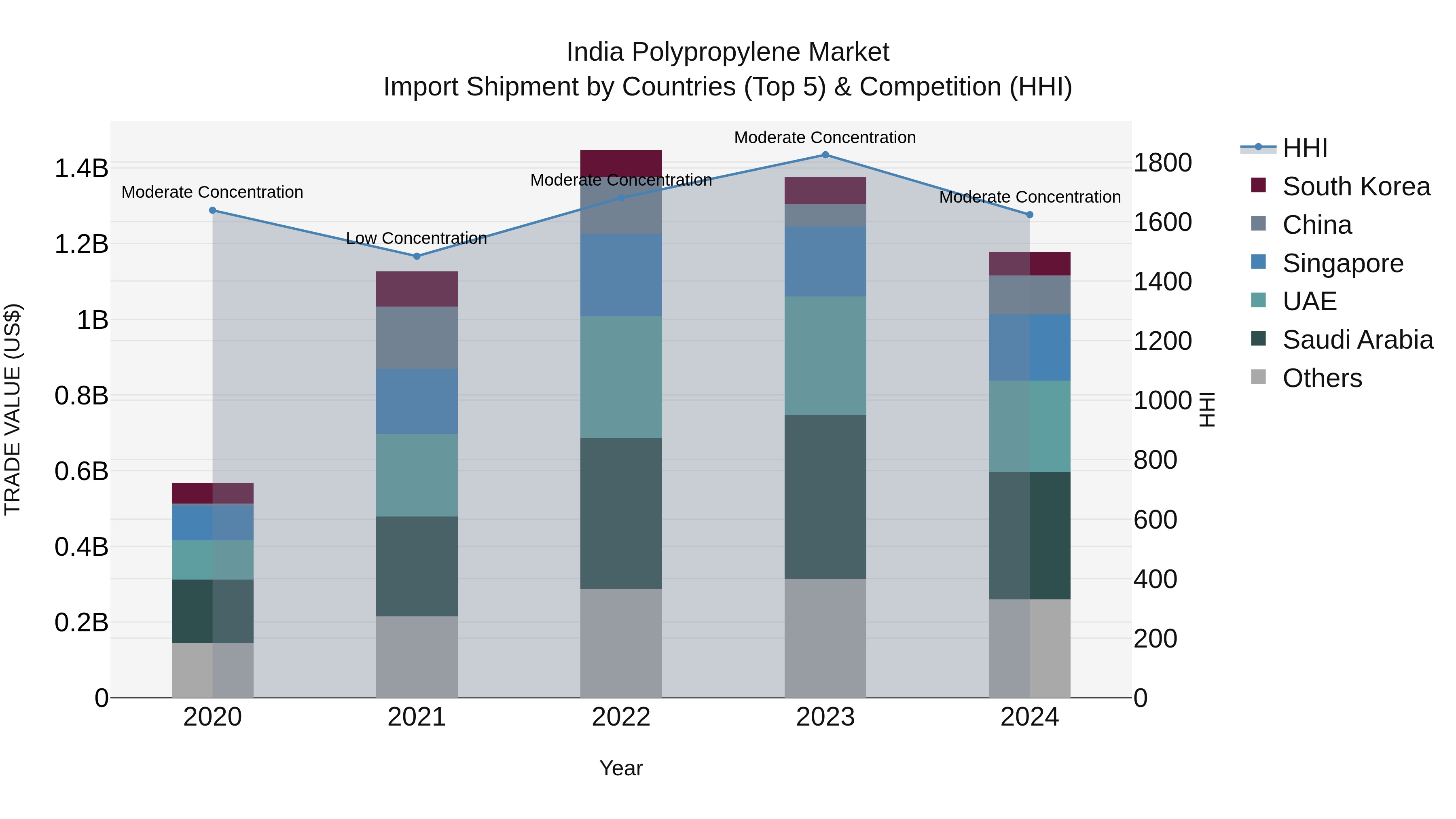
India`s polypropylene import market in 2024 saw significant contributions from top exporting countries including Saudi Arabia, UAE, Singapore, China, and South Korea. With a moderate concentration level indicated by the HHI, the industry experienced a notable Compound Annual Growth Rate (CAGR) of 20.02% from 2020 to 2024. However, there was a slight dip in the growth rate from 2023 to 2024 at -14.37%, possibly reflecting market dynamics and external factors impacting the import landscape. Overall, the sector continues to show promise and resilience amidst changing global trade conditions.
India Polypropylene Market Overview
Polypropylene is a significant player in the plastic industry, and it finds applications in packaging, automotive, and consumer goods. The India polypropylene market is on the rise, driven by the packaging sector`s growth, consumer product demand, and automotive manufacturing.
Drivers of the Market
The India polypropylene market`s growth is influenced by its extensive use in various sectors, including packaging, automotive, and consumer goods. Polypropylene`s attributes, such as lightweight, durability, and chemical resistance, make it a preferred choice for manufacturing a wide range of products. The market`s expansion is closely linked to industrial and consumer demand.
Challenges of the Market
Challenges in the India Polypropylene market include price fluctuations in raw materials, environmental concerns about plastic use, and competition from alternative materials. Quality control and sustainability are also important issues.
COVID-19 Impact on the Market
India polypropylene market was affected by the pandemic`s economic consequences. Slower industrial activity and transportation disruptions led to reduced demand. The sector responded by shifting production towards essential products like medical equipment and packaging materials.
Key Players in the Market
The India Polypropylene market is dominated by leading manufacturers like Reliance Industries Limited, India Oil Corporation Limited, and Haldia Petrochemicals Limited. These companies offer a diverse range of polypropylene products, including homopolymer and copolymer grades, which are widely used in the production of various consumer goods, automotive components, and packaging materials.
Key Highlights of the Report:
- India Polypropylene Market Outlook
- Market Size of India Polypropylene Market, 2024
- Forecast of India Polypropylene Market, 2031
- Historical Data and Forecast of India Polypropylene Revenues & Volume for the Period 2021-2031
- India Polypropylene Market Trend Evolution
- India Polypropylene Market Drivers and Challenges
- India Polypropylene Price Trends
- India Polypropylene Porter's Five Forces
- India Polypropylene Industry Life Cycle
- Historical Data and Forecast of India Polypropylene Market Revenues & Volume By Type for the Period 2021-2031
- Historical Data and Forecast of India Polypropylene Market Revenues & Volume By Homopolymer for the Period 2021-2031
- Historical Data and Forecast of India Polypropylene Market Revenues & Volume By Copolymer for the Period 2021-2031
- Historical Data and Forecast of India Polypropylene Market Revenues & Volume By Application for the Period 2021-2031
- Historical Data and Forecast of India Polypropylene Market Revenues & Volume By Injection Molding for the Period 2021-2031
- Historical Data and Forecast of India Polypropylene Market Revenues & Volume By Fiber & Raffia for the Period 2021-2031
- Historical Data and Forecast of India Polypropylene Market Revenues & Volume By Film & Sheet for the Period 2021-2031
- Historical Data and Forecast of India Polypropylene Market Revenues & Volume By Blow Molding for the Period 2021-2031
- Historical Data and Forecast of India Polypropylene Market Revenues & Volume By End-use Industry for the Period 2021-2031
- Historical Data and Forecast of India Polypropylene Market Revenues & Volume By Packaging for the Period 2021-2031
- Historical Data and Forecast of India Polypropylene Market Revenues & Volume By Automotive for the Period 2021-2031
- Historical Data and Forecast of India Polypropylene Market Revenues & Volume By Building & Construction for the Period 2021-2031
- Historical Data and Forecast of India Polypropylene Market Revenues & Volume By Electrical & Electronics for the Period 2021-2031
- Historical Data and Forecast of India Polypropylene Market Revenues & Volume By Medical for the Period 2021-2031
- India Polypropylene Import Export Trade Statistics
- Market Opportunity Assessment By Type
- Market Opportunity Assessment By Application
- Market Opportunity Assessment By End-use Industry
- India Polypropylene Top Companies Market Share
- India Polypropylene Competitive Benchmarking By Technical and Operational Parameters
- India Polypropylene Company Profiles
- India Polypropylene Key Strategic Recommendations






































