India Power Generation Market Size, Share & Growth Rate
The India Power Generation Market was estimated at USD 835 Million in 2025 and is projected to reach USD 1200 Million by 2032, growing at a CAGR of 5.3% from 2026 to 2032. This growth trajectory is significantly driven by the accelerating demand for electricity as a consequence of rapid urbanization, industrial development, and population expansion. The Indian governments unwavering commitment to increasing the share of renewable energy is also catalyzing investment in alternative power generation sources, ensuring a more sustainable future for the energy sector.
India Power Generation Market Year-wise Growth Rate and Key Drivers
This graph highlights how the India Power Generation Market has steadily grown over the years, supported by major growth factors.
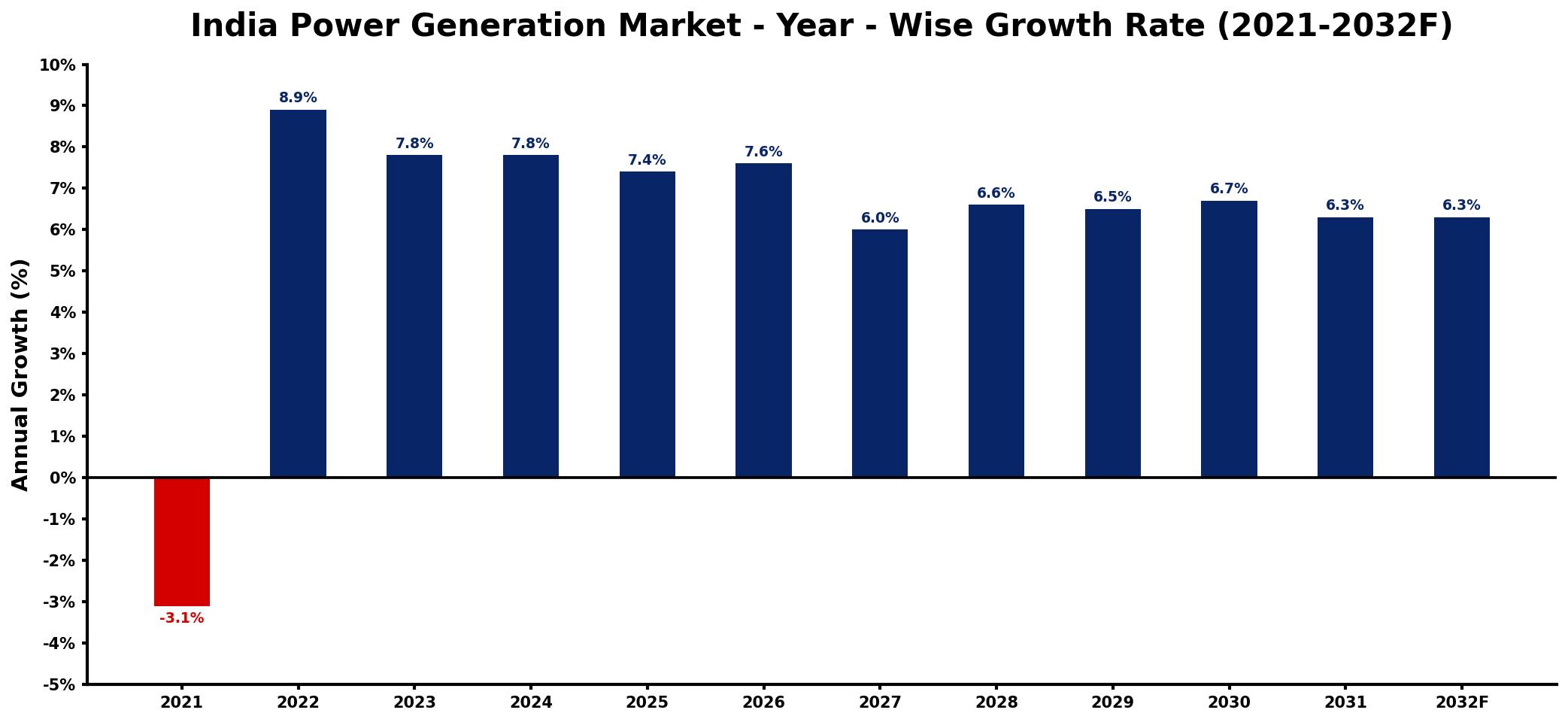
The table below presents the year‑wise growth rates along with the key drivers influencing the market
| Year | Growth Rate | Major Drivers |
| 2021 | -3.1% | decrease in renewable investments |
| 2022 | 8.9% | rise in industrial energy consumption |
| 2023 | 7.8% | expansion of solar projects |
| 2024 | 7.8% | growth in electric vehicle adoption |
| 2025 | 7.4% | increased foreign direct investment |
| 2026 | 7.6% | development of smart grids |
| 2027 | 6.0% | enhanced energy efficiency initiatives |
| 2028 | 6.6% | increased production capacity utilization |
| 2029 | 6.5% | increased overall sector activity |
| 2030 | 6.7% | increased residential solar installations |
| 2031 | 6.3% | expanding industrial usage applications |
| 2032 | 6.3% | rising procurement volume requirements |
Note: Market size estimations and growth projections presented in this report are based on 6Wresearch's proprietary forecasting methodology, utilizing the latest available industry data, government publications, and primary research inputs.
India Power Generation Market Synopsis
The primary force reshaping the India Power Generation Market today is the robust push towards renewable energy. With government policies and incentives aimed at reducing dependence on traditional fossil fuels, there is a marked shift towards solar, wind, and other sustainable energy sources. This focus is in response to both environmental concerns and the pressing need for reliable energy supply amidst rapid demand growth.
Additionally, the expansion of infrastructure, particularly in urban areas, is propelling the power generation market forward. The interplay of increasing electricity consumption and technological innovations like smart grids and energy storage solutions is redefining how energy is produced, distributed, and consumed across the nation.
India Power Generation Market Key Takeaways
- The market is expected to grow from USD 835 Million in 2025 to USD 1200 Million by 2032.
- Renewable energy sources are gaining prominence, fueled by government incentives and environmental commitments.
- Technological advancements are enhancing grid efficiency and reliability, supporting overall market growth.
- Continued urbanization and industrialization drive up the demand for sustainable energy solutions.
- Investment in infrastructure and energy storage solutions is crucial to meet the growing electricity demand.
Evaluation of Restraints in India Power Generation Market
Despite its positive trajectory, the India Power Generation Market faces notable restraints that could hinder its growth. One critical limitation is the challenge of meeting the rapidly increasing electricity demand, which is intensifying due to population growth and economic development. Significant capital investment is required to develop the necessary infrastructure and transmission networks to maintain grid stability. Additionally, integrating renewable energy sources into the existing grid poses technical challenges, particularly given their inherent intermittency. Financial viability issues, stemming from regulatory frameworks and long-term power purchase agreements, are also essential considerations that need to be addressed to attract sustained investment.
India Power Generation Market Trends
The current trends in the India Power Generation Market reflect a shift towards cleaner energy sources, with solar and wind technologies leading the charge. As solar costs decline and new wind projects come online, these renewable options are becoming increasingly competitive with traditional fossil fuel sources. Moreover, the adoption of smart grid technologies is growing, enabling more efficient energy management and distributed generation. Energy storage solutions are also on the rise, allowing for better integration of renewable sources and improving the resilience of the grid. These trends are not just responses to regulatory pressures but also market-driven shifts towards sustainable energy practices.
India Power Generation Market Opportunities
There are substantial growth opportunities within the India Power Generation Market, particularly in the renewable energy sector. The governments ambitious targets for clean energy installation pave the way for investment in solar parks, wind farms, and other sustainable infrastructure projects. Additionally, the development of energy storage systems represents a key area for innovation and investment. As the country moves towards a more decentralized energy model, opportunities will also arise in localized energy generation solutions, particularly in rural areas where traditional grid access may be limited.
Government Initiatives in the India Power Generation Market
The Indian government is actively promoting initiatives aimed at expanding the power generation sector, particularly in renewables. Schemes such as the National Solar Mission and various wind energy projects are designed to bolster renewable energy capacity. Public spending on infrastructure improvement and smart grid technology also supports this growth. Additionally, policies encouraging foreign direct investment in renewable projects and incentives for technology adoption are crucial in fostering a more robust energy landscape in India.
Future Insights of the India Power Generation Market
Looking ahead to 2026-2032, the India Power Generation Market is expected to continue its positive momentum, primarily due to ongoing urbanization and a concerted push for renewable energy. As technology advances and cost structures for solar and wind continue to improve, these sources will likely dominate the energy mix. Furthermore, investment in energy storage will play a pivotal role in addressing grid reliability issues, ensuring a smoother transition to a more sustainable energy future.
India Power Generation Market Latest Developments (2025 - 2026)
In recent months, there has been a notable increase in government-led renewable energy initiatives, with several large-scale solar and wind projects being approved. Additionally, advancements in energy storage technology are gaining traction, with pilot programs being implemented across various states. The market is witnessing an uptick in private sector partnerships aimed at enhancing grid infrastructure and efficiency. This collaborative approach signals a proactive response to meeting the increasing energy demand and improving the overall resilience of the power generation sector.
India Power Generation Market - Key Attractiveness of the Report
- 10 Years of Market Numbers
- Historical Data Starting from 2022 to 2025
- Base Year: 2025
- Forecast Data until 2032
- Key Performance Indicators Impacting the Market
- Major Upcoming Developments and Projects
Key Highlights of the Report:
- India Power Generation Market Outlook
- Market Size of India Power Generation Market, 2025
- Forecast of India Power Generation Market, 2032
- Historical Data and Forecast of India Power Generation Revenues & Volume for the Period 2022-2032F
- India Power Generation Market Trend Evolution
- India Power Generation Market Drivers and Challenges
- India Power Generation Price Trends
- India Power Generation Porter's Five Forces
- India Power Generation Industry Life Cycle
- Historical Data and Forecast of India Power Generation Market Revenues & Volume By Application for the Period 2022-2032F
- Historical Data and Forecast of India Power Generation Market Revenues & Volume By Commercial for the Period 2022-2032F
- Historical Data and Forecast of India Power Generation Market Revenues & Volume By Industrial for the Period 2022-2032F
- Historical Data and Forecast of India Power Generation Market Revenues & Volume By Residential for the Period 2022-2032F
- Historical Data and Forecast of India Power Generation Market Revenues & Volume By Source for the Period 2022-2032F
- Historical Data and Forecast of India Power Generation Market Revenues & Volume By Non-Renewable for the Period 2022-2032F
- Historical Data and Forecast of India Power Generation Market Revenues & Volume By Renewable for the Period 2022-2032F
- India Power Generation Import Export Trade Statistics
- Market Opportunity Assessment By Application
- Market Opportunity Assessment By Source
- India Power Generation Top Companies Market Share
- India Power Generation Competitive Benchmarking By Technical and Operational Parameters
- India Power Generation Company Profiles
- India Power Generation Key Strategic Recommendations






































