India Predictive Analytics Market Size & Growth Rate (2026-2032)
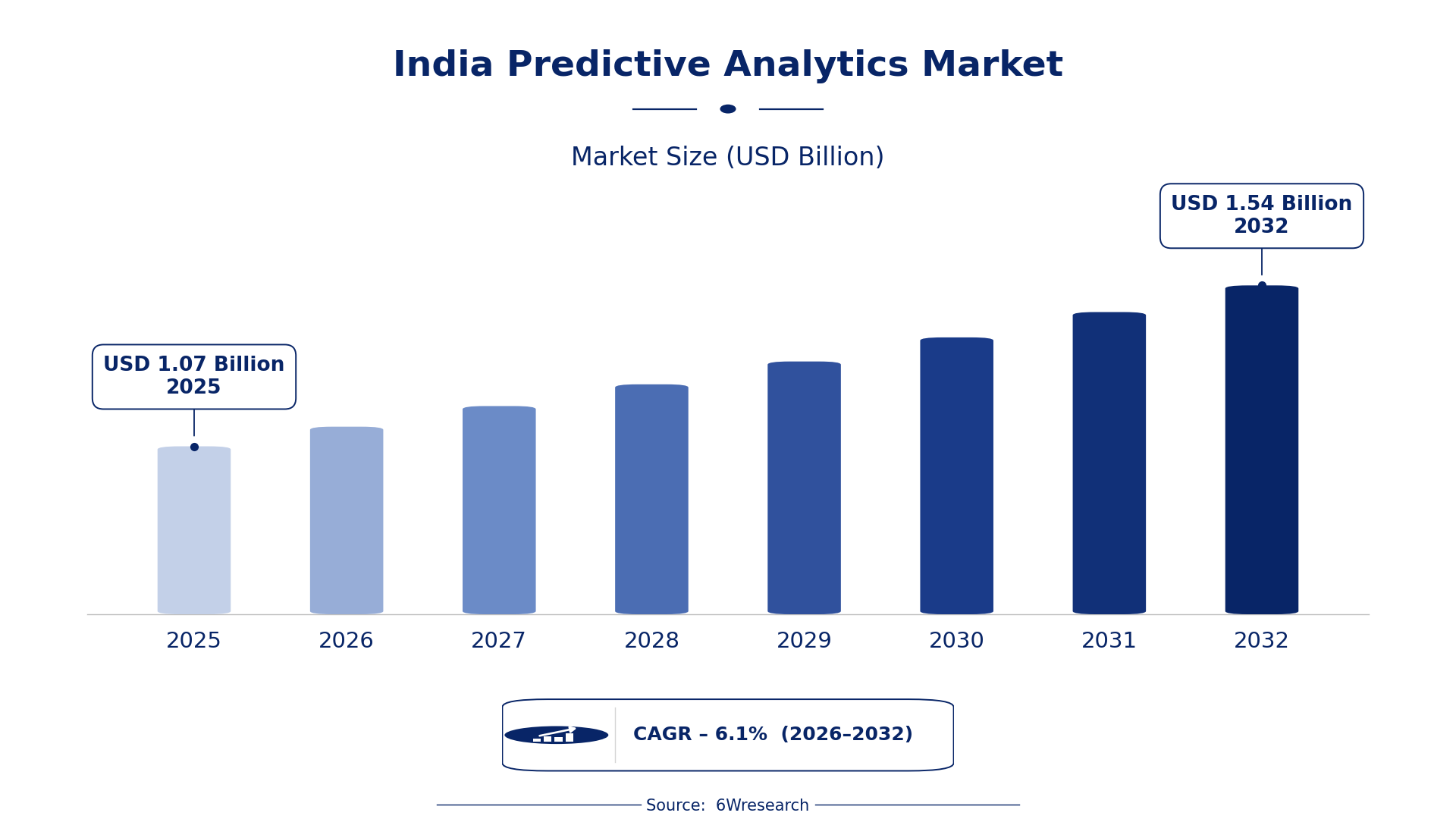
The India Predictive Analytics Market was estimated at USD 1074 Million in 2025 and is projected to reach USD 1537 Million by 2032, growing at a CAGR of 6.1% from 2026 to 2032.
India Predictive Analytics Market Synopsis
The demand for predictive analytics in India is rapidly increasing as businesses recognize its potential to enhance operational efficiency and customer engagement. With an explosion of data generated across sectors, organizations are keen to harness these insights for strategic decision-making.
Sectors such as finance, healthcare, and e-commerce are leading the way in adopting predictive analytics solutions. These industries leverage advanced analytics to anticipate customer needs, streamline processes, and mitigate risks, illustrating a clear trend towards data-driven operations.
India Predictive Analytics Market Year-wise Growth Rate and Key Drivers
This graph illustrates the annual growth rates of the India Predictive Analytics Market from 2021 to 2032, highlighting a steady upward trajectory and projected expansion over the forecast period.
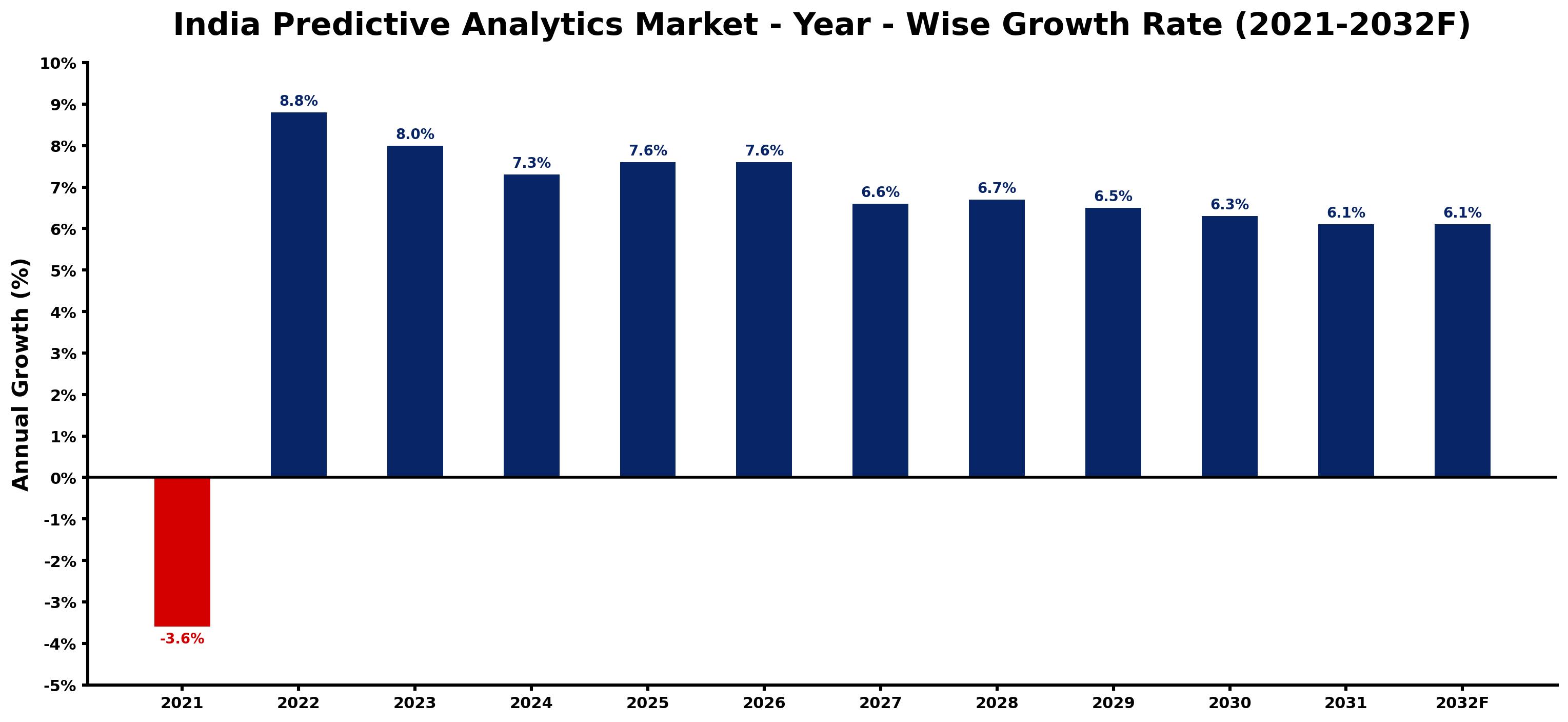
The table below presents the year‑wise growth rates along with the key drivers influencing the market
| Year | Growth Rate | Major Drivers |
| 2021 | -3.6% | Delayed government funding for data infrastructure projects. |
| 2022 | 8.8% | Rapid adoption of AI for retail inventory management. |
| 2023 | 8.0% | Government initiatives promoting digitalization in agricultural forecasting. |
| 2024 | 7.3% | Increased demand for customer behavior forecasting in e-commerce. |
| 2025 | 7.6% | Growing focus on predictive maintenance in manufacturing sector. |
| 2026 | 7.6% | Utilization of predictive analytics in urban transportation planning. |
| 2027 | 6.6% | Rising interest in data science education driving analytics workforce. |
| 2028 | 6.7% | Expanding use of analytics in personalized healthcare solutions. |
| 2029 | 6.5% | Insurance companies leveraging predictive models for risk assessment. |
| 2030 | 6.3% | Adoption of predictive analytics in smart grid energy management. |
| 2031 | 6.1% | Enhanced regulatory compliance using predictive fraud detection models. |
| 2032 | 6.1% | Growing reliance on big data for business sustainability strategies. |
Note: Market size estimations and growth projections presented in this report are based on 6Wresearch's proprietary forecasting methodology, utilizing the latest available industry data, government publications, and primary research inputs.
India Predictive Analytics Market Key Takeaways
Below are some of the specific key takeaways from the market, including:
- The growing integration of machine learning algorithms is enhancing the accuracy and effectiveness of predictive models.
- Organizations are prioritizing data privacy and ethical considerations while implementing predictive analytics solutions.
- Real-time data processing capabilities are becoming increasingly essential for adaptive predictive models.
- The COVID-19 pandemic has accelerated the adoption of predictive analytics tools to better respond to market volatility.
- Investment in predictive analytics is expected to rise, driven by the need for personalized customer experiences and operational optimization.
Evaluation of Restraints in India Predictive Analytics Market
Despite the promising growth, several restraints hinder the India predictive analytics market. The complexity of building accurate models poses a significant challenge, especially when dealing with evolving data sets. Organizations often struggle with ensuring model interpretability, which is crucial for user trust and decision-making. Additionally, concerns regarding data privacy and compliance with regulations can impede the adoption of predictive analytics tools, as businesses navigate the fine line between harnessing data and respecting user confidentiality.
India Predictive Analytics Market Trends
Several key trends are shaping the India predictive analytics market. One prominent trend is the increasing focus on real-time analytics, as organizations seek to make swift decisions based on the most current data. Another notable trend is the rise of cloud-based predictive analytics solutions, which offer scalability and flexibility for businesses of all sizes.
on top of that, there's a shift towards integrating predictive analytics with other emerging technologies like artificial intelligence and the Internet of Things (IoT), enabling more comprehensive insights and automation. This convergence is likely to redefine how industries approach data analytics.
India Predictive Analytics Market Opportunities
The India predictive analytics market presents numerous growth opportunities for businesses willing to invest in data-driven solutions. The healthcare sector, for instance, is poised for significant advancements, with predictive analytics helping improve patient outcomes and optimize resource allocation.
Additionally, the retail sector is increasingly adopting predictive analytics for inventory management and personalized marketing strategies. As companies across various industries continue to prioritize digital transformation, the demand for advanced analytics solutions will only intensify, creating a fertile ground for innovation and investment.
Government Initiatives in the India Predictive Analytics Market
Government policy is increasingly recognizing the potential of predictive analytics to drive economic growth and improve public services. Initiatives aimed at fostering a data-driven culture are gaining traction, with a focus on enhancing data infrastructure and encouraging collaboration between the public and private sectors. Such policies are essential for creating an environment conducive to the growth of predictive analytics in India.
- A national digital infrastructure upgrade programme launched in early 2025 aims to enhance data accessibility and analytics capabilities across sectors.
- Currently ongoing is a public-private partnership initiative that focuses on integrating predictive analytics into government services for better citizen engagement.
- A planned regulatory framework expected to be introduced in 2026 will focus on data privacy and ethical standards in predictive analytics.
- A recently completed training programme initiated in 2024 aimed at building skills in data analytics among government employees is showing positive outcomes.
Future Insights of the India Predictive Analytics Market
Looking ahead to 2026-2032, the India predictive analytics market is likely to experience robust growth driven by advancements in technology and increasing data volumes. As organizations become more adept at harnessing data, the focus will shift towards developing more sophisticated predictive models that can adapt to changing circumstances.
The integration of AI and machine learning will play a critical role in this evolution, enabling businesses to gain deeper insights and drive innovation. As demand for predictive analytics rises, organizations that invest in these capabilities will position themselves as leaders in their respective fields.
India Predictive Analytics Market Latest Developments
Over the past year, the India predictive analytics market has seen considerable activity as companies strive to capitalize on data-driven insights. The focus has been on enhancing predictive capabilities to better meet customer demands and navigate market challenges.
- A leading technology vendor launched a new predictive analytics platform in early 2025, aimed at small and medium-sized enterprises looking to leverage data for competitive advantage.
- In Q3 2025, a major e-commerce player implemented advanced predictive analytics tools to enhance inventory management and customer personalization.
- A partnership between a regional analytics firm and a healthcare provider is currently ongoing, focusing on improving patient care through data-driven insights.
- Upcoming in late 2026, a comprehensive analytics solution tailored for the financial sector is expected to roll out, addressing specific industry challenges.
India Predictive Analytics Market - Key Attractiveness of the Report
- 10 Years of Market Numbers
- Historical Data Starting from 2022 to 2025
- Base Year: 2025
- Forecast Data until 2032
- Key Performance Indicators Impacting the Market
- Major Upcoming Developments and Projects
Key Highlights of the Report:
- India Predictive Analytics Market Outlook
- Market Size of India Predictive Analytics Market, 2025
- Forecast of India Predictive Analytics Market, 2032
- Historical Data and Forecast of India Predictive Analytics Revenues & Volume for the Period 2022-2032F
- India Predictive Analytics Market Trend Evolution
- India Predictive Analytics Market Drivers and Challenges
- India Predictive Analytics Price Trends
- India Predictive Analytics Porter's Five Forces
- India Predictive Analytics Industry Life Cycle
- Historical Data and Forecast of India Predictive Analytics Market Revenues & Volume By Component for the Period 2022-2032F
- Historical Data and Forecast of India Predictive Analytics Market Revenues & Volume By Solutions for the Period 2022-2032F
- Historical Data and Forecast of India Predictive Analytics Market Revenues & Volume By Services for the Period 2022-2032F
- Historical Data and Forecast of India Predictive Analytics Market Revenues & Volume By Deployment Mode for the Period 2022-2032F
- Historical Data and Forecast of India Predictive Analytics Market Revenues & Volume By Cloud for the Period 2022-2032F
- Historical Data and Forecast of India Predictive Analytics Market Revenues & Volume By On-premises for the Period 2022-2032F
- Historical Data and Forecast of India Predictive Analytics Market Revenues & Volume By Organization Size for the Period 2022-2032F
- Historical Data and Forecast of India Predictive Analytics Market Revenues & Volume By Large enterprises for the Period 2022-2032F
- Historical Data and Forecast of India Predictive Analytics Market Revenues & Volume By Small and medium-sized enterprises (SMEs) for the Period 2022-2032F
- Historical Data and Forecast of India Predictive Analytics Market Revenues & Volume By Vertical for the Period 2022-2032F
- Historical Data and Forecast of India Predictive Analytics Market Revenues & Volume By BFSI for the Period 2022-2032F
- Historical Data and Forecast of India Predictive Analytics Market Revenues & Volume By Manufacturing for the Period 2022-2032F
- Historical Data and Forecast of India Predictive Analytics Market Revenues & Volume By Retail and eCommerce for the Period 2022-2032F
- Historical Data and Forecast of India Predictive Analytics Market Revenues & Volume By Government and Defense for the Period 2022-2032F
- Historical Data and Forecast of India Predictive Analytics Market Revenues & Volume By Healthcare and Life Sciences for the Period 2022-2032F
- Historical Data and Forecast of India Predictive Analytics Market Revenues & Volume By Energy and Utilities for the Period 2022-2032F
- Historical Data and Forecast of India Predictive Analytics Market Revenues & Volume By Telecommunications and IT for the Period 2022-2032F
- Historical Data and Forecast of India Predictive Analytics Market Revenues & Volume By Transportation and Logistics for the Period 2022-2032F
- India Predictive Analytics Import Export Trade Statistics
- Market Opportunity Assessment By Component
- Market Opportunity Assessment By Deployment Mode
- Market Opportunity Assessment By Organization Size
- Market Opportunity Assessment By Vertical
- India Predictive Analytics Top Companies Market Share
- India Predictive Analytics Competitive Benchmarking By Technical and Operational Parameters
- India Predictive Analytics Company Profiles
- India Predictive Analytics Key Strategic Recommendations






































